From Finals-Week FOMO to Sequenced Focus: Degree vs Bootcamp

Finding Clarity on the TTC When Your Backpack Is Still Full of Finals
If you’re in finals week in Toronto and a “learn to code in 12 weeks” ad hits you mid-study block, and suddenly your brain starts screaming Career Pivot Anxiety instead of memorizing anything…
Jordan (name changed for privacy) told me it started at 8:47 p.m. on Line 1, riding home under those flickery fluorescent lights that make everyone look a little sleep-deprived. Their phone screen felt warm through the case. A glossy bootcamp ad slid into their feed like it had been waiting for the exact second their willpower dipped. Their knee bounced against the seat. Their jaw locked so hard they could feel it in their molars. In their backpack, an unopened study guide sat like a brick—heavy in that specific way a deadline gets heavy when you’re trying not to look directly at it.
“I try to study,” they said, voice low like they didn’t want the panic to hear them, “but then I ‘just check’ one link. And suddenly it’s not one link. It’s… Reddit, tuition calculators, ‘day in the life’ videos. And then I’m back to my notes with less time and more shame.”
They weren’t asking me to predict which path would make them rich or safe. Their question was brutally practical: a bootcamp ad showed up during finals—do I pause school, or just finish my degree? What’s my next step?
I watched them press their tongue to the inside of their cheek, like they were trying to hold their thoughts in place. The feeling coming off them wasn’t a vague “anxiety.” It was more like their mind was a laptop running 20 tabs plus a video call, fan screaming, while their body stayed trapped in a chair pretending everything was fine.
“You’re not behind,” I said, and I meant it. “You’re overloaded with choices at the exact moment you need focus. Let’s not force a forever answer tonight. Let’s make a map. We’re going to aim for clarity you can actually use this week.”

Choosing the Compass: The Two Paths Tarot Spread for a Career Pivot During Finals Week
I’m Lucas Voss—Wall Street to Oxford Business School to tarot reader, which sounds like a chaotic plot twist until you realize both jobs are basically the same muscle: pattern recognition under pressure. Before we touched the deck, I asked Jordan to put both feet on the floor and take one slower exhale than inhale. Not as a ritual for the universe—just as a handbrake for a nervous system trying to sprint in place.
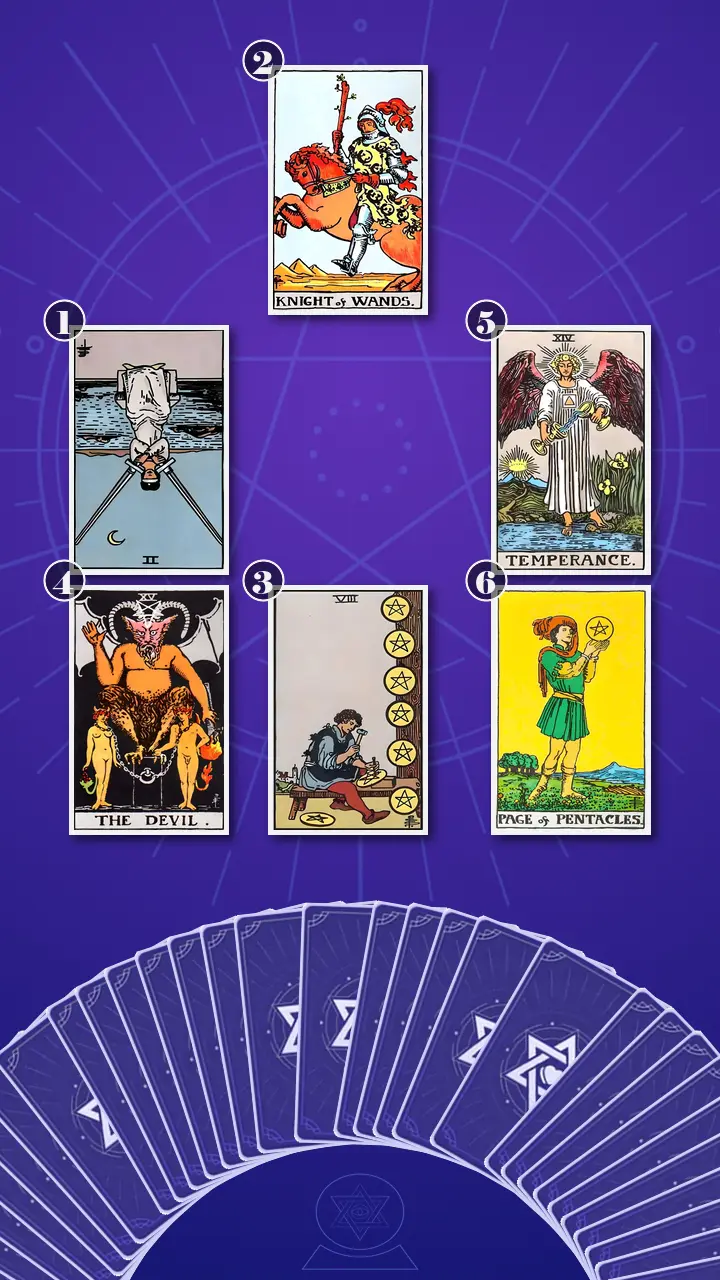
“Today we’ll use a spread called Two Paths,” I told them, and I also told you why: when someone is stuck in choice paralysis—degree vs bootcamp—the mistake is treating it like a binary destiny question. This spread is built to do something more useful: name the current knot, compare both options without promising guarantees, expose the hidden driver (the thing fueling the spiral), and then turn it into actionable advice—a next step you can take even if you still feel uncertain.
The layout is a fork with a spine: one card for what’s happening right now, one for the bootcamp branch, one for the degree branch, one for the underlying fear pulling at your ankle, then a pivot card that shows the integrating principle, and finally a practical next step card. Minimal cards, maximum signal. Like a good decision memo—short, structured, readable under stress.
“We’ll start with what’s hijacking your attention this week,” I said. “Then we’ll look at what each path actually offers you. Then we’ll go under the surface—because the tab spiral is never just about information. And we’ll end with one move you can make that keeps finals from paying the price.”
Reading the Map When Your Brain Won’t Stop A/B Testing Your Life
Position 1 — Current knot: the observable paralysis right now
“Now we’re turning over the card that represents the current knot—the specific, observable way finals pressure and the bootcamp ad are creating decision paralysis right now.”
Two of Swords, reversed.
I nodded toward the image. “This is the blindfold and the crossed swords over the heart—but reversed, it’s like the whole ‘I can hold both options calmly’ posture collapses into noise.”
And I used the translation that matters in real life: “You sit down to study with your notes open, but you keep the bootcamp tabs open ‘in case.’ Every time you hit a hard concept, you reflexively jump to reviews and outcome posts for a hit of control. You’re not choosing either path—you’re holding both at once, and the strain leaks into everything: half-studying, half-planning, fully exhausted.”
This reversed Two of Swords is an Air energy blockage: thinking as looping. Not a lack of intelligence—an overload of mental load plus stakes. It’s the kind of card that shows up when “research” becomes emotional self-soothing.
I framed it in a way I’ve seen a hundred times in high-pressure environments: “Information isn’t clarity when it has no stop condition.”
Jordan gave a short laugh that sounded like it scraped on the way out. “That’s… yeah. That’s exactly what happens,” they said, and then their mouth twisted. “It’s kind of mean how accurate that is.”
I let that land, then mirrored the loop as a fast-cut montage the way their week had actually felt: “Twelve minutes of real study. Then ‘just checking’ one bootcamp page. Then a LinkedIn spiral—someone your age announcing something shiny. Then you reopen the same Reddit thread you already read. Then you snap back to your notes with less time and more doubt.”
“I’m not choosing,” Jordan whispered, almost to themselves. “I’m bracing.”
That line mattered. Because bracing is what you do when you think impact is inevitable.
Position 2 — Bootcamp branch: what this option genuinely offers (without promises)
“Now we’re turning over the card that represents the bootcamp branch—what it’s genuinely offering you, what it activates in you, without turning it into a guaranteed outcome.”
Knight of Wands, upright.
“This is pure momentum,” I said. “A rearing horse. A raised wand. It’s the part of you that wants a clean reset.”
Then I tied it to Jordan’s real scenario: “The bootcamp path feels like a door slamming open mid-finals: new cohort, new schedule, new identity. You can almost feel the relief of motion—like you could outrun the stress by switching tracks.”
The Knight of Wands is Fire in balance edging toward excess. Courage and speed—but impatient with process. It’s not “bad.” It’s power. The question is: power aimed at what?
I asked them the two-question reality check the card demands: “When you imagine bootcamp, what feels energizing—learning the skill, changing your identity, or escaping the pressure you’re under this week? Do you want the learning… or do you want out of this week?”
Jordan’s face softened into a half-smile of recognition—caught, but not judged. “The clean reset fantasy is so loud,” they admitted. “Like… I can see myself with a new schedule and new people and I’m not the person who’s behind on finals.”
“That makes sense,” I said. “The ad didn’t just sell you a program. It sold you relief.”
Position 3 — Degree branch: what finishing the degree genuinely builds (without romanticizing)
“Now we’re turning over the card that represents the degree branch—what finishing your degree genuinely offers you, without pretending it’s magical or forever.”
Eight of Pentacles, upright.
“This is apprenticeship,” I said. “It’s the unglamorous reps. The craftsperson hammering one coin at a time.”
And the modern translation hit the exact spot: “Finishing the degree looks like repetition: doing the practice problems, showing up, submitting the thing. It’s the path where confidence comes from receipts—proof you can finish hard arcs even when you don’t feel inspired.”
This is Earth energy in balance: steady effort that builds credibility. It doesn’t trend well on Instagram. It does, however, build a nervous system that trusts itself—because it’s seen itself follow through.
I leaned in slightly. “The trap here is turning the whole degree into a verdict on your worth. The win is treating finals as one more rep. One coin on the board.”
Jordan’s shoulders dropped about half an inch. Not relief exactly—more like dignity returning. “Okay,” they said. “I can do one more rep.”
Position 4 — Underlying driver: the fear/attachment making it compulsive
“Now we’re turning over the card that represents the underlying driver—the hidden fear or attachment that makes this decision feel like an identity verdict.”
The Devil, upright.
On Wall Street, this is the card I would’ve called the compulsion trade: the thing you keep doing because it gives you a hit of certainty, even while it drains you. I flashed back—briefly—to a trading desk memory of someone refreshing a screen like the next tick would finally make them feel safe. Spoiler: it never did.
“The Devil doesn’t mean you’re doomed,” I told Jordan. “It means the loop has a hook.”
Then I gave the real-life translation: “You’re not actually chained to either option—you’re chained to the fear of regret and the need to optimize. The bootcamp ad presses a deeper button: ‘Don’t be the person who falls behind.’ So you keep checking outcomes and salaries to numb uncertainty. The more you feed it, the more trapped you feel—like your timeline belongs to the internet instead of to you.”
This is attachment energy in excess: status narratives, speed narratives, certainty narratives. The chains are loose—meaning the “trap” is partly maintained by belief and repetition.
I asked the question that cuts beneath the tabs: “What outcome are you most afraid of proving true about yourself if you commit? ‘I’m behind’? ‘I wasted time’? ‘I can’t control my future’?”
Jordan swallowed, eyes on the card. “Control,” they said. “If I pick wrong, it’s like… I proved I don’t know how to run my own life.”
“That’s the real stake,” I said quietly. “Not just school vs bootcamp. Control vs uncertainty.”
When Temperance Spoke: The Two Cups That Turned a Verdict Into a Sequence
Position 5 — Decision pivot: the integrative principle that restores self-trust
I let my hand hover for a beat before turning it. “We’re about to flip the pivot card,” I said. “The one that shows how to make your next step without regret-fear running the meeting.”
For a second, the room felt unusually quiet—like the laptop fans and the city noise outside had agreed to pause.
Temperance, upright.
“Okay,” I said, and even I felt my own shoulders ease. “This is integration. Pacing. Right timing. One foot on land, one in water—staying grounded while you acknowledge your feelings.”
I brought it straight into Jordan’s week: “Instead of trying to pick a forever identity during finals, you design a pace: protect what’s time-sensitive (exams), then give the pivot a real, contained decision window (two weeks with criteria). You stop swinging between extremes and start blending realism and ambition like a plan.”
Setup (the moment they’re stuck in): Jordan was living at 11:38 p.m.—notes open, but three tabs deep in “bootcamp outcomes 2026,” jaw clenched—telling themselves they were “being responsible” while finals quietly got closer. They were trying to force a perfect long-term answer from a brain already maxed out by deadlines.
Delivery (the sentence that changes the frame):
Stop treating the crossroads like a trap and start mixing your next steps with intention, like Temperance pouring between two cups.
I let the silence do its job for a couple of seconds.
Reinforcement (what shifts in their body, then in their options): Jordan’s reaction came in layers. First: a tiny freeze—breath held, fingertips hovering over the edge of their water bottle like they’d forgotten what they were doing. Second: the cognitive penetration—eyes unfocusing for a moment, as if their brain replayed the last three nights of tab-switching in fast-forward. Third: the release—one long exhale that started shaky and ended clean, and their shoulders dropped like they’d been carrying a bag they didn’t realize they could put down.
“But… if I do it in order,” they said, and there was a flash of resistance in the way their eyebrows pulled together, “doesn’t that mean I’ve been doing it wrong? Like I wasted time?”
It was an unexpectedly sharp little flare of anger—at themselves, at the pressure, at the whole ‘why can’t I just pick’ story.
“No,” I said, steady. “It means you were trying to get comfort from certainty. That’s human. Temperance isn’t calling you wrong—it’s giving you a method. Finals week is not the time to demand a forever answer.”
I slid into my signature way of making this operational—because insight without a container just becomes another tab. “In my work, I use something I call a 5-Minute Decision Tool—a tri-axis check: Advantage, Risk, Breakthrough. Temperance is basically that tool in card form.”
“Here’s what Temperance asks you to do,” I continued. “Not decide your life at midnight. Just mix the next step on purpose. Advantage: finishing the next exam protects your immediate reality. Risk: spiraling steals the hours you can’t replace. Breakthrough: you can still explore bootcamp—inside a time-boxed window—without letting it hijack finals.”
Then I gave them the exact experiment the card wanted, in the most un-mystical way possible. “Set a 10-minute timer. Open a blank note. Two headings: ‘Finals (next 7 days)’ and ‘Pivot (next 14 days).’ Under Finals, write one deliverable—like ‘Problem Set Q1–3’ or ‘Review lecture 8.’ Under Pivot, list one contained action—like ‘Register for one bootcamp info session’ or ‘Email academic advising for LOA policy.’ When the timer ends, stop—even if it feels unfinished.”
Jordan blinked hard, like their eyes were suddenly too dry. “That… feels doable,” they said, and then they laughed, softer this time. “Like I’m allowed to be a person with deadlines, not a person who has to solve capitalism before Tuesday.”
“Exactly,” I said. “And right now, with this card, you’re moving from FOMO-driven urgency and decision fatigue to grounded agency through paced, time-boxed sequencing.”
I asked the question that anchors the pivot in lived reality: “Now, with this new perspective—can you think of a moment last week where this would’ve changed how you felt? A moment when you tab-switched?”
Jordan’s gaze dropped to the table. “Wednesday,” they said. “Robarts. I got stuck on one concept and instantly went to salary posts. If I’d had the two lists… I would’ve just done one practice problem. Then parked the pivot thought.”
Position 6 — Actionable next step: grounded motion that stops the spiral
“Now we’re turning over the card that represents the actionable next step—a small, realistic move you can take this week that reduces spiraling and supports finals performance.”
Page of Pentacles, upright.
“I love this as a finals-week card,” I said. “It’s beginner energy with a budget. Curious, but contained.”
Then I made it concrete: “You treat the pivot like a small project with an output: one page comparing costs/timelines, one advising email, one info session on your calendar. You stop doomscrolling and start collecting facts that actually change your next step.”
This is Earth energy in a healthy ‘start small’ state. It says: open your calendar, not another rabbit-hole tab. Hand on your planner. One ticket at a time.
Jordan reached for their phone—not to scroll, but to open their calendar app. That was the exact nonverbal shift I want in a reading: motion toward structure, not motion toward more noise.
The One-Page Reality Check: Actionable Next Steps for Degree vs Bootcamp (Without Panicking)
I looked back across the whole spread and stitched it into a single story, the way I would in a decision review: you’re in Air-under-strain right now (Two of Swords reversed), so your thinking becomes looping; Fire shows up as a tempting escape hatch (Knight of Wands), and it’s not wrong—it’s motivation—but it spikes when you’re under pressure; Earth reminds you what you can actually build (Eight of Pentacles); the hidden engine is compulsion fueled by comparison and fear of losing control (The Devil); and the antidote isn’t a dramatic announcement—it’s Temperance: sequence, time-box, integrate. Then Page of Pentacles turns all of that into one small deliverable.
Your blind spot, Jordan, is thinking this has to be decided in one dramatic moment—like a verdict. That’s The Devil making the stakes feel absolute. The transformation direction is the opposite: make it a sequence. Protect what’s urgent, then test what’s possible.
Here are your next steps—small enough to do this week, structured enough to stop the infinite-scroll A/B test:
- Build a Time-Boxed Pivot WindowCreate one calendar event called “Bootcamp Research Window (20 min)” on two specific days after your last exam block. Outside that window, you’re not allowed to research—only to capture thoughts in one place.Expect resistance (“What if I miss the best cohort?”). Treat that as a signal to time-box, not a command to spiral. If 20 minutes feels too edgy, do 10.
- Start a “Pivot Parking Lot” Note (So Finals Can Breathe)Open one running note titled “Pivot Parking Lot.” When a bootcamp thought hits mid-study (“Should I pause school?” “Is my degree too slow?”), write one line and return to the next study task. No links, no tabs.Make the boundary physical: Focus mode or a website blocker. If you override it, don’t shame yourself—just write “control loop” at the top of the note and go back to the task.
- One Page. One Email. One Session. Then Stop.This week, do exactly three concrete moves: (1) Attend one bootcamp info session (live or recorded) and write 5 facts (cost, weekly hours, start dates, prerequisites, financing). (2) Email academic advising with one clear question about leave-of-absence policy. (3) Make a one-page side-by-side: Degree (remaining credits + grad date + costs) vs Bootcamp (start date + total hours + total cost).No midnight decisions rule: after 10:30 p.m., you’re only allowed to capture questions for tomorrow, not answer them tonight. The output is the one page—not more tabs.

A Week Later: Ownership, Not Certainty
About a week later—after the last exam, after the adrenaline crash—Jordan messaged me. Not a paragraph. Just a screenshot of their calendar with two neat blocks: “Pivot Window (20 min)” and “Study Sprint (25 min).” Underneath, they wrote: “I sent the advising email. I watched one info session. I made the one page. Then I closed my laptop. I slept.”
It wasn’t a fairy-tale ending. It was the kind that matters: clear but still human. They told me the next morning, the first thought still tried to bite—what if I’m wrong?—but this time they had the two cups. They smiled, a little shaky, and went to make coffee instead of opening LinkedIn.
That’s the real Journey to Clarity I care about: not certainty, but agency. Not “bootcamp or degree forever,” but a paced sequence that protects what’s urgent and tests what’s possible—on purpose, in order, with boundaries.
When finals are already heavy, it’s brutal how one perfectly-timed “12-week shortcut” can make your jaw lock and your brain act like you have to choose your entire future tonight—or you’ll be behind forever.
If you didn’t need the perfect long-term answer this week, what’s the smallest next step you could finish first—and what’s one curiosity you’d be willing to explore later inside a real, time-boxed window?