From Choice Paralysis to Informed Consent: Refi vs Federal Under Pressure
The 11:48 p.m. Refinance Tab That Wouldn’t Close
Jordan came to me with the kind of question New York seems engineered to generate: a high-stakes money decision, on a random workday, under a hard deadline.
“The refi offer ends today,” she said, and the way she said today made it sound like a door was already halfway shut.
She was 27, a few years into her first corporate role, living in Queens. We met over video, and even through the screen I could see the posture of someone trying to hold their life together by gripping it. Her shoulders sat a little too high. Her jaw looked like it had been set hours ago and forgotten there.
“I can run a meeting,” she told me, voice dry with that particular kind of late-night caffeine, “but I can’t hit ‘accept’ on this refinance thing. And if I let it expire, I feel… stupid. Like I’m choosing to waste money.”
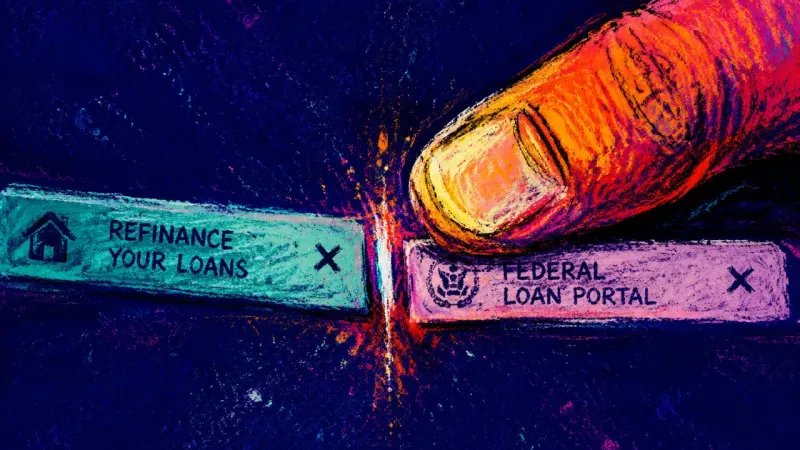
In her apartment, it was 11:48 p.m. on a Wednesday. The laptop glow painted her hands a pale blue. She had one tab open with the refinance offer, another with her federal loan portal, and a Google Sheets amortization calculator that looked like it had been revised so many times it was losing the plot. Somewhere off-camera, a radiator clicked and hissed like an annoyed metronome. Her coffee—once hot—had gone metallic and cold. Her phone screen kept lighting up, warm from scrolling. Refresh. Screenshot. Compare. Refresh.
Pressure can disguise itself as productivity. In Jordan’s case it lived in her body: a tight chest, clenched jaw, restless fingers that kept going back to the same numbers as if repetition could turn uncertainty into fact.
She said the core contradiction plainly, almost like a confession: “I want immediate relief and I want to feel like I’m making progress… and I’m terrified of giving up protections and locking into a mistake I can’t undo. I don’t want to mess this up and pay for it for a decade.”
I nodded, letting the silence do what silence can do when it’s not judgmental—make room. “We’re not going to pretend there’s a perfect, consequence-free answer,” I said. “But we can absolutely find clarity in how you decide. Tonight isn’t about proving you’re ‘good with money.’ It’s about building a decision process you can stand behind.”
“Because right now,” she added, half-laughing without humor, “I keep doing the math and somehow I feel less sure.”
“That line,” I told her, “is the sound of decision fatigue. Let’s make a map through it.”

Choosing the Compass: The Decision Cross · Context Edition
I’m Hilary Cromwell—Cambridge emeritus professor by title, archaeologist by training, and, these days, a tarot reader who treats the cards less like prophecy and more like a field notebook. When you spend years excavating old cities, you learn something that applies surprisingly well to modern inbox panic: most disasters aren’t caused by one single choice. They’re caused by a pattern—especially the pattern of making choices under pressure without a clear rule.
To begin, I asked Jordan to take one slow breath in, then out. Not for mysticism. For transition. The nervous system can’t interpret “I’m safe” if the body is still braced like it’s about to be hit.
“Hold the question in your mind as something simple,” I said. “Not ‘What is the best choice?’ but: ‘What trade-off can I live with—refinancing or staying federal—when the offer ends today?’”
For this kind of career-and-environment stress—money decisions that hijack your week—we used a spread I call the Decision Cross · Context Edition. It’s built for binary choices like refinance vs stay federal, but with two lenses most people skip when they’re spiraling: the hidden noise that inflates the decision, and the values-based anchor that steadies it.
If you’ve ever googled “should I refinance my student loans or keep them federal” and ended up worse off, this spread explains why: you don’t need more information. You need information in the right order, with boundaries, and a process that emphasizes informed consent over optimization.
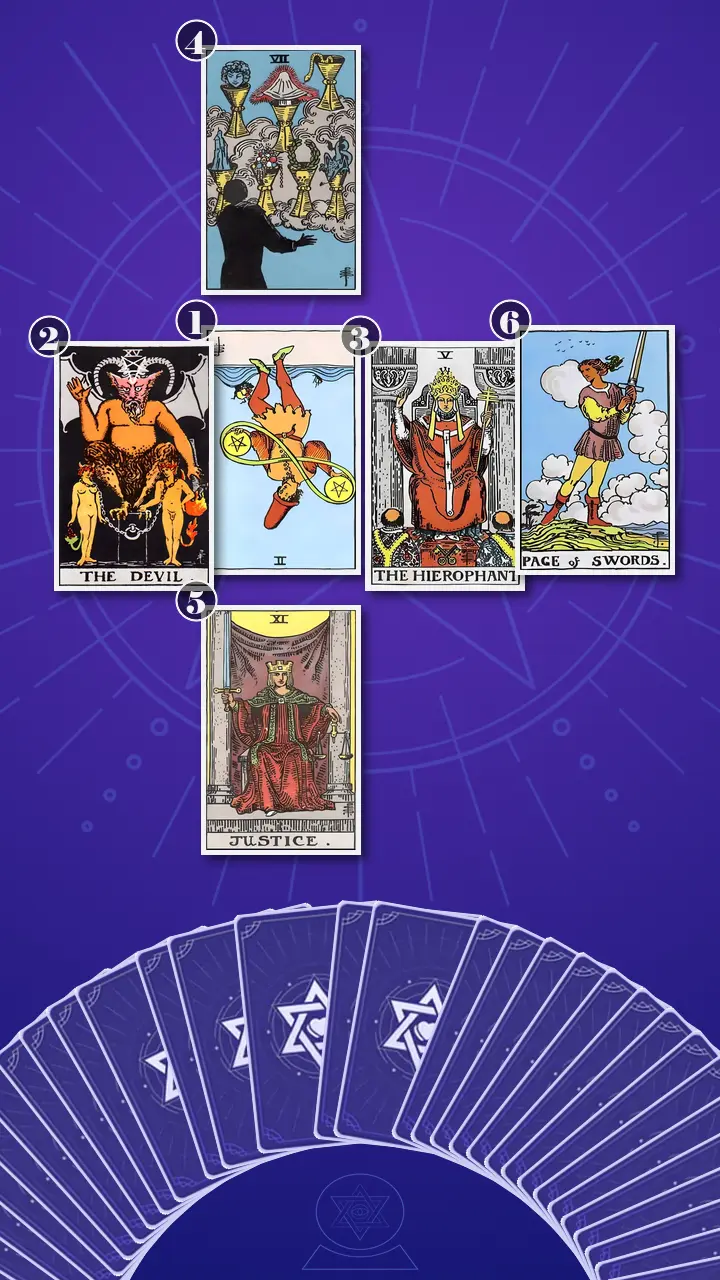
I told Jordan (and, frankly, any reader who has lived inside a refinance deadline): “Card 1 will show the stress pattern you’re in right now—the observable loop. Cards 2 and 3 put each option on the table without moralizing: what refinance pulls you toward, and what staying federal actually provides. Card 4 reveals the hidden factor—the mental fog. Card 5 is our anchor: what you need to feel safe and aligned regardless of which choice you make. And Card 6 gives a practical next step, because clarity without action becomes another kind of spinning.”
The Browser Bar Shrinking into Favicons
Position 1: The current stress pattern under the deadline
“Now turning over,” I said, “is the card that represents the current stress pattern and your decision-paralysis behavior under the deadline.”
Two of Pentacles, in reversed position.
I didn’t even have to reach for poetic language; modern life provides it. “This is late-night juggling,” I said, “refinance tab, federal portal, Google Sheets, and a group chat full of screenshots. You tell yourself you’re being responsible, but your body says otherwise—tight jaw, restless hands, constant refreshing.”
I watched Jordan’s eyes flick down and back up, the way they do when you recognize yourself in a mirror you didn’t ask for.
“Two of Pentacles upright is balance—money, time, obligations, all kept moving. Reversed, the energy is blocked and overloaded. It’s not that you can’t do the math. It’s that your capacity is maxed out, and the deadline is turning planning into spinning.”
I added, gently but clearly: “You’re not stuck because you’re bad with money—you’re stuck because you’re trying to eliminate uncertainty instead of choosing a trade-off.”
Jordan let out a short, bitter laugh. “That’s… so accurate it’s kind of rude.”
“It’s precise,” I corrected, friendly. “Rude would be telling you this means you’re irresponsible. What it actually means is: your system is juggling too many inputs at once.”
And because the Two of Pentacles reversed loves a visual metaphor, I described exactly what her night looked like: “The browser bar shrinks until every tab becomes a tiny unreadable favicon. Slack pings land. The radiator clicks. Your hands keep doing the same two motions—refresh → screenshot → scroll—as if the next refresh will finally produce certainty. That’s not research anymore. That’s nervous-system multitasking.”
Position 2: Option A (refinance)—the psychological pull and trade-offs
“Now turning over,” I said, “is the card representing Option A: refinancing—what it offers, what it asks, and what it’s really trying to solve emotionally.”
The Devil, upright.
Jordan’s mouth tightened, like she didn’t want to admit how much this card fit. I didn’t dramatize it. The Devil doesn’t mean “bad.” It means binding agreements and temptation—especially the temptation to trade tomorrow’s flexibility for today’s relief.
“Refinancing,” I said, “looks like a clean escape hatch: lower payment, immediate relief, proof you’re finally handling adulthood. And I want you to notice the chemistry of it—the rate-drop dopamine plus the deadline pressure.”
I paused. The radiator hissed again in her apartment, as if the environment wanted to underline the point: urgency makes noise.
“The Devil’s energy is an excess of attachment. It’s the moment you might downplay the fine print or the loss of federal protections because you want the discomfort to stop today, not necessarily because the trade-off truly fits your life.”
I gave her a line I’ve seen too many people need: “A limited-time offer can feel like clarity. Sometimes it’s just volume turned up.”
Jordan swallowed. “It literally feels like… if I don’t do it, I’m failing adulthood.”
“That,” I said, “is the chain. And notice: in the card, the chains are loose. The trap isn’t the option. The trap is deciding from shame.”
Position 3: Option B (stay federal)—the safety it provides and its limits
“Now turning over,” I said, “is the card representing Option B: staying with federal loans—what it supports, what it prioritizes, and what kind of safety it provides.”
The Hierophant, upright.
“This is ‘rulebook’ energy,” I said. “Two pillars. Crossed keys. A structure that exists whether you feel calm or not.”
In modern life terms: “Staying federal can feel like being held by an established framework—predictable policies, standardized protections, less personal negotiation of risk. It’s not flashy. It may not scratch the itch of an ‘optimized win.’ But it can provide psychological safety when life gets messy: job changes, health surprises, moving cities.”
The Hierophant’s energy is often balanced—supportive, but with constraints. “The trade-off,” I told her, “is accepting the pace and limits of an institution instead of the satisfaction of a private deal. You might resent the higher interest. You might feel you ‘left money on the table.’ But what you’re buying is guardrails.”
Jordan looked away from the screen for a moment. “I hate that I’m even… considering feelings. It should be numbers.”
“If you were an ancient city planner,” I said, letting my archaeologist’s mind do what it does, “you wouldn’t build only for a sunny day. You’d build for floods, droughts, political shifts—because the city has to survive the years you can’t predict. That’s not irrational. That’s long-term value assessment.”
Position 4: The hidden factor—what’s inflating the decision
“Now turning over,” I said, “is the card representing the hidden factor: complexity, overlooked details, or mental noise that’s inflating this decision.”
Seven of Cups, upright.
“Here’s the fog,” I said simply.
“This is your mind running seven alternate timelines at once: ‘What if I lose my job?’ ‘What if rates drop again?’ ‘What if I move?’ ‘What if I get a surprise medical bill?’ Each scenario has its own emotional weight. So the decision starts to feel impossible—not because you’re incapable, but because you’re trying to build a perfect loan plan for every hypothetical future.”
The Seven of Cups energy is an excess of imagination without touch. Too many options, none chosen. “It’s like scrolling Netflix for forty minutes because picking one thing feels like losing all the other possibilities,” I told her. “Or reading r/personalfinance and r/StudentLoans until the internet becomes seventeen conflicting anecdotes and your brain starts begging for a referee.”
Jordan nodded once—sharp, almost angry. The nod that says: yes, and I’m mad that it’s true.
“This card explains why the Two of Pentacles reversed can’t fix itself with more research,” I said. “Because the research isn’t staying in a container. It’s multiplying the futures.”
When Justice Held the Scales Steady
Position 5: The decision anchor—what creates safety and alignment
I let my hands rest on the deck for a beat before turning this one. “We’re opening the hinge of the reading,” I said. “The card that bridges panic into process.”
“Now turning over,” I continued, “is the card representing the decision anchor: the values, protections, and conditions that help you feel safe and aligned regardless of which option you choose.”
Justice, upright.
Jordan went still, like she’d reached the quiet part of a museum after a loud street. Even over video, I felt the room change.
“Justice doesn’t reward the most anxious person,” I said. “It rewards the most clear person. Scales for trade-offs. Sword for the clean cut when you stop debating and choose with integrity.”
Then, because my mind thinks in excavation layers, I brought in my signature lens—Historical Case Matching and Civilization Pattern Recognition. “In archaeology,” I told her, “civilizations don’t collapse because they fail to find the perfect grain price. They collapse when their decision rules break under stress—when leaders chase short-term relief and ignore what actually keeps the system resilient. This is one of those crossroads moments in miniature.”
“Justice is asking you to stop treating this like a test you could fail,” I said. “And start treating it like a contract you sign with yourself: fair, explicit, repeatable.”
Jordan’s eyes narrowed slightly. “But what if I still pick wrong?”
“That question,” I said, “is exactly why Justice appears. You don’t need perfect certainty—you need informed consent. A process you can explain and stand behind.”
And then I built the aha moment the way I’d build an argument for a lecture hall: setup, delivery, reinforcement—no theatrics, just precision.
Setup
If you’ve been toggling between a refinance tab and your federal loan portal like it’s a life-or-death A/B test—cold coffee, tight jaw, “one more calculator” at midnight—you already know the feeling.
Delivery
Not “I must optimize this before the clock runs out,” but “I weigh what I gain and what I give up,” like Justice holding the scales steady before the sword makes a clean cut.
Reinforcement
Jordan’s reaction came in layers—like sediment settling after a storm.
First, a brief physiological freeze: her breath caught mid-inhale, and her thumb stopped moving on the edge of her laptop as if it had finally lost its job. Then the cognitive seep: her gaze unfocused for a second, not at the screen but through it, as though her mind was replaying last week’s midnight spreadsheet ritual. Finally, the release: a long exhale that softened her mouth, and her shoulders dropped just enough to be noticeable.
“Wait,” she said quietly. “So I’m allowed to decide… without proving it’s the perfect rate?”
“Yes,” I said, and kept my voice steady on purpose. “You’re allowed to decide with incomplete information. Justice energy is simple: informed consent over optimization.”
Then I gave her something practical, because Justice isn’t vibes—it’s structure. “Set a 10-minute timer. On one sheet—Apple Notes is fine—write two headers: ‘I gain’ and ‘I give up.’ Do it for both options with just three bullets each. No Googling while the timer runs. When the timer ends, stop. If your chest tightens or you start spiraling, pause and take three slow breaths; you’re allowed to end the exercise early and come back later. The point isn’t to force a decision in ten minutes. It’s to practice a clean, bounded way of thinking you can trust.”
I watched her blink, eyes slightly wet—not from sadness exactly, but from the relief of being less personally judged by her own indecision.
“Now,” I asked, “with this new lens—gain versus give up—can you think of a moment last week where this would’ve changed how you felt?”
She nodded slowly. “On the 4/5 train. I had my thumb over ‘Continue application,’ and then I saw someone post ‘debt-free’ and I panicked. I wasn’t even choosing a loan. I was trying to… catch up to strangers.”
“That,” I said, “is the shift. From deadline-driven choice paralysis and fear of irreversible regret to values-based decision confidence you can explain in one sentence. Not because you eliminated uncertainty—because you chose a trade-off you can own.”
Position 6: The next step—turning doomscrolling into targeted clarity
“Now turning over,” I said, “is the card representing a practical next step: how to convert this into a decision rule and complete the decision with integrity.”
Page of Swords, upright.
“This is the investigator,” I told her. “Alert, precise, and—most importantly—bounded. Not ‘absorb the entire internet.’ More like: open a support ticket with five specific questions.”
The Page of Swords energy is balanced when it’s used well: curiosity with boundaries, due diligence with a stop condition.
“Here’s the rule,” I said, and let it land as cleanly as a thesis statement: “If you can’t phrase the question clearly, you don’t need more opinions—you need a cleaner question.”
Jordan’s face changed in a way I’ve come to love in readings: the faint, practical urge to do something small and specific rather than chase one more wave of reassurance.
The One-Page ‘Scales & Sword’ Decision Rule
I pulled the whole spread together for her like an excavation report: what we found, how the layers relate, and what it means for the next move.
“Here’s the story,” I said. “Two of Pentacles reversed is your overloaded capacity—too many tabs, too much midnight math, the deadline turning planning into spinning. The Devil shows how refinancing becomes emotionally charged: immediate relief, ‘adulting’ validation, and urgency marketing that tries to tether you to a decision made from shame. The Hierophant shows what staying federal actually offers: guardrails, predictability, a rulebook you can lean on when life changes, even if it doesn’t feel like an ‘optimized’ win. Seven of Cups explains the hidden cost: too many imagined futures and hot takes multiplying faster than clarity. And then Justice arrives as the bridge—your inner arbiter—asking for a fair, values-based process you can explain. Page of Swords is the exit ramp: fewer opinions, better questions, and then you stop.”
“Your cognitive blind spot,” I continued, “is thinking the problem is a lack of information. It isn’t. It’s a lack of a decision rule you trust. When you don’t trust your rule, you keep gathering data the way a drowning person grabs at water.”
“So the transformation direction is exactly what Justice demands: shift from ‘Find the perfect rate’ to ‘Define the protections and trade-offs I’m willing to live with, then choose accordingly.’”
Then I offered her a framework drawn directly from my archaeological toolkit—my Time Stratigraphy Method and Artifact Restoration Thinking.
“When we excavate,” I said, “we separate layers. Not everything buried together belongs to the same era. Your panic belongs to the deadline layer. Your values belong to the long-term layer. Tonight, we separate them so you don’t let a loud layer pretend it’s the only one.”
- The 25-Minute Non-Negotiables SprintSet a timer for 25 minutes. In Apple Notes, write your top 3 protections/values (examples: flexibility if your job changes, payment stability, predictability). When the timer ends, stop. No calculators, no Reddit, no group chat.If your brain says “this is oversimplifying,” lower the bar—messy bullets count. You’re putting research in a container, not banning it forever.
- The Two-Column Trade-Off Sheet (Justice)Do a 10-minute sheet for BOTH options: two headers—“I gain” and “I give up.” Cap it at 3 bullets per column. Then draft one sentence: “I chose X because I value ___ more than ___ right now.”Do it on your phone if opening the laptop triggers the whole spiral. The goal is legibility, not perfect wording.
- The Five-Question Cutoff (Page of Swords)Write a max-5 question list that would genuinely change your decision (for example: “If I refinance, what protections do I lose and can any be replaced?” “What happens if my income changes?” “Is there a co-signer release?”). Pick ONE authoritative source to verify (lender support or your federal loan servicer). Stop after you get those answers.Use “questions first, internet second.” If you catch yourself opening r/personalfinance, pause and write the question you were actually trying to answer.
“Let the process be the thing you trust,” I told her, “especially when your feelings are loud.”

A Week Later: Ownership, Not Certainty
Six days later, I got a message from Jordan while I was making tea—one of those small, ordinary moments that proves change doesn’t always arrive with fireworks.
“I did the two-column sheet,” she wrote. “I gained a lower payment with refi, but I gave up flexibility I realized I actually need right now. I chose to stay federal because I value guardrails more than optimization this year. And I sent my servicer three questions instead of spiraling.”
She added: “I still don’t feel 100% sure. But I slept. Like, actually slept.”
Clear but not invincible: she told me the next morning her first thought was still, “What if I’m wrong?”—and then she paused, unclenched her jaw, and said, “Okay. But I know why I chose.”
That’s the Journey to Clarity in real life: not the fantasy of certainty, but the quiet competence of a decision you can explain in one sentence—made from values and risk tolerance rather than urgency.
When the deadline is loud, it’s easy to treat this like a test you could fail—tight chest, clenched jaw, running the numbers again—because part of you believes one ‘wrong’ choice would prove you don’t actually control your future security.
If you weren’t trying to buy certainty—just choosing a trade-off you can live with—what would your one-sentence reason sound like tonight?
Author Profile