From Panic Tab-Switching to Evidence-Based Focus Before Two Finals

Finding Clarity at Robarts: The Warm Iced Coffee Moment
If you’ve got two finals on the same day and you keep reopening your study plan like it’s a slot machine—classic choice paralysis under time pressure.
Jordan (name changed for privacy) slid into the chair across from me like they’d been carrying their backpack with their teeth. We were on a video call, but I could still see the Toronto finals-week vibe on them: the Robarts fluorescent buzz, the wobble-y desk by the outlet, the little flinch every time a notification lit up the corner of their screen.
“It’s literally tomorrow,” they said. “Two finals. Same day. And I’m stuck on the dumbest question: do I review notes or do practice exams next?”
They held up their laptop to show me the battlefield: a practice exam PDF on one side, a Google Doc full of color-coded headings on the other. The trackpad looked slightly sticky, like a spilled iced coffee had dried into a thin syrup. Their leg bounced under the desk with the steady violence of a metronome that hated them.
“Notes feel safe,” Jordan admitted, voice low. “Practice feels… real. And when I miss a question, my chest does this thing where it’s like—okay, abort mission, go back to notes, re-plan everything.”
I watched their shoulders creep up toward their ears, jaw set like they were bracing for impact. The pressure on them wasn’t abstract; it was tactile—like trying to study while someone keeps tightening the straps of a backpack you can’t take off.
“That feeling makes sense,” I told them, keeping my tone calm on purpose. “We’re not going to solve your entire academic life tonight. We’re going to do something smaller and more powerful: we’re going to find clarity about what to do next—in a way your nervous system can actually follow.”
“Because right now,” I added gently, “it sounds like planning is doing a lot of emotional labor. Planning can be calming—but calm isn’t the same as prepared.”

Choosing the Compass: The Decision Cross Tarot Spread
I asked Jordan to take one slow breath—not as a mystical ritual, just a reset. “Let your brain stop sprinting for ten seconds,” I said. “Then hold the question: two finals, same day—review notes or do practice exams next?”
I shuffled slowly, because the shuffle is basically a physical way to say: we’re leaving the spiral and entering the session. When I cut the deck, I felt Jordan’s pace change on the other end of the call—still wired, but less scattered.
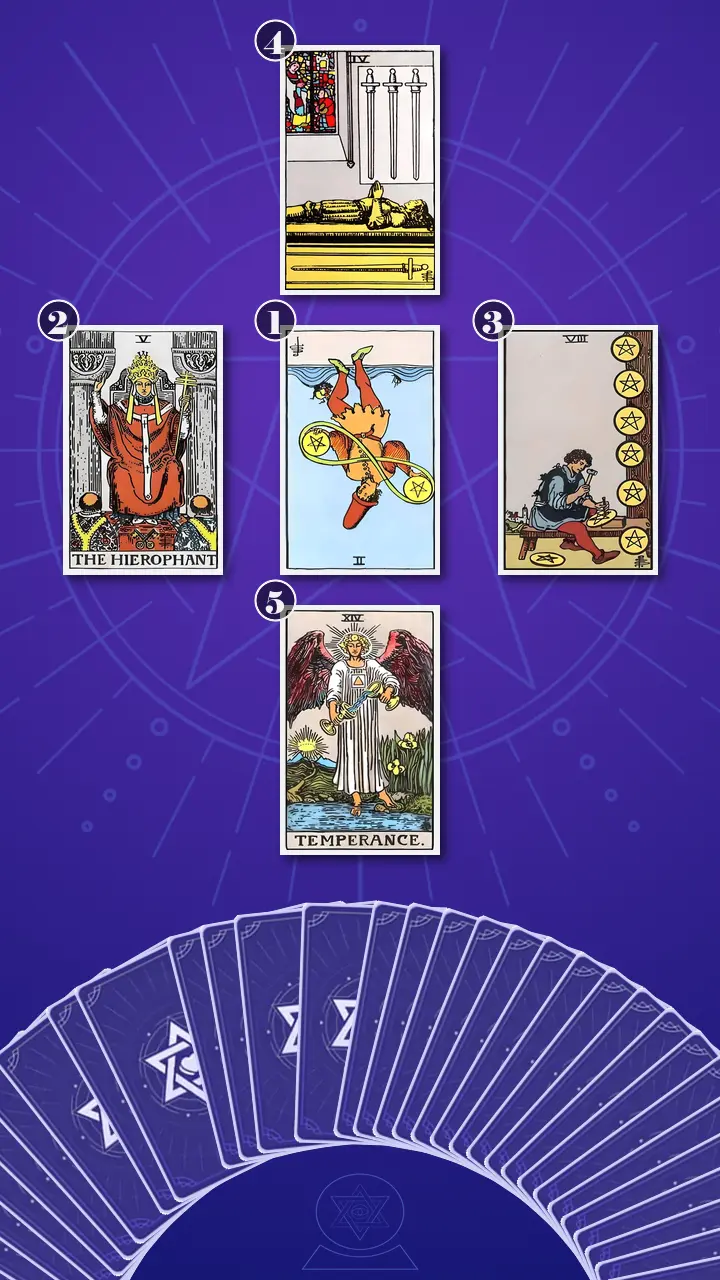
“Today I’m using a spread called the Decision Cross,” I said. “It’s a simple tarot spread for two options under time pressure—perfect for a finals-week study plan when you don’t have the luxury of overthinking.”
And for you, reading this: this is how tarot works best in situations like this. Not as fortune-telling, but as decision support. The Decision Cross keeps the card count minimal (so we don’t create more noise), compares the two strategies side-by-side (notes vs practice exams), and—this is the important part—adds a ‘blind spot’ position. Because in real life, it’s usually not the choice that wrecks you. It’s the missing ingredient: pacing, energy, recovery, or a hidden fear driving the switching.
“Card 1 is the pressure point—what your stress pattern looks like right now,” I explained. “Card 2 is Option A: reviewing notes. Card 3 is Option B: practice exams. Card 4 is the blind spot that determines whether either option works. And Card 5 is the integrated next step—what to do in the next few hours without needing the perfect answer first.”
Reading the Map: Notes vs Practice Exams in Context
Position 1: The stress pattern running the show
“Now we flip the card that represents the current stress pattern and the concrete way indecision is showing up in your studying right now,” I said.
Two of Pentacles, in reversed position.
I didn’t rush it. “This is the ‘two tabs, zero progress’ card,” I told Jordan, and I watched their eyes narrow like they already knew what was coming.
Here’s what it looked like in modern life—exactly like their screen: practice exam PDF open on one side, notes doc on the other. And every time a question got hard, their cursor ricocheted—PDF → notes → YouTube recap → Discord group chat. The infinity ribbon in the card wasn’t a cute symbol; it was an anxiety loop. The choppy sea behind the juggler was the clock: relentless, loud, always moving.
“You’re trying to keep both courses and both study methods perfectly in the air,” I said. “But the constant switching is what’s draining your time—and it’s making you distrust whatever you’re doing in the moment.”
Jordan gave a short laugh that had more bitterness than humor. “That’s… mean. But accurate.”
“Accurate is good,” I said. “Because accurate means fixable.”
I pointed to the reversed energy. “Reversed, this isn’t flexible juggling anymore. It’s reactive multitasking—energy blocked and leaking. And the shadow expression is exactly what you described: you start a practice set, panic on Question 2, then ‘quickly check notes’… and thirty minutes later you’re reorganizing headings instead of finishing anything timed.”
My Wall Street brain flashed a memory I don’t usually talk about: the trading floor on a volatile day, monitors screaming red, everyone switching between risk dashboards like the next screen might erase the truth. Switching feels like control. It almost never is.
“Here’s the ruthless question,” I told Jordan, soft but direct. “What if the real time-waster isn’t notes or practice—but the switching?”
They nodded—sharp, almost angry—and then a small exhale slipped out, like their body had been holding its breath for hours.
Position 2: Option A—Reviewing notes
“Now we flip the card for Option A (review notes): what this approach gives you and how it helps under today’s constraints,” I said.
The Hierophant, upright.
“Okay,” Jordan said immediately, and their shoulders dropped a fraction. “Yeah. Notes.”
“This card is structure,” I explained. “The official map. The professor’s language. Learning objectives. Definitions. Frameworks.” The crossed keys in the image weren’t mystical to me—they were access points. The stuff that reliably opens the door on an exam: the core concepts you can’t fake.
I gave them the modern translation: “Option A looks like pulling up the lecture slides, the syllabus objectives, and your cleanest summary notes because it feels like stepping onto solid ground. It’s soothing because it’s verified.”
Jordan’s mouth tightened, like they were bracing for me to shame them for that comfort.
I didn’t. “Wanting that ground isn’t a flaw,” I said. “It’s your brain looking for stability. The trade-off is that notes can turn into passive rereading if they aren’t linked to a moment where you have to produce an answer under time.”
“So when notes are healthy,” I added, “they’re like a map you can recite. When notes become avoidance, they’re like staring at Google Maps while never leaving your apartment.”
Jordan looked down, then back up. “I do reread the same slide like it’s going to change.”
“That’s the ‘safety vs application’ tension,” I said. “And it’s not moral. It’s mechanical.”
Position 3: Option B—Practice exams
“Now we flip the card for Option B (practice exams): what this approach gives you and how it helps under today’s constraints,” I said.
Eight of Pentacles, upright.
“This is the training montage,” I said, and I saw Jordan’s expression change—less comfort, more grit. “One coin at a time. One rep at a time.”
I anchored it in their life: “Option B is treating tonight like a training session. You run a short timed practice block, mark what you missed, then fix the specific skill—not your entire self-concept.”
They flinched a little at that phrase—self-concept—because that was the part that hurt. Practice exams didn’t just test content. They threatened identity.
“I need you to borrow a sentence from me,” I said. “A wrong answer is data, not a verdict.”
As I said it, I watched their hands unclench around their pen. Not fully. But enough to change what could happen next.
“Eight of Pentacles upright is disciplined Earth energy,” I continued. “Not frantic. Not dramatic. Just iteration. It’s like debugging: you don’t rewrite the whole codebase because one unit test fails. You patch the module.”
Jordan’s eyes flicked to their practice PDF again, like it had transformed from a threat into a tool.
Position 4: The blind spot—the missing ingredient
“Now we flip the card for the blind spot: what you’re not factoring in that determines whether either method works,” I said.
Four of Swords, upright.
I slowed my voice on purpose. “This card isn’t about quitting,” I said. “It’s about recovery as strategy.”
Four of Swords is the moment your brain stops vibrating from screen glare. It’s the quiet that lets learning consolidate instead of smearing into noise. In modern life: it’s you standing up, refilling water, walking one lap inside Robarts, looking out the window long enough for your eyes to stop trying to focus on pixels.
“You’re underestimating how much your nervous system is driving the switching,” I said. “When your brain is running hot, your accuracy drops. Then you panic and compensate by switching methods. Rest isn’t a reward after you’re ‘done.’ It’s part of the study system.”
Jordan stared at the card on their screen, then swallowed. “But I’m behind,” they said. “I can’t afford breaks.”
That was the real obstacle, and it was practical—not a mindset poster.
“I hear you,” I said. “And I’m going to be blunt in a kind way: you can’t afford foggy hours. Four of Swords isn’t asking for a spa day. It’s asking for a 10–15 minute reset that makes the next timed block worth doing.”
They leaned back, and their shoulders dropped another notch—like they were testing the idea in their body and finding it… possible.
When Temperance Spoke: Turning ‘Notes vs Practice’ Into a Feedback Loop
I placed my hand lightly over the deck. “We’re flipping the core card now,” I said. “The one that tells you what to do next without needing a perfect plan.”
Position 5: The integrated next step
“Now we open the card that represents the integrated next step: the most effective way to proceed in the next few hours without needing a perfect answer,” I said.
Temperance, upright.
Setup—because I wanted Jordan to feel seen before I challenged the binary: you could almost hear the loop in their head. If I pick notes, I might not be able to perform. If I pick practice, I might prove I’m not ready. If I pick wrong, I waste my only chance. They were trying to make the decision feel safe first, like safety itself would generate time.
Not “notes versus practice,” but intentional blending—pour your effort between two cups like Temperance, so every practice mistake tells you exactly what to review next.
I let it hang there. No extra words for a beat.
Reinforcement hit in layers—Jordan’s reaction didn’t arrive as a single emotion. It was a chain:
First, their breath caught—like a tiny freeze. Their fingers hovered over the trackpad, not clicking anything. Second, their eyes unfocused for a second, as if they were replaying the last week of studying and suddenly noticing the real pattern: not laziness, not lack of discipline—just a loop that never closed. Third, their face softened and their shoulders sank, and the sound that came out of them wasn’t a laugh this time. It was an “oh.” Quiet. Almost embarrassed. Relieved.
“So I’m not choosing a personality,” they said, voice a little shaky. “I’m choosing a process.”
“Exactly,” I said. “Notes feel safe. Practice feels real. Temperance says: make it a loop so ‘real’ becomes manageable.”
Here’s where my own toolkit clicked in—because I don’t just read cards; I map decisions. “Let’s run my Potential Mapping System on you for thirty seconds,” I said. “Under pressure, are you a Deep Thinker—someone who tries to secure understanding first—or a Sprinter—someone who stabilizes by doing reps?”
Jordan didn’t hesitate. “Deep Thinker. I need it to make sense or I freak out.”
“Perfect,” I said. “Then Temperance for a Deep Thinker isn’t ‘do endless practice until you feel confident.’ It’s ‘do short timed reps to create data, then use notes as a targeted patch—so your brain gets meaning without escaping measurement.’”
I slid into the “proof over panic” experiment, keeping it permission-based: “Set a 10-minute experiment, and you can stop if it spikes anxiety.”
“One: open a practice set and do exactly 8 minutes timed—no notes, no pausing. Two: mark only what you missed or guessed. Three: spend 2 minutes writing one line: ‘My next patch is ___’—one concept only.”
“Boundary,” I added, because boundaries create safety faster than pep talks. “If you notice tab-switching, you’re allowed to pause, take three slow breaths, and restart the timer—no punishment, no re-planning spiral.”
Jordan blinked hard, like their eyes were stinging. “I can do ten minutes,” they whispered, almost like it was surprising news.
“Now,” I said, “use this new lens and look back at last week. Was there a moment when you bailed into notes because the discomfort spiked—when this loop could have changed how you felt?”
Jordan nodded slowly. “Yesterday. I did half a practice exam and quit. If I’d just done eight minutes… I would’ve had something to patch instead of spiraling.”
That was the shift in real time: from panic-driven tab-switching and decision fatigue to evidence-based focus. Not because life got easier. Because the process got clearer.
From Insight to Action: The Closed-Loop Cram for Two Finals
When I zoomed out and stitched the spread together, the story was clean. Two of Pentacles reversed said your time isn’t just limited—it’s being quietly stolen by reactive switching. The Hierophant reminded you that notes and professor language are real support, not something to feel guilty about. The Eight of Pentacles insisted you need performance reps to turn knowledge into exam-day execution. The Four of Swords exposed the blind spot: without deliberate recovery, both notes and practice decay into fog. Temperance resolved the whole dilemma: stop hunting for the single best method and close the loop.
The cognitive blind spot here is brutally common in finals week: you’ve been treating the decision (notes vs practice exams) like a one-time identity verdict, instead of a system you can run once. The transformation direction is equally simple: from “notes OR practice” to a tight feedback loop where timed practice reveals gaps, notes patch only what the missed questions expose, and planned resets protect focus.
I gave Jordan my most pragmatic framework—my 5-Minute Decision Tool. “When your brain starts shouting I don’t have time to choose wrong,” I said, “we do a tri-axis check: Advantage, Risk, Breakthrough. Not to overthink—just to start.”
- Run One Closed Loop (Timer-First)Tonight, do this once: 25 minutes timed questions on one topic (no notes, no pausing) → 15 minutes review mistakes (circle misses/guesses only) → 20 minutes notes only on what those misses reveal. Stop when the timer ends.If you feel the urge to re-plan mid-block, write the plan change on a sticky note labeled “After the timer.” Treat the urge as a stress signal, not an instruction.
- Build a One-Page “Mistake Patch List”On a single page (paper or a doc), for each missed question write: (1) concept label, (2) why you missed it (forgot / misread / time), (3) the one rule, formula, or sentence that would fix it. This becomes your high-ROI notes.Keep it ugly. If you catch yourself formatting instead of writing, say out loud: “Calm isn’t the same as prepared,” and write the next line anyway.
- Reset Like It’s Part of the SyllabusBetween loops, take 10–15 minutes: bathroom, water refill, short walk inside/outside the building. Phone on Do Not Disturb. Eyes off screens.Rest can feel ‘unearned’ when you’re behind. Make it mechanical: set a reset timer. If you start doom-scrolling, end the break early—not as punishment, just as a boundary.
“Close the loop: attempt → review → patch → reset,” I said, because the brain remembers simple rhythms when everything else is loud.
Jordan stared at their tabs—notes, practice PDF, a half-open Reddit thread titled something like “best way to cram for final in 1 day.” Then they did something small but meaningful: they closed Reddit first.

A Week Later: Proof Over Panic on the TTC
Three days later, I got a message from Jordan. No long recap, no dramatic breakthrough speech—just a screenshot of a messy page titled “Mistake Patch List” and one line: “Did the 8-minute timed thing. I didn’t die. It actually told me what to review.”
In my head, I pictured them on the TTC the next morning: winter air still caught in their jacket, phone on low brightness, not scrolling classmates’ Stories this time—just reviewing three patches they’d earned from real reps. Clear, a little tired, still human. (They’d told me they slept a full night… but woke up with the thought, What if I’m wrong?—and then, for the first time, didn’t obey it.)
This is what I love about tarot when it’s used ethically and practically: it doesn’t demand certainty. It gives you a structure that turns panic into next steps. Jordan didn’t magically become a different student. They just stopped feeding the switching loop and started feeding a feedback loop.
When two finals land on the same day, it’s not just the workload—it’s that tight, jittery moment where choosing one method feels like risking proof that you’re not as in control as you need to be.
If you didn’t have to find the perfect method tonight—only a process you can repeat once—what would your first small loop look like?