From Turning-30 Stuckness to Cautious Momentum: A 30-Day Anchor Focus

The 10 p.m. Three-Tab Spiral
Turning 30 in London can feel like the cost of living + career + dating triathlon hits all at once—so you open LinkedIn, your bank app, and Hinge in the same hour and somehow still feel stuck.
Jordan (name changed for privacy) sat down across from me with the kind of calm face you learn to wear in a fast-moving office—lip balm on, hair clipped back, phone face-down like it might start buzzing with Slack any second. But her hands told the truth. They kept moving: smoothing her sleeve, tapping her thumbnail, fidgeting with the ring pull on her tote bag.
“It’s my birthday week,” she said, like she was reporting a fact at work. “And I just… I don’t even know what I’m supposed to fix first. Work feels stuck. Money feels stuck. Love feels stuck.”
I asked her a question I’ve learned cuts through the abstract fast. “Be honest: when you feel behind, which app do you open first—LinkedIn, your bank app, or a dating app?”
She let out a short laugh that didn’t land as humour. “All three. Like… it’s 8:47 p.m. on a Tuesday, I’m sunk into the sofa in work trousers, laptop on my knees. LinkedIn in one tab, a budget spreadsheet in another, and then Hinge on my phone with a half-typed message.”
As she spoke, I could almost hear it: the laptop fan whining in the background, the harsh blue screen light on tired eyes, the tiny buzz of notifications that feel like alarms. That London flat quiet where the neighbour’s TV bleeds through the wall and your tea goes cold before you remember it exists.
Her chest rose on a shallow inhale, and her fingers kept twitching like they were trying to type their way out of a feeling. The stuckness in her wasn’t laziness—it was like trying to move through a waist-high syrup: heavy in the sternum, restless in the hands, a body begging for action with no landing point.
“You’re not lazy,” I told her, keeping my voice simple and steady. “You’re in research-mode because choosing feels like a verdict. Today we’re going to turn that fog into a map—something you can actually use to decide what comes first and what can wait.”

Choosing the Compass: The Energy Diagnostic Map (7) Spread
I invited her to take one slow breath in through her nose, then a longer exhale—long enough that her shoulders dropped a fraction. While she held her question in mind—work, money, love… what first?—I shuffled slowly, not as theatre, but as a way to help her nervous system transition from spinning to focusing.
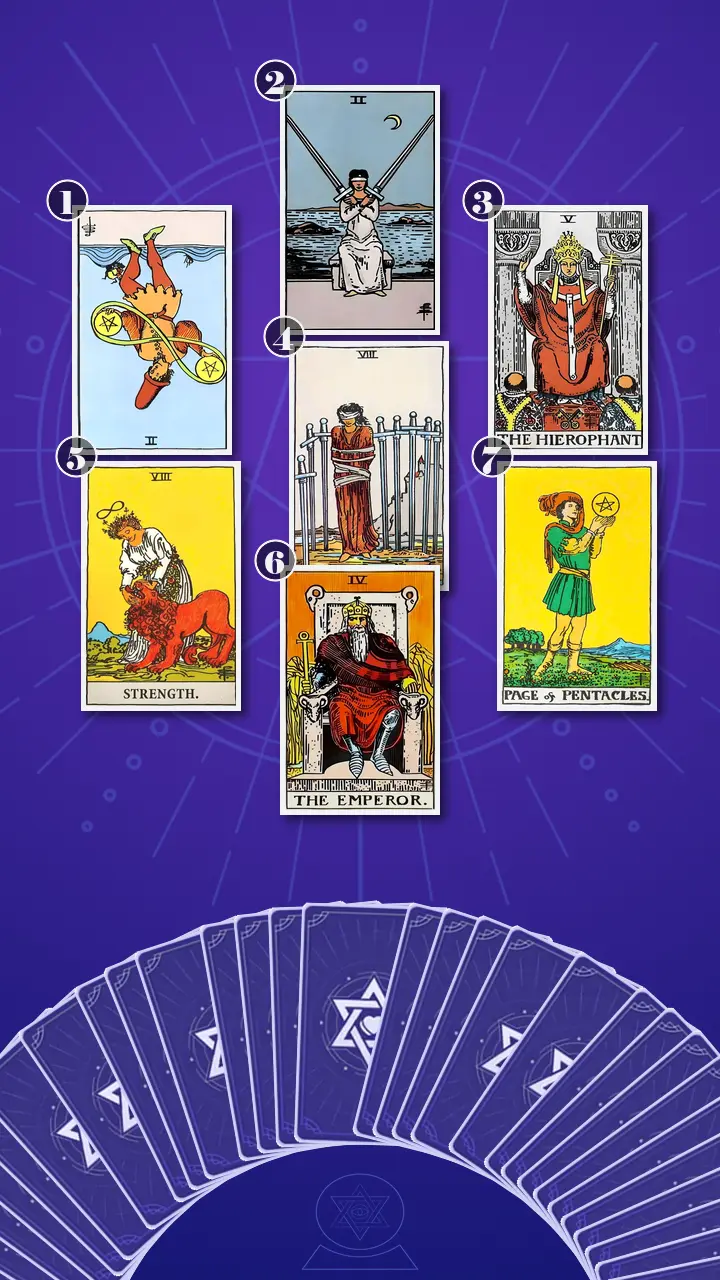
“For this,” I said, “I’m using a spread I call the Energy Diagnostic Map (7) · Context Edition. It’s a seven-card circular spread designed for milestone overwhelm—when multiple life areas feel stuck at once and the real problem is the knot in the middle.”
For anyone reading along: this is why this spread works when you’re at a career crossroads and also feeling decision fatigue about money and dating. The question isn’t binary, and it isn’t solved by one ‘perfect’ answer. This layout separates the surface symptoms (what your stuckness looks like day-to-day), the inner tug-of-war (what you’re protecting yourself from feeling), and the external pressure (the milestone scripts), then puts the core blockage dead center—visually unavoidable. From there, it shows the internal resource that helps you move, the key mindset shift, and finally one practical next step you can complete in real life.
“Card one,” I added, “will mirror the visible pattern. Card four in the center is the core trap. Card six is the turning point—what changes everything. And card seven will give you a grounded next step for the coming week.”
Reading the Roundabout: Where the Stuckness Actually Lives
Position 1: Surface symptoms — The day-to-day ‘stuck’ behaviour
“Now we’re turning over the card that represents surface symptoms: the most visible, day-to-day ‘stuck’ behaviour across work, money, and love.”
Two of Pentacles, reversed.
Even before I spoke, Jordan’s mouth twitched, like she recognised an old screenshot of herself.
“This is painfully specific,” I said, and I kept my language concrete on purpose. “It’s 10 p.m. and you’re toggling between LinkedIn, a budgeting app, and a dating app like you’re triaging three emergencies. You tell yourself you’re being responsible, but the juggling is the bottleneck: every switch bleeds attention, and by midnight you have new tabs, new plans, and zero finished actions.”
I tapped the image lightly. “See the infinity loop around the coins? That’s the ‘just one more tweak’ cycle. And the sea behind them—choppy, unstoppable—that’s rent, deadlines, the emotional bandwidth piece. Life doesn’t pause so you can catch up, so you juggle harder.”
Jordan gave a brief, bitter laugh—then winced like she’d surprised herself. “Okay,” she said. “That’s… honestly kind of cruel.”
I nodded. “It feels cruel because it’s accurate. And because the false relief is real: it feels like progress. Planning can look like progress when you’re scared of outcomes.”
Her fingers stopped moving for the first time since she’d sat down. The laptop-fan hum she’d described earlier seemed to fill the quiet between us, even though we were in my reading space, not her flat.
Position 2: Inner tug-of-war — What you’re protecting yourself from feeling
“Now we’re turning over the card that represents the inner tug-of-war: the decision paralysis behind ‘what first?’ and what you’re protecting yourself from feeling.”
Two of Swords, upright.
“This is the blindfold card,” I said. “Not because you’re clueless. Because you’re keeping it theoretical.”
I used the exact modern translation I’d been holding in my mind. “You can argue convincingly for focusing on career, money, or dating—and that’s the problem. You keep all three options perfectly balanced in your head, like a debate club final, so you never have to commit to one long enough to find out what happens.”
I watched her eyes track down to the crossed swords, then back up. “If you had to pick one lane for 30 days,” I asked, “what’s the feeling you’re avoiding? Disappointment? Regret? Being judged?”
Her jaw tightened. “Being judged,” she said quickly. Then, softer: “By me. Mostly.”
“That makes sense,” I replied. “Indecision can masquerade as risk management. But it also keeps everything in draft mode.”
Position 3: External pressure — The milestone scripts turning it into an identity test
“Now we’re turning over the card that represents external pressure: milestone scripts, social comparison, and environmental demands amplifying the stuckness.”
The Hierophant, upright.
“This is the invisible checklist you didn’t agree to but keep grading yourself against,” I said. “The keys here read like a ‘proper adulthood’ gate: you feel like there’s a correct sequence—salary, partner, stability—and you’re waiting to be approved.”
I let the words land in a way that didn’t blame her. “You scroll friends’ milestone posts and your brain quietly converts them into rules: what you should earn by 30, how serious your relationship should be, what savings should look like. Even if you’d never say it out loud, you start acting like there’s a standard you’re failing—and that makes every decision feel loaded with shame.”
Jordan stared at the card, then looked away to the window. Outside, late-afternoon London light hit the glass in that flat, grey way—like the city itself was holding its breath.
“It’s so embarrassing,” she said. “Like, I’m happy for them. But also my brain just… tallies.”
“That’s the Hierophant voice,” I said. “It’s not evil. It’s familiar. But it’s not always yours.”
Position 4: Core blockage — The mental trap freezing all three areas
“Now we’re turning over the card that represents the core blockage: the key belief or mental trap that keeps work, money, and love frozen.”
Eight of Swords, upright.
I didn’t rush this one. The room felt quieter, like even the street noise had stepped back.
“Here’s the trap in plain language,” I said. “You tell yourself you can’t start improving anything until you know the correct first priority. So you wait for certainty, do more research, and replay scenarios—until the ‘no move is safe’ feeling becomes your default. The trap is mostly made of thoughts, but it still feels physical in your body.”
Then I voiced the inner monologue I’d heard a hundred times—sometimes from clients, sometimes from my own younger self. “If I pick money first, love will fall behind. If I pick love, I’m irresponsible. If I pick work, I’m shallow.”
I pulled us into her London scene on purpose, because it’s where the truth lives. “Phone glare in a dark living room. Thumb hovering. Shoulders up near your ears like you’re bracing for impact.”
I pointed to the loose rope. “The cage looks solid,” I said. “But your hands can still move.”
Jordan’s reaction came in a sequence: first a small freeze—her breath paused. Then her eyes unfocused for a second, like she was replaying an exact Sunday night. Then the exhale finally arrived, quiet but long, like a seam in fabric being found and pulled.
“So what’s real,” she asked, voice smaller now, “and what’s imagined?”
“Beautiful question,” I said. “Real constraints are time, money, energy. Imagined constraints are things like: ‘I must be certain before I begin,’ or ‘If I choose wrong, it proves I’m not competent.’ We’re going to separate those.”
Position 5: Available resource — The quality that lets you tolerate starting imperfectly
“Now we’re turning over the card that represents your available resource: the internal quality you can rely on to tolerate discomfort and create momentum.”
Strength, upright.
Jordan leaned in without noticing she’d done it.
“Strength is power without force,” I said. “Not ‘fix your life’ energy. More like: you tolerate the awkwardness of a starter step.”
I gave her a script that’s short enough to survive a stressful Tuesday. “Try this line: ‘I can be uncomfortable and still be reliable.’ And pair it with a body cue: unclench your jaw. Drop your shoulders one inch.”
She tried it—almost experimentally. Jaw loosening, shoulders lowering, like she was giving her body proof before her mind could argue.
“That,” I said, “is you stepping out of the swords. Not dramatically. Just… one inch.”
When the Emperor Spoke: Permission vs Leadership
Position 6: Key transformation — The leveraged shift that changes the whole pattern
I took a breath myself before turning the next card. This was the turning point position—the one that answers what first? in a way that isn’t a life sentence.
“Now we’re turning over the card that represents the key transformation: the mindset shift that determines what to prioritise first and how to hold the priority.”
The Emperor, upright.
The image felt almost loud—stone throne, straight posture, armour beneath the robe. A container. A decision that can hold its shape.
Setup (the stuck loop you’ve been living in): I watched Jordan’s eyes flick between the Emperor’s throne and the memory of her sofa scene—the LinkedIn tab, the Monzo balance after rent, the half-drafted Hinge message. She was trapped in the idea that the first priority has to be correct, because a wrong move would be visible, judgeable, and humiliating.
Stop waiting for a rulebook to tell you what comes first; choose your own order and build a sturdy throne for it—one clear container that makes follow-through inevitable.
I let silence do some of the work. The kind of silence that isn’t awkward—just spacious enough for a new thought to land.
Reinforcement (the moment it hits your body, not just your brain): Jordan’s face went still, like she’d been bracing for a lecture and got something else entirely. First, her brows lifted—just a millimetre. Then her eyes widened in a quick, sharp ‘oh’ recognition, as if the problem was never choosing the right lane; it was refusing to be the driver. Her throat bobbed when she swallowed. Her hands—those restless, searching hands—stopped moving and settled flat on her thighs. Her shoulders dropped, but not with instant peace. More like the relief of setting down a heavy bag… followed by the strange dizziness of realising you can actually walk somewhere now. “Wait,” she said, and there was a flash of resistance, almost anger, because clarity can feel like losing an excuse. “But if I decide the order… doesn’t that mean I’ve been doing it wrong this whole time?”
I met her eyes. “It means you’ve been trying to be safe,” I said. “And you used the tools you had: planning, researching, optimising. The Emperor isn’t here to shame you. He’s here to give you a structure that makes action possible.”
This is where my old life always flickers in—like a Bloomberg terminal memory you didn’t ask for. In M&A, people think the win is ‘picking the perfect deal.’ It isn’t. The win is building a structure you can execute—clear assumptions, defined downside, and a timeline for reviewing reality. The Emperor is that energy: governance.
“Let’s do a quick Strategic Crossroads Analysis,” I said, pulling in my own toolkit naturally. “Not to overcomplicate—just to cut through the identity noise. We’re going to treat the next 30 days like a probability-weighted experiment. Not forever. Not a verdict.”
I held up three fingers. “Option A: anchor focus is money. Option B: anchor focus is work. Option C: anchor focus is love. Each gets one small weekly action. Then we assess what evidence you get.”
I watched her breathe. This time she didn’t rush to defend herself with more plans.
“Now,” I asked, “with this new lens—leadership, not permission—think back to last week. Was there a moment where this could’ve changed how you moved? Even slightly?”
Jordan stared at the Emperor again. Then she nodded once, slow. “Sunday,” she said. “I rewrote my whole budget spreadsheet at 11 p.m. instead of just… moving £50. Because moving it would mean I’m really doing it.”
“Exactly,” I said. “This is the shift from milestone-triggered stuckness to self-authored priorities—and from reassurance-seeking to evidence-based self-trust. Evidence builds confidence faster than reassurance.”
Position 7: Next step — The small, grounded action that proves traction
“Now we’re turning over the card that represents the next step: one practical action for the coming week that builds traction and self-trust.”
Page of Pentacles, upright.
“One coin at eye level,” I said. “One tangible investment. Beginner-proof on purpose.”
I gave it to her in the simplest modern scenario. “You pick a trackable action and treat it like a promise: save a fixed amount weekly, apply to one role per week, or send one thoughtful message. It’s not dramatic, but it creates evidence—and evidence cuts through the fog faster than more thinking does.”
Jordan’s lips pressed together, not in tension this time, but in concentration. “So the answer to ‘what first’ is… not which area is most important. It’s choosing one and holding it.”
“That’s it,” I said. “One measurable promise beats three perfect plans.”
The One-Page Throne: Actionable Next Steps for the Next 30 Days
I leaned back and stitched the whole map into a single story for her—because insight without integration just becomes another tab you keep open.
“Here’s the pattern the cards are showing,” I said. “On the surface, you’re juggling three domains at once (Two of Pentacles reversed), which looks like effort but produces no visible results. Inside, you keep everything perfectly balanced to avoid the vulnerability of choosing (Two of Swords). The pressure is amplified by milestone scripts—what 30 is ‘supposed’ to look like (The Hierophant). At the center, you’re caught in a mental policy that says: ‘No move is safe until I can guarantee it’s the correct first move’ (Eight of Swords). Your way out isn’t more force—it’s Strength: gentle discipline, the ability to be uncomfortable and still be reliable. And the turning point is The Emperor: leadership through a simple container. Finally, the Page of Pentacles turns that container into a small, trackable investment.”
“Your cognitive blind spot,” I added, “is that you’ve been treating prioritising like a final exam. That turns every choice into an identity test. The transformation direction is the opposite: make it a 30-day container, not a forever identity.”
“Okay,” Jordan said, and here came the practical obstacle—because real life always shows up. “But I genuinely don’t have time. My job is chaos. And if I pick a focus, I’m scared I’ll fail at it and then feel worse.”
“That fear is data, not a command,” I said. “So we shrink the action until it becomes doable under chaos. And we pre-commit in a way your nervous system can tolerate.”
I pulled in my boardroom-style approach, but kept it human. “We’ll do a 10-minute rapid assessment—SWOT-TAROT hybrid—just enough to choose an anchor without spiralling. Then we use a trading-floor focus technique: time-box it, execute it, and walk away.”
- Draft your 30-Day Anchor Focus ContractSet a 10-minute timer. In your Notes app, write: “For the next 30 days, my anchor focus is ___ because I want evidence of traction.” Choose ONE: money, work, or love—based on what would create the most immediate relief or stability.If “But what if I pick wrong?” shows up, treat it like a weather report. Keep writing anyway. This is a reversible experiment, not a verdict.
- Choose one measurable weekly action (under 30 minutes)Pick exactly one action you can point to as evidence. Examples: “Every Friday 6 p.m.: move £50 to savings.” OR “Every Tuesday lunch: apply to 1 role.” OR “Every Sunday 4 p.m.: send 1 thoughtful message on Hinge.” Put it in Google Calendar as a repeating event.If your chest tightens, shrink the action by 50% (e.g., £25, or one job saved + one message drafted). Small still counts. That counted.
- Build the ‘Later List’ boundary (stop tab-switching)Create a note titled “Later List.” For the other two life areas, park ideas there instead of acting on them. When you feel the itch to open a second ‘life-fix’ tab, add one bullet to the Later List and close the app.No debating with yourself in the moment. If you missed a week, don’t add punishment rules. Restart at the next scheduled time.

A Week Later: Evidence, Not a New Personality
Seven days later, I got a message from Jordan. No dramatic life overhaul. No manifesto. Just a photo: her phone screen with a recurring calendar event titled “Evidence Day,” and beneath it, a Monzo transfer confirmation—£50 moved. Her text was one line: “I did it even though it felt weirdly scary.”
The bittersweet part was there too, honest and small: she’d done the transfer, then sat alone in a Pret near Liverpool Street for an hour, not celebrating—just letting the quiet feel unfamiliar, like a new coat she wasn’t sure fit yet.
That’s what a real Journey to Clarity often looks like. Not certainty. Ownership. A sturdy throne built out of one kept promise.
And if turning 30 makes every choice feel like a public exam, it’s not that you don’t care—it’s that you’re terrified one visible ‘wrong move’ will prove you’re not in control or competent enough to be safe.
If you gave yourself permission to treat the next 30 days as a reversible experiment—not a verdict—what would you choose as your one anchor focus just to gather evidence?