Rest With One Eye Open on Sundays—Choosing One Keystone Reset

Finding Clarity in the 6:26 p.m. Radiator Tick
If your Sunday includes opening Slack “just to check,” building a new workout/meal plan, and rereading a text thread like it’s homework… you’re trying to fix your whole life before Monday.
Taylor showed up on my screen from her NYC apartment, the kind of place where the radiator makes that relentless ticking sound like it’s counting down to Monday. She was on the couch with her laptop balanced on a throw pillow—Slack in one tab, Google Calendar in another, and a meal-planning app open like a third witness. The light from the screen turned her eyes glassy and dry. Her leg bounced so fast it made the whole cushion tremble.
“I keep doing this,” she said, rubbing the spot where her shoulder met her neck like she could knead the week out of it. “Work, health, love. Every Sunday I’m like, okay, I’m going to reset everything. And then I… don’t. I just reorganize and research and refresh. I end up more exhausted than when I started.”
There was a particular kind of exhaustion in her face—less “I’m sleepy,” more “my nervous system is holding a suitcase it never sets down.” Heavy shoulders, but wired. Like stillness was a room she couldn’t enter without setting off an alarm.
“And the worst part,” she added, voice dropping, “is if I choose one—like, focus on health—then I’m terrified work will slip and people will notice. If I focus on work, I’ll keep burning out and I’ll have zero bandwidth for dating. If I focus on love, I feel irresponsible. Like… there’s a correct order and I’m failing a test.”
I let that land, because it wasn’t just a scheduling problem. It was a worth problem wearing a calendar’s clothes.
“You’re not lazy,” I told her. “You’re doing triage—three emergencies at once. Let’s try something different today. Let’s make a map through the fog. Not a perfect plan. Just enough clarity to take one real step.”

Choosing the Compass: How Tarot Works When You’re Burned Out
I’m Giulia Canale. I grew up around the Venetian canals, and I’m trained as a Jungian psychologist—so I listen for patterns, symbols, and the places the psyche gets stuck repeating itself. Years ago, I worked on international cruise ships as an intuition trainer. When you’re mid-ocean, people don’t ask for abstract answers. They ask for something usable—something that helps them sleep, speak, decide. That’s still how I read Tarot: as a tool for clarity and next steps, not a mysticism fog machine.
I asked Taylor to take one slow breath and to name the question in one clean line. She did, almost like she was trying not to cry: “Sunday burnout. What do I reset first—work, health, or love?”
As she exhaled, I shuffled. Not as a ritual for luck—more like a psychological threshold. The act of shuffling gives the mind something to do while the deeper layers speak.
“Today,” I said, “we’ll use a spread I designed for exactly this kind of loop: the Energy Diagnostic Map (7) · Context Edition.”
For you reading this: this question has three parallel priorities that are emotionally loaded—work, health, love—and they’re feeding each other. A simple past/present/future spread can flatten it into a timeline and miss the system. This spread works more like a subway map: it shows what’s visible, what’s conflicting internally, what’s pressuring externally, where the whole line jams, and then it translates insight into one integrative shift plus one grounding action.
“The first card will show what your Sunday looks like on the surface,” I told Taylor. “Then we’ll separate your inner tug-of-war from external pressure. The center card is the engine—what keeps the loop running. And the final cards will give us a resource, a transformation, and a practical next step for the next seven days.”
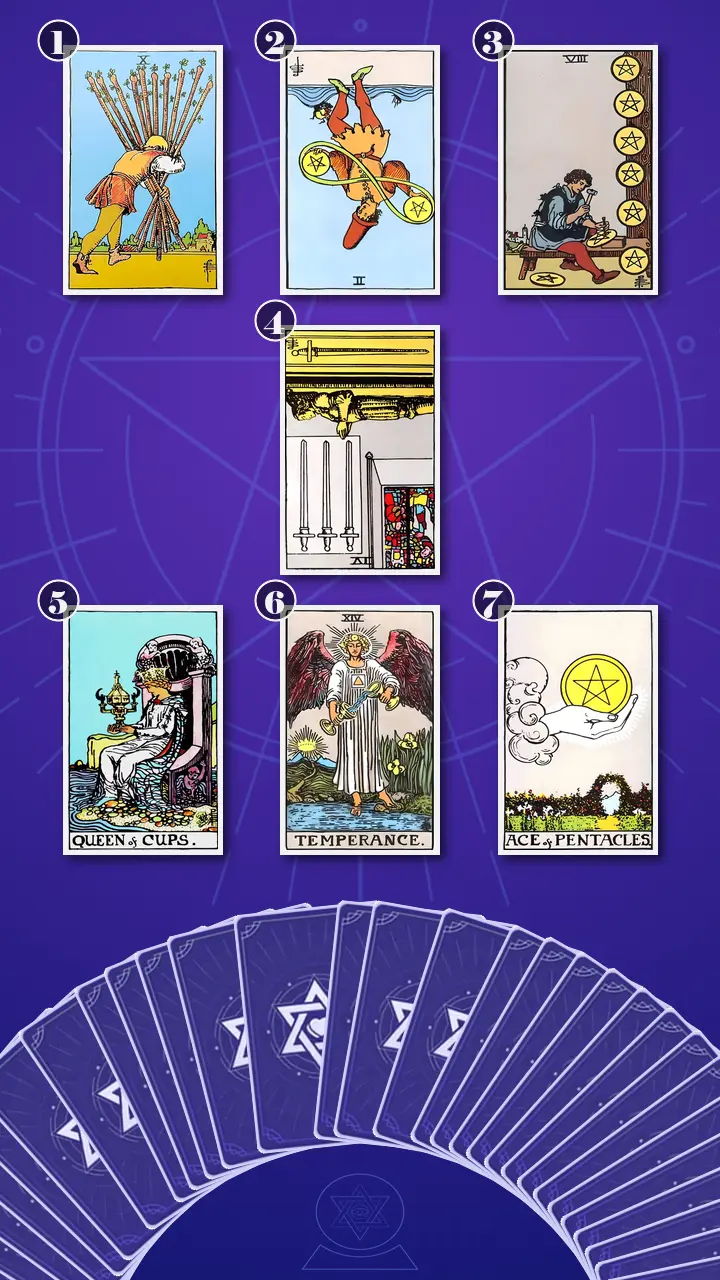
Reading the Map: Where Sunday Scaries Turn Into a System
Position 1 — Surface snapshot: what Sunday burnout looks like right now
“Now flipping over,” I said, “is the card representing the surface snapshot—what Sunday burnout looks like in your real behavior right now.”
Ten of Wands, upright.
It was almost too perfect: a figure bent forward under a bundle so large it blocks their view.
“This is Sunday,” I said. “Not as a vibe—as a posture. It’s like your ‘reset’ has turned into you carrying three invisible backpacks: one labeled Monday work, one labeled health overhaul, and one labeled relationship upkeep. You’re technically doing things—lists, research, calendar tweaks—but it feels heavy, directionless, and oddly joyless. Like the load blocks you from noticing what would actually help.”
In energy terms, the Ten of Wands is excess: responsibility creep. Effort without oxygen. This isn’t you being weak. It’s you trying to prove worth through endurance until the weight itself becomes the problem.
Taylor gave a short laugh that sounded like it scraped on the way out. “That’s… brutal,” she said. “Like, accurate. But brutal.”
“Sometimes the first card feels like being seen too clearly,” I said gently. “But it’s also a relief: it means we’re not guessing.”
Position 2 — Inner tug-of-war: what’s competing inside you
“Now we’re looking at the inner tug-of-war—what’s competing inside you when you ask ‘work, health, or love?’,” I said, turning the next card.
Two of Pentacles, reversed.
“Your inner tug-of-war looks like compulsive tab-switching,” I said. “Inbox → workout plan → texts → calendar → back to inbox. You’re trying to keep everything ‘moving’ so nothing drops, but the constant switching is what drains you. Committing to one priority feels risky, so you keep juggling instead of landing anywhere long enough to recover.”
Reversed, this card is blockage: flexibility turning into frantic switching. It mimics control, but it steals depth. And it makes balance feel like a performance—like if you don’t keep everything spinning, you’ll be exposed.
“Balance isn’t frantic juggling,” I told her. “Balance is a repeatable rhythm.”
She nodded, but it wasn’t confident. It was the kind of nod people do when they recognize themselves and wish they didn’t.
Position 3 — External pressure: what keeps you “on”
“Now flipping over is external pressure—the environment signals that keep you on and make Sunday feel like a pre-Monday test,” I said.
Eight of Pentacles, upright.
“External pressure shows up as the constant vibe that you should be improving,” I said. “At work, in your body, and in your relationships. Sunday becomes a mini performance review: optimize meals, optimize fitness, optimize communication, optimize your career trajectory. Even rest starts to feel like something you need to do correctly.”
This card is balance when it’s craft—one thing at a time, steady learning. But here, in context, it becomes excess in the environment: the city’s ‘always refine’ culture amplifying your internal project manager voice.
I watched Taylor’s eyes flick away from the screen, like she could see her Instagram feed hovering in the air. “I hate how much those ‘Sunday reset routines’ get in my head,” she admitted. “Like… hot girl walk, meal prep, relationship check-in, all before noon. I can’t even get out of my own brain.”
“That’s not a personal flaw,” I said. “That’s comparison fatigue plus a workplace that rewards being reachable.”
Position 4 — Core blockage: the hidden mechanism keeping the reset from working
I held my hand over the center of the spread for a beat. “This next one,” I said, “is the engine. The core blockage—the hidden mechanism that keeps the reset from working.”
Four of Swords, reversed.
I felt something in my own chest soften in recognition, the way it does when a pattern finally reveals itself. On ships, I saw this exact thing in people who were technically off-duty but never truly off.
“The hidden mechanism is that you never fully power down,” I told her. “Even when you sit or lie down, you keep your phone within reach, keep notifications on, and keep mentally rehearsing Monday. So the fatigue never completes its cycle—then your brain panics and treats work/health/love like urgent emergencies you must solve with planning.”
I said it plainly, because she needed the truth more than a pep talk: “If you’re exhausted, the answer isn’t a better plan—it’s a real pause.”
She went still. And then I saw the echo play out on her face: the moment someone realizes they’ve been calling something “rest” that wasn’t.
“Rest with one eye open,” I continued, letting the words paint the scene. “You’re in bed with clean sheets, your phone warm in your hand. You tell yourself you’re winding down.”
And then, in short compulsive lines—because that’s how the mind sounds in this loop—I named it the way her nervous system lives it:
Refresh.
Check Slack.
Rehearse Monday.
Plan meals.
Reread the text thread.
Refresh again.
“You’re stopped,” I said softly, “but you’re not resting.”
Taylor’s mouth parted like she was about to respond, then didn’t. Her breathing paused—just for a second—then restarted lower, like her body finally found the bottom of the lungs.
“I thought I was resting,” she said, very quietly. “But I’m literally never offline.”
“Exactly,” I said. “And when real recovery doesn’t happen, every category becomes urgent. You end up trying to solve depletion with more effort.”
Position 5 — Available resource: what you can draw on right now
“Now we look for what’s available,” I said. “This is your resource—what inner strength or support you can draw on to reset more cleanly.”
Queen of Cups, upright.
“Your available resource is the part of you that can ask—without turning it into a KPI—‘What am I actually feeling?’” I said. “The Queen of Cups is quiet self-attunement. She notices whether you’re overstimulated, lonely, depleted, or anxious—so you can choose a reset based on real needs, not an idealized version of who you think you should be by Monday.”
In energy terms, this is balance: emotional data without performance. The lidded cup is a boundary. A reminder that some needs can be held privately and gently, not optimized into a spreadsheet.
Taylor blinked fast, twice. “I don’t even know what I feel half the time,” she admitted. “I just… go into manager mode.”
“That’s why this card matters,” I said. “It’s a permission slip back into your body.”
When Temperance Spoke: The Moment the Order Stopped Mattering
Position 6 — Key transformation: the mindset shift that unlocks movement
I let the next card sit face down for a beat. The radiator ticked somewhere in her apartment; on my end, in Venice, water lapped softly against stone. Two different cities, the same human nervous system.
“We’re flipping the most important card now,” I said. “This is the key transformation—the mindset shift that decides what to reset first without needing a perfect answer.”
Temperance, upright.
The angel poured water between two cups, steady and unhurried—one foot on land, one in water, a path leading toward a glowing horizon.
“This is integration,” I said. “It’s not ‘pick work and abandon love’ or ‘do health and ignore your career.’ Temperance is the proportions. The rhythm. The sustainable blend.”
And then I brought in my signature lens—because this is where it helps most.
“I’m going to use what I call a Choice X-Ray,” I told her. “Not to make the choice for you, but to reveal the hidden costs and benefits you’re paying when you try to reset everything at once.”
“When you attempt all three domains on Sunday, the benefit is you get a hit of ‘I’m responsible.’ But the hidden cost is your nervous system never downshifts—so you start Monday depleted and resentful. When you choose one keystone reset for seven days, the visible fear is ‘I’m failing the others.’ But the hidden benefit is capacity: you become the kind of person who follows through, which supports work, health, and love.”
She frowned—an actual flash of resistance. “But if I don’t use Sunday to get ahead,” she said, sharper now, “Monday will eat me alive.”
I nodded, because that belief is not silly. It’s protective. “That makes sense,” I said. “And it’s exactly why Temperance doesn’t ask you to stop caring. It asks you to stop treating Sunday like an emergency room.”
The setup
It was Sunday night in her body, even though it was still evening on the clock: Slack open, a new meal plan draft, and a text she hadn’t answered. Her shoulders felt heavy, but her brain wouldn’t shut up. She was trapped in the idea that the ‘right order’ would finally make her feel safe.
The delivery
Stop treating Sunday like a triage for three emergencies; practice one measured blend—like Temperance mixing the cups—so your reset supports every part of you.
I let the sentence hang there. No extra explanation. Just the truth, in the quiet.
The reinforcement
Taylor’s reaction came in layers—the kind you can only see when you’re paying attention.
First, her body froze: her leg stopped bouncing mid-air, like someone hit pause. Her breath caught, and her hand hovered over her trackpad without clicking.
Then, the cognition seeped in: her gaze unfocused, eyes sliding slightly to the side as if she was replaying every Sunday where she’d tried to “earn” rest by monitoring everything. I could almost hear the internal transcript changing from fix everything to why is it always fix everything?
Then came the emotional release—small but real. Her shoulders dropped a fraction. Her jaw unclenched, and she exhaled like she’d been holding air all weekend. “I hate that this makes me feel… relieved,” she said, voice a little shaky. “And also guilty. Like if I stop juggling, something bad happens.”
“That’s the bridge,” I said. “Relief plus guilt is a sign you’re stepping out of productivity-as-self-worth. This isn’t about becoming less competent. It’s about moving from wired-but-tired vigilance into grounded self-trust through a repeatable rhythm.”
I leaned forward slightly. “Now, use this new lens and think back: last Sunday—was there a moment where, if you’d allowed a measured blend instead of triage, you would’ve felt different?”
She swallowed. “When I got that text,” she said. “Right when I opened my calendar and saw Monday packed. I treated the text like another task. I could’ve just… replied one kind sentence, and then stopped.”
“Exactly,” I said. “Temperance isn’t a grand overhaul. It’s a steady pour.”
From 10 Tasks to 1 Seed: Actionable Next Steps for the Next 7 Days
Position 7 — Next-step grounding: one practical action that embodies the new priority
“Now we anchor it,” I said, turning the final card. “This is the next-step grounding—one practical, low-pressure action for the next seven days.”
Ace of Pentacles, upright.
“Your next step is one tangible seed you can actually follow through on for seven days,” I said. “Something physical and measurable that makes life feel a bit more stable. Not a whole new system. One seed. The single coin in the hand.”
And then I stitched the whole spread into one clean story—because coherence is what calms decision fatigue.
“Here’s what the map says,” I told her. “You’re carrying too much on the surface (Ten of Wands). Inside, you’re juggling by switching constantly, which drains you (Two of Pentacles reversed). Outside, the city and your job keep whispering ‘improve, improve, improve’ (Eight of Pentacles). The real choke point is that you don’t get true rest—only vigilance disguised as downtime (Four of Swords reversed). Your resource is emotional truth without performance (Queen of Cups). The turning point is integration: one measured blend, not a perfect order (Temperance). And the way you rebuild trust is by planting one seed and stopping (Ace of Pentacles).”
“Your cognitive blind spot,” I added, “is thinking the right plan will create capacity. But the spread is blunt: capacity comes from recovery first, then proportion, then one seed of follow-through.”
To make it practical, I switched into the same voice I used on ships when someone needed a plan before we docked—clear, time-bound, doable.
“I want to give you a small framework. I call it my Port Decision Model,” I said. “On a cruise, you can’t dock at three ports at once. You choose one port window, get what you need, and you leave on time. Your Sunday is a port. The goal isn’t to do everything. The goal is to refuel.”
- One protected “real pause” (45 minutes, or the 12-minute pilot)On Sunday, set one calendar block. Put your phone in another room. Do one calming thing that isn’t optimization: a shower + lotion, a slow walk without podcasts, or lying on the floor with a blanket.If 45 minutes feels impossible, do 12 minutes and call it a pilot. The win condition is: phone out of the room, timer on, and you can stop anytime.
- Write the one-sentence Keystone ResetRight after the pause, write one sentence: “This week, my keystone reset is ______.” (Examples: “sleep consistency,” “no work email after 7,” “one low-pressure connection moment.”)Don’t justify it. Treat it like data from the Queen of Cups: simple, private, honest.
- Do the 10-minute Temperance Blend (5 + 5)Before opening any work app, do 5 minutes of gentle movement (stretch or slow walk around your place) + 5 minutes of one connection action (one kind text or voice note).If your brain says “too small to matter,” name it as the Ten of Wands logic. From 10 tasks to 1 seed—follow-through beats overhaul.
- Choose one Ace-of-Pentacles seed for 7 days (then stop)Pick one measurable commitment: “Walk 10 minutes after lunch 3x,” or “Cook one simple dinner Wednesday,” or “Log out of Slack after 6 p.m. Sunday.”You’re allowed to stop after one. Stopping is the practice, not quitting.
“If you want extra support,” I said, “use Reality Testing: try your keystone reset for 48 hours and evaluate it like an experiment, not a verdict. We’re not proving you’re perfect. We’re proving what actually helps.”

A Week Later: The Quiet Proof
Six days later, I got a message from Taylor while I was walking along a narrow canal, the air smelling faintly of rain on stone.
“I did the 12-minute pilot,” she wrote. “Phone in the other room. I hated it for the first two minutes. Then my shoulders dropped. I picked sleep as my keystone reset for the week—lights out by 11:30 four nights. And I sent one text without rewriting it. Monday still sucked, but it didn’t feel like a cliff.”
She added, almost as an afterthought: “This morning I still had the ‘what if I’m behind’ thought. But I noticed it… and didn’t sprint.”
That was it. Not a brand-new life. Just the first real evidence of a nervous system learning it can stand down.
In this Journey to Clarity, the Tarot didn’t tell her whether work, health, or love was “the right” first choice. It showed her the real blockage—rest that never completes—and the real remedy: a measured blend that rebuilds capacity, then one seed of follow-through.
When Sunday turns into you refreshing, planning, and rehearsing with heavy shoulders and a wired-but-tired body, it’s often because slowing down feels like proof you’re falling behind—so you try to earn rest by fixing everything at once.
If you didn’t have to find the perfect order—just one keystone reset for the next seven days—what would you quietly choose to make everything a little more sustainable?