Friendship Overfunctioning: Replacing Planner Panic With Reciprocity

Finding Clarity in the 3:17 p.m. Office Kitchen
If you’re a late-20s city person with a full Google Calendar and a half-dead group chat, and the moment you stop planning you get hit with instant group chat limbo panic—yes, this is the pattern I was looking at when Taylor (name changed for privacy) sat down with me.
She lived in Toronto, worked as a marketing coordinator, and by the time she reached me she already knew the outer facts of the problem. On Thursday afternoons, usually around a coffee break, she would stand in an office kitchen under fluorescent lights, paper cup cooling in one hand, phone in the other, jumping between Slack, her calendar, and two iMessage chats. She would type, “Anyone free Saturday?” and then, before anyone answered, start adding restaurant options, time slots, even a backup patio nobody had asked for. The coffee went bitter. The fridge hummed. Her shoulders rose toward her ears as if her body had decided the weekend itself needed rescuing.
“I want to see people,” she told me. “I just do not want to be the social cruise director every single time. But if I stop, the silence in the group chat is louder than it should be.”
I could hear the real contradiction immediately: she wanted relief from always being the one who planned the hangouts, but she was afraid of what it might mean about the friendship if she stopped. The anxiety in her wasn’t abstract. It felt, even from across the table, like a phone left on vibrate under her ribs—tight chest, buzzing stomach, hands reaching for the screen before her mind had even finished its story.
I nodded and said what I have learned to say very plainly in moments like this. “You’re not too needy. You’re just tired of having to engineer belonging.” Then I leaned in a little and added, “Let’s make a map of this. Not to judge you, and not to predict who texts next. Just to find the clarity inside the pattern.”

Choosing the Compass: A Situation-Obstacle-Advice-Outcome Spread
I asked her to take one slow breath, place both feet on the floor, and hold the question exactly as it was: why do I resent planning hangouts but panic when I stop? Then I shuffled slowly. For me, that part is not theater. It is a threshold. It helps the nervous system stop sprinting long enough for the mind to see what it has been doing on autopilot.
I told her I was using a Situation-Obstacle-Advice-Outcome spread. It is one of the cleanest four-card structures I know for friendship overfunctioning, especially when someone is trapped in a repeating loop and needs actionable advice, not a dramatic verdict. This is how tarot works when I use it well: not as a machine for fate, but as a way of organizing attention. Card meanings in context can show where the visible behavior ends, where the hidden fear begins, what lens corrects the pattern, and what the next realistic step looks like.
For her question, the fit was precise. The first position would show the observable symptom: the planning-resistance loop, where a hangout turns into logistical overwork. The second would reveal the underlying blockage: the fear that silence or lack of initiative means exclusion. The third—our turning point—would name the key shift from reassurance-seeking to reciprocity. The fourth would ground the reading in practice, in a lighter kind of connection she could actually try this week.
When Justice Asked for Receipts, Not Reassurance
Position 1: The Loop That Calls Itself “Being Helpful”
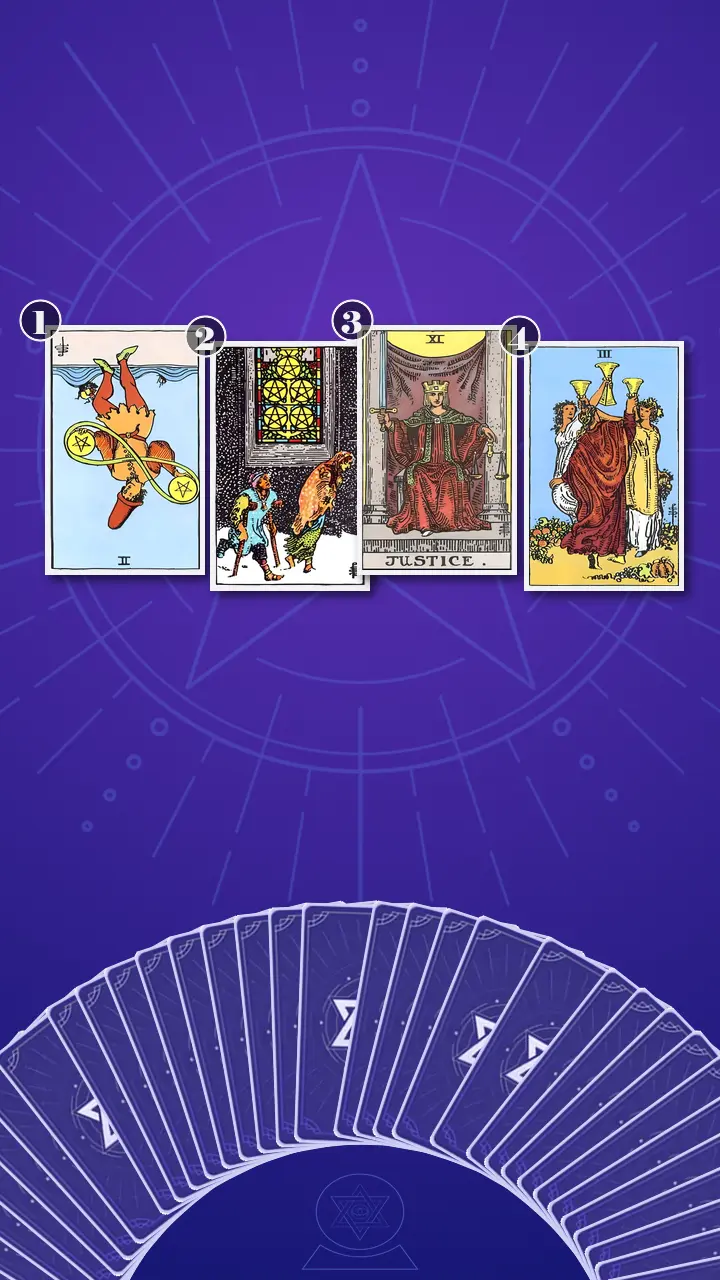
I turned over the first card. “This is the position that shows the observable symptom from the diagnosis: the planning-resistance loop where hangouts become logistical overwork instead of connection.” The card was the Two of Pentacles, reversed.
I told her that this card always makes me think of someone keeping five browser tabs, two calendars, and one dying group chat open so the plan does not collapse. In her life, it looked exactly like toggling between a work task, her calendar, and two chats during an afternoon break, trying to keep the weekend socially alive before it had even formed. One simple invite turned into dates, neighborhoods, backup options, and emotional smoothing. By the time people replied, she was already drained, irritated, and a little too dependent on the replies to feel okay.
In energy terms, this wasn’t balance. It was overload. The Two of Pentacles is built for flexibility, but reversed it becomes unstable over-management—like project-managing a casual brunch as if it were a cross-functional launch. The infinity loop in the card showed me the exact cycle: suggest, wait, adjust, rescue. Her nervous system had started using logistics to regulate uncertainty. That is why the planning felt both relieving and infuriating.
She froze first. Then she looked down at the card, blinked twice, and let out a short laugh with a bitter edge. “Wow,” she said. “That’s accurate enough to be rude.” Her thumb moved over the rim of her coffee cup, slow and repetitive. I took that as a good sign. Defensive humor usually means the truth has landed.
Position 2: The Window Lit on the Other Side
I turned the second card. “This position reveals the core psychological blockage: the underlying fear that silence or lack of initiative means exclusion and reduced belonging.” The card was the Five of Pentacles, upright.
I asked her to picture a quieter scene than the office kitchen: Sunday morning, laundry half-folded on the bed, winter light flat against the window, radiator clicking, phone face down for exactly seven minutes before it gets flipped back over. No typing bubble. No new message. Nothing has happened, but the body is already acting like something has been taken away. That is the Five of Pentacles. It is group chat silence anxiety translated into weather.
This card showed a deficiency state—a scarcity story around belonging. The fear underneath her friendship overfunctioning was not really, “Nobody has replied yet.” It was, “If I stop being useful, I might find out I was never securely inside this at all.” The lit window in the card mattered to me here. It mirrored the way other people can seem naturally inside community while she feels she has to earn access through competence, availability, or being the one who makes plans. Through a Jungian lens, this is where an old adaptation starts masquerading as identity.
I asked her softly, “Are you always responding to the current friendship dynamic, or sometimes to an older fear that you have to secure your place by being useful?” She didn’t answer right away. Her jaw loosened first. Then her gaze went slightly unfocused, as if she were replaying half a dozen quiet weekends at once. “Nothing explicit happens,” she said finally. “That’s what makes me feel ridiculous. But my body goes straight to, oh, I’m outside again.”
“Exactly,” I told her. “Silence is uncomfortable, but it is not always a verdict.”
Position 3: Justice, the Receipts, and the Mask Called Useful
When I reached for the third card, the room changed. The rain against the window thinned out, and in the brief quiet between street sounds I could hear the tiny scrape of cardstock against the table. “This,” I told her, “is the advice position—the key transformation. The card here names the shift from over-functioning for reassurance toward assessing reciprocity, fairness, and shared responsibility.” I turned it over. Justice, upright.
I looked at her and said, “You know that moment when you decide not to send the weekend text, then spend half the day checking the chat anyway—coffee gone cold, shoulders tight, reading a normal delay like it might explain your whole place in the group? That’s the exact threshold this card interrupts.”
Then I gave her the cleanest sentence in the reading. “The real question isn’t ‘How do I keep this alive?’ It’s ‘What is actually mutual here?’”
Stop weighing your worth by how much social labor you can carry, and let Justice's scales measure mutual effort so connection can stand upright without you holding the whole balance.
I let the sentence sit. Justice always brings me back to Jung’s idea of persona—the mask that begins as a useful adaptation and then quietly becomes the only face you think you are allowed to wear. In my own mind, I had a quick flash of shared kitchens and dinner tables in cities I’ve lived in, across cultures, where everyone said they wanted easy community and one hyper-competent woman quietly became the infrastructure. I see that pattern so often that I have a name for the diagnostic lens: Persona Fatigue Diagnosis. She wasn’t only tired from making plans. She was exhausted from maintaining the social mask of The Reliable One. And when I used my Group Archetype Decoding, the role was even clearer: in this ecosystem, she had been unconsciously cast as The Caretaker-Coordinator, the person who keeps the emotional Wi-Fi running. Justice was not asking whether she could do that role. It was asking whether the role had been mistaken for love.
Her reaction came in layers. First, she went completely still, breath held halfway in. Then her eyes lost focus for a second, like she was scrolling backward through old threads in her head. Then the feeling arrived—not relief first, but resistance. She sat back and said, a little sharper than before, “But if I do that, and the scales are off, then what? Does that just mean I’ve been wrong about people?” Her fingers had curled inward against her palm without her noticing.
“No,” I said, and kept my voice steady. “It means you stop asking panic to be your analyst. Moving from algorithm brain to spreadsheet brain is not colder. It’s clearer. Stepping back is not to punish, not to test—just to see.” I watched some of the fight leave her shoulders at that. The anger in her was clean anger, not spiral anger. Much healthier.
Then I gave her something immediate. “Within the next ten minutes, open a note and make two columns: ‘What I know’ and ‘What I’m assuming.’ Use one recent group-chat moment and list only observable facts for two minutes. If you start spiraling, stop there. If it feels okay, add one line: ‘Who has met me halfway lately?’”
After that, I invited her one step further. “Now, use this new perspective to think of one group-chat moment from last week where you wanted to send the rescue text. What would have changed if, instead of asking whether they still liked you, you had asked who initiated, who followed through, and who left you holding the whole thing?”
She inhaled, longer this time. Her face softened, then tightened, then softened again—the strange little dizziness that comes when a burden slides off and leaves you standing without it. “I would’ve noticed,” she said quietly, “that one friend actually did offer another day. And another only responded once I’d done all the details.” She exhaled through a laugh that was almost a sigh. “That is… a completely different question.”
“Yes,” I said. “And that shift matters. This is not just about making weekend plans. It’s the first real step from anxious vigilance and resentful over-planning toward calmer self-respect and shared connection.”
Position 4: A Table You Don’t Have to Carry
I turned the final card. “This position grounds the target state in practice: a realistic next step toward lighter, shared, emotionally nourishing connection.” The card was the Three of Cups, upright.
I smiled when I saw it, because it was such a grounded answer. Not total withdrawal. Not forcing yourself to become aloof. The Three of Cups is what happens when connection gets smaller, simpler, and more shared: a post-work walk, one friend actually choosing a time back, split fries on a weeknight, a casual catch-up where the energy comes from multiple people instead of your invisible labor behind the scenes. Less curation, more participation. Less carrying, more shared rhythm.
In energy terms, this card restored flow. The spread had started in distorted Earth—calendars, logistics, proof, effort. Justice cut through that density with clarity. Now the Three of Cups softened into Water: connection as something felt and shared, not managed into existence. I told her, “Wanting people is not the problem. Carrying the whole social calendar to feel wanted is.”
She looked at the card and gave me a small, wary smile—the kind people have when hope feels possible but they don’t yet trust it to stay. “So I don’t need to disappear,” she said. “I just need to stop producing the whole event.”
“Exactly,” I said. “You’re not quitting friendship. You’re letting reciprocity show you where friendship already lives.”
The One-Invite Rule and the Social Receipts Method
By the time I gathered the spread into a single story, the pattern was very clean. First came the Two of Pentacles reversed: the visible loop of always initiating plans and feeling resentful while doing the emotional labor of social planning. Underneath it sat the Five of Pentacles: the deeper belonging fear that makes a quiet group chat feel like social winter. Justice interrupted the whole mechanism by replacing reassurance with reciprocity, and the Three of Cups showed the outcome that becomes possible when connection is allowed to be shared instead of curated.
The blind spot, I told her, was not that she cared too much. It was that she had started confusing usefulness with belonging. Her competence had followed her out of work and into friendship until, in a very small and very modern way, it started to feel like Severance: the efficient version of her had swallowed the softer one. The transformation direction was simple, though not always easy—move from carrying the social calendar to observing mutual effort, and let that observation shape where you invest.
“But six hours without managing a thread sounds impossible,” she said when I started talking about pauses.
“Then we don’t begin with six,” I said. “We begin with ninety minutes. The point is not to win a detachment challenge. The point is to give your nervous system one clean experiment.”
I gave her three practices. I framed the third with my own boundary tool, The Mask Detachment Protocol, because insight lands better when the body has something concrete to do.
- The Low-Lift InviteOn one weekday this week—ideally before the old Thursday spiral kicks in—send one clear option to one group or one friend. For example: “I’m grabbing coffee at 2 on Saturday at Neo on Queen West if anyone wants to join.” One place. One time. One follow-up max. After that, stop managing the thread for at least 90 minutes.If your mind says this is too bare-minimum and people need more options, treat that as familiar anxiety, not a command. An invitation is not a full-time job.
- The Social Receipts NoteThe next time the chat goes quiet, open a private note titled “What actually happened / What my brain added.” Spend two minutes listing only observable facts: who replied, what they said, what has not happened yet. Then add one reciprocity check: “Across the last month, who initiated, followed through, or made room?”Keep it factual and tiny. If the note starts turning into self-criticism, stop after the facts column. Clarity works even in small doses.
- The Mask Detachment ProtocolBefore you send any invite, put your phone face down for 60 seconds and ask, “Do I want connection right now, or am I trying to regulate panic?” If it’s panic, wait ten minutes. If it’s genuine desire, send the simplest version possible. In that pause, mentally separate her core self from the planner role her groups expect.This is not about becoming distant. It is about recovering baseline social energy by loosening the social mask of The Useful One.
I also asked her to run the first experiment where the stakes were lowest: one easier friendship, one ordinary catch-up, no pressure to turn it into the main event. The Three of Cups likes shared energy, not a production budget.

A Week Later: The Quiet Proof
A week later, she sent me a message. “I did the coffee text,” it said. “One clear plan. No backup options. One friend said yes right away. One stayed vague. I didn’t rescue it.” Then, after a minute, another message arrived: “It was weirdly peaceful.”
She ended up meeting one friend for coffee by a bright front window and going home without turning the whole day into a referendum on her social value. Lighter, but not magically cured; clearer, but still a little tender. That is usually how real change looks.
This is what I trust about a Situation-Obstacle-Advice-Outcome tarot spread for friendship overfunctioning and reciprocity: it does not hand someone a fate. It helps them move from panic-math to pattern recognition, from anxious monitoring to self-respect, from “How do I keep this alive?” to “What is actually mutual here?”
There is a very specific kind of loneliness in being the one who can always make the plan happen while quietly wondering whether anyone would come looking for you if you didn’t. Wanting people is not the problem. Carrying the whole social calendar to feel wanted is.
If you stopped using effort to prove your place for just one small moment this week, what kind of invitation—or what kind of pause—would feel most honest to you?
Every reading at AceTarot is a Journey to connect with inner wisdom and empower next step.
Learn more about our Journey to Clarity.