Life Admin Burnout by Friday—and How One Closed Loop Changes the Week

Finding Clarity in the Too-Bright Kitchen
When Jordan (name changed for privacy) came to me, I could have opened with the line I know so many late-20s city workers would recognize: if your Toronto commute home is basically one long promise that tonight will be the night you finally catch up, and then 11:48 PM arrives with your eyes burning and the dishes still there, this reading is for you.
She asked me the kind of question people type into Google at midnight: why am I behind on sleep, bills, dishes, and texts by Friday?
As she spoke, I could almost smell the scene she was bringing into the room: 8:47 PM on a Thursday in a small west-end Toronto apartment kitchen, the overhead light too bright, lemon dish soap on her fingers, sink water running, her phone warm in her damp hand while an unread iMessage thread sat open and her banking app flashed up, then vanished again. The counter looked louder than it was. Her shoulders had climbed so high they were nearly earrings.
“I am somehow busy all day and still behind on the basics,” she told me. “None of these tasks are huge, so why do they feel impossible together?”
I told her what I could already see. By Thursday night, she was not behind on one thing. She was carrying four buzzing tabs—sleep, money, dishes, and messages—and each one made the others louder. The pressure had the texture of trying to read road signs inside a snow globe someone would not stop shaking: tight shoulders, wired-tired eyes, a body heavy as wet laundry and restless as static.
I kept my voice warm and plain. “This isn’t laziness. It’s four open loops fighting for the same tired brain. Let’s make a map of the week instead of turning it into a verdict on you. That’s our journey to clarity today.”

Choosing the Compass: A 7-Card Tarot Spread for Life-Admin Burnout
I asked Jordan to place both feet on the floor, take one slow breath, and hold the real question in mind—not the polished version, the actual Thursday-night one. Then I shuffled slowly. For me, that moment is never theater. It is a handover from mental noise to focused attention.
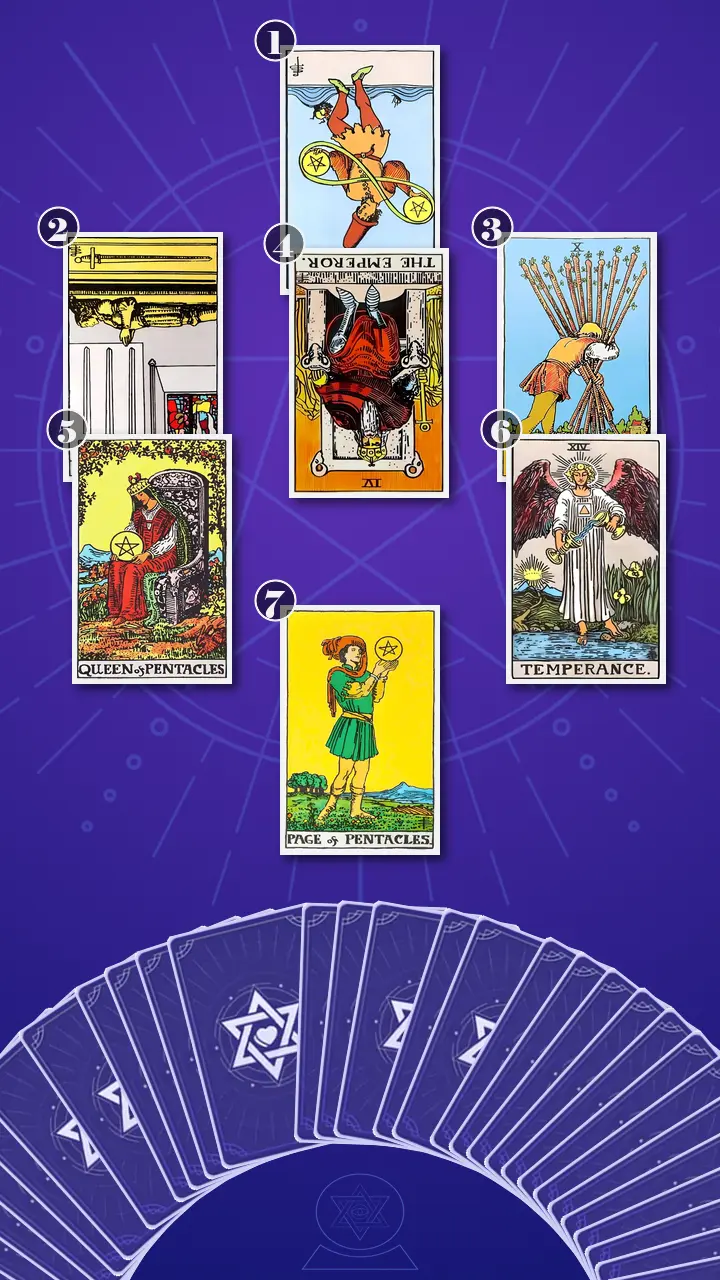
I chose my 7-card Energy Diagnostic Map · Context Edition, a tarot spread for overwhelm I use when a problem behaves like a system rather than a single bad choice. Her week was not one issue. It was sleep loss feeding money stress, money stress feeding avoidance, avoidance feeding dishes and texts, and all of it stealing the rest that might have helped.
A simple past-present-future line would have flattened that recursive pattern. So I placed card four at the center like one jammed intersection, set cards one through three above it as the pressure around the knot, and laid cards five through seven below it as the route out. I told Jordan, “The first card will show how the Friday pileup behaves on the surface. The center card will reveal what belief is charging the whole thing. And the sixth card is where I expect the real shift to appear.”
Reading the Jammed Intersection
Position 1: The Tabs That Never Close
I turned the first card. This position shows the visible Friday symptom cluster: what the backlog looks like in behavior across sleep, bills, dishes, and texts. The card was the Two of Pentacles, reversed.
I could see the modern scene immediately: Thursday at 9:14 PM, Jordan in socks on the kitchen tile, dish soap on one hand and her warm phone in the other, toggling from iMessage to her banking app to the sink, busy enough to dodge guilt but not long enough to actually pay, wash, or send. It had 23-open-tabs energy. Motion everywhere. Landing nowhere.
Reversed, this is not flexible balance. It is excess motion with blocked completion. The infinity loop around the coins becomes endless tab-switching: every task circles back because nothing gets fully landed. The inner monologue is almost mechanical: I’ll do that after this. Let me just check this first. I’m handling it. Why is nothing done?
Jordan gave a quick laugh with a bitter edge. “That’s so accurate it’s kind of rude.” Her fingers tapped once against her mug, then stopped.
I smiled. “Sometimes the first card just walks straight into the kitchen.”
Position 2: Sleep Mode That Never Sleeps
I turned the next card. This position reveals the inner tug between needing rest and feeling compelled to stay mentally on until everything is handled. The card was the Four of Swords, reversed.
Its modern face was painfully familiar: 12:06 AM, room dark except for the phone screen, body begging for sleep while the mind stays clocked in—one more transfer, one more reply, one more reminder check. Bedtime becomes a second shift. Revenge bedtime procrastination meets life admin guilt, and neither wins.
Here the energy is split in a very specific way: rest is deficient, but mental activity is in excess. The body lies down; the week does not. “Sleep is not the prize you get after catching up,” I said, because I wanted that truth to land without apology. “If rest only counts after perfection, then rest never gets a turn.”
Jordan pressed her lips together. I watched the line of her jaw soften only after a long second, as if the sentence had to push through a locked hinge.
Position 3: Carrying Every Grocery Bag at Once
I turned the third card. This position names the outside load that keeps the week overstuffed before self-maintenance can happen. The card was the Ten of Wands, upright.
I told her I did not want to insult her with time-management clichés. At 5:52 PM, leaving work with a tote cutting into her shoulder, a still-hot inbox in her head, groceries not bought, laundry not touched, a sink waiting at home, and texts owed to people she genuinely cares about, the basics are no longer separate tasks. They become one heavy bundle. It is the least glamorous version of trying to carry every grocery bag in one trip.
This is overloaded fire: real strain, not imagined failure. The load is genuinely heavy; it is simply being carried in one undifferentiated armful. That is why the next right move disappears. Not because she is incapable, but because her line of sight is blocked by the bundle itself.
When I said that, Jordan’s shoulders dropped a fraction for the first time. Relief often begins there—in being accurately measured.
Position 4: The Boss in Her Own Apartment
I slowed before turning the fourth card, because this position sits at the center of the spread. It uncovers the core blockage: the fear that falling behind means life is out of control and reflects badly on the self. The card was The Emperor, reversed.
I felt the familiar pinch of recognition. I grew up watching dry-stone walls hold against Highland wind. A wall that is too loose collapses, yes—but one stacked too rigidly cracks just as surely in winter. Support has to hold; it also has to flex. Whenever I meet The Emperor reversed, I think of that old lesson before I think of authority.
In Jordan’s life, this card looked like a strict catch-up night built in Google Calendar or Notes: dishes, bills, texts, reset. One interruption, one task taking longer than expected, and the plan stopped being a tool and became a verdict. It turned a weekly reset into a private performance review.
“When every task becomes moral, nothing feels small,” I said. “A messy sink stops being a normal midweek sink. It becomes evidence. A late bill stops being admin. It becomes a sentence.”
Jordan went very still. First her breath paused. Then her gaze slipped past the cards, as if she were replaying Friday night on the couch with Notes and Calendar open. Then came the release: a low, almost embarrassed “Oh.” Her hand pressed flat against her sternum.
“It stopped being a task and became a verdict,” she said quietly.
“Exactly,” I answered. “And nobody does good maintenance under trial conditions.”
Position 5: A Warm Lamp, Not a Spotlight
I turned the fifth card. This position identifies the underused resource that can make ordinary tasks feel supportive instead of accusatory. The card was the Queen of Pentacles, upright.
The whole temperature of the reading shifted. I described the scene that came with her: kettle on, a softer lamp instead of the overhead glare, one bill paid while seated, the counter wiped for two minutes, leftovers plated, phone face-down. Not spotless-apartment content. More Struggle Care. More making the night liveable.
This is balanced earth. The Queen does not ask Jordan to become impressive. She asks, what small act would make your space, body, or budget feel five percent safer tonight? That is a completely different question from how do I finally fix the whole week.
I watched Jordan exhale through her nose and uncurl her fingers from the edge of the chair. “Okay,” she said, almost to herself. “That actually feels possible.”
“Good,” I told her. “Because done enough is a form of care.”
When Temperance Poured Between Two Cups
Position 6: The Antidote Hidden in Pace
When I reached the sixth card, the room seemed to go quieter around us. Rain at the window, which had been needling the glass all session, settled into a steadier rhythm. This position holds the key transformation that turns frantic catch-up into sustainable pacing. The card was Temperance, upright.
By then Jordan was sitting inside a very specific fear: if she did less, wasn’t she just lowering the bar? If she stopped treating the whole evening like a rescue mission, didn’t that mean she was letting adulthood slide?
Stop treating balance as a prize you earn after the backlog disappears; Temperance asks you to pour your week one measured cup at a time.
I let the sentence rest between us.
Then Jordan frowned. “But if I only do one thing, doesn’t that mean I’m letting the rest go?”
“No,” I said. “It means you’re stopping the flood.”
“You are not bad at adulthood because the week stayed unfinished,” I added. “The pattern changes when you stop demanding a heroic reset and start giving each category one measured pour of attention.”
This is where my own way of reading enters. In the Highlands, you learn early that weather is information, not accusation. That is part of my Nature Empathy Technique, and part of how I teach intuition through natural signs: first read the pressure honestly, then respond to the pressure you actually have. Temperance is not passive. It is skilled regulation. It is the difference between reactive juggling and measured pouring, between living at one percent battery and budgeting your charge across the week.
“You do not need a heroic reset,” I told her, more softly now. “You need one closed loop. And then you need the discipline to stop.”
I asked her to try my simplest weather-reading question: “Before you open another app tonight, put both feet on the floor and notice which category tightens your body first—money, mess, messages, or sleep. That tightening is not a command. It’s a signal. Your system is already telling you which cup needs the next measured pour.”
Jordan’s face changed in stages. First there was the freeze—eyes fixed on the card, mouth slightly parted, breath held high in the chest. Then the thought moved through her; her focus went soft, like she was suddenly back in that too-bright kitchen, replaying all the nights she had tried to clear bills, dishes, texts, and sleep debt in one heroic sprint. Then came the release. Her shoulders slid down. Her palm left her chest. She let out a long breath that sounded half like relief and half like someone stepping off a treadmill that had been running under her feet for months.
I could also see the vulnerable part arrive right behind the relief—that odd, lightheaded moment that comes when clarity hands responsibility back to you. She blinked hard and gave a tiny, disbelieving laugh. “If I’d had that last Thursday,” she said, “I would’ve paid the hydro bill and gone to bed. I wouldn’t have made the whole stupid reset plan.”
“That’s the shift,” I said. “Not from mess to perfection. From frazzled guilt and self-surveillance to measured self-trust. From heroic reset thinking to paced follow-through.”
I pointed to the angel’s cups. “Within the next ten minutes after you get home on a hard night, choose one category only: sleep prep, one bill, one dish round, or one text. Set a seven-minute timer and finish just that loop. Then stop on purpose. If seven minutes makes your chest race, cut it to three. Temperance still counts.”
Then I asked, “Using this new lens, can you remember a moment last week when the right amount would have changed the whole tone of the night?”
Jordan nodded slowly. “Wednesday. If I’d written tomorrow’s first task on paper instead of trying to solve it in bed, I probably would’ve slept.”
Position 7: The Single Checkbox That Rebuilds Trust
I turned the final card. This position translates insight into one concrete, low-drama action for the coming week. The card was the Page of Pentacles, upright.
The Page never tries to fix everything at once. He studies one coin, one field, one next move. In Jordan’s world, that looked like one boring, repeatable anchor: Tuesday lunch equals pay the first due bill. After shower equals wash only cups and plates. 12:30 PM equals answer one text before opening Instagram. Duolingo streak energy, but for adulthood basics.
This is grounded earth in balance. One task, one habit, one visible proof. Not optimization. Not a new personality. Just a single checkbox her tired brain can still win, which is exactly how self-trust grows back.
Jordan looked at the Page and smiled properly for the first time. “That I can do,” she said.
From Heroic Reset to One-Loop Evenings
Once all seven cards were on the table, the story was clean. The visible weekday backlog was real: too many open loops, too much guilt-based task switching, too little rest. The outside load was genuinely heavy. But the knot at the center was not dishes or bills or unread texts. It was the harsh inner manager that treated every unattended task as equal proof of failure.
That was the blind spot. Jordan had been triaging by guilt, not by need. She was managing herself like a boss she would hate to work for. The direction of change was clear: protect sleep, stop moralizing the basics, choose one concrete next action, and let the rest wait without turning that wait into self-accusation.
Jordan gave me one more honest objection. “But by 9:30, I’m usually done. Like, genuinely done.”
“Then we work with the real body, not the imaginary one,” I said. “A two-minute version still counts. That’s not cheating. That’s regulation.”
These were the actions I gave her for the next seven days:
- One-Loop EveningTonight, make one drink you actually like, sit down at the table or counter, and do exactly one practical care task before you stand up again: pay one bill, clear only the cups and plates, or send one real reply.If momentum starts trying to turn into a reset marathon, stop there on purpose. Done enough is a form of care.
- 3-Minute Bedtime Energy ReviewFor one week, make the last fifteen minutes before sleep a no-admin zone. Then spend three minutes with paper, not your phone: write which category was loudest today—money, mess, messages, or sleep—and write tomorrow’s first tiny task.No paying, replying, or planning from bed. If fifteen minutes feels too ambitious, begin with five and keep it boring.
- Sound-Cue Page AnchorOn one walk or commute home, use a short walking meditation with the environmental sounds already around you—the streetcar bell, a crosswalk beep, the lobby door click. By the third sound, choose tonight’s single measured pour. Then place one repeatable anchor in the tool you already obey: Tuesday lunch = pay hydro; after shower = wash cups and plates; 12:30 PM = answer one text before social media.Track it with one check mark only. The goal is not a better system you abandon on Friday; it is one visible proof your real week can hold.
None of this promised a perfect apartment, a silent inbox, or a magically organized life. That is not what tarot is for when I use it well. It does not hand someone a fantasy version of themselves. It shows the mechanism, then hands the steering wheel back.

A Week Later: The Quiet Proof
A week later, Jordan sent me a message at 7:18 PM. “Paid hydro on Tuesday lunch. Did cups and plates twice after my shower. Put my phone down before sleep on Thursday. Still have two unread texts, but they don’t feel like a character flaw tonight.”
I read that and smiled, because that is how finding clarity usually looks in real life. Not a cinematic reset. A quieter kitchen. A smaller chest-tightening. One adult task done before the night turns punitive.
The morning after her first full night of sleep, she told me the old thought still showed up—what if I fall behind again?—but this time she laughed, put the kettle on, and answered one text before opening anything else.
That is the whole journey, as I see it: from frazzled guilt and self-surveillance to measured self-trust and steadier calm. Not because the cards fixed her life, but because they helped her stop mistaking backlog for identity.
It is exactly why I reach for this 7-card Energy Diagnostic Map · Context Edition tarot spread when someone tells me they are behind on everything by Friday: it turns a pile of shame into a route you can actually walk.
If tonight you find yourself in that same too-bright kitchen with a warm phone in your hand, feeling the private shame of being behind on ordinary things, please remember this: noticing the pattern is already a change in the pattern.
So when the week starts shouting in four directions again, what is the one tiny loop you would actually choose to close first—and which cup are you willing to let wait until tomorrow?
Every reading at AceTarot is a Journey to connect with inner wisdom and empower next step.
Learn more about our Journey to Clarity.