A Laundry Chair, Three Unread Texts, Then a Daily Floor That Held

The 9:40 p.m. Kitchen and the Shame-Heavy Backlog
If you are a late-20s city worker who can run a project timeline at 2 p.m. but freeze at one laundry basket and three unread texts at 9:40 p.m., this is life-admin burnout, not laziness.
That was the thought I had when Maya (name changed for privacy) sat down across from me and said, with a tired half-laugh, “Inbox, laundry, takeout, unread texts—what’s actually wearing me down?” She was 29, living in Toronto, working as a project coordinator at a hybrid creative agency—the kind of job where Slack, Gmail, and calendar invites can start tugging at you before coffee. She could hold a client timeline together all afternoon, but most weeknights ended in the same small-apartment knot.
I could almost see Tuesday at 9:40 p.m. as she described it: the too-bright overhead light in her kitchen, Uber Eats open on her phone, Gmail half-refreshed, a chair buried in clean laundry, three texts left unread because she wanted to answer “properly.” The fridge hummed. Blue phone light hit the counter. Her shoulders climbed toward her ears, her jaw set, and the whole apartment seemed to turn into one giant push notification.
“Nothing is catastrophic,” she told me. “Everything just feels slightly overdue.” The sensation in her body, she said, was like carrying every open browser tab in her chest from room to room. That was the real contradiction: she wanted to keep up with the basics—messages, meals, clothes, email—but the pileup of unfinished basics kept turning into proof that she was somehow failing at basic adulthood.
I told her, gently, “You’re not weak, and you’re not secretly bad at life. You’re worn down. There’s a difference. Let’s make a map of this—that’s our journey to clarity tonight.”

Choosing the Map: A Five-Card Cross for Everyday Overwhelm
I asked her to put both feet on the floor, take one slow breath, and hold the question in plain language. Then I shuffled. I always do that slowly on purpose—not as mystical theater, but as a way of helping the nervous system step out of the doom-scroll loop and into focus.
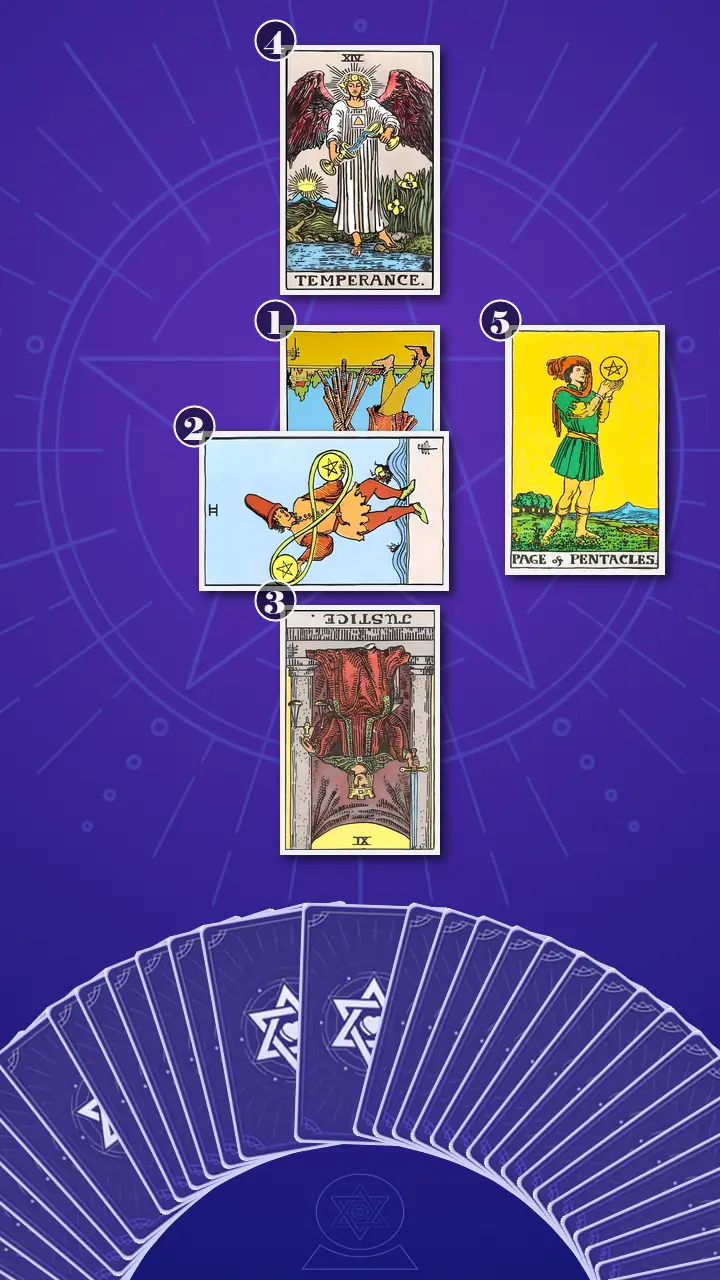
For a question like this, I use the Five-Card Cross · Context Edition. It’s a five-card diagnostic reading, not a fortune-style prediction. When someone asks me why unread texts guilt, inbox overload, laundry, and takeout decisions feel so heavy, I do not need a dramatic prophecy. I need a clear map of visible strain, immediate friction, deeper cause, remedy, and actionable next steps.
I laid the cards in a cross. The center would show what was most visible right now. The crossing card would show what kept the backlog active. The card below would reveal the hidden emotional drain beneath the mess. The card above would point to the regulating quality that could restore balance. The card to the right would show what grounded integration looked like if she stopped chasing a total reset. That’s how tarot works best for everyday overwhelm: card meanings in context, not vague slogans.
Reading the Knot at the Center
The Carrier Who Can’t See the Next Step
Now I turned over the card that shows the visible symptom cluster from her diagnosis: the accumulating backlog of inbox, laundry, food decisions, and messages. Ten of Wands, reversed.
This looked exactly like Maya opening her laptop after dinner to clear one email, then noticing the laundry chair, the delivery app, the unread texts, and the half-planned grocery situation—until her whole evening collapsed into one heavy blob before she started anything. The energy here was blocked fire: effort still existed, but capacity had tipped into depletion. The bundled wands press against the figure’s chest and block the road ahead. In modern life, it’s The Bear ticket-printer anxiety, except the tickets are dishes, promo emails, text threads, and clean socks.
When I said that, Maya gave a short laugh that turned bitter on the way out. “Okay,” she said, “that’s accurate to the point of being rude.” Her thumb kept rubbing the seam of her paper cup. I told her this card was not calling her incapable. It was showing how four ordinary basics had fused into one shame-heavy backlog. The first question was not “How do I do everything?” It was “What burden can I set down this week?”
Busy, but Not Relieved
Next I turned over the card representing the immediate friction that kept the backlog active: unstable juggling, task-switching, and decision fatigue. Two of Pentacles, reversed.
This was the hour where Maya bounced from Slack to email, then to Uber Eats, then to text previews, then started a wash cycle without folding the clean one first, then checked Instagram, then reopened email. She ended the night saying she had been “doing stuff” without actually feeling lighter. The energy here was unstable earth—too many moving parts, no reliable container. The infinity ribbon around the pentacles had become auto-refresh on every tab.
“Busy is not the same as relieved,” I said. That landed. She nodded slowly and looked down at the crossed cards. This card was showing her that motion was not the same thing as closure. Relief would not come from spinning the plates faster. It would come from reducing how many plates were spinning at once.
The Courtroom Hidden Inside a Sink
Then I turned over the card below the center, the one that reveals the hidden drain beneath the visible mess: the core fear and self-judgment making ordinary tasks heavier than they are. Justice, reversed.
Here the reading stopped being about chores and started being about meaning. This card looked like Maya seeing three unread texts, dishes in the sink, or another takeout receipt and instantly turning admin into identity. Not “three emails are pending,” but “normal adults would’ve handled this already.” The energy was distorted air—thought turned into self-cross-examination rather than clean discernment.
The sword and scales sent my mind, for a second, back to the planetarium before calibration. If the projector axis is off by even a fraction, a perfectly good constellation looks wrong on the dome. Not a broken sky—a tilted instrument. Justice reversed feels like that. A scheduling issue walks into the room, and the inner court enters it into evidence.
“What if the thing draining you,” I asked her, “is not only the task list, but the courtroom you drag it into?”
She went still in three clear beats: first her inhale paused; then her gaze slipped past me to the rain-dark window as if she were replaying those condo-elevator rides home; then her shoulders tipped forward with a slow nod. “Yes,” she said quietly. “It’s never just the task. It’s what the task says about me.” Tiny tasks feel huge when your brain stores them as verdicts. That was the real choke point in the spread.
When Temperance Poured Between Two Cups
The Medicine Above the Noise
When I turned over the fourth card, the atmosphere changed. The city rain against the glass softened into a hush, and somewhere behind me the kettle clicked off like a period at the end of a sentence. This was the card that highlights the regulating quality that can loosen the limiting pattern and reorient daily life toward balance. Temperance, upright.
I showed her the angel with one foot in water and one on land, water moving steadily between two cups. This is not the energy of a heroic reset, I said. This is the move from courtroom language to kitchen language—from evidence and verdicts to portions, sequence, pace, and enough for tonight. The pile is real, but the private trial happening around it is what has been making it unbearable.
Because I spend so much of my life talking about celestial mechanics, I sometimes explain attention with a lens I call Black Hole Focus. When emotional density gets high enough, everything near it bends inward. One text, one sink, one email thread, one delivery receipt—suddenly they all cross the same mental event horizon and look equally catastrophic. Temperance does the opposite. It widens the orbit. It restores proportion, so one unread text becomes one unread text again, not proof that your whole life is slipping.
You know that late-night kitchen moment where Uber Eats is open, the laundry is still on the chair, the unread texts are glaring, and your body reacts like all of it is one giant problem instead of four small unfinished basics.
This backlog is not proof that you are failing; let Temperance replace the all-or-nothing purge with one steady pour between cups.
I let the sentence stay in the room. Maya did not relax immediately. First her breath caught halfway in, as if her body had been bracing for another verdict and missed it. Then her eyes unfocused for a second, the way people look when memory is replaying three different weeknights at once. Then came a flash of resistance—sharp, brief, honest. “But then what?” she said, voice tightening. “Have I just been making this harder on myself?”
“No,” I said. “You’ve been meeting ordinary life in extremes. That’s different from being the problem.”
Her jaw loosened. One shoulder dropped, then the other. She set her phone face-down on the table like it had finally stopped testifying against her. A small, embarrassed laugh came out, watery at the edges. I asked her, “Now, with this new lens, think back to last week. Was there a moment when this would’ve changed how your body felt?” She sat with it. “Wednesday,” she said at last. “If I’d just eaten something simple, answered one person, moved one load, and stopped... the whole night would’ve felt less prosecutorial.” That was the crossing point: not from messy to perfect, but from frazzled depletion and self-judging backlog toward a calmer internal dashboard where tasks could be sorted neutrally instead of personalized.
The Apprentice of One Real Thing
Finally, I turned to the card on the right, the one that translates insight into grounded next steps when the guidance is applied. Page of Pentacles, upright.
This looked like Maya choosing one 15-minute life-admin ritual—same place, similar time, one concrete category—and treating it as practice rather than proof. The energy here was balanced earth: steady, teachable, specific. The page does not redeem the whole week. The page holds one pentacle at eye level and learns self-trust by tending one real thing at a time.
I told her this was the apprentice card. Think less makeover, more Duolingo streak for life admin: one reply block, one laundry load, one simple grocery list. “Can I repeat this?” matters more here than “Does this redeem me?” She smiled for the first time without irony and tucked one leg under herself, which told me more than words could have. Her nervous system had finally left the courtroom.
From Courtroom to Kitchen: A Minimum Viable Rhythm
When I stepped back, the story of the spread was clean. Ten of Wands reversed showed the fused burden. Two of Pentacles reversed showed the task-switching tax that kept the burden active. Justice reversed showed the inner judge turning logistics into character evidence. Temperance answered with proportion, and the Page of Pentacles grounded that answer in one repeatable habit. This is exactly why I trust the Five-Card Cross · Context Edition tarot spread for life-admin exhaustion: it separates the pile itself from the extra meaning wrapped around the pile.
Maya’s blind spot was not a lack of discipline. It was the belief that small actions did not count unless they led to a full reset. That is how weekend reset fantasy keeps winning. Her transformation direction was clear: stop treating unfinished basics as proof of failure, choose a minimum viable rhythm, and let neutral prioritizing rebuild self-respect.
I gave her three practical next steps. I wanted them small enough to survive a tired Wednesday, not polished enough for a Sunday Notion template.
- Create a Planetary Memory Palace Daily FloorOpen one phone note tomorrow and divide it into three simple orbits: Admin, Home, and People. Put only one item in each orbit—like “reply to Sam,” “start washer,” and “put containers in recycling.” Fill it in on Monday, Wednesday, and Sunday nights in under 7 minutes so tomorrow already has a floor.If you’re fried after work, let the Home orbit be tiny. The floor is support, not a test.
- Practice “Pending Is Not Personal”For one week, write one pending task in neutral language before acting on it: “archive promo emails,” “fold towels,” “reply to Eli.” Underneath it, add one sentence: “This is a task status, not a personality trait.”If the wording makes you roll your eyes, that’s fine. It only has to interrupt the automatic verdict.
- Set a 15-Minute Grounding BlockChoose one real slot this week—say 8:15 p.m. at the kitchen table with headphones on—and give each day one category only: Monday email, Wednesday laundry, Thursday two text replies, Sunday simple groceries. When the timer ends, stop on purpose and use my Shooting Star Notes method for 30 seconds to capture the next tiny step.Do not let momentum turn into punishment. Eight minutes still counts. Repetition is the win.
I told her, “You do not need a reset weekend. You need a floor.” Then I gave her the phrase I wanted sitting on her lock screen: “Pending is not personal.”

A Week Later, the Room Felt 10 Percent Quieter
Six days later, I got a text from Maya. “I did the Admin/Home/People note,” she wrote. “Sent one ‘thinking of you, fuller reply tomorrow’ message. Archived promo emails. Folded towels. Did not become a new person, but my kitchen isn’t yelling at me tonight.”
That was exactly the kind of finding clarity I hope tarot can offer. Not a perfect life. Not productivity cosplay. Just a cleaner relationship to ordinary reality. One real rhythm beats one dramatic comeback.
She told me later that the next morning she woke with the old thought—what if I fall behind again?—and then smiled, opened her Daily Floor note, and got on with breakfast.
When every unread text, takeout receipt, and chair full of laundry lands in your body like proof you are slipping, it is easy to forget you were overwhelmed before you were ever “bad at life.”
If tonight you stopped waiting to feel fully caught up, what would your own smallest repeatable version of one steady pour between cups—your quiet “I looked after today”—actually look like?