Side DM Guilt After Friend Group Fallout: Toward One Honest Boundary

When Side DMs Start Feeling Like Proof
If you are in that post-uni, early-career London phase and a friend leaving the WhatsApp group has turned every side DM into a loyalty test, I know exactly why this reading hurts.
When Sophie (name changed for privacy) sat across from me, she did not begin with a dramatic speech. She gave me a commute. Tuesday, 8:47 p.m., Victoria line heading south: muted WhatsApp group at the top of the screen, one new reaction in the main thread, then a side DM opened with a half-typed “hey, sorry, just seeing this” that got deleted before the train reached the next stop. She told me the carriage smelled faintly metallic, the fluorescent strip light hummed overhead, and her phone felt hot in her palm. If I answer here, I betray there. If I answer there, I betray here.
Then she said the line that told me the whole shape of the problem: “I feel fake no matter which chat I answer first.” I watched her shoulders inch upward as she said it, as if the sentence itself had weight. Her guilt had the exact body of someone standing between Tube doors already beeping, unable to choose a platform before both start to feel wrong.
I told her, gently, that this was not silly, and it was not just overthinking texts. This was a real group chat loyalty bind, the kind that can make a normal reply feel politically loaded. “Let’s not try to win the case tonight,” I said. “Let’s make a map. Our whole journey today is toward clarity.”

Choosing the Social Weather Map
I asked Sophie to put her phone face-down, plant both feet on the floor, and take one slow breath before I shuffled. I have never cared for ritual as theatre. I care for it as a way of moving a person from notification-speed into thought.
For her, I chose my seven-position spread called Energy Diagnostic Map · Context Edition. When people ask me how tarot works in friend group fallout, this is the practical answer: I use a structure that separates the visible symptom from the hidden rule underneath it. A classic relationship spread can over-focus one friendship. Sophie’s pain was triangular — herself, the friend who left, and the group that remained — so the map had to be wide enough to hold all three.
I laid card four at the center as the psychological hub. Card one would show the surface symptom: the toggling, drafting, deleting, and freezing. Cards two and three would reveal the inner split and the outer social pressure. Card four would name the belief keeping the loop alive. Then cards five and six would show the resource and the shift, with card seven giving one grounded next step she could actually try this week.
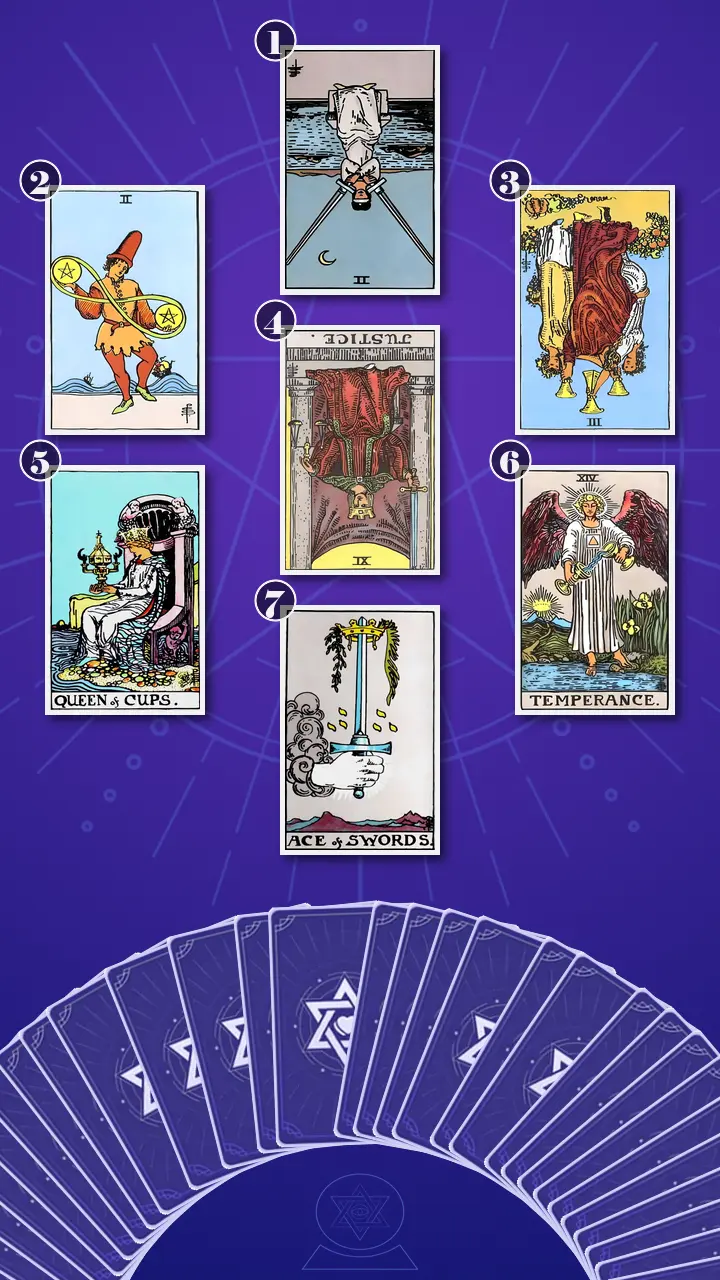
Reading the Map of Friendship Screenshot Anxiety
The Blindfold on the Tube — Two of Swords Reversed
I turned the first card and told her, “This position presents the visible symptom from the diagnosis: the toggling, drafting, deleting, and freezing between the group chat and side DM.” The card was Two of Swords, reversed.
It could hardly have been more exact. In modern life, this is the after-work commute where the muted WhatsApp group and the side DM are open in separate windows, the first line gets rewritten three times, the heart emoji is removed, the last ten messages are reread, and you still get off at your stop having sent nothing. The energy here is blocked and overloaded at once. The blindfold is not ignorance; it is over-monitoring. She is staring at the screen constantly, yet the real signal is lost under too many imagined outcomes. It is like having nineteen tabs open and none of them answering the actual question.
I told her something I often need to say early in readings like this: neutral is not always honest. Delay has already begun making choices on her behalf.
Sophie gave a short laugh with a sting in it. “That’s horribly accurate,” she said. “Almost rude.” Her fingers tapped once against the rim of her mug and then went still.
Two Selves in Two Tabs — Two of Pentacles Upright
The second card spoke to the inner contradiction: the attempt to keep both friendships stable at once and the felt split between two loyalties. It was Two of Pentacles, upright.
This is the card of juggling, but not in the breezy, capable way people sometimes imagine. In Sophie’s world it looked like keeping one version of herself active in the group so she did not appear absent, while warming up another version in the private DM so she did not appear abandoning. I said it felt a bit like Severance for group chats — one self in the main thread, another in the side DM — except both selves are exhausted and neither gets to rest. The energy here is excess adaptation: too much real-time tone adjustment, not enough loyalty to her own values.
She looked down at the card and nodded without speaking. That quiet nod told me she knew exactly how much unpaid conflict admin she had been doing inside her own body.
When the Group Vibe Turns Political — Three of Cups Reversed
The third position shows the external social pressure: the fractured friend-group atmosphere that makes every message feel charged. Here I found Three of Cups, reversed.
I told her this card is what happens when Friday drinks, birthday plans, Story views, likes, and silences stop feeling casual and start feeling like alliance markers. The cheerful circle of friends in the traditional image loses formation. In modern terms, the group chat still exists on-screen, but it no longer feels emotionally unified. The energy here is a depletion of trust in the environment itself. Sophie was not imagining the social temperature shift; she was living in it. It had the energy of a low-key Love Island recoupling played out through reactions and side DMs instead of around a fire pit.
I watched her shoulders drop a fraction. That mattered. Sometimes the first kindness in a reading is simply to confirm that the weather really has changed.
The Inner Loyalty Court — Justice Reversed
Then I reached the center of the spread. “This position exposes the core mechanism,” I said, “the self-judging belief that one imperfect response could prove you are a bad friend or that you do not belong.” The card was Justice, reversed.
This was the real engine of the suffering. Before she replied, she was mentally running both chats through an invisible rubric: was that emoji too warm, was this sentence too distancing, would this look bad in a screenshot, does answering here first mean I chose a side? The energy here is distortion. Fairness has tilted into self-prosecution. The task of being honest disappears under the task of getting acquitted.
This is where I naturally reached for one of my own lenses, what I call Ancient Reflection. I have spent enough years on archaeological digs to know that one broken shard never gets to explain an entire civilization. As I looked at Justice reversed, I had a flash of a trench in Cyprus and a fragment of red pottery in my palm. We never asked one shard to carry the whole history of the site. I told Sophie, “One WhatsApp reply is a shard, not a verdict on your character. The side DM is not the whole problem. The private trial is.” Then I added the line she most needed: “You are not a human screenshot-prevention system.”
She went very quiet. Her jaw unclenched before she even spoke. When I asked her what she feared people would conclude if she sent the ‘wrong’ message tonight, she answered at once: “That I’m two-faced.” Naming it changed the room. Shame became pattern, and pattern is always easier to work with than fog.
The Lidded Cup — Queen of Cups Upright
From there I moved to the supportive quality already available in her. The fifth card was Queen of Cups, upright.
I was glad to see her. This card says Sophie’s empathy is not the problem. In real life, it looks like being able to say, “I care about both of you,” without volunteering to interpret, relay, or absorb everybody’s feelings. The closed cup in the image is crucial. It is not emotional coldness; it is emotional privacy. The energy here is balanced receptivity. I told her, “Care is not the same as carrying the whole group. This card is like putting a chat on mute without putting your heart on mute.”
At that, her breath lengthened. “That sounds nice,” she said, almost with surprise, as if the idea of staying kind without becoming the unofficial messenger had not quite seemed available before.
When Temperance Poured Between Two Cups — Temperance Upright
When I turned the sixth card, the room itself seemed to settle. The rain at the window thinned to a softer ticking. “This position names the key transformation,” I said, “the shift from proving perfect fairness to acting from integrated values and measured truth.” The card was Temperance, upright.
In modern life, this is not about deciding which chat deserves more loyalty. It is about one coherent tone across channels — not two fake versions of you, but one steady voice that can exist in more than one place. Because I often work with Mythic Archetypes, I read Temperance as the old alchemist: not a saint choosing one pure element over another, but a skilled pair of hands finding the ratio that lets opposites live together. Here the two liquids are care and clarity. Sophie did not need perfect neutrality. She needed integration.
Picture that Tuesday Tube ride: the group chat muted but still glowing at the top, the side DM open, your thumbs hovering, your phone warm, your shoulders up near your ears, trying to write one message that proves you are still a good friend to everyone.
Stop treating every text like a courtroom verdict; like Temperance pouring between two cups, mix honesty with care and let that balanced response be enough.
In other words, the healthiest reply is not the one that looks equally loyal from every angle; it is the one that sounds like you, stays kind, and does not ask you to abandon your own boundary.
She went through the reaction in three clear waves. First came the physical freeze: breath caught, fingers suspended halfway to her mug. Then came the cognitive seep: her eyes lost focus for a moment, as if she were replaying a dozen unsent drafts in fast motion. Then came the emotional release, though not in a neat form. “But then one of them could still be upset,” she said, and there was a flash of anger in it. “So what was all that carefulness even for?” It was grief, really — grief for the energy spent trying to satisfy a standard nobody had actually offered her except herself. I kept my voice calm. “Yes,” I said. “Someone may still be disappointed. But disappointment is not proof that you have betrayed anyone.” I saw the muscles around her mouth loosen. Her shoulders dropped with that slightly strange, light-headed feeling people get after setting down a heavy rucksack they had forgotten they were carrying. Then I asked, “Now, with this new lens, think back to last week. Was there a moment when one simpler, more honest sentence would have changed how you felt?” She let out a long breath. “Tuesday,” she said. “I could have just said I cared, and that I didn’t want to be in the middle.”
That was the true crossing in the reading: not from confusion to perfect certainty, but from private trial to self-trust — from guilt-tightness and friendship screenshot anxiety toward the first steadier calm.
The Clean Sentence — Ace of Swords Upright
The final card grounded everything in action. “This position points to the practical next step,” I told her, “one clear, value-aligned communication experiment you can try this week.” The card was Ace of Swords, upright.
This card always feels like the version with track changes removed. In Sophie’s life, it looked like one sentence she could stand behind even if it were forwarded anywhere: “I care about you, and I don’t want to be in the middle of messages between chats.” The energy here is clean, decisive clarity. Not harshness. Not a manifesto. Just one honest line cutting upward through fog. A clean sentence can be kinder than a perfectly balanced paragraph.
She nodded in that unmistakable way people do when they can hear their own voice returning to them.
From the Inner Court to One Honest Text
When I stepped back from the whole spread, the pattern was beautifully stark. The reading opened with the double-two trap: first suspended decision, then frantic balancing. Above the center sat the fractured social weather of the group itself, the real external tension she had been reading through every reaction and silence. But the psychological hub was Justice reversed: the hidden rule that said she must manage everyone’s feelings perfectly or risk losing belonging. Underneath that, the Queen of Cups and Temperance created the recovery arc. Feel deeply. Contain wisely. Respond consistently. Then the Ace of Swords gave the exit.
Her cognitive blind spot was subtle and brutal: she had started treating other people’s disappointment as if it were evidence of her wrongdoing. That is why she kept performing fairness instead of telling the truth. The transformation direction was simple, though not always easy: move from proving perfect fairness to everyone toward stating one honest boundary and letting that be enough.
I gave her three low-friction ways to bring the reading off the table and into the chat window. Care is not the same as carrying the whole group.
- The Same-Core-Truth TestOpen Notes before opening either chat. Write one sentence under 25 words that you could stand behind if it were forwarded to the main thread or the side DM. I call this an Inscription Affirmation: draft it as if it were being carved into clay, not sprayed out in a panic.Set a 3-minute timer and stop editing when it ends. The goal is one honest, measured response you can live with — not a legally perfect text.
- The Boundary-First ReplyFor the next message this week, use exactly two sentences. Sentence one names care. Sentence two names boundary. Example: I care about you and I can see this is hard. I do not want to be in the middle or pass messages between chats.If sending feels too big, write it only, then come back after a walk or shower. The first honest reply may feel awkward before it feels relieving.
- Celestial Tracking, Not Social WeatherMute the group chat for one full commute. When you check it at home, split a phone note into two headings: What I feel and What is mine to handle. Add one observable fact and one story you are telling yourself before you reply.Navigate by fixed stars — kindness, honesty, no triangulation — not by every reaction, Story view, or silence.

A Week Later, the Quiet Proof
A week later, Sophie messaged me during her lunch break. She had used the two-sentence format. She had also muted the group for the journey home instead of checking every vibration through her coat pocket. The text did not solve the entire friend group. It did something smaller and far more valuable: it stopped splitting her in two.
She told me she sent it, then sat alone with a takeaway coffee on a bench near St Paul’s, phone face-down beside her for fifteen minutes. She still felt shaky. She also felt space in her chest again. That was enough proof for a first week.
That is what I trust most about tarot at its best. It does not hand out immaculate certainty. It offers orientation. This Energy Diagnostic Map · Context Edition gave Sophie a practical map out of reply paralysis in a fractured friend group and toward something steadier: a values-based response, one honest boundary, and the beginning of self-trust.
There is a very specific kind of loneliness in staring at two chats with your shoulders up by your ears, knowing that whichever one you answer first might get read as who you really are. If that is where you are tonight, I want you to know that seeing the private trial for what it is means you are already no longer fully inside it.
So the next time the muted group chat jumps to the top and the side DM lands right after it, what simple boundary — your own small Temperance pour between care and clarity — might feel honest enough to send?