When LinkedIn Becomes a Scoreboard After a Layoff—And the Routine That Grounds You

The Sunday Scaries and the Blue-Light Scoreboard
If Sunday Scaries now come with an empty calendar and a LinkedIn feed full of “Excited to share…” posts, you’re not alone.
Jordan—29, Toronto, marketing-ops brain that used to run on deadlines like espresso—sat across from me in my café with her phone face-down like it might bite. Outside, the street was damp with late-winter slush. Inside, the radiator clicked, the milk steamer sighed, and the city glow leaked through the front window like someone forgot to turn the dimmer off.
She told me about Sunday at 9:21 p.m. in her condo: Netflix half-playing, the phone screen being the real show. Feed. Jobs. “Who viewed your profile.” The blue light sharp enough to feel like it had edges. And that specific body thing: jaw locked, fingers restless, chest tight when nothing new appeared.
“I’m not even applying,” she said, and the words came out flat—like she’d already used up the dramatic version of them in her head. “I’m just watching my life happen on a screen.”
I watched her thumb hover in the air, not touching anything, but still doing the same micro-motion it does when it’s about to refresh. That tiny reflex can look calm from the outside. From the inside, it’s a storm siren.
Jordan kept going. “I keep rewriting my headline like it’s going to unlock confidence. And I know it’s ridiculous. But when the inbox is quiet—when there’s no recruiter message, no ‘we’d love to chat’—my chest goes tight and I open LinkedIn anyway. Like… I’m chasing reassurance, not information.”
The anxiety wasn’t a vague cloud around her—it was a motor under her skin, buzzing in her hands and clenching her jaw as if her body could physically hold her employability in place.
“Okay,” I said gently. “We’re not going to shame your nervous system for trying to survive a layoff. We’re going to get you something better than a refresh: a clear next step you can repeat. Let’s make a map through the fog—your journey to clarity.”

Choosing the Compass: The Celtic Cross · Context Edition
I didn’t make it mystical. I made it practical—like resetting a kitchen station before a rush.
“Two breaths,” I told her. “Not to ‘manifest’ anything—just to bring your body back into the room.” I set down a small demitasse of espresso for her, mostly because warm hands help people come back from cold spirals. Then I shuffled slowly, the way I’ve done between cappuccinos for years: steady, rhythmic, human.
“For this question—Why do I keep refreshing LinkedIn after layoffs, and what’s my next step?—I’m using the Celtic Cross · Context Edition.”
For readers who wonder how tarot works in a moment like this: I use it like a structured conversation with your patterns. This spread is perfect for a career crossroads because it doesn’t just describe what you feel—it traces the chain from the present behavior (refreshing) to the deeper root (scarcity and belonging), then points to near-term, actionable advice. It’s ethical, too: the “outcome” is framed as integration and empowerment, not a fixed prediction.
I previewed the map for Jordan—simple and clear. “The center card will show your current loop—what you’re doing on autopilot. The crossing card shows what keeps pulling you back in. There’s a root card underneath—what your system is trying to protect. And there’s a ‘next-step focus’ card that’s basically your next 7–14 days.”
She nodded once, small. Like she didn’t want to hope too loudly.
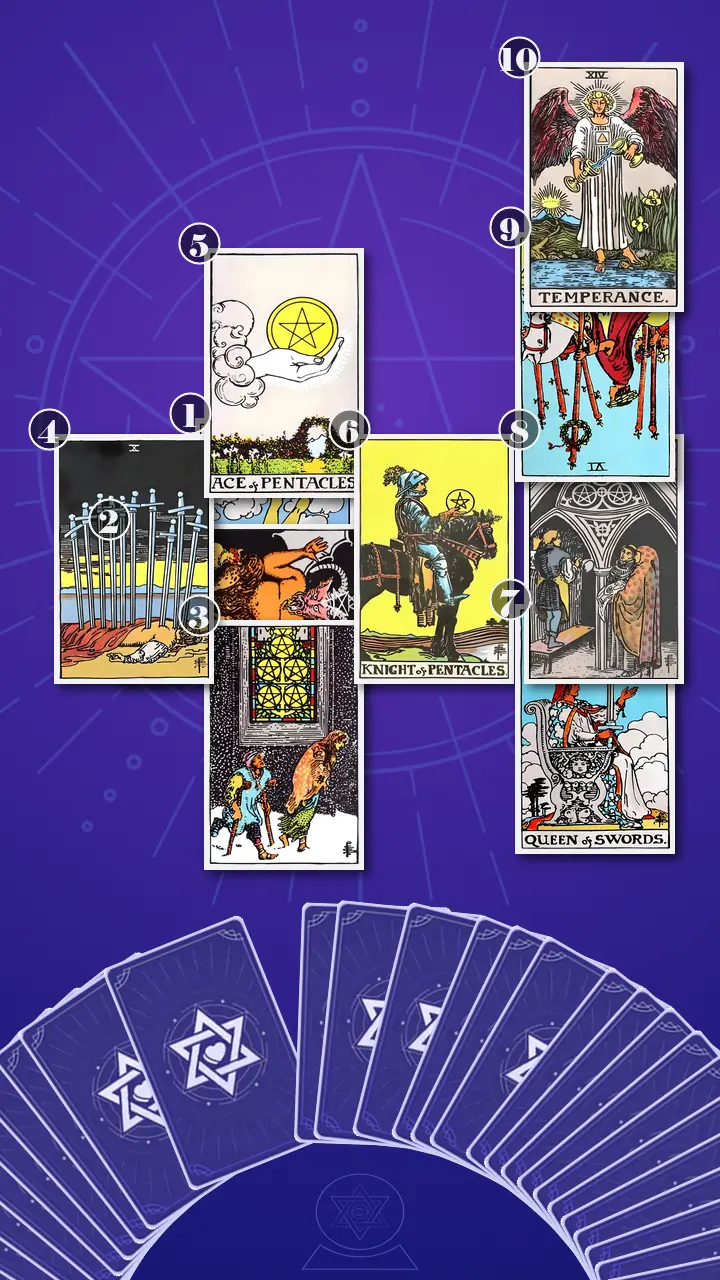
Reading the Map: Card Meanings in Context (When You’re Feeling Stuck)
Position 1: Current loop in the body and behavior
“Now we’re looking at the card that represents your current loop in your body and behavior—what you’re doing right now that keeps you stuck.”
The Page of Swords, reversed.
I didn’t even need to reach for a poetic translation. This card has a modern one built into it: 18 tabs open and calling it ‘research’ while your brain overheats. The raised sword becomes reactive scanning—mind on alert, always checking for threats and signals.
“This is that moment you described,” I told her, “where refreshing feels like you’re being strategic. But it’s really your nervous system trying to reestablish control.”
In energy terms, this is Air overload and blockage: thinking becomes jittery vigilance. The brain mistakes more information for more certainty—and it never gets satisfied.
Jordan let out a quick laugh that had no joy in it. “That’s… too accurate. Like, rude.” Her mouth smiled for half a second; her eyes didn’t. Then her fingers went back to picking at her sleeve seam. Recognition can be a relief and a sting at the same time.
Position 2: Immediate obstacle (the compulsive hook)
“Now we’re looking at the card that represents the immediate obstacle—what reinforces the loop even when you know it’s draining.”
The Devil, upright.
“Okay,” I said softly, because this card gets misused. “This isn’t ‘you’re bad’ or ‘you’re weak.’ This is a system.”
The Devil in real life is negotiated captivity: I can stop anytime—right after I check one more thing. It’s LinkedIn as a slot machine with professional fonts. Sometimes you get the hit—a profile view, a message, a new posting that feels like hope. Your body learns the loop faster than your logic.
In energy terms, it’s excess and attachment. A chain that promises relief from uncertainty—and quietly charges you in fatigue, stalled momentum, and a shrinking sense of choice.
Jordan winced, then nodded, then covered it with a little shrug. “I keep telling myself I’m being proactive. But it’s like… bargaining. If I watch closely enough, I won’t get blindsided again.”
“Exactly,” I said. “And the Devil loves that deal—because the deal keeps you clicking instead of closing one ‘ticket’ in real life.”
Position 3: Root driver (scarcity and belonging)
“Now we’re looking at the card that represents the root driver underneath the behavior—the need your system is trying to manage.”
Five of Pentacles, upright.
I glanced at the image: the cold street, bowed heads, and that glowing stained-glass window—warmth so close you can see it, but you feel locked out of it.
“This is the real engine,” I told her. “Not vanity. Scarcity.”
The modern version is painfully Toronto: rent auto-pay alert hits, you open your banking app, your chest tightens, and you immediately open LinkedIn to self-soothe with the idea that something could happen. Or it’s a group chat where someone asks “Any updates?” in the sweetest way, and it still lands like a spotlight.
In energy terms, Five of Pentacles is deficiency—security and belonging feeling thin. When the nervous system feels “outside,” it will grab for anything that resembles a warm window, even if it’s just visibility metrics.
Jordan’s eyes got shiny fast, like her body had been holding this behind glass. “I keep thinking… if I’m not being contacted, I’m on the outside now.” Her voice dipped. “And I hate that I think that.”
“Don’t hate it,” I said. “Name it. Scarcity is the fuel here, not your identity.”
Position 4: Recent past imprint (the ending event)
“Now we’re looking at the card that represents what just happened—the imprint that shaped your nervous system into scanning and bracing.”
Ten of Swords, upright.
There’s a bluntness to this card I respect. A hard ending. No soft-focus. But also—if you look—the horizon shifts from dark to dawn.
“This validates the shock,” I said. “Your brain is still replaying the meeting, the email, the final sentence. And because it felt sudden, your mind started scanning the internet like an incident dashboard.”
In energy terms, this is overwhelm: the story of finality gets louder than the reality that the day still keeps happening.
Jordan swallowed. Her shoulders lifted toward her ears without her noticing. “Sometimes at night I can hear the HR person’s voice in my head and then I’m on LinkedIn before I even realize I picked up my phone.”
“That makes sense,” I said. “Your system is trying to prevent a second sword. But refreshing can’t do that. Processing can.”
Position 5: Conscious goal (stability/opportunity)
“Now we’re looking at the card that represents what you think you need next—what you’re reaching for.”
Ace of Pentacles, upright.
“You want something real,” I said. “Not vibes. Not ‘engagement.’ A tangible beginning—income, stability, a role you can build with.”
The Ace is an offered coin in a hand, with a garden gate behind it. The detail matters: the opportunity exists, but you still have to walk through the gate. That means making a deliverable you can hold—an application submitted, a portfolio piece finished, a target list created.
In energy terms, this is balance returning through Earth. Ground. Proof.
“Refreshing feels like motion,” I added, meeting her gaze. “Finishing is motion.”
She nodded again—this time it looked less like apology and more like recognition of a path.
Position 6: Next-step focus (7–14 days)
“Now we’re looking at the card that represents your next-step focus—what you can practice immediately without needing certainty first.”
Knight of Pentacles, upright.
This is my favorite kind of medicine for anxiety because it’s boring on purpose. The Knight doesn’t sprint. He repeats.
“Your next step isn’t a dramatic pivot,” I told her. “It’s a repeatable job-search rhythm. One small finished action a day—especially on the low-motivation days.”
In energy terms, it’s steady balance: consistent effort that builds trust over time. Like a commute routine—unsexy, but it gets you where you need to go.
Position 7: Self stance (boundaries and clarity)
“Now we’re looking at the card that represents your inner tool—how you can change your relationship with the loop.”
Queen of Swords, upright.
I felt my own posture straighten, like the card taught the room how to hold itself.
“This is your clean cut,” I said. “One rule. One sentence. One message.”
Then I said the line I use when someone is bargaining with a loop: “Stop negotiating with the chain—write one rule.”
Jordan shifted in her chair—sat up straighter, shoulders dropping a fraction. That’s the body recognizing authority it can actually trust.
“I want that,” she said. “I want to be… clean and clear again.”
“We can do that,” I replied. “And it doesn’t require becoming a different person. It requires a boundary that makes your brain feel safe enough to focus.”
Position 8: Environment (external supports and pressures)
“Now we’re looking at the card that represents external supports and pressures—what your network and the market are teaching you about the real path forward.”
Three of Pentacles, upright.
“This is collaboration,” I said. “Referrals. Informational chats. Feedback. People seeing you through contribution and conversation, not through passive visibility.”
In energy terms, it’s balanced support. The antidote to isolation. The card’s blueprint scene matters: progress comes from being in the room with others—even if the room is a 15-minute call.
Jordan’s lips pressed together like she was doing mental math. “I keep acting like I have to figure this out alone before I’m allowed to talk to anyone.”
“That’s the Five of Pentacles talking,” I said. “It’s a cold street mindset. Three of Pentacles is you stepping inside and saying, ‘Can I ask a real question?’”
Position 9: Hopes and fears around visibility
“Now we’re looking at the card that represents your hopes and fears—especially around being seen.”
Six of Wands, reversed.
“This is the public scoreboard problem,” I said. “You want recognition. You also fear public failure or being overlooked.”
LinkedIn makes that fear feel measurable. Likes. Views. Silence. And in a layoff season, silence can feel like a verdict.
I said it plainly, because this is where shame loves to grow: “LinkedIn is a tool. Not a courtroom.”
Jordan exhaled through her nose—almost a snort, like she’d been waiting for someone to say that without lecturing her about screen time. “Yes. Exactly. I keep acting like the algorithm is a judge.”
When Temperance Spoke: Pouring Between Two Cups
Position 10: Integration and empowerment (the stabilizing routine)
I let the café noise settle for a beat. Even the espresso machine seemed to pause between cycles, like the room knew we were turning the page.
“Now we’re looking at the card that represents integration and empowerment—the most stabilizing mindset and routine that supports your next step.”
Temperance, upright.
Setup (what she’s trapped in): It’s 11:38 p.m., you’re on the couch, thumb hovering over LinkedIn again—because the silence feels louder than any rejection, and one more refresh feels like the only way to stay ‘in the game.’
Delivery (the sentence that lands):
Not another frantic refresh—choose deliberate balance, like Temperance pouring between two cups, and let consistency create clarity.
Reinforcement (what changed in her body): Jordan went still in a way that wasn’t shutdown—it was listening. First, a tiny freeze: her breath caught and her fingers stopped moving. Then the cognition seeped in: her eyes unfocused for a second, like she was replaying a week of midnight scrolling in fast-forward. Then the release: a slow exhale she couldn’t fake, shoulders dropping as if someone finally lowered a weight she’d been carrying in her jaw. Her eyes watered, but she didn’t wipe them right away—she just let them sit there, proof that something true had been touched.
“But—” she started, and there it was: the unexpected flash of resistance. Her brows pulled together, angry for a half second. “If it’s about rhythm… does that mean I’ve been wasting time? Like I did this to myself?”
“No,” I said immediately, steady. “It means you were trying to get relief the only way your system knew how. Temperance doesn’t punish you. Temperance gives you a maintenance plan.”
Here’s where my café life becomes my tarot life. I’ve watched thousands of espresso shots over twenty years: there’s a peak window where the flavor is alive—too short and it’s sour, too long and it’s bitter. That’s my Sacred Timing lens. The point isn’t ‘never drink espresso.’ The point is: don’t over-extract it until it turns harsh and you still don’t feel satisfied.
“LinkedIn has a peak window too,” I told her. “A short, intentional pour. Then you stop. Otherwise it’s over-extraction—bitter, jittery, and it steals your appetite for the real meal: finished actions.”
I leaned in a little, like I was sharing a recipe. “When you’re panicking, you chase signals. When you’re steady, you build receipts. That’s Temperance.”
“Now,” I asked her, “with this new lens—can you think of one moment last week where a planned ‘pour’ would’ve helped? Where you refreshed because the silence felt unbearable?”
She didn’t answer fast. She looked down at her hands like she’d never noticed they were always braced. “Thursday night,” she whispered. “Rent hit. I checked my bank app. Then LinkedIn. Then layoff threads. I wasn’t even looking for jobs anymore—I was just… trying not to feel the drop.”
“That’s the bridge,” I said. “This isn’t just a career tactic. It’s moving from urgent scanning and comparison toward grounded focus—proof through one small action, then cautious hope, then a steadier rhythm.”
I offered her a simple practice from Temperance, because insight without a next move can turn into another scroll: “Try a 10-minute Temperance Pour reset tonight. Two minutes: both feet on the floor, notice jaw and hands—no fixing. Six minutes: one tiny pour from panic into proof—send one DM, submit one application, or write three role-specific resume bullets. Two minutes: write one line—‘Today I finished __; tomorrow I’ll repeat __.’ If anxiety spikes, stop early and choose the smallest version. Draft the message without sending. Still counts.”
From Scoreboard to System: Actionable Advice for Your Next Two Weeks
When I stitched the whole spread together for Jordan, it read like a clean cause-and-effect story.
The layoff (Ten of Swords) shocked her system into bracing. Underneath, the real wound was fear of being locked out—of stability, belonging, and worth (Five of Pentacles). That fear fed a compulsion loop (The Devil) that dressed itself up as “strategy” (Page of Swords reversed): refresh, tweak, monitor, repeat. Meanwhile, her conscious self wanted one tangible new start (Ace of Pentacles), and the map’s answer was simple and unglamorous: build a repeatable routine (Knight of Pentacles), set one boundary like a clean cut (Queen of Swords), and move back into real-world connection (Three of Pentacles) so the platform stops being a courtroom and becomes a tool.
The cognitive blind spot I named gently was this: she was confusing monitoring with movement. It looked like progress, felt like control, and cost her the one thing that would rebuild confidence—finished proof.
The transformation direction was just as clear: shift from constant monitoring to a scheduled, repeatable job-search rhythm that prioritizes one finished action over one more refresh. Consistency creates clarity—panic only creates noise.
Then I gave her the next steps, small enough to do in a real Toronto week, not an imaginary “perfect motivation” week:
- Boundary-First LinkedIn WindowsPut two fixed 15-minute LinkedIn windows on your calendar (for example, 11:00–11:15 a.m. and 4:00–4:15 p.m.). Outside those windows, log out or remove the app from your home screen. Before each window, write one intention in Notes: “I’m here to do ___, then I’m done.”Treat it like my Sacred Timing rule for espresso: short, intentional, no over-extraction. If two windows feels like too much, start with one for 7 days.
- One Finished Action Before Any ScrollingMake a single rule: one finished action before you scroll. Choose one: send 1 outreach DM, submit 1 application, or finish 1 resume bullet tailored to a role. Only after it’s done do you open LinkedIn—during your window.Make it the “boring version” on purpose. If a full application is too big, do the draft version: upload resume + fill contact info + save. Finished is finished.
- One 15-Minute Collaboration TouchpointSend one message to a former teammate or friendly contact asking for a 15-minute informational chat. Keep it light and specific: “Hey—quick question about X role/team trend. Would you be up for a 15-minute call this week? Totally fine if not.”You’re not asking for a job; you’re asking for context and connection. If it helps, pair it with Aroma Anchoring: brew coffee or smell something you associate with calm before you hit send, so your body learns “outreach = safe.”
Jordan hesitated at the calendar part—an honest, practical obstacle. “What if I wake up and I’ve already opened it?” she asked. “Like it’s muscle memory.”
“Then we don’t moralize it,” I said. “We do what I do when I close the café: a reset that makes the next day easier.” I taught her a home version of my Energy Cleaning closing ritual—wipe the mental counter, not with magic, with structure: notifications off for a week (keep only direct messages if you want), phone off the nightstand, and a sticky note on the charger: ‘Finish first.’

A Week Later: Proof, Not Signals
Eight days later, Jordan texted me a photo of her Notes app. Two calendar blocks highlighted. A three-line tally underneath: “DM sent ✅ / Resume bullet finished ✅ / No views checked until after ✅.”
“I still get the urge,” she wrote. “But I can feel it in my hands now before I’m already scrolling. And doing one thing first makes the rest of the day… less haunted.”
She added, almost as an afterthought: “Also, someone replied to the 15-minute chat ask. I didn’t die.”
Her win wasn’t cinematic. It was quieter than that—like a latte foam settling instead of boiling over. She’d built a tiny receipt that said: I can move without being reassured first.
Clear isn’t the same as certain. But it’s enough room to breathe.
When the inbox goes quiet, it can feel like your worth goes quiet too—so you keep refreshing, not because you’re shallow, but because being ‘outside’ for even a moment feels unbearable.
If you didn’t need LinkedIn to reassure you today, what’s one small, finishable action you’d choose as proof that you’re still in motion?