Stuck in the Scoreboard Spiral: Building Rhythm Without a Full Reset

Finding Clarity in the Sunday-Night Dashboard Spiral
You’re a 20-something in Toronto with a hybrid job, and you check Apple Screen Time like it’s a performance review—especially during the Sunday Scaries.
Taylor (name changed for privacy) appeared on my screen with their hoodie half-zipped and the kind of posture that says, I’ve been bracing all day. Behind them: a Toronto condo living room that looked perfectly normal—until you noticed how the light in the kitchen was too harsh for 9 p.m., and how the dishwasher’s steady grind had become background noise for a weekly ritual they didn’t even enjoy.
“It’s always Sunday,” they said, rubbing their jaw like it had its own opinion. “I open the reports and it’s… sleep down, spending up, screen time up. And then I’m writing a whole new life plan in Notes like I’m about to fix myself by Tuesday.”
I watched their eyes flick, off-camera, to where their phone probably was. That wired-but-tired buzz was in their face: the micro-tension in the cheeks, the shallow inhale that never quite landed. Restlessness isn’t just a feeling—it’s like trying to sit still while a swarm of bees is trapped under your ribs, and your phone is the only window you think you can open.
“So your question is basically: My weekly stats—sleep, spending, screen time—what needs rebalancing?” I asked. “But I’m also hearing a deeper pressure underneath it.”
Taylor gave a quick, tired nod. “If I can see the numbers, I can fix it. And if I can’t fix it… I don’t know, it feels like I’m losing control. Like I’m falling behind.”
I leaned in, gentle but clear. “Okay. Let’s make this a Journey to Clarity—less about winning the week, more about understanding what your nervous system is doing when it sees a ‘bad’ number. We’ll use the cards like a map, not a sentence.”

Choosing the Compass: A 7-Card Tarot Spread for Habits and Self-Control
I invited Taylor to put one hand on their chest for one slow breath—nothing mystical, just a signal to their body that we weren’t doing another frantic review. While they inhaled, I shuffled on my end, the cards making that soft, papery whisper that always reminds me of late nights on transoceanic voyages: travelers asleep below deck, the ship steadying itself through weather, and me teaching intuition as a practice of noticing—not judging.
“For this,” I said, “I’m using a custom 7-card spread I call the Energy Diagnostic Map (7) · Context Edition. It’s basically a weekly stats tarot reading designed for routines and self-regulation.”
And for you reading this: the reason I choose this spread is simple. Taylor’s problem isn’t a single decision. It’s a feedback loop—tracking → over-correction → rebound. This 7-card structure starts with what the metrics show (without moralizing), then moves into the emotional tug-of-war and the external pressures, then names the real root blockage. Only after that do we talk about resources and a one-week experiment. It’s a tarot spread for screen time and phone overuse, spending spirals, and sleep disruption—because it treats the whole thing like a system, not a personality flaw.
“We’ll read it like an hourglass,” I told Taylor. “First we widen—what’s happening on the surface and why. Then we narrow into the engine of the pattern. Then we widen again into choice: what you can do this week that doesn’t require perfection.”
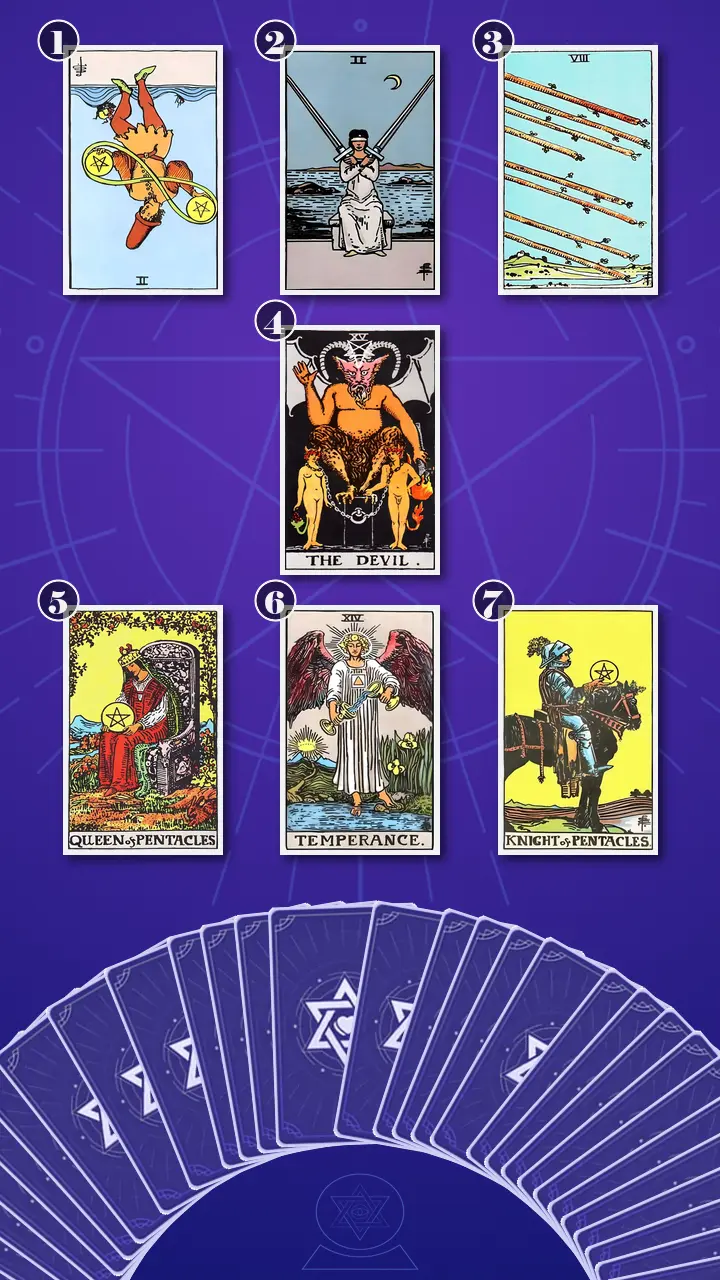
Reading the Map: When the Numbers Start Feeling Like a Verdict
Position 1 — Surface pattern: what your weekly stats are visibly showing
“Now we’re turning over the card that represents the surface pattern—what your weekly stats are visibly showing,” I said.
Two of Pentacles, reversed.
It was almost too perfect: the juggler, the infinity loop, the choppy sea. And I didn’t float away into symbolism—I anchored it in Taylor’s real life.
“This is you standing in your Toronto condo kitchen on a Sunday night, fridge humming, toggling between Apple Screen Time, your banking app, and your sleep tracker like it’s a control panel,” I said. “You see one ‘bad’ number and suddenly you’re rewriting three rules at once: ‘No-spend week. Phone off at 9. Lights out at 10:30.’”
Energetically, reversed Two of Pentacles is blockage: not a lack of effort—too much effort in too many directions. It’s balancing by moving faster, which makes the whole week wobble harder. The stats aren’t settling because the rules keep changing midweek.
Taylor let out a small laugh that had a bitter edge to it. “That’s… brutal,” they said. “Like, accurate, but brutal.”
“I know,” I said softly. “And I’m not saying it to shame you. I’m saying it because when we can name the pattern, we can stop treating it like a moral failing.”
Position 2 — Inner tug-of-war: what you’re trying to manage underneath
“Now we’re turning over the card that represents your inner tug-of-war,” I said.
Two of Swords, upright.
“It’s 11:48 p.m.,” I said, “and you’re sitting on the edge of the bed with blue light on your face, telling yourself you’re about to choose the disciplined option. But inside it’s a stalemate: one part of you wants rest because you feel fried, and another part insists you have to stay plugged in—catch up, check the numbers, make a better plan.”
This is an excess of mental control and a deficiency of felt permission. Two of Swords doesn’t mean you lack data. It means the data is being used to avoid the discomfort of choosing a boundary you can’t “optimize.”
“The blindfold is the key,” I added. “You keep trying to think your way into certainty. But your body already knows what it needs. The problem is you don’t let it have a vote until it’s too late.”
Taylor’s gaze went unfocused for a beat, like they were replaying a familiar midnight scene. Their shoulders lifted—then dropped a millimeter, the first tiny sign that something was landing.
Position 3 — External pulls: what in your environment is increasing the load
“Now we’re turning over the card that represents external pulls—what in your environment is speeding you up,” I said.
Eight of Wands, upright.
“Your evening window is basically a launchpad,” I said, “Slack or Teams pings, group chats, delivery promos, ‘ENDS TONIGHT’ emails, autoplay content—everything lands in the same window.”
I could practically hear the TTC squeal in my head from Taylor’s earlier description: the commute that ends but never really ends inside the nervous system. The Eight of Wands is excess speed—inputs outrunning capacity. It’s not just “you being weak.” It’s a context set to fast by design.
“This card often brings relief,” I told them. “Because it shows you’re not crazy for struggling. You’re trying to build a bedtime and a budget in an environment that removes stopping points.”
Taylor exhaled—small, but real. “Okay,” they murmured. “So it’s not just me being… broken.”
“Exactly,” I said. “It’s a system. Systems can be redesigned.”
Position 4 — Core blockage: the root imbalance that keeps the loop running
“Now we’re turning over the card that represents the core blockage—the engine of the pattern,” I said, and even through a screen I felt Taylor brace.
The Devil, upright.
“Here’s the thing,” I said, keeping my voice plain and kind. “The core imbalance isn’t that you’re ‘bad at routines.’ It’s the quick-relief loop that quietly runs the week. The moment you feel depleted—post-work crash, lonely Sunday night, low-grade anxiety—your hand goes to the easiest hit: one more scroll, one more episode, one more small purchase for a mood shift.”
I paused and zoomed in on the micro-moment, because that’s where shame dissolves into clarity. “It feels optional tonight,” I said, “but it becomes automatic by Friday.”
Energetically, The Devil is attachment—a sticky coping strategy that hijacks choice when you’re tired. In Jungian terms, this is where the shadow lives: not the evil part of you, but the disowned need that comes out sideways. The need might be comfort, quiet, permission, or even companionship. But the shadow says, We can’t ask for that directly—just get the hit.
I watched Taylor’s mouth tighten. Their phone wasn’t even in their hand, but their thumb rubbed against their index finger like it missed the motion.
“And this is the part most people miss,” I said. “A crackdown creates a rebound. You see the numbers spike, you feel guilty, you clamp down harder, and your nervous system—already depleted—rebels for relief. That’s how the chain tightens.”
Taylor swallowed. Their eyes went shiny, not dramatic, just real. “I hate how automatic it is,” they said. “Like I’m not even having fun. I’m just… on it.”
“That sentence is the whole reading,” I replied. “Because it tells me this isn’t about ‘fun.’ It’s about regulation.”
Position 5 — Usable resource: what steady support you already have
“Now we’re turning over the card that represents your usable resource—what steady support you already have,” I said, because naming the resource is how we rebuild self-trust.
Queen of Pentacles, upright.
“You already know how to make your life feel supported when you treat care like infrastructure, not a test,” I said. “This looks like charging your phone across the room, having an actual snack ready so you don’t DoorDash out of depletion, putting a comfy blanket on the couch so you don’t ‘accidentally’ end up doomscrolling in bed.”
Energetically, the Queen is balance: grounded attention. Her gaze isn’t surveillance. It’s care.
“Your dashboard is a weather report, not a verdict,” I added, and I watched Taylor’s jaw loosen just slightly—as if their body wanted to believe me before their brain did.
When Temperance Spoke: One Measured Pour at a Time
Position 6 — Key rebalancing medicine: the transformation principle for this week
“We’re turning over the most important card in this spread,” I said. “The one I treat like medicine.”
Temperance, upright.
Before I interpreted it, I did what I always do with my clients—my Energy State Diagnosis. I looked in three dimensions: environment, relationships, self.
“Environment: your week runs like Eight of Wands—fast inputs, low friction,” I said. “Relationships: you’re half-on, half-available, like you can’t fully clock out socially or professionally. Self: Two of Swords—your inner world is negotiating instead of choosing. That’s the leak. Not willpower. Leaky rhythm.”
Then I let Temperance do what it does: simplify without minimizing.
Setup (the moment right before the click): I said, “Picture that Sunday-night moment: your phone is warm from refreshing, your jaw is tight, and one ‘bad’ number makes you want to rewrite your whole life by Monday. You’re trying to juggle three spinning plates while checking a scoreboard every few minutes.”
Delivery (the line that has to land):
Stop treating balance like a pass/fail test and start mixing a workable rhythm, one measured pour at a time.
I let the silence hang for a beat. Even through a video call, the air felt different—like the room had stopped vibrating for half a second.
Reinforcement (what happened in Taylor’s body): Taylor’s reaction came in layers. First: a freeze—breath caught, eyes fixed on the card like it had accused them personally. Then: the eyes softened and drifted slightly off to the side, as if a memory was replaying—Sunday night, Notes app open, rules piling up. Then: the release—a long, shaky exhale that made their shoulders drop, followed by a sudden flash of irritation.
“But—” they said, voice sharp for a second, “if it’s not pass/fail… doesn’t that mean I’ve been doing it wrong? Like I’ve been making it worse?”
I didn’t rush to soothe. I met them where they were. “It means you’ve been trying to regulate with the tool your culture hands you first: optimization,” I said. “It worked for a minute, so you kept using it. Temperance isn’t telling you you were ‘wrong.’ It’s telling you what actually works for a human nervous system: a thermostat, not a light switch.”
I brought in my other language—my Venetian one—because it’s the clearest metaphor I have. “Where I’m from,” I said, “the canals don’t stay balanced because someone yells at the water. They stay balanced because the flow is guided—small gates, measured timing. That’s Temperance. You don’t need a crackdown. You need a valve.”
I asked, “Now, with that new lens—can you think of one moment last week where this would have changed how you felt? A moment where you saw a number and your whole body went into ‘prove it’ mode?”
Taylor blinked hard. “Tuesday,” they said quietly. “I saw my screen time jump at like… 8:30 p.m. And I was like, ‘Cool, I already ruined it,’ so I stayed up later.”
“That’s the exact crossing,” I said. “This isn’t just about a decision. It’s the shift from restless self-critique and scoreboard-style monitoring to calm ownership through a repeatable weekly rhythm.”
“And here’s the cue phrase I want you to borrow this week,” I added. “Stop negotiating with the stats.”
Position 7 — One-week action: the concrete next step
“Now we’re turning over the card that represents your one-week action—the simplest step that makes this real,” I said.
Knight of Pentacles, upright.
“This card is boring on purpose,” I told Taylor. “It says: do the same small thing for seven days and don’t renegotiate it midweek. Your biggest obstacle isn’t motivation—it’s renegotiation triggered by a ‘bad’ number.”
Energetically, the Knight is balance through repetition. Not intensity. Not perfection. The still horse is pace control.
Taylor frowned. “But I don’t have five extra minutes,” they said, practical obstacle first. “By the time I’m done with dinner and the last pings, I’m wiped. That’s when I cave.”
“Perfect,” I said, because that’s where the real work lives. “Then we don’t build a plan that requires extra minutes. We build a plan that removes decisions.”
The One-Week Baseline: From Dashboard Dread to Actionable Advice
I pulled the whole spread into a single story, so Taylor could feel the logic instead of fighting it.
“Here’s what I see,” I said. “On the surface (Two of Pentacles reversed), your week wobbles because you keep juggling sleep, spending, and screen time by changing rules midstream. Underneath (Two of Swords), you’re stuck between two needs—rest and control—so you bargain instead of choosing. Outside (Eight of Wands), your world is loud and fast, so reaction becomes your default. At the core (The Devil), quick relief—scrolling and small purchases—becomes automatic when you’re depleted. And your resource (Queen of Pentacles) is that you actually do know how to care for yourself practically when you stop treating it like a test. Temperance is the medicine: mixing small constraint and small comfort until the week becomes a rhythm. Then the Knight makes it real: repeat it for seven days.”
“The blind spot,” I added, “is that you’ve been treating the dashboard like it’s allowed to renegotiate your life every day. But data without a stable baseline becomes fuel for anxiety. The transformation direction is clear: from ‘fix everything with strict rules’ to ‘choose one small constraint that protects your baseline and repeat it for a week.’”
Then I gave Taylor a plan that fit their tired week—my kind of plan: tiny, concrete, consent-based. I framed it as a single experiment, not a personality upgrade.
- Set a bedtime window (not a perfect bedtime)Pick one 45-minute lights-out window you can repeat for seven nights (example: 11:15–12:00). On hybrid days, aim for the window—no “make up for it” bedtime heroics.If your brain demands a dramatic reset, treat that urge as depletion. Choose the smallest version that feels almost too easy, and repeat it anyway.
- Create a phone parking spot (bed = no phone zone)Tonight, pick one surface across the room (dresser, desk, shelf). That is the only charging spot for seven days. When you enter the bedroom, the phone goes there—before you sit down.Make it a 60-second “return to baseline” move: stand up, drink water, park the phone, and only then decide what’s next.
- Add friction to impulse spendingFor one week, any non-essential item goes in-cart for 48 hours. Add a one-line note in your Notes app: “What feeling am I trying to buy relief from?”If you’re too tired to journal, write a single word (e.g., “stress,” “lonely,” “overstimulated”). Naming is enough to break the autopilot.
“And one more rule,” I said, channeling pure Knight of Pentacles energy. “You can look at your stats anytime. But you only change the plan during one 15-minute window next Sunday. That’s your canal gate. Everything else is just water trying to rush.”

A Week Later: The Quiet Proof of a Repeatable Rhythm
Six days later, Taylor messaged me. Not a long update. Just: “Phone’s charging in the hallway. I still get the urge to grab it, but I’m actually sleeping. Also, I didn’t do a no-spend week. I just didn’t DoorDash Monday–Thursday. It’s… weirdly fine.”
Their win wasn’t fireworks. It was smaller and better: they had one messy evening, still felt the pull, still hated the “bad” number—and they returned to baseline the next night without escalating into punishment. Clear, but a little tender. Like standing alone in a café after making a grown-up choice, calm in your body, and still wondering for a second, What if I mess it up again?—only this time, you don’t spiral.
That’s the Journey to Clarity I care about: not perfect stats, but a repeatable rhythm. When you stop treating balance like a pass/fail test, you start building self-trust the way it’s actually built—through measured pours and boring consistency.
When one messy day makes your whole week feel “out of control,” you don’t just feel guilty—you feel that tight, wired pressure to prove to yourself you can still steer.
If you didn’t have to win the week—only return to your baseline—what’s one small boundary you’d be willing to repeat for seven days and see what changes?
Author Profile