When Friends Make Plans Without You: Chill, Spiral, Then a Clean Ask

When Friends Make Plans Without You and the Scroll Begins
If you are a 20-something in a city like Toronto who can type “no worries!!” in the group chat and then spend Friday night zooming into a dinner photo you were not in, this is probably your exact flavor of adult friendship anxiety.
When Maya (name changed for privacy) sat across from me in the back corner of my café, she said it with a laugh that had no real humor in it. “I’m not mad,” she told me, wrapping both hands around a cappuccino she had already forgotten to drink. “I just want to know what happened.”
Then she gave me the scene in one rush. It was 9:18 p.m. on a Friday in her west-end Toronto condo: Netflix throwing blue light across the room, her laptop still warm on her knees, leftover takeout smelling faintly sweet. Instagram lit up with a tagged dinner photo from Ossington. The radiator clicked. Her phone went hot in her palm. Her stomach dropped hard enough that she sat upright before she even had words for why.
She typed “looks so fun” within seconds, shoulders tight, while another part of her was already opening Instagram, iMessage, and the group chat side by side like there had to be one final clue hidden in punctuation, timestamps, or who viewed what first. That was the real conflict: she wanted to feel included and chosen by her friends, but she was terrified that asking about exclusion would make her look needy, dramatic, or easier to reject.
Hurt gets louder when it has to dress up as chill. In Maya’s body, it felt like trying to swim through cold syrup with a tight chest and a thumb that would not stop scrolling.
I nodded. “That makes sense,” I said. “And no, it doesn’t mean you’re petty. It means something landed. Let’s make a map of the sting before your mind turns it into a verdict. That’s our journey to clarity today.”

Choosing the Compass: A Five-Card Cross for Friendship Clarity
I asked her to set her phone face-down, take one slow breath, and hold the question in plain language: why do I act chill when friends leave me out, and then spiral later? I shuffled the cards the same way I reset my café before opening—less mystical theater, more a deliberate shift into focus.
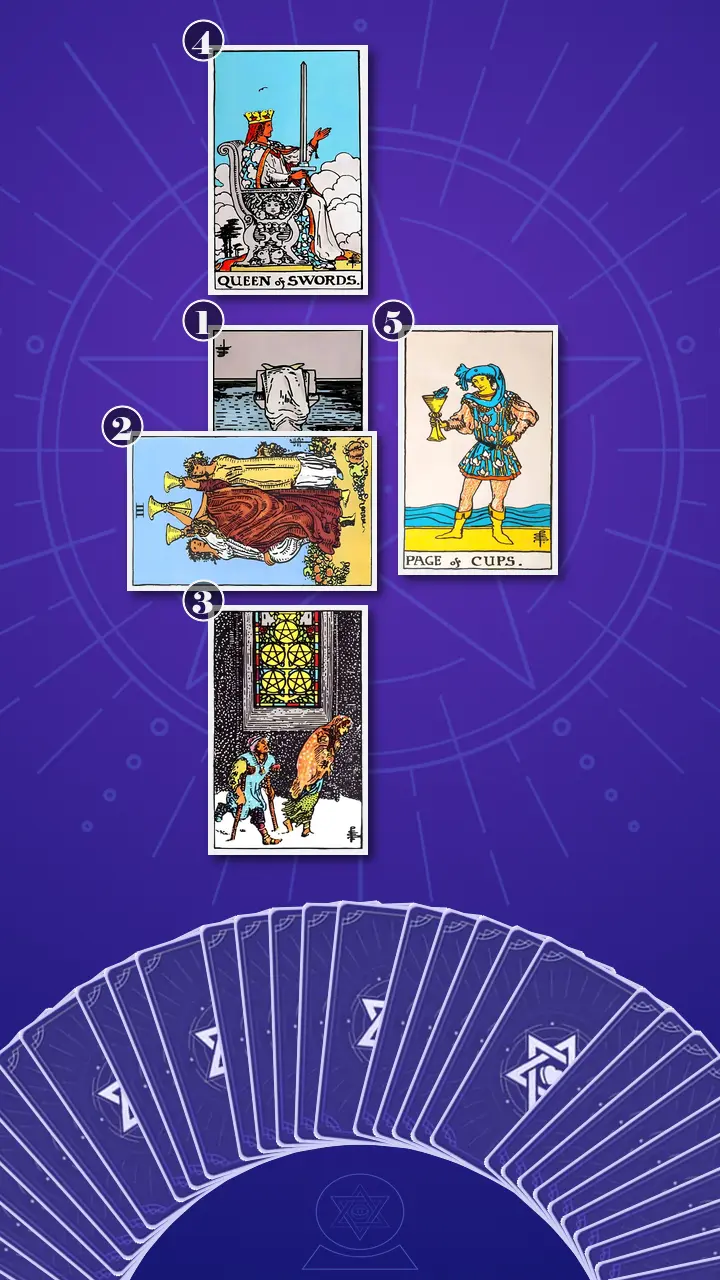
For this reading, I used the Five-Card Cross · Context Edition. When people wonder how tarot works for feeling left out by friends, this is exactly the kind of spread I reach for. We did not need the full weather system of a Celtic Cross. We needed a compact diagnostic: enough room to map the surface symptom, the immediate social trigger, the older wound underneath, the helpful reframe, and the next actionable step.
That is why this particular five-card tarot spread for friendship problems works so well for social overthinking. The center card shows the visible pattern. The crossing card shows what is pressing on it. The card below reveals the root wound. The card above offers the clearest guidance. And the card to the right shows how the insight becomes lived behavior. Tarot, at its best, gives card meanings in context. It turns a vague ache into a readable map.
I told Maya what I was watching for most closely: the surface loop of acting unbothered, the challenge of group dynamics, the buried belonging story, and the one card that would show us how to move from mind-reading to finding clarity.
Reading the Map: From Group-Chat Archaeology to the Root Wound
Position 1: The Chill Text and the Closed Chest
I turned over the first card, the one representing the observable symptom in her pattern: the calm front paired with private spiraling after being left out. It was the Two of Swords, reversed.
The image said everything before I spoke. Blindfold over the eyes. Crossed swords over the chest. Still sea beneath a stone seat. In Maya’s life, this was the exact moment she saw a tagged dinner post, sent a breezy reply before she had named the sting, and then spent the next hour flipping between Instagram, iMessage, and the group chat as if hidden truth lived in timestamps, reactions, or punctuation. It was, as I put it to her, a little Severance-coded: public self sending the polished message, private self doing the after-hours investigation.
Reversed, the energy here is blocked Air cracking under pressure. Not balance. Not peace. Containment that has started to fail. The feeling is not processed; it is postponed. So the mind reroutes the same trip over and over, like having twelve browser tabs open about the same problem and none of them being the actual source document.
I asked her the question beneath the card: “In the first five minutes, what did your body know before your text did?”
She didn’t nod right away. She gave a small bitter laugh instead. First her breath caught. Then her eyes unfocused as if replaying the phone screen. Then she pressed the heel of her hand lightly against the center of her chest. “Okay,” she said. “That’s accurate enough to be rude.”
“Not rude,” I told her gently. “Specific. The blindfold is relying on clues instead of direct information. The crossed swords are the way you keep hurt locked behind a competent tone. You are not calm in that moment. You are bracing.”
Position 2: The Social Math of the Closed Circle
Next I turned over the card showing the immediate social trigger and the inner tug-of-war: wanting inclusion while fearing that asking about it will look needy. It was the Three of Cups, reversed.
Upright, this card is easy shared rhythm—raised cups, bodies turned toward one another, the pleasure of being inside the moment. Reversed, that same image becomes painful. In Maya’s modern life, one missed hangout instantly became social math. She zoomed into the Story, checked who got tagged first, read the phrase “we all” like evidence, and started wondering whether there was now a core trio or inner loop that existed without her.
This is distorted Water. Group feeling turns into comparison. Connection becomes ranking. Her mind stops asking, “What actually happened?” and starts asking, “Where do I stand with everyone?” That is how one dinner becomes a whole algorithm she feels she is losing.
I said, “This is why adult friendship anxiety gets so sharp online. Stories make a single night look like a complete social truth.” Then I asked, “What hooked you most—the photo, the silence beforehand, or the inside jokes after?”
Her jaw shifted to one side. “The phrase ‘we all,’” she said quietly. “That one always gets me.”
I watched her fingers tighten around the mug, then loosen. The defense was starting to soften, but not comfortably. That is often how the real reading begins.
Position 3: The Warm Window and the Older Verdict
The third card, placed below the center, showed the mechanism underneath the spiral: the belonging wound and the fear that exclusion says something final about her worth. It was the Five of Pentacles, upright.
This card always lands in the body first. A lit window. Warmth inside. Figures moving through snow outside. The second I saw it, I thought of how Maya had described standing in her kitchen later under the yellow stove light, tea gone flat, apartment suddenly too quiet after hearing, “We assumed you were busy.” By then it was not even about one plan anymore. The warm restaurant on their Stories had become a glowing room she was never meant to enter.
This is pain turning solid. Earth taking over. A social miss becomes evidence. The internal jump happens fast: not “I wasn’t invited this time,” but “I’m the kind of person people like around, but don’t really choose.” A missed invite is data, not a final verdict on your place in someone’s life. But this card shows exactly how quickly the nervous system tries to make it one.
In that moment, an old instinct from my café life rose in me. In Grounds Divination—the Venetian art of reading the sediment left in a coffee cup—I never mistake the pattern that clings to porcelain for the whole coffee. Grounds show where the swirl settled and what residue remained. They do not get to rewrite the brew itself. Maya’s mind had been treating emotional residue like final truth.
I translated that for her as simply as I could. “You’re reading the stain, not just the sip,” I said. “The hurt is real. But the story attached to it is older than this one dinner.”
She went very still. First her thumb froze against the paper sleeve. Then her gaze dropped to the Five of Pentacles window as if a hundred smaller memories had lined up behind it. Then she exhaled and whispered, “It’s not even about tonight anymore.”
“Exactly,” I said. “That sentence is the hinge.”
When the Queen Lifted Her Sword
Position 4: Not Colder, Clearer
Then I turned over the fourth card, the one naming the transformation lever: the shift from mind-reading and self-silencing toward clear self-respect and reality-testing. The room changed with it. A streetcar rattled past the front window and then the café fell into a rare clean hush between orders. Even the steam wand had gone quiet. The card was the Queen of Swords, upright.
In a friendship reading, the Queen of Swords meaning is never “be harsher.” It is “be more exact.” Upright sword. Open hand. Clear sky with moving clouds. In Maya’s world, that looked like stopping the conspiracy-board energy and switching into editor mode: facts, cuts, clean wording. Instead of building a case in her head, she writes, “What I know: I was not part of this plan. What I am assuming: it means I am unwanted.” From there, one grounded message to one trusted friend. No apology for having feelings. No emotional case file. Just a clean question text.
This is restored Air. The same suit that began with blindfold, crossed arms, and shut-down perception now reappears as direct thought used for discernment instead of armor. Her growth is not about feeling less. It is about using thought to reality-test rather than to punish herself.
She stared at the card for a second too long, like she already knew it was going to ask more of her than the others had.
You are in bed with your phone lighting up your face, replaying who knew first and whether the caption meant something. Your body already feels the answer as a threat before you have any actual answer at all.
You do not need the blindfold of being ‘low-maintenance’; lift the Queen’s sword, name the sting plainly, and let truth, not guesses, cut through the spiral.
I let the sentence rest between us for a beat. Then I added, quietly, “You do not need better detective work; you need cleaner language.”
Her first reaction was not relief. It was resistance. Her inhale stopped halfway. Her brows pulled together. Then her mouth tightened with something close to anger. “But if that’s true,” she said, voice low, “what have I been doing all weekend? Just making up a whole trial in my head?”
“Not making it up,” I said. “Protecting yourself with the safest tool you had. But protection is not the same thing as clarity.”
I watched the realization move through her in three small waves. First her eyes lost focus, as if a row of browser tabs had suddenly closed. Then her shoulders dropped one careful inch. Then a shaky breath left her chest, half relief and half embarrassment. There was that brief dizzy quality that can follow a real insight—the tiny vulnerable blankness that comes when a heavy interpretation lifts and you suddenly have to decide what is true without it.
I slid a napkin toward her. “Now use this lens on last week,” I said. “Was there a moment when facts and assumptions fused so fast you couldn’t tell them apart?”
She nodded slowly. “The second I saw ‘we all,’ I decided it meant there was an inner circle and I wasn’t in it.”
“That,” I told her, “is the step. Not from hurt to never hurt again. From shame-laced exclusion spirals to clear self-respect and reality-tested friendship clarity.”
Position 5: The Soft Check-In
The final card showed the direction of integration if she embodied that guidance: how to reconnect with vulnerability and reciprocity without abandoning self-protection. It was the Page of Cups, upright.
I smiled when I saw it. After all that contracted energy, here was the emotional field shrinking from the whole group to one human-sized exchange. In modern life, this card is not a huge confrontation. It is a two-line check-in. A low-pressure coffee. A short voice note. “I felt a bit thrown when I saw that, and I wanted to check in,” instead of waiting for people to magically notice the bruise.
This is gentler Water coming back online. Not the sour comparison of the reversed Three of Cups, but curiosity, sincerity, and the willingness to say something real before certainty arrives. The fish rising from the cup has always felt like a perfect little truth bomb to me: honest feeling can create connection more often than polished detachment ever does.
“So I don’t have to make a whole case?” she asked.
“Exactly,” I said. “This does not have to be a speech. Belonging gets clearer in one honest check-in than in three hours of story forensics.”
That landed differently. She sat back instead of folding inward. Her hands opened on the table. The question in her face was no longer “How do I stop caring?” It was “Who is safe enough to be honest with first?” That is a much wiser question.
From Story Forensics to Actionable Advice
When I looked at the whole spread together, the story was precise. First came the split on the surface: breezy text outside, stomach-drop hurt inside. Then the group trigger turned that hurt into social ranking and mind-reading. Underneath it all sat the older outsider wound, the part that hears a missed plan as proof of being less chosen. The Queen of Swords interrupted that chain by separating facts from assumptions. And the Page of Cups showed that repair would not come from decoding the whole friend group; it would come from one clear, human exchange with someone capable of reciprocity.
I named the blind spot plainly. “You have been treating the fear of looking needy as more dangerous than the cost of silent guessing.”
Then I named the direction just as plainly. “Clarity is not the same thing as making it weird. Your move is not to become colder. It’s to become clearer, and then smaller and softer in how you test connection.”
When I offered the first practice, Maya grimaced immediately. “Twenty minutes without checking Stories?” she said. “If I’m being honest, I don’t even make it twenty seconds.”
I laughed, not at her, but with the reality of being a person with a phone and a nervous system. “Then we make the doorway smaller,” I said. “In my café I call this the Morning Espresso Ritual. The first brew sets the tone before the internet gets a vote.”
- The Morning Espresso What-I-Know CheckBefore you reopen Instagram or the group chat tomorrow morning, make your coffee or tea and open Notes. Write two headings only: ‘What I know for sure’ and ‘What I am assuming.’ Keep each list to three bullet points max. Five minutes is enough.If your brain says, ‘This is overdramatic,’ treat that as old armor, not truth. If five minutes feels too hard, do the two-line version while the kettle boils.
- The Clean Question TextAfter a 20-minute no-story-check pause—or a 5-minute one if that is more realistic—draft one factual question to one person only. For example: ‘Hey, seeing that dinner caught me off guard. Was it super last-minute, or did I miss the plan somewhere?’ Send it only if your body has come down one notch.Draft first, decide later. You do not owe the whole group an explanation, and you do not have to send it at 11:47 p.m. after three rounds of group-chat archaeology.
- One-Person Reality TestThis week, choose one friend who has responded with care before and either send a two-sentence check-in or invite them for a short coffee or walk. Keep it human-sized: ‘I felt a bit thrown when I saw that plan, and I wanted to check in rather than make up a story.’Curiosity is enough. Two sentences is enough. If texting feels too loaded, make it a low-stakes Thursday coffee after work and bring it up briefly in person.
Then I added one more piece from the way I close my café at night. Energy Cleaning, I call it: the small reset before residue becomes tomorrow’s atmosphere. “If you feel the spiral restarting,” I told her, “mute that specific Story feed or group chat for one evening. Not as punishment. As cleanup. You are allowed to stop feeding the part of your mind that only knows how to guess.”

A Week Later, the Quiet Proof
A week later, just before the lunch rush, I got a message from her. “I did the Notes thing with coffee first,” it read. “Then I texted one friend. It really was last-minute. She said she’d thought about inviting me and assumed I was slammed. I still had the ‘wow, I spiraled hard’ feeling after—but I didn’t reopen the Story once.”
That is what a real journey to clarity looks like most of the time. Not solving your whole friendship life in one conversation. Not becoming immune to the sting. Just one clean question, one interrupted spiral, one small piece of evidence that self-respect can stay in the room even when uncertainty shows up first.
Sometimes the sharpest part is not missing the plan—it is the moment your chest tightens, your phone warms in your hand, and you start wondering whether wanting to be chosen already makes you too much. If that moment finds you again, what is the smallest honest sentence you might want to keep ready in Notes, right under ‘What I know’ and ‘What I am assuming,’ instead of reaching for story forensics?