While the Host Waited, 'I'm Easy' Gave Way to a Clear First Pick

The 6:18 p.m. Ossington Freeze
If you're a mid-20s city person who can present clean UX logic at work but still freeze when the group chat says, 'you pick dinner,' I usually know within the first few minutes that I'm not looking at simple indecision. I'm looking at people-pleasing choice guilt — the kind that turns a normal meal plan into a high-stakes belonging test.
When Maya (name changed for privacy) came to me, she opened with a laugh that had a crack in it. 'This is so stupid,' she said. 'It was 6:18 on Ossington, drizzling, the host had the tablet out, my friends turned to me and said, "You pick," and I opened Maps even though I already knew I wanted ramen.'
As she talked, I could almost feel the scene with her: streetcar brakes scraping in the background, the smell of wet pavement and garlic, her phone warming in her hand while she bought herself three more seconds by asking what everyone else felt like. The question was small. Her body acted like it wasn't. I watched her press her lips together as she described the exact moment her chest tightened and her throat went a little flat, because she wanted to take part in the choice and, at the same time, feared her preference would inconvenience everyone around her.
'I just don't want to be the difficult one,' she said.
I told her that made perfect sense to me. Guilt like that doesn't feel dramatic in the moment; it feels practical, almost polite. But it wraps around the ribs like a coat zipped too high, until even saying 'I'd love sushi tonight' can feel like bad group etiquette. I leaned a little closer to the camera and said, 'Let's not call this silly. Let's map it. Our whole journey today is about finding clarity inside that exact freeze — the moment you start treating your own appetite like extra work for everyone else.'

Choosing the Compass with The Shadow Spread
I asked Maya to put both feet on the floor and think of the last time attention landed on her at the table. Then I shuffled slowly, not as a performance, not as some theatrical ritual, but as a way of helping the nervous system stop sprinting long enough for the real pattern to appear.
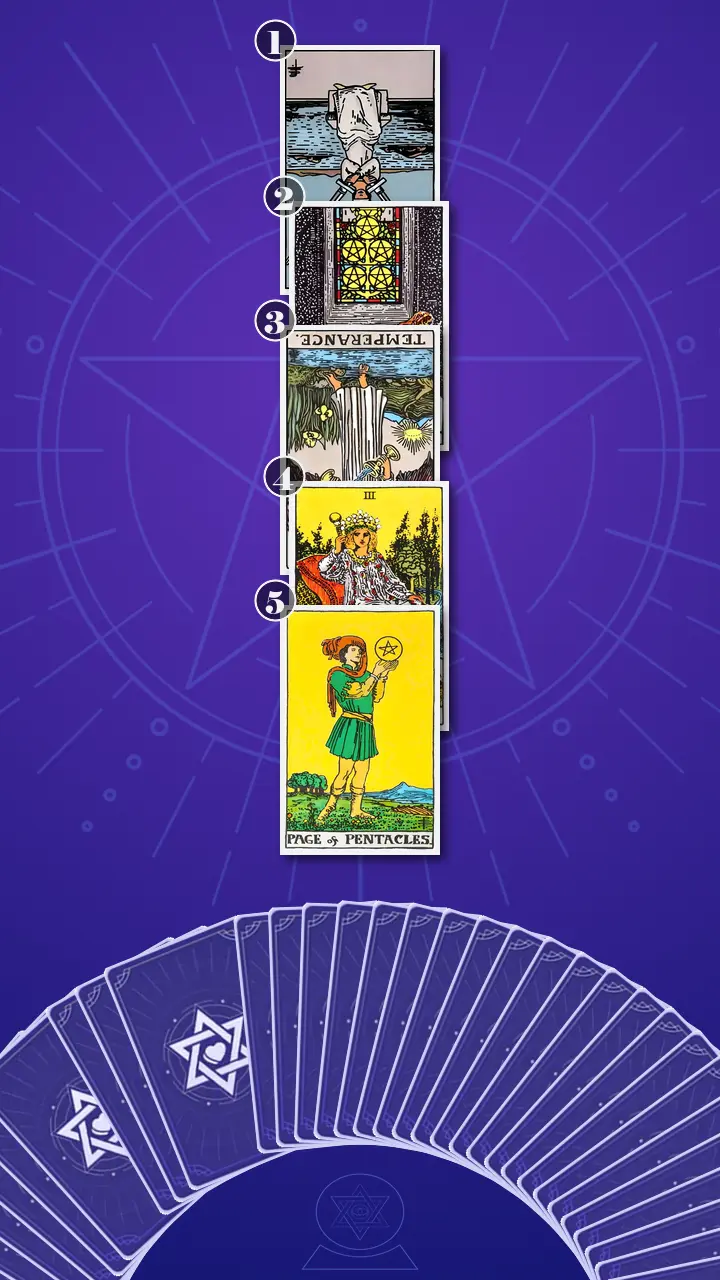
For this reading, I chose a five-card Shadow Spread. This is how tarot works at its best for a question like, 'Why do I feel like a burden when friends ask me to pick dinner?' Dinner is only the trigger. The deeper issue is a hidden belief that having a preference makes you inconvenient, difficult, or harder to include. I didn't need a giant diagnostic spread to answer that. I needed a clean map: symptom, fear, defense, reframing, practice.
Years of guiding visitors through a planetarium taught me something useful about patterns: what looks like one bright point is often several motions layered together. Maya's dinner-choice paralysis worked the same way. So I told her exactly what we were about to look at. The first card would show the visible freeze — the hesitation, apology, and 'anything is fine' reflex. The second would reveal the belonging fear under it. The third would show the protective habit keeping it alive. The fourth, the key card of the whole reading, would offer the corrective truth. The fifth would turn that truth into a repeatable social experiment she could actually use the next time a server was standing there waiting.
Down the Staircase of Group Decision Anxiety
Position 1: The Loop That Calls Itself 'I'm Easy'
Now the card I turned was the one showing the presenting problem from the diagnosis: the hesitation, apology, and choice paralysis that appear when Maya is asked to pick dinner. It was Two of Swords, reversed.
I told her this card was almost painfully literal. In modern life, it looks like Maya on a Friday evening with three tabs open — Google Maps, menu photos, and the group chat — trying to calculate the least inconvenient answer instead of naming the place she actually wants. The more she tries to predict everyone else's reaction first, the less access she has to her own preference. The blindfold in the card becomes mind-reading. The crossed swords over the chest become that physical bracing in her chest and throat when all eyes turn to her. Reversed, this is blocked Air energy spilling out into visible indecision. It isn't that she has no preference. It's that self-protection has jammed the signal.
'It's the social version of scrolling Netflix so long that choosing feels more stressful than watching nothing,' I said. 'Except here, you're not just picking dinner. You're trying to prevent anyone from ever experiencing even five seconds of inconvenience because of you.'
I asked her, 'The last time friends said "you pick," what happened in your body in the first three seconds — and what did you say instead of what you actually wanted?'
She gave a quick, bitter little laugh and looked down at her sleeve. 'Wow,' she said. 'That's accurate enough to be kind of rude.' Her fingers pinched the cuff once, then released it. That reaction mattered. Recognition had landed before explanation finished.
Position 2: The Cold Story Under a Warm Group Chat
The next card I turned was the one revealing the hidden fear beneath the issue — what Maya believes could happen socially if she names a preference. It was the Five of Pentacles, upright.
I felt the whole spread deepen. I told her this card was not about dinner at all. It was about social frost. This is the moment a normal pause in the chat, or one neutral face at the table, starts to feel like evidence that your preference made you harder to keep close. The lit window in the card is the warmth that is actually there — warm friends, ordinary logistics, a group that really is including you. The snow is the cold interpretation you tell yourself before anyone has even said no. Cold Earth energy here becomes scarcity: not enough permission, not enough belonging, not enough room to be ordinary.
'Nobody has even said no,' I told her, 'but inside, you're already feeling left out.'
She went still in that very specific way people do when a sentence catches them from the inside. Her breath paused. Her eyes lost focus for a second, as if replaying a Tuesday evening group chat. Then came the long exhale. 'I always do this with delayed replies,' she said quietly. 'Like if nobody answers for four minutes, I assume I was annoying.'
I nodded. 'Exactly. A friend saying "maybe somewhere closer?" lands on you as "I shouldn't have said anything," instead of what it usually is — simple logistics. So the real fear here isn't choosing the wrong restaurant. It's what you imagine the pause might mean about your place in the group.'
Position 3: When Consideration Becomes Self-Cancellation
The third card sat at the center of the spread, the hinge of everything: the protective habit Maya uses to stay safe. It was Temperance, reversed.
This was the major blockage in the reading, and I said that plainly. Upright, Temperance is balance. Reversed, it becomes over-adjustment — the kind that looks thoughtful on the outside and hollowing on the inside. In Maya's life, it looked exactly like the office lunch-order moment she had described to me: checking budget, location, dietary needs, commute time, everyone's mood, who had sushi yesterday, who looks tired, who might think the place is too loud. Every adjustment sounds reasonable. Together, they erase the original signal.
'This is like over-optimizing a Figma file for every stakeholder note until the core idea disappears,' I told her. 'By the time you've made room for everyone, there's no clear outline of you left.'
She shut her eyes for a second. I could see the line of her jaw tighten, then soften.
'Flexibility is beautiful until it becomes a way of disappearing,' I said. 'That's what this card is showing me. You're not being fake. You're being hyper-considerate. But somewhere along the line, consideration stopped being relational and started becoming self-cancellation.'
I watched the realization reach her in stages. First her shoulders drew up almost defensively. Then her mouth parted, not to argue, but because something had clicked before she had words for it. Finally she pressed a hand to the center of her sternum and said, half-laughing, half-wincing, 'Wait. I'm solving a conflict that doesn't even exist yet.'
'Yes,' I said. 'And that awareness is the first crack in the pattern.'
When The Empress Took Her Seat
Position 4: The Corrective Truth
When I turned the fourth card, the room changed. My desk lamp caught the wheat-gold field first, and suddenly the whole spread felt warmer. After the cold of the Five of Pentacles and the over-edited tension of Temperance reversed, this card arrived like the nervous system remembering the ground.
This was the key card of the reading — the corrective truth, the antidote. It was The Empress, upright.
I let Maya look at it for a moment before I spoke. She was still holding that Friday-night TTC feeling in her body: the phone warm in her hand, the message drafted and deleted, the tight chest that had taught her an ordinary preference might be proof she was too much. She had been trying to earn her place in the group by asking for as little as possible.
'The real issue isn't that you're bad at choosing,' I told her. 'It's that you've been treating an ordinary preference like proof you might be too much — and it isn't.'
You do not have to starve your own appetite to keep the peace; let The Empress seat you fully in the field of abundance, where your wants are part of the meal, not a burden on it.
I left a beat of silence after that. Years in the planetarium taught me that rhythm changes understanding; people absorb the sky differently when you stop talking and let the dark do part of the work. So I asked Maya to plant both feet on the floor, unclench her jaw, and breathe with me in a pattern I use often with clients when the body has mistaken a social moment for danger. I call it Pulsar Breathing: inhale for four, exhale for six, steady and even, like a repeating signal in deep space. When the mind is scanning faces for permission, the body needs a rhythm more trustworthy than panic.
I watched the reaction move through her in three clear waves. First came the freeze: her fingers stopped against her mug, and for one second she didn't blink. Then came the cognitive drop-through: her gaze drifted past the screen as if she were replaying every typed-and-deleted 'Thai?' and every 'I'm easy lol' she'd sent instead. Then the release arrived — not neat, not cinematic. Her shoulders lowered. Her mouth trembled into a disbelieving smile. She inhaled, and when she exhaled, the sound carried both relief and a little anger. 'So I've been apologizing for taking up literally normal space,' she said.
'Yes,' I said softly. 'And that's not a verdict. It's a doorway.'
Her eyes glossed for a second. Then she laughed again, but this time there was air in it. The kind that comes after a tight room opens a window. I could also see the vulnerable part of clarity landing — that small, dizzy feeling people get when the burden they've been carrying turns out not to be required, because now they have to decide what to do with the freedom. I asked her, 'Now, with this new angle, was there a moment last week when this would have changed how your body felt?'
She answered immediately. 'Tuesday. I typed "Thai?" in the group chat, saw nobody reply right away, and deleted it.' She shook her head. 'If I'd had this sentence then, maybe I would've just left it there.'
'Exactly,' I said. 'This card is the shift from guilty self-erasure and mind-reading toward steady self-trust and ordinary participation. Your appetite is information, not inconvenience. Having a preference is not a social emergency.'
Position 5: Beginner Reps for Self-Trust
The final card I turned translated all of that into behavior — the grounded next step Maya could practice in real life. It was the Page of Pentacles, upright.
I loved seeing this here, because the Page never asks for a personality overhaul. It asks for reps. In modern life, this is basically Duolingo for preferences: one honest option, one clean sentence, one chance to let the group respond without over-managing the outcome. The Page studies the pentacle the way Maya now needed to study her own first instinct — with curiosity, steadiness, and low drama. This is balanced Earth energy. Not performance. Practice.
'You don't need one perfect breakthrough,' I told her. 'You need beginner reps. Name it once. Skip the apology. Let the group be a group.'
That line landed differently. I saw her sit a little taller. The tension in her mouth eased. 'That,' she said, giving the smallest real smile of the night, 'sounds embarrassingly doable. Which I think is good.'
'It's very good,' I said. 'Confidence here won't come from waiting until you feel calm first. It will come from discovering, in real time, that the world does not collapse when you say one true thing out loud.'
From Burden Belief to Actionable Advice
By the time I finished the spread, the story was clear. Maya's surface problem was not really being 'bad at choosing.' The Two of Swords reversed showed the visible gridlock: the second attention lands on her, she braces. The Five of Pentacles showed why the moment feels so loaded: a pause or neutral reaction instantly becomes a belonging story. Temperance reversed exposed the habit that keeps the whole system running: she manages everyone else's comfort so thoroughly that she disappears from the decision. Then The Empress corrected the lie at the center of it — the lie that her wants are extra weight for other people to carry. Finally, the Page of Pentacles turned that truth into a method.
The blind spot, I told her, was not selfishness. It was the opposite. She had quietly decided that being considerate meant she had to pre-solve budget, mood, commute, and disappointment before earning the right to say what sounded good. In other words, she was checking other people's reactions before speaking, as if their faces had to grant permission for her preference to exist. The shift was simple, but not easy: move from reaction-scanning to one honest first pick. Clarity is participation, not control.
If you've ever searched things like 'why do I feel guilty having preferences,' 'how to stop saying anything is fine,' or 'why choosing dinner feels weirdly high stakes,' this is the answer I give most often: your nervous system has mistaken appetite for liability. Tarot helps here not by predicting which restaurant everyone will like, but by showing exactly where the burden belief gets built — and exactly where it can be interrupted.
So I gave Maya three practical next steps.
- First-Pick Practice.This week, with one trusted friend or in one low-stakes group chat, send one clear sentence first: 'I'd love ramen tonight' or 'My first pick is sushi.' Do it before opening Beli, Google Maps, or review apps.Tip: If your chest spikes, do one round of Pulsar Breathing first. The rep still counts even if the group chooses something else, because the goal is naming a preference, not winning the plan.
- The Two-Minute Menu Rule.Before you start researching every option, set a two-minute timer and choose from the first three places that genuinely sound good to you. Then save three reliable spots in Notes or Google Maps as your 'easy yes places' so you are not starting from a blank page every time.Tip: This lowers the urge to over-check. You're building a runway for self-trust, not proving you can optimize the perfect dinner.
- Five-Minute Mind-Reading Interrupt.After you send a suggestion, do not reread the chat for five minutes. If there is a pause, ask one clarifying question such as 'Do we want somewhere closer to downtown?' instead of inventing a rejection story.Tip: Measure facts, not vibes. Did anyone say no? Did the friendship change? Usually the answer is no, and that matters.
Before we ended, Maya asked the practical question I was hoping for. 'But what if I freeze and forget all of this in the moment?'
'Then you make the moment smaller,' I said. 'One friend instead of five. One text instead of a table full of faces. One sentence instead of a speech. You're not trying to become a different person by Friday. You're giving your body evidence that honesty is survivable.'

A Week Later, One Clean Sentence
Four days later, I got a message from her. 'I texted, "My first pick is sushi, but I'm open." We ended up getting tacos. Nobody cared. I still checked the chat twice, then put my phone face down and made tea.' That was all. No dramatic life overhaul. Just a small, bright piece of proof.
That is often what a real journey to clarity looks like in relationship readings. Not a personality transplant. Not perfect confidence. Just the first visible movement from guilty self-erasure and mind-reading toward steadier self-trust. The five-card Shadow Spread had done exactly what it was meant to do: map the symptom, reveal the fear, expose the defense, offer the healing truth, and place something tangible back in her hands.
Sometimes the hardest part isn't picking sushi or tacos — it's that tiny chest-tight second when an ordinary preference feels like proof you might be too much to keep close. If that second lives in you too, I hope you borrow this from Maya's reading: you do not need to earn the right to be easy to include by erasing yourself first.
If you gave yourself one beginner-sized rep this week, what would it sound like to take one full seat at the table, name a real preference in one clean sentence, and let that be enough?