When a Friend Goes Quiet: From Dread to a Calm Check-In
Finding Clarity in the Draft-Delete Spiral
You tell yourself you’re being “chill,” but you’ve refreshed iMessage, Instagram DMs, and their story views so many times your thumb basically has muscle memory.
Taylor (name changed for privacy) sat down across from me with her phone face-down like it had claws. She was 28, a UX designer in Toronto—someone who could ship feedback in three crisp bullets on Slack, but a 48-hour silence from a friend turned her whole nervous system into a blinking red notification.
She described Tuesday night like it was a scene she’d rewatched too many times: 11:38 PM in her condo, heat humming too loud, the room dark except for the phone glow. She’d scrolled back through iMessage until the glass felt warm in her hand. Her eyes stung. Her jaw was so clenched it made her temples throb. A perfectly normal “lol” suddenly felt colder, like it had been edited after the fact.
“If someone goes quiet,” she said, voice small but sharp, “my brain turns it into a verdict.”
I could see the core contradiction living in her posture—shoulders pulled forward, like she wanted closeness and also wanted to protect her pride at the exact same time. She wanted reassurance, but the part of her that hates needing anything was already rehearsing a disappearance.
The dread in her wasn’t abstract. It sat in her chest like a tight, cold fist, squeezing every time she imagined hitting Send and getting nothing back.
“I’m not here to tell you to assume the best,” I said gently. “We’re here to find clarity—what silence is actually triggering, what old timeline taught you what it ‘means,’ and what a grounded next step looks like that doesn’t make you beg for proof or pretend you don’t care.”

Choosing the Compass: The Four-Layer Insight Ladder
I asked Taylor to take one slow breath—not as a ritual, but as a clean handoff from spiraling to observing. Then I shuffled, the cards whispering against each other like soft paper in a Venetian breeze. It’s a sound I learned to trust during my years working on ships: when the ocean was loud, you focused on the simplest, most reliable signal you had.
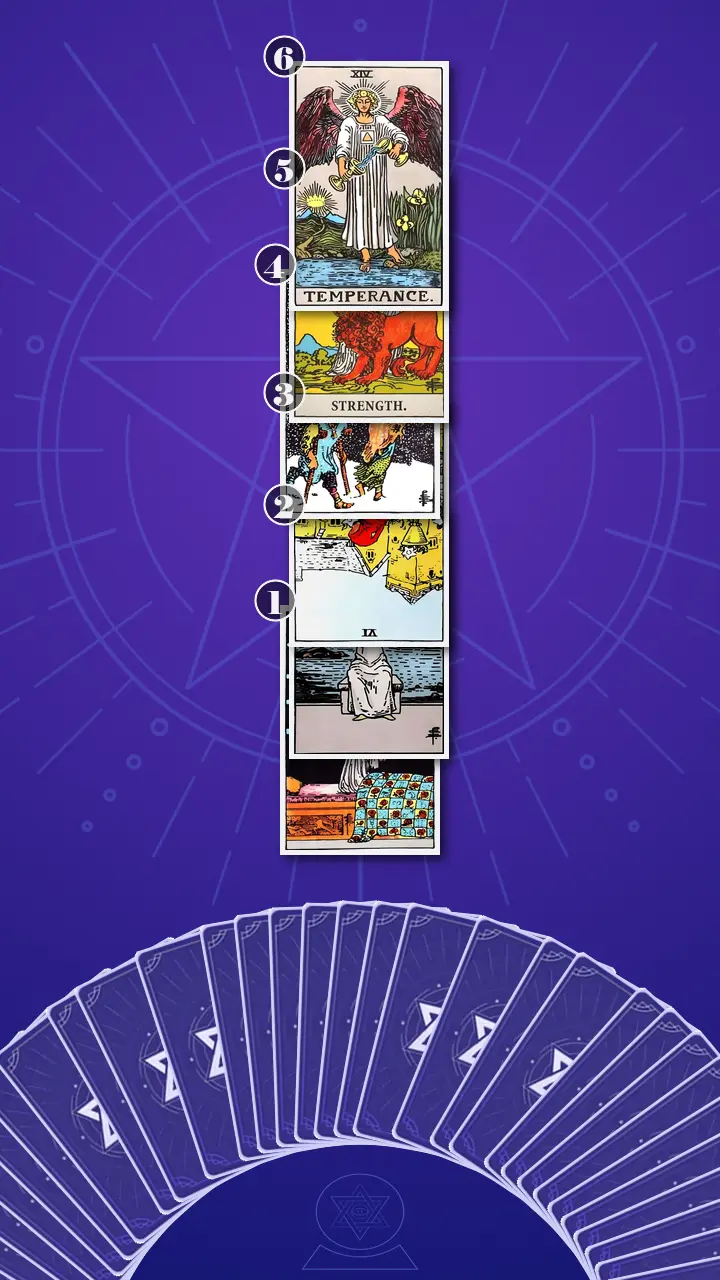
“Today,” I said, “we’ll use a spread I call the Four-Layer Insight Ladder · Context Edition.”
If you’ve ever searched how tarot works and felt skeptical, this is the part I always clarify: a spread like this isn’t about predicting whether your friend will text back. It’s about mapping a pattern—symptom → coping stance → origin story → core fear → reframe → actionable integration. Taylor’s question was explicitly about an “old timeline,” so we needed a structure that could separate today’s silence from yesterday’s conditioning, without flattening either.
In this ladder, the first card shows what you do in the first 24–48 hours (the visible behavior loop). The second shows your default protection move (how you try to stay safe, even if it keeps you stuck). The third names the old timeline that trained your interpretation of silence. The fourth touches the deeper fear underneath. The fifth is the turning point—the key shift that rebuilds self-trust before you reach out. The sixth is the grounded next step: balanced communication and a boundary with your attention.
Reading the Ladder: From “Evidence” to the Story You Add
Position 1 — The First 24–48 Hours: What You Do on Autopilot
“Now we’re turning over the card that represents what you do in the first 24–48 hours after a friend goes quiet, and how your mind frames the silence,” I said.
Nine of Swords, upright.
I didn’t even have to reach for a poetic metaphor—this card is already a whole midnight scene. “It’s 12:41 AM in your Toronto condo,” I told her, “the room is dark except for your phone glow. You open iMessage, then Instagram DMs, then back to iMessage like it’s a loop you can solve. You reread the last thread and zoom in on a harmless period or shorter reply like it’s a ‘tone shift.’ Your chest feels tight, your jaw locks, and you start writing a whole narrative: they’re mad, you overshared, you’re annoying, they’re drifting.”
This isn’t intuition. This is suffering-in-advance dressed up as analysis. In energy terms, it’s excess Air—too much thinking, too many sharp possibilities lined up on the wall like the nine swords in the image.
And then I used the split-screen contrast that always lands for people who live through this loop:
One screen: the phone-lit bed, your brain running trial footage of the last message like it’s evidence. The other screen: the next morning, you act calm in public—replying to Slack, liking someone’s post—while privately checking again, again, again.
Inside, it sounds like: If I text, I’m needy. If I don’t, I’m replaceable. If I wait, I’m safe… for now.
“It’s like your brain is trying to do incident response with zero data,” I said. “So it manufactures data out of punctuation.”
Taylor let out a short laugh that had a bitter edge. “That’s… rude,” she said, then immediately swallowed like she hadn’t meant to admit how accurate it was. Her fingers rubbed the side of her ring as if she could sand the feeling down.
Position 2 — The Protection Move: How You Freeze to Stay Safe
“Now we’re turning over the card that represents your default protection move—how you try to stay safe, especially the freeze/overthinking loop that keeps it stuck,” I said.
Two of Swords, upright.
“This is 9:08 AM,” I told her. “You’re on Slack and you can be competent in seconds—but one friendship text has you frozen. You draft three versions of ‘hey, all good?’ in Notes, delete all of them, and decide: ‘I’m not texting first.’ But you still keep the thread pinned. Still check who watched your story. Still glance at the green dot.”
In energy terms, this card is blockage. Not because you’re weak—because you’re trying to avoid pain. The blindfold isn’t stupidity; it’s a self-protection device. But it blocks new information too.
“You’re calling it boundaries,” I said carefully, “but it feels like emotional limbo. Like keeping a message in Drafts because it’s ‘safe storage,’ when really it’s a stalled conversation that keeps your nervous system on standby.”
I watched her shoulders rise a millimeter—as if the word standby described her whole week. She nodded once, but her mouth tightened in that specific way people do when they’re trying not to look “too much.”
“Silence is unknown—not evidence,” I added, letting it sit there as a hinge. “But when you’re wearing the blindfold, unknown feels like danger.”
Position 3 — The Old Timeline: Where You Learned What Silence ‘Means’
“Now we’re turning over the card that represents the old timeline that taught you what silence means—what you learned to assume, and what you still carry,” I said.
Six of Cups, reversed.
Reversed, this memory card stops being nostalgia and becomes a lens that won’t come off. “This is the time-travel card,” I told her. “The silence doesn’t just feel like today. It feels like an old classroom, an old group chat, an old friendship dynamic where attention was inconsistent and you learned to earn your spot by being easy, low-maintenance, and ‘fine.’”
When I said time-travel, her gaze shifted off the table for a second, unfocused—like she was replaying something without selecting it on purpose. Adult body in a condo bedroom; emotional brain suddenly eight years old.
“Today’s silence isn’t automatically about you,” I said softly. “Your old rule is about you.”
I asked her a question I ask often in my Jungian work: “If this were a story, what’s the rule the child version of you learned about quiet?”
She stared at the card. “Silence means I’m in trouble,” she said, almost like she didn’t want to hear her own sentence out loud.
“Good,” I said. “That’s not a life sentence. It’s a setting.”
Then I gave her the simplest reframe invitation, because complex explanations can become another kind of avoidance:
Old rule: “Silence means I’m in trouble.”
Adult update: “Silence can also mean they’re busy—and I can ask directly.”
She exhaled through her nose, slow and shaky, like her body finally had permission to stop pretending this was only about the present.
Position 4 — The Deeper Fear: What Silence Touches Underneath
“Now we’re turning over the card that represents the deeper fear the silence touches—worth, belonging, safety—and what you’re actually afraid it would prove about you,” I said.
Five of Pentacles, upright.
The image is two figures in the snow outside a stained-glass window—warmth visible, but not accessible. I translated it into her world immediately.
“It’s 6:19 PM on a Wednesday. You’re on the TTC, the train rocking slightly, you smell someone’s cologne nearby. You see your friend post a story—out at a bar, laughing, ‘active now’—while your message sits unanswered.”
“And your mind doesn’t land on ‘they’re busy.’ It lands on ‘I’m outside.’”
Her hand went to her sternum without thinking, as if her body was confirming the card. Chest tight. Jaw locked. A cold drop in the stomach.
“Wanting reassurance doesn’t make you clingy—it makes you human. What you do with it is the skill,” I said. “This card says the real fear isn’t delayed texting. It’s the belonging panic: I’m replaceable. I don’t have access to the warmth anymore.”
Her eyes went glossy fast—surprise tears, not dramatic ones. She blinked hard once, then looked down like she was embarrassed to have a nervous system at all.
I’d seen this on ships, too: guests didn’t panic because they didn’t know where the dining room was. They panicked because not knowing made them feel like they didn’t belong. The situation is different; the human pattern is the same.
When Strength Held the Lion at the Edge of “Send”
Position 5 — The Turning Point: The Key Shift That Breaks the Old Meaning
“Now we’re turning over the card that represents the key shift that breaks the old meaning of silence and rebuilds self-trust before you reach out,” I said.
The air in the room felt quieter as I flipped it, the way it does when something essential finally has a name.
Strength, upright.
“This is the moment your thumb hovers over Send,” I told her. “You’re about to text ‘Did I do something?’ because it would force an answer. But instead you notice the lion moment—the surge in your chest, the heat in your face, the urge to either chase reassurance or disappear. Then you do one long exhale, unclench your jaw, let your shoulders drop, and choose a message that isn’t a courtroom.”
Setup: Taylor’s face tightened like she was back in that 11:26 PM screen-glow trance—rereading the last thread like evidence because the quiet felt like it had to mean something about her. The old timeline wanted certainty before contact, like safety could be earned through perfect wording.
Delivery:
Stop treating silence as a verdict; practice calm self-leadership and let Strength tame the inner alarm before you text.
I let a pause hang, the way I used to let a wave pass before giving instructions on deck. Not to be dramatic—just to let the nervous system register that a new option exists.
Reinforcement: Taylor’s body reacted in a chain I’ve learned to watch for—because it’s the difference between “interesting” and “integrated.” First, a tiny freeze: her breath caught, and her fingers hovered above the edge of her phone like she might grab it. Then the cognition seeped in: her eyes lost focus for a second, like a memory was replaying—every time she’d tried to earn safety by being low-maintenance. Finally, the release: a deep exhale from her chest, shoulders lowering as if someone had loosened a strap she forgot she was wearing.
“But if I calm down first,” she said, and there was a flash of anger under the tenderness, “doesn’t that mean I was making it all up?”
“It means you were making meaning,” I answered, steady. “Which is what humans do. Strength isn’t saying you were wrong for feeling it. It’s saying: don’t abandon yourself by letting the alarm do the texting.”
This is where my own framework clicks in—something I call Social Role Switching, a tool I built from years navigating cruise-ship dynamics where people are stressed, tired, and interpreting everything through emotion. “Right now,” I told her, “you’re flipping between two roles: the Detective who hunts for tone changes, and the Ghost who disappears to avoid rejection.”
“Strength is a third role,” I said. “The Calm Leader. The part of you that can be warm without begging, direct without accusing. That’s self-leadership.”
I leaned in slightly. “Now, with this new lens—can you think of a moment last week when this would’ve changed how you felt?”
Taylor blinked, slower. “Wednesday on the TTC,” she said. “When I saw the story. I felt… outside. I could’ve done the reset then. Instead I went home and stared at my phone like it was a slot machine.”
“Exactly,” I said. “This isn’t about forcing yourself to be chill. It’s moving from dread-driven mind-reading into self-led steadiness. A reply doesn’t get to decide your worth.”
Position 6 — Integration: Balanced Communication and a Boundary With Your Attention
“Now we’re turning over the card that represents a balanced, practical way to communicate and set emotional boundaries so your nervous system doesn’t outsource stability to a reply,” I said.
Temperance, upright.
“One clean check-in,” I said. “No paragraphs. No bait. No emotional invoice. Then you set a boundary with your attention—Focus mode for an hour—and you return to your life.”
In energy terms, Temperance is balance. A volume knob instead of an on/off switch. Not flooding the friend with anxious energy, and not disappearing to protect pride. It’s measured flow.
I thought of the “Maritime Social Protocol” I used to teach onboard: when someone misses a meetup, you send one clear ping, then you go back to your duties. Not because you don’t care—because hovering creates panic, and panic spreads. Temperance is that same wisdom in modern friendships.
The Strength-Then-Text Protocol: Actionable Next Steps
I summarized what the ladder showed us in one clean story, because integration is where tarot becomes practical: your mind spikes into worst-case storytelling (Nine of Swords), then you freeze to avoid the risk of rejection (Two of Swords). Underneath, you’re not reacting to this friend alone—you’re reacting through an old timeline where silence meant trouble (Six of Cups reversed). And under that, the real ache is belonging: the fear of being outside the warm window (Five of Pentacles). The way out isn’t perfect wording; it’s self-trust in your body (Strength) followed by measured communication plus an attention boundary (Temperance).
The cognitive blind spot here is subtle: you treat anxiety as if it’s a signal to gather more “evidence,” when it’s often just your nervous system asking for safety. The transformation direction is clear: regulate first, then reality-test with one honest message—so you stop mind-reading silence and start collecting real information.
Here’s what I gave Taylor—small, doable, and designed for real life when you’re already activated:
- The 2-Minute Strength ResetBefore you text (or before you open the thread again), set a timer for 120 seconds. Inhale normally, then do a longer exhale like you’re fogging a mirror. Unclench your jaw on purpose and drop your shoulders. If it helps, place one hand on your chest.If doing this feels awkward, do it silently on the TTC or in the bathroom—no one has to know. You’re not “calming down to be nice.” You’re calming down to stay with yourself.
- One-Sentence Reality-Test Check-InSend one simple, non-accusatory message: “Hey, haven’t heard from you in a bit—no pressure to reply fast, just checking in. You okay?” Then stop. No follow-up paragraph. No second guess.Save it as a note or keyboard shortcut so you don’t have to reinvent wording while anxious. If you need an even lighter version, use: “Hey—thinking of you. Hope you’re okay.”
- Temperance Boundary: Focus Mode + Evidence vs StoryAfter you send, put your phone on Focus mode for 60 minutes and physically move your body (shower, stretch, walk to grab an iced coffee). If your mind tries to reopen the case, write a two-line “Evidence vs Story” note: 2 facts (e.g., “no reply in 3 days”), 2 stories (e.g., “I’m being replaced”).If you slip and check anyway, don’t punish yourself—restart the hour. This is nervous-system training, not a moral test.
Ownership, Not Certainty
A week later, Taylor sent me a message that wasn’t dramatic. It was the kind of text that tells the truth precisely because it’s small: “I did the 2-minute reset. Sent the one sentence. Put my phone on Focus and walked to the corner store. I still wanted to check the whole time, but it didn’t wreck my night.”
Her friend eventually replied—apologizing, explaining a messy family week. It didn’t erase the old timeline in Taylor’s body, but it did something more important: it gave her proof she could stay open without begging, and stay steady without pretending she didn’t care.
This is what I mean by a Journey to Clarity. Not certainty. Not mind-reading. Just ownership—of your breath, your message, and the part of you that’s allowed to want connection.
When someone goes quiet, it can feel like your chest tightens and your brain turns the pause into a verdict—because you’re craving closeness while bracing for the moment you’re quietly left out.
If you didn’t need a reply to feel worthy for the next hour, what would your most honest (and simplest) check-in sound like?