From Photo-Dump Shame Spirals to Grounded Worth: The Strength Pause

Finding Clarity in the 9:14 a.m. Photo Dump Audit
You re-check the same post multiple times, zooming into the background for evidence, even though you already know it’s making your chest tight.
Jordan (name changed for privacy) showed up to our session the way a lot of people do when they’re trying to look fine while their nervous system is absolutely not fine. It was 9:14 a.m. for her in a Toronto condo bedroom—grey light leaking through the blinds, duvet pulled up to her collarbone, the HVAC hum weirdly loud. She held her phone like it was warm and dangerous at the same time, thumb hovering over Instagram with that tiny, relentless hope that refreshing could rewrite reality.
“I know it’s just photos,” she said, but her voice had that thin edge, like she’d been swallowing words all night. “But it feels like a receipt for whether I matter.”
I watched her eyes flick down—post, faces, comments—like she was scanning for her own reflection in someone else’s glass. Wanting to feel chosen, but her brain treating not posted like not wanted. The shame wasn’t an abstract feeling; it sat in her body like a tight throat and a cinched chest, like she was trying to breathe through a scarf pulled too snug. Her hands kept doing that restless micro-reach for the phone, the way you touch a bruise to confirm it still hurts.
“So the question isn’t only ‘Why didn’t they post me?’” I said gently. “It’s ‘Why does a missing photo turn into an identity verdict so fast?’ And the worst part is the inner OS prompt you get right after: Do I say something… or pretend I’m chill?”
She let out a small laugh that had more bitterness than humor. “Wait—how do you know I literally zoom in on the background like it’s a crime scene?”
“Because you’re not the only person living in the visibility economy,” I said. “And because we can map this. Today’s not about judging you for caring. It’s about finding clarity—so your worth doesn’t keep getting negotiated in blue light.”
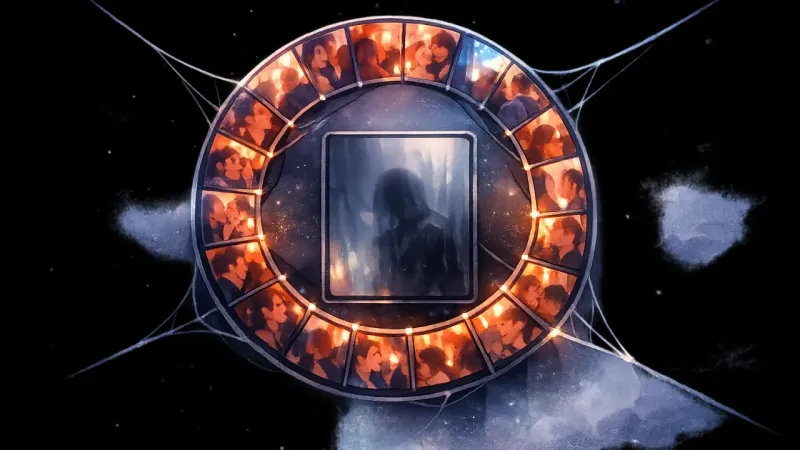
Choosing the Compass: A Celtic Cross for Belonging Anxiety
I was calling in from my little office at the Tokyo planetarium—after hours, when the building smells faintly like warm electronics and dust from the star projector. I always like that in-between time: the sky outside is real, but inside we’re also practicing how humans make meaning out of lights in the dark.
I asked Jordan to take one breath where she could actually feel her ribs move, then another where she let her shoulders drop a millimeter. Not as a mystical ritual—more like pressing “pause” before we press “play.” While she breathed, I shuffled slowly, letting her question stay specific: Not in the photo dump—why does my self-worth spiral?
“For this,” I told her, “I’m using the Celtic Cross.”
And for you reading this: the Celtic Cross works here because it holds both layers at once—the immediate trigger (the post, the missing tag, the comment that hits like a slap) and the deeper mechanics (the attachment to visibility, the compulsive checking loop, the mind’s habit of turning uncertainty into a story). It has a clean logic chain: present tension (Cards 1–2) → root cause (3–4) → healthy aim and next internal skill (5–6) → self + environment + projection (7–9) → integration (10). It’s basically a map for “how did we get here, and what’s the next right move?”
In this reading, I wanted Jordan to pay special attention to three positions: the center card that shows what the spiral looks like in her body right now, the foundation card that reveals what’s driving the compulsion beneath “it’s just photos,” and the near-future card—the practical skill that can bridge her from shame to steadiness.
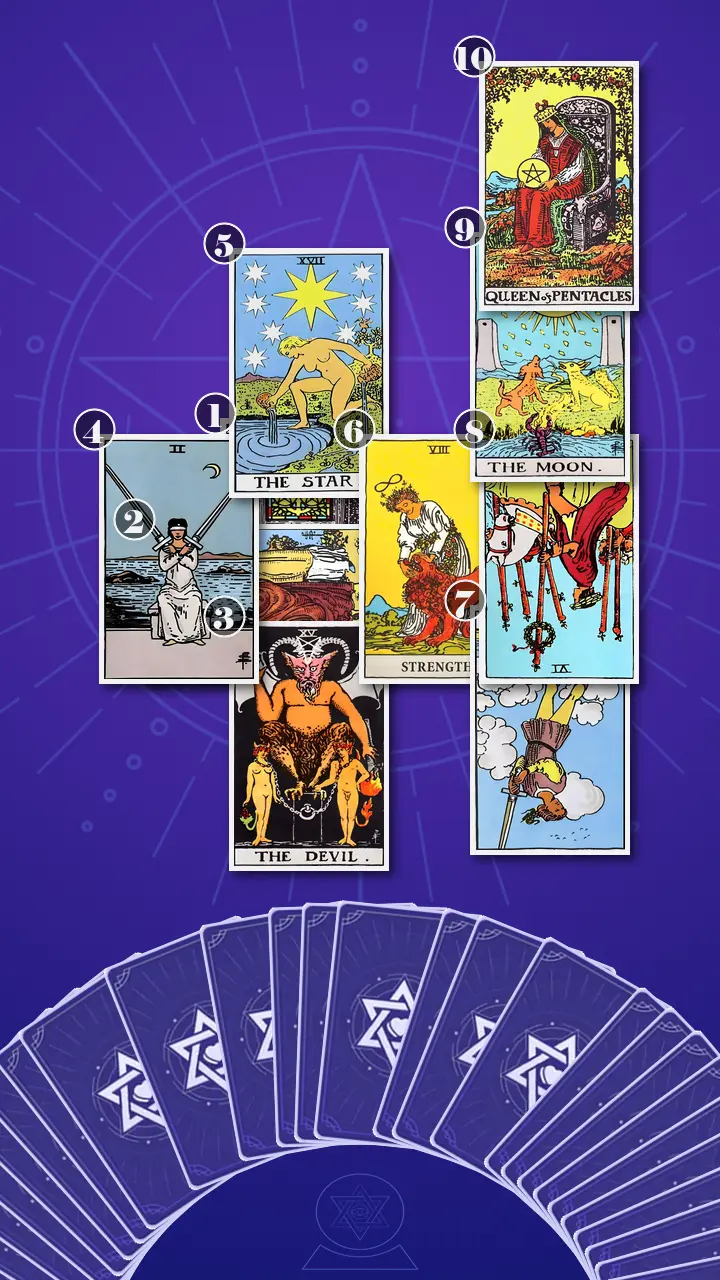
Reading the Map: Card Meanings in Context
Position 1: The immediate self-worth spiral trigger — Five of Pentacles (upright)
“Now we turn over the card that represents the immediate self-worth spiral trigger and what it feels like in your body and daily behavior right now,” I said.
Five of Pentacles, upright.
“This is like when you sit in bed refreshing a post, feeling you’re on the cold sidewalk of the group while everyone else is ‘inside’ the warm room of belonging.” I didn’t soften it, because this card doesn’t. Two figures outside a lit window. The body knows this feeling: tight throat, sinking stomach, fingers that won’t stop tapping refresh.
The energy here is scarcity—not in money, but in belonging. It’s a deficiency state: your mind discounts every warm moment you actually lived and hyper-focuses on what’s missing, like one absent photo means the whole night didn’t count.
Jordan’s mouth twitched again—another almost-laugh, almost-wince. “That’s… kind of cruelly accurate.”
“It’s accurate,” I corrected softly. “Not cruel. Also—this matters: A photo dump is not a receipt for your worth. But your nervous system is treating it like one.”
Position 2: What intensifies the spiral — Three of Cups (reversed)
“Now we turn over the card that represents what is actively intensifying the spiral—the friction point between belonging needs and social comparison.”
Three of Cups, reversed.
“This is like when you interpret a casual group post as a scoreboard of closeness, where being featured equals being ‘in’ and being missing equals being disposable.”
In a balanced state, Three of Cups is ease—friendship as nourishment. Reversed, the energy gets blocked and twists into: Who’s the inner circle? Who’s the extra friend? It turns celebration into ranking, even if nobody consciously meant it that way.
I asked, “When you saw the post, what was the detail that flipped the switch—caption, comment, who got the best angle?”
“The comments,” she said instantly. “Like… ‘best night ever’ and inside jokes. I was there. But it reads like I wasn’t.”
“Right,” I said. “Your mind isn’t just noticing absence. It’s translating it into a social status statement.”
Position 3: The root under ‘it’s just photos’ — The Devil (upright)
“Now we turn over the card that represents the underlying attachment driving the compulsion to seek proof.”
The Devil, upright.
“This is like when you promise yourself you won’t check, then ‘just quickly’ open the app again—because the chain is psychological, not physical.” The chains in this card are loose. Which is both the bad news and the good news.
The energy here isn’t evil. It’s compulsion—an excess of attachment to external approval. The feeling underneath is: If I’m not visibly chosen, I’m not safe.
I narrated a mini-scene, because sometimes you have to see the loop to stop calling it “just being thorough.”
You’re in bed. Phone in hand. You tell yourself, One more check, then I’ll stop. Your thumb refreshes. Zooms. Scans. You feel a micro-hit of control—like maybe you’ll finally find the missing piece that makes it make sense. Then the control collapses into more questions, so you check again. The loop isn’t trying to hurt you; it’s trying to end uncertainty. It just can’t.
Then I shifted it into the courtroom, the way I do when a person is building a case against themselves.
Prosecutor (the mind): “Exhibit A: you’re not in the photo dump.”
Witness (the body): “My throat is tight. My chest feels pinned.”
Prosecutor: “Exhibit B: they wrote ‘best night ever’ without mentioning you.”
Witness: “My stomach dropped. My hands won’t be still.”
“You see the problem?” I asked Jordan. “The Prosecutor keeps presenting screenshots. The Witness keeps presenting sensation. And you keep trying to win the trial instead of tending to the person on the stand.”
Jordan went quiet, then nodded—small, uncomfortable, but real. The kind of nod that says, Okay, you got me.
“Also,” I added, “this is important: You’re not desperate—you’re dysregulated. That’s not an insult. That’s a map.”
Position 4: The coping style that’s been holding you — Two of Swords (upright)
“Now we turn over the card that represents how you’ve been coping recently—where you’ve been holding back needs or freezing in uncertainty.”
Two of Swords, upright.
“This is like when you tell yourself you ‘don’t care’ and stay silent, while your body is tense and your mind is running scenarios in the background.”
The energy here is a stalemate. Not balance—more like emotional shutdown disguised as being chill. It’s a protective deficiency: you deny the need so you don’t have to risk asking.
I said, “You’ve been trying to manage uncertainty by not choosing a stance. Not naming the need. Not looking directly at it.”
Jordan’s eyes flicked away from the screen, as if she’d just been caught reading her own diary. “Yeah. Because if I bring it up, I’ll look insecure… and then it’ll be true.”
“Or,” I offered, “it could be true that you have a need for reassurance and you’re still a dignified person.”
Position 5: What you want instead — The Star (upright)
“Now we turn over the card that represents what you truly want instead of the spiral—the healthy aim you’re trying to reach.”
The Star, upright.
“This is like when you choose to close the app, take a breath, and do one grounding thing—shower, walk, journal—before you let the internet narrate your value.”
This card changes the camera angle. Up until now, everything has been tight framing: screenshots, zooming, counting, scanning. The Star is the zoom-out. The kettle click. Shower steam. The moment fresh air hits your face and you remember you exist outside an app.
I watched Jordan’s shoulders drop a fraction, like her body recognized the possibility before her mind did.
“I can be tender with myself,” she said slowly, like she was testing the words, “without pretending this doesn’t hurt.”
“Exactly,” I said. “The aim isn’t to become someone who never gets stung. The aim is to stop turning the sting into a verdict.”
When Strength Spoke: The Move That Changes the Spiral
Position 6 (Key Card): The next internal skill — Strength (upright)
When I turned the next card, the room felt quieter—like even the planetarium’s distant air system had decided to listen. “Now we turn over the card that represents the next best internal shift available—a practical emotional skill to move from shame to steadiness.”
Strength, upright.
Setup. I told her, “This is the exact moment you described: it’s 9:12 a.m., you’re still in bed, thumb hovering over Instagram. You open the photo dump, zoom in on the background like it’s evidence, and your stomach drops—your brain turns ‘not posted’ into ‘not wanted’ in under ten seconds.”
Jordan’s face tightened, like her body wanted to argue with the simplicity of it. Her mind wanted a more complex explanation—something that felt like control. Something that felt like safety.
Delivery.
Stop wrestling the feed for proof of belonging; practice Strength by calming the ‘lion’ of your reaction with steady, compassionate self-leadership.
I let it hang there for a beat.
Reinforcement. Jordan’s first reaction wasn’t soft. It was sharp—an unexpected flash of anger, the kind that shows up when a pattern is named cleanly.
Her breath caught (freeze), her fingers hovered in mid-air like she’d been about to tap her phone (the habit trying to complete itself), then her gaze unfocused for a second, as if a week of late-night refreshing replayed behind her eyes (cognitive seep). Her jaw clenched, then released. She swallowed hard. Her eyes went glassy, not quite tears, but close enough that she blinked twice like she was negotiating with her own face (emotional release trying to stay contained).
“But if I’m the one who has to calm it,” she said, voice tight, “doesn’t that mean… I’ve been doing it wrong? Like, all this time?”
“No,” I said, very steady. “It means you’ve been trying to soothe a lion by interrogating it. And lions don’t respond to cross-examination. They respond to leadership.”
This is where I brought in my own lens—something I learned as much from astronomy as from tarot.
“In astrophysics, there’s a thing called redshift,” I said. “It’s how we detect when something is actually moving away—distance, separation, drift. My Cosmic Redshift Communication skill is basically: don’t confuse a noisy signal for actual distance. Social media is full of distorted wavelengths. A missing photo can look like ‘they’re moving away’ when the relationship itself hasn’t changed at all.”
“So what Strength asks,” I continued, “is: before you decide this is redshift—before you decide it means you’re not chosen—you lead your nervous system first. Because the lion isn’t wrong. It’s loud.”
I slid the practice to her in plain terms, the way I’d explain a constellation to a middle-school class: simple enough to use, real enough to work.
“Do a 2-minute Strength Pause before you check,” I said. “Phone face-down. One hand on your chest. Inhale for 4, exhale for 6, twice. Name it: ‘This is shame + panic.’ Then choose: wait two more minutes, or check once—no zooming—and close the app. If your body spikes, you’re allowed to stop immediately. This is practice, not a test.”
I watched her shoulders sink on the exhale, like she’d been holding them up by her ears for days. There was relief, but also that strange dizziness that comes when a person realizes: Oh. I can’t outsource this.
“Now,” I asked, “with this new lens—reaction as practice, not visibility as proof—can you think of one moment last week when this would have changed how you felt?”
Jordan stared down and then nodded once, slow. “On the TTC,” she said. “I re-opened the post and counted tags like… like it was going to tell me who I am.”
“That’s the bridge,” I told her. “Not from ‘hurt’ to ‘unhurt,’ but from shame spiral to grounded self-leadership.”
Position 7: Your stance and self-talk — Page of Swords (reversed)
“Now we turn over the card that represents your current stance and self-talk pattern—how you’re relating to the trigger inside your own mind.”
Page of Swords, reversed.
“This is like when you treat social media like an investigation, collecting micro-signals and trying to predict rejection so you won’t be surprised.”
The Page of Swords is mental sharpness. Reversed, it becomes excess—self-surveillance, assumption-making, doomscrolling disguised as “just getting clarity.”
I looped it back to the Devil, because these two together are basically the spiral in stereo.
“Here’s the compulsion in one line,” I said: “Your mind tries to protect you by watching harder. But watching harder makes you feel less safe.”
Jordan nodded again, quieter this time. The energy in her face shifted from defensive to tiredly honest.
Position 8: The environment pressure — Six of Wands (reversed)
“Now we turn over the card that represents the social-media and friend-group context shaping recognition and exclusion.”
Six of Wands, reversed.
“This is like when you feel that friendship only ‘counts’ if it shows up in a highlight reel, even if the real closeness happened privately.”
This card is the visibility economy, spelled out. Recognition is supposed to be celebratory; reversed, it becomes unstable and externally controlled—who gets tagged, who gets the best angle, who gets the inside-joke comments. The energy is inconsistent feedback, and it’s not distributed fairly online.
I could almost see Jordan reliving the scroll: the pause on a friend’s face, the quick swipe to comments, the silent math of closeness.
“Relief-and-annoyance moment,” I said, naming what I saw. “It’s not just you being ‘crazy.’ This environment is built to make visibility feel like value.”
“Yeah,” she admitted. “Like Close Friends stories are… a literal inner circle.”
“Exactly,” I said. “And your nervous system takes it personally.”
Position 9: Hopes and fears — The Moon (upright)
“Now we turn over the card that represents the hope for clarity and the fear of what uncertainty ‘means’—the projection layer of the spiral.”
The Moon, upright.
“This is like when you read a quiet group chat or an untagged photo as a hidden message about your worth, even though no one has said anything directly.”
The Moon is uncertainty plus imagination. The energy is projection: the mind fills blanks with the scariest story, because fear hates an empty space.
I gave her a split-screen, choose-your-own-narrative version—because this is where cognitive flexibility gets born.
Lane A (the scariest story): They didn’t post you because you’re not really part of the group. You were embarrassing. You’re convenient, not chosen.
Lane B (three equally plausible explanations): 1) They posted what looked aesthetically cohesive (not a relationship audit). 2) You were in someone else’s camera roll, not the person who posted. 3) They didn’t think about it that hard—because to them, you’re already included offline.
Jordan swallowed, hand going instinctively to her chest like she’d finally noticed how hard it was working. “My throat gets tight and then I decide Lane A is… facts.”
“That’s the Moon,” I said. “And here’s your anchor sentence for it: Visibility is noisy data, not a verdict.”
Position 10: Integration — Queen of Pentacles (upright)
“Now we turn over the card that represents how integration looks when you act from self-worth—the most grounding way forward.”
Queen of Pentacles, upright.
“This is like when you stop trying to ‘win’ the feed and instead build a week that feels secure—meal prep, budgeting, therapy/journaling, movement, and one reliable friend date.”
The Queen’s energy is steady Earth—balanced, resourced, tangible. She holds her value in her own hands. Not in the comments. Not in the tags.
“Private consistency counts—even when it’s not postable,” I said. “This card doesn’t ask you to become above it all. It asks you to become held—by you.”
From Insight to Action: The Strength Pause Protocol
I leaned back and let the whole story knit itself together, because the Celtic Cross is only useful if it becomes coherent.
“Here’s what I see,” I told Jordan. “You get a real sting (Five of Pentacles). That sting gets intensified by the way group joy can turn into comparison online (Three of Cups reversed). Underneath, the checking is driven by attachment—your brain chaining worth to visibility (The Devil). You’ve been coping by playing it cool and keeping your needs blindfolded (Two of Swords). What you actually want is healing and self-acceptance (The Star). The bridge is Strength: lead your reaction with calm, compassionate control. Because your mind’s current stance is self-surveillance (Page of Swords reversed), and your environment rewards public recognition in a way that’s honestly messy (Six of Wands reversed). The Moon shows why it gets so cinematic so fast—uncertainty becomes a fear-forecast. And the way forward is Queen of Pentacles: self-worth as practice, in your body, in your routines, in your real life.”
Your cognitive blind spot, I named gently, “is treating visibility like proof—like the post can accurately measure something as complex as belonging. The transformation direction is the opposite: treat visibility as data with limits, and do one self-validating action before you reach for external validation.”
Then I gave her the smallest possible next steps—the ones that work even when you’re tired, even when you’re tempted, even when your brain says, This is stupid.
- The 2-minute Strength Pause (once a day)When the urge to check hits, put your phone face-down on the bed or counter. One hand on your chest. Inhale 4, exhale 6, twice. Name it out loud: “This is shame + panic.” Then choose: wait 2 more minutes, or check once with a no-zoom rule and close the app.If 2 minutes feels impossible, do 60 seconds. You’re interrupting the automatic spiral, not “fixing yourself.” If your body spikes, stop and do something physical (water, stretch, step outside).
- The 3-line Offline Proof note (after any hangout)Before you open Instagram, open Notes and write: (1) one shared laugh, (2) one kindness exchanged, (3) one thing you contributed. Keep it factual—no poetry, no performative self-improvement.If journaling makes you cringe, use a saved template. This is for you, not content—no posting, no screenshotting.
- One connection bid within 24 hoursText one friend you genuinely like: “Coffee this week?” That’s it. No mention of the photo dump. Make it about real connection, not a trial about the post.If your brain wants to draft-and-delete, send the simplest version. One sentence is enough. Let the relationship answer with reality, not your fear-story.
Before we ended, I offered one of my own strategies in a way that wouldn’t turn into another performance metric.
“If it helps,” I said, “make a tiny Social Star Map for the week. Not a packed schedule—just a focus. One ‘Venus’ moment (a warm, steady one-on-one coffee), one ‘Saturn’ boundary (a no-zoom rule with a timer), and one ‘Earth’ deposit (something you can touch—laundry reset, groceries, a walk). It’s not about being social. It’s about being resourced.”
A Week Later: The Quiet Proof
A week later, Jordan messaged me. Not a paragraph. Just a screenshot-free sentence: “I did the Strength Pause on the streetcar. I still checked later, but I didn’t zoom, and I didn’t spiral.”
She told me she sent the “Coffee this week?” text to one friend—hands shaking a little, then relaxing when the reply came back: “Yes. Thursday?” No dramatic confrontation. No social media detective work. Just a real plan on a real day.
Her bittersweet proof came in the smallest form: she slept through the night for the first time in a while, but when she woke up, her first thought was still, “What if I’m wrong?”—and then she breathed once and thought, “Even if I’m wrong, I can handle the feeling first.”
That’s what I mean when I say tarot is a Journey to Clarity. Not certainty. Ownership. A shift from treating visibility as a verdict to treating it as imperfect data—and leading yourself with steadiness anyway.
When you’re not in the photo dump, it can feel like your chest tightens and your whole worth gets negotiated in the blue light of your phone—like being ‘unseen’ online means you’re not truly chosen in real life.
If you treated visibility as imperfect data for one week—not proof—what’s one tiny way you’d want to lead yourself through the sting before you reach for your phone?