Late-Night Calendar Tetris, Replaced by One Fairness Rule

The “Sure, That Works” Reflex—and the 11:30 p.m. Calendar Tetris
If you’re the kind of person who replies “Sure, that works” to a Slack ping before you even open your calendar—then ends up double-booked anyway—this is probably your overcommitment loop.
Jordan (name changed for privacy) sat across from me on a video call from their Toronto condo living room, lit mostly by laptop glow and the faint streetlamp stripes through the blinds. It was late enough that the city sounded softened—just the distant hush of traffic—and yet their trackpad clicks were sharp, almost accusatory. They kept dragging color-coded Google Calendar blocks for what sounded like the fourth time, phone still warm in their hand as if it had been clutched through the whole reshuffle.
“I don’t know why I keep doing this to myself,” they said. “I say yes and then I’m trapped by my own calendar.”
I watched their jaw work—tight, then tighter—like they were trying to bite down on the week itself. The overwhelm wasn’t an abstract feeling; it was more like standing under a flickering subway light while someone keeps stacking boxes into your arms and asking you to smile like it’s fine.
“You want to be the dependable one,” I said gently, “but every ‘yes’ keeps costing you the one person you can’t reschedule: you. Let’s use the cards to draw a map through this—something that gives you clarity and a next step you can actually try this week.”

Choosing the Compass: The Transformation Path Grid for Overcommitment
I asked Jordan to take one slow breath and to hold a single, plain question in mind: What loop is running when I overcommit—and what’s my next step out? While they exhaled, I shuffled—not as theater, but as a transition. A way of stopping the autopilot long enough for something truer to speak.
“Today,” I told them, “we’ll use a spread I call the Transformation Path Grid (6) · Context Edition.”
For you, the reader: this is the spread I use when the problem isn’t a lack of tools, but a repeating inner loop—impulse yes, later scramble. It’s compact on purpose: present symptom → main blockage → root driver → pivot → next step → integration. It answers “what loop is this?” and “what do I do next?” without drifting into vague prediction.
I pointed to the layout as I placed the cards into a simple 2x3 grid. “The top row names the loop: what you’re doing, what’s blocking you, what’s underneath it. The bottom row shows the pivot and the practice—how we break the pattern in real time and what balance looks like when it starts to stick.”
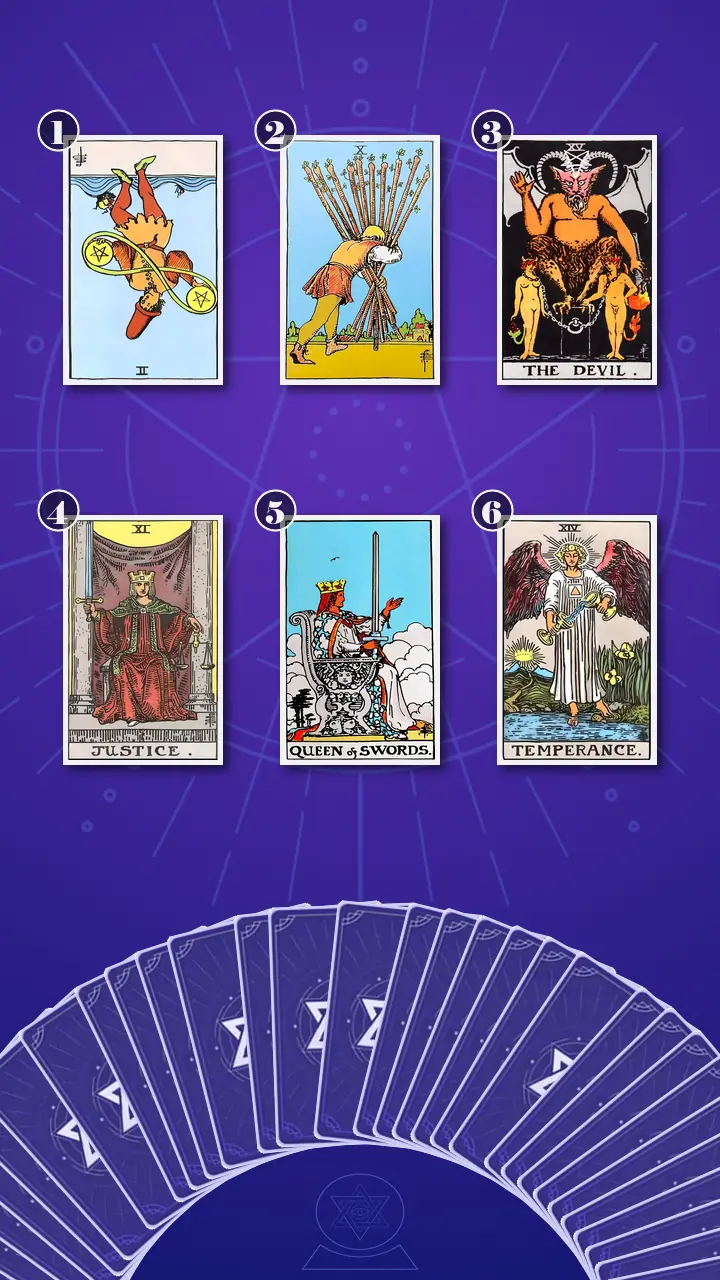
Reading the Map: Card Meanings in Context
Position 1 — The Observable Symptom: What double-booking looks like right now
“Now flipped,” I said, “is the card that represents the observable overcommitment symptom: what your double-booking behavior looks like in real life right now.”
Two of Pentacles, reversed.
In the old image, the juggler tries to keep two coins spinning inside an infinity loop while rough waves rise behind him. Reversed, that motion turns unstable—less ‘nimble,’ more ‘about to drop everything.’
“This is you accepting a meeting invite while walking back from coffee,” I said, tying it directly to their week. “Then later realizing it overlaps with another call. Instead of renegotiating, you start playing calendar Tetris—moving lunch, pushing a workout, squeezing errands into late night. The week stays in motion so you can avoid the tiny discomfort of saying, ‘I need to check first.’”
Energetically, it’s a blockage of Earth energy: time and resources can’t settle into a stable container because the container keeps getting edited. Like a shared doc anyone can change—then being shocked the final version is chaos.
Jordan let out a short laugh that had a bitter edge. “That’s… way too accurate,” they said. “Like, kind of brutal.”
“Brutal,” I agreed, “but also clarifying. It tells us the issue isn’t your calendar app. It’s what happens before the calendar even gets a vote.”
Position 2 — The Main Friction Point: What makes it hard to slow down and check capacity
“Now flipped,” I said, “is the card that represents the main friction point: what makes it hard to slow down, check capacity, and keep commitments realistic.”
Ten of Wands, upright.
“This card always makes me think of carrying too many tote bags through Union Station,” I told them. “Your phone keeps buzzing, and every new ping feels like it has to be balanced on top because your hands are already full.”
I kept the translation simple and concrete: “Your calendar looks packed in a way that could read as impressive, but it feels like you’re carrying the whole team’s weight. You’re so loaded you can’t see ahead—so conflicts don’t feel planned, they feel like they appear out of nowhere.”
This is Fire in excess: effort used to keep everything held up, even when it blocks your view. The dependable image stays intact; the depleted reality gets hidden behind late nights and skipped meals.
Jordan’s shoulders dropped a fraction. A slow exhale. Then a small nod—more resignation than drama. “I can handle it,” they murmured, as if quoting their own inner script. “I should handle it. Why can’t I handle it?”
“Fast yeses feel kind in the moment,” I said. “They don’t always feel kind on Thursday night.”
Position 3 — The Underlying Hook: The belief that keeps the loop running
“Now flipped,” I said, “is the card that represents the underlying hook: the belief or fear that keeps the overcommitment loop running.”
The Devil, upright.
I’ve excavated sites where a small, unseen constraint—one collapsed wall, one hidden void—dictated the whole shape of what could be built above it. This card is like that. It isn’t ‘evil.’ It’s a binding mechanism.
“This is the moment you hover over ‘Decline’ on a Google invite,” I said, “and your thumb freezes like it’s wired directly to other people’s opinions. Your nervous system treats a request like a belonging test. You say yes to stay safe—liked, included, competent. Later, when the schedule collapses, you feel trapped by your own yes… but the trap isn’t the calendar. It’s the belief that disappointing someone proves you don’t belong.”
Energetically, it’s attachment in excess—approval as safety. The chains in the image are loose, but they feel tight.
Jordan’s face went still in a three-step sequence I’ve learned to respect: first a tiny breath-hold, then their eyes unfocused as if replaying a dozen Slack moments, then a swallow that made the throat move like a hard truth passing through. “If I don’t answer fast,” they said quietly, “what story will they tell about me?”
“Exactly,” I replied. “And that’s why a better Notion template won’t fix it. We need a new standard—something that interrupts the loop in the moment.”
When Justice Spoke: Fairness to Capacity, Not Faster Yeses
Position 4 — The Turning Mechanism: The standard that interrupts the loop
“We’re turning over the pivot,” I said. “This card represents the turning mechanism: the mindset or standard that can interrupt the loop in the moment you’re about to say yes.”
The room felt quieter—like even the background hum of Toronto paused to listen.
Justice, upright.
In one hand, scales. In the other, a sword held straight—not threatening, just clean. I felt my old academic reflex spark: in ancient cities, Justice wasn’t a vibe. It was architecture—weights and measures in the marketplace, inscriptions that made agreements visible. Fairness wasn’t wished for; it was structured.
Setup: Jordan had been trapped in a belief that reliability meant instant agreement. Say yes now, feel relief now. Pay for it later—in missed meals, cramped shoulders, apology texts, and the private shame-flush of overlapping blocks at 11:30 p.m.
Delivery:
Not “I can make anything work,” but “I choose what’s fair”—let the scales of Justice set the standard and the sword make the decision clean.
I let the sentence sit between us the way an inscription sits on stone—unchanged by mood, readable in any weather.
Reinforcement: Jordan reacted in layers. First, their jaw loosened like a muscle that had forgotten it could. Then they blinked, a little too slowly, and their eyes got bright—not full tears, but the glassy edge of recognition. Their shoulders sank down and back, and for a second they looked almost dizzy, as if the idea of a fair rule had rearranged gravity.
“But… if I do that,” they said, and their voice tightened with a flash of anger, “doesn’t it mean I’ve been doing it wrong this whole time?”
“It means you’ve been doing what worked to keep belonging,” I said carefully. “That’s not ‘wrong.’ It’s just expensive. Justice doesn’t scold—Justice recalibrates.”
I leaned in with my own diagnostic lens—what I call Ancient Reflection: the way historians review a collapse without contempt, just cause-and-effect. “Let’s audit the pattern like an archaeologist,” I said. “Trigger: ping. Reflex: yes. Relief: immediate. Cost: later chaos. If we change only one piece—insert a pause—the whole ruin stops repeating.”
“Now,” I asked them, “with this new lens—fairness to capacity—can you remember a moment last week when this would have changed how you felt?”
Jordan stared at the card, then looked off to the side like they were seeing their calendar in their mind. “Thursday,” they said. “Someone asked for a ‘quick sync.’ I felt my chest drop, like… like I had no choice. I could’ve said I’d confirm. I could’ve checked what it would replace.”
“That’s the shift,” I told them. “From overwhelm-and-guilt reflexes toward values-based boundaries. Not a personality transplant—just a new rule.”
Position 5 — The Next Doable Step: Boundary communication you can practice this week
“Now flipped,” I said, “is the card that represents the next doable step: the communication or boundary behavior you can practice this week.”
Queen of Swords, upright.
“This is the two-line message,” I said, smiling a little. “You reply with two clean sentences instead of a paragraph. No over-apology, no backstory, no ‘I can maybe…’ that invites bargaining. You sound calm because you’re not trying to prove you’re nice—you’re being clear.”
Energetically, it’s Air in balance: truth with steadiness. Clarity without cruelty.
I gave them a before/after contrast, because it matters. “Before: nine lines of ‘so sorry, totally understand, my bad.’ After: ‘I can’t make that time. I can do Thursday at 2.’”
Jordan rolled their shoulders once, like unclenching a strap. “I… weirdly want to copy/paste that,” they admitted.
“Good,” I said. “That’s your body recognizing a lower-cost path.”
Position 6 — Integration: What a healthier rhythm looks and feels like
“Now flipped,” I said, “is the card that represents integration: what a healthier rhythm looks and feels like when the new standard is applied consistently.”
Temperance, upright.
“This isn’t a dramatic overhaul,” I told them. “It’s sustainable balance built through small, repeated adjustments.”
I translated the imagery into modern sensory reality: “Think of your week like a playlist crossfade instead of abrupt track cuts. Commute, food, decompression—those are the fade. When you protect transitions, you stop treating your nervous system like a disposable resource.”
Energetically, it’s blending—Water and Earth in balance. A repeatable rhythm instead of crisis-mode scheduling.
The One-Note “Fairness Rule” and the Weigh–Speak–Stabilize Cadence
I threaded the whole grid into one story for Jordan: “You’re not ‘bad at scheduling.’ You’re in a loop where a fast yes buys short-term safety, and then your calendar collects the debt—double-booking, late-night reshuffling, apology texts. Ten of Wands shows the overload that blocks your view. The Devil shows the hook: approval mistaken for belonging. Justice replaces that hook with a fair standard. The Queen of Swords turns the standard into clean language. Temperance is what happens when you repeat it long enough to feel steady.”
“Here’s the blind spot,” I added. “You keep trying to solve an identity fear with a system upgrade. More color-coding. More rules. More reshuffling. But the transformation direction is simpler: from instant agreement to a default pause that treats your calendar as a boundary you can trust.”
Then I gave them actionable advice—small, specific, and designed for real life, not fantasy weeks. I also used one of my own interventions—Inscription Affirmations—because Justice works best when the rule is written like a carving, not negotiated like a mood.
- Install the 30-minute confirmation ruleCreate a text shortcut on your phone for: “Let me check my calendar and I’ll confirm in 30.” Use it for every new request this week—Slack pings, meeting invites, friend texts.Expect resistance; if someone pushes, repeat once. If your chest tightens, step away for 60 seconds before replying—the win is creating the pause.
- Write a one-line Fairness Rule (your Justice inscription)In your Notes app, title a note “Fairness Rule.” Write one sentence you can remember under pressure, like: “If it replaces rest, meals, or deep work, it’s a no—or it needs a trade.” Before you confirm anything, say the trade out loud: “If I say yes, I’m moving ___.”Keep it simple enough to use on the TTC with Slack buzzing. Consistency matters more than perfection.
- Pin two Queen of Swords scriptsDraft and pin two replies: (1) “I can’t make that time.” (2) “I can’t do this week, but I can do Thursday at 2.” Use one once this week without adding a paragraph afterward.If “no apology” feels too edgy, allow one softener—then stop. Clarity is not cruelty—especially when it saves your follow-through.

A Week Later: The Quiet Proof of Finding Clarity
Six days later, Jordan messaged me a screenshot—not of a perfect calendar, but of a single moment. A Slack thread where someone asked for a “quick sync,” and Jordan’s reply was clean: “Let me check my calendar and I’ll confirm in 30.” Beneath it, they’d typed: “I didn’t die. No one hated me. And I didn’t have to move lunch.”
It was almost comically small. And that’s why it mattered. Reliability wasn’t being proven by speed anymore. It was being proven by realism—and a fairness standard they could repeat.
When your calendar double-books, it’s not just logistics—you can feel your chest drop because somewhere in you, “no” still sounds like losing belonging.
If you gave yourself permission to pause before the next yes—just long enough to check what it would cost you—what would you want your calendar to protect first?