When Old Trophies Trigger a New Audition: Practicing Clean Boundaries

The Dusty Trophy Drawer and the Invisible Audition
If you’ve ever found old trophies/certificates and immediately felt like you’re back in an invisible audition, you’re not imagining that pressure.
Maya (name changed for privacy) sat cross-legged on the floor of her small Toronto apartment, one drawer yanked open like it had confessed something. The air was dry in that late-Sunday way—stale heat, a faint papery-dust smell—and the trophy in her hand was colder than it had any right to be. Her laptop hummed on the couch behind her, and her phone kept lighting up with Slack notifications like a tiny strobe.
She stared at the little gold figure on top, then at her screen, and I watched her throat work like she was swallowing around a pebble.
“It’s stupid,” she said, voice tight. “But I found these trophies and I swear my brain went, cool, so I have to keep being that impressive forever. Now I’m rewriting everything. Like… I keep rewriting Slack replies so I don’t sound rude. I say yes to stuff and then panic because my calendar is full. And then I’m resentful at everyone—even though I technically volunteered.”
It came out fast, like she was trying to get ahead of the verdict.
Her insecurity wasn’t an abstract feeling—it lived in her body like a tightened drawstring: throat cinched, stomach clenched, bracing for the moment someone might be disappointed and decide she was “difficult.”
I nodded slowly, keeping my voice soft and clean. “That makes total sense. Your system is reacting like those trophies aren’t memories—they’re a contract. Let’s not shame it, and let’s not let it run the show either.”
I set the trophy down on the coffee table like we were placing a weight outside the conversation. “We’ll use tarot the way I use sound in radio: not to magically fix you, but to help us hear what’s actually driving the noise. Today is a Journey to Clarity—so you can be kind without abandoning yourself.”

Choosing the Compass: The Four-Layer Insight Ladder Tarot Spread
I asked Maya to take one slow inhale and a longer exhale—nothing mystical, just a nervous-system gear shift. While she held the question in mind (“Found my trophies—why does people-pleasing run me? Next step”), I shuffled at an unhurried pace, the way I’d cue a track before going live.
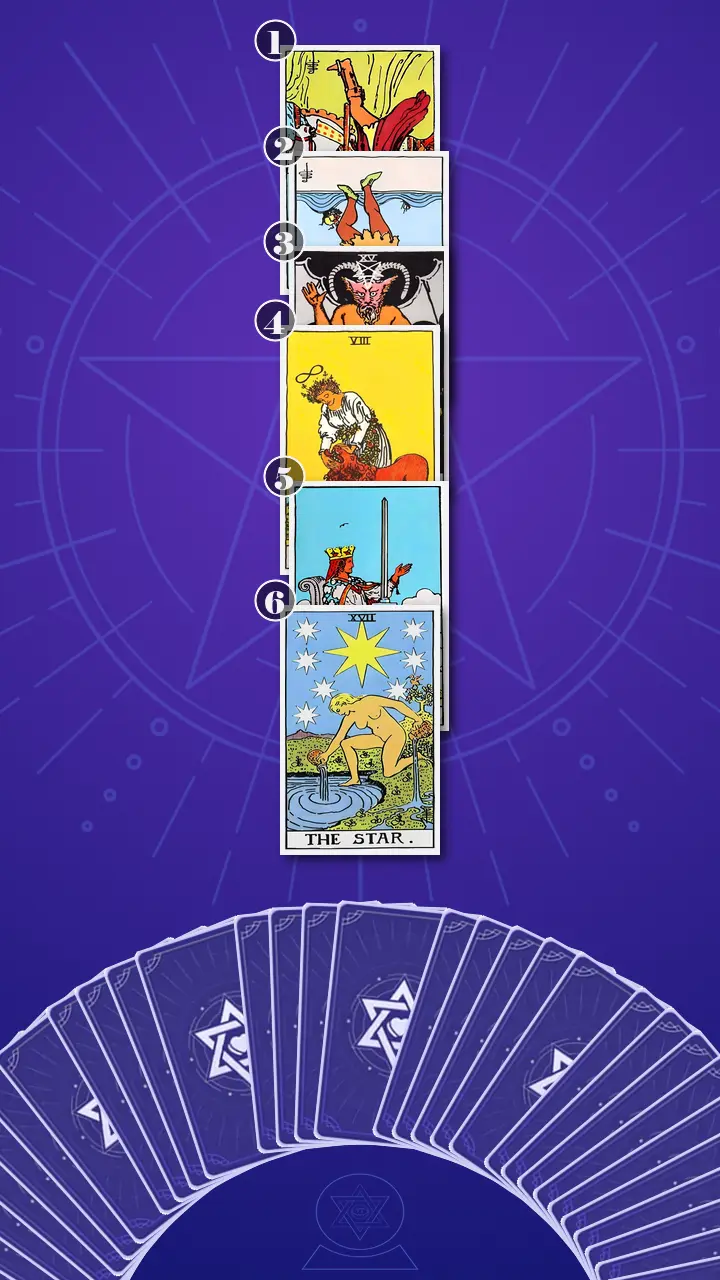
“Today,” I told her, “we’re using a six-card spread called the Four-Layer Insight Ladder · Context Edition.”
For anyone reading along: I choose this spread when the problem looks ‘small’ on the surface (a text, a Slack ping, a yes you didn’t mean), but it’s actually a deep inner system—self-worth, approval addiction, boundary-building. This ladder is minimal-but-complete: it starts with the symptom you can observe, tracks the loop, drops into the root fear, then finds one turning-point capacity. It ends with a practical next step and an integration card—ethical, self-directed, and grounded in choice rather than prediction.
“Here’s the map,” I said, laying the cards in a vertical line like stepping stones down a stairwell: “The first card shows what your people-pleasing looks like right now. The third goes under the floorboards—what fear keeps it running. And the fourth is the turning point: the inner capacity that breaks the loop without forcing a personality change.”
Reading the Map: From ‘Polite’ to ‘Pinned’
Position 1 — The Surface Snapshot: What the people-pleasing looks like right now
“Now we turn over the card that represents what the people-pleasing looks like right now in concrete behavior—especially after the trophies trigger.”
Six of Wands, reversed.
“This is painfully modern,” I said. “You find old trophies and suddenly your brain treats everyday interactions like public judging. You downplay your wins out loud, but privately you keep checking Slack reactions, rereading your sent messages, and feeling deflated if the ‘crowd’—likes, praise, quick replies—doesn’t show up fast. The people-pleasing looks like polishing your tone so nobody can possibly misread you.”
I watched her eyes flick to her phone face-down on the cushion, as if it might start grading her again.
“Reversed,” I continued, “the Six of Wands isn’t ‘no success.’ It’s unstable validation. Fire energy—confidence, pride, visibility—gets blocked. You don’t fully feel your own win unless someone mirrors it back.”
“And the trophies?” I tapped the table gently. “They’re like a LinkedIn victory parade in physical form. You touch proof you were once celebrated, and the crowd in your head wakes up hungry.”
Maya gave a small, embarrassed laugh—sharp at first, then softer. “That’s… rude,” she said, half-grinning. “But yes. Like I’m pretending I’m chill while I’m secretly refreshing things.”
“Exactly,” I said. “Split-screen life: outward ‘I’m fine,’ inward read receipts.”
Position 2 — The Loop: The repeating coping pattern in daily life
“Now we turn over the card that represents the repeating coping pattern—how you juggle others’ expectations and your own needs.”
Two of Pentacles, reversed.
“This is the calendar-Tetris card,” I said, and Maya’s mouth tightened in recognition. “Your default is to say yes while half-looking at your calendar, then spend the next day doing schedule gymnastics—moving meetings, pushing tasks late, and sending extra apologies to keep everyone happy. You’re switching tabs—Outlook, Slack, texts—because stopping long enough to feel your limits makes you anxious.”
“Reversed,” I explained, “Earth energy—capacity, time, steadiness—goes into overload. The juggling isn’t balance; it’s a coping strategy. The motion itself becomes the relief.”
I leaned in a little. “This is where people-pleasing at work gets sneaky. It looks like professionalism—fast replies, can-do tone. But it costs you clarity.”
She pressed two fingers to her stomach, almost unconsciously. “My yes needs a calendar check,” she muttered, like she was trying the sentence on for size.
“Yes,” I said. “That’s not a personality flaw. That’s a missing step.”
Position 3 — The Root: What the trophies hooked into, and what fear keeps it running
“Now we turn over the card that represents the deeper root—what the trophies story hooked into, and what fear keeps this pattern running.”
The Devil, upright.
The room felt quieter when it landed—like the audio had been muted on everything except her breathing.
“I’m going to say something very gently and very directly,” I told her. “You’re not ‘too nice.’ You’re using niceness to stay safe.”
I let that sit, because I could see it hit the place behind her ribs.
“In modern life,” I continued, “this card looks like an invisible rule: ‘If I disappoint someone, I lose belonging.’ Underneath the helpfulness is a private contract. So you keep signing—cheerful replies, extra effort, extra emotional labor—because it feels safer than risking disapproval. Even tiny requests feel high-stakes, like you’re one ‘no’ away from being labeled difficult.”
“The Devil’s chains are loose in the old art,” I said, tracing the air above the card without touching it. “That’s the point: often nobody is actually holding you there. Your body is.”
Her reaction came in a quiet three-step sequence: first, a small freeze—she stopped blinking. Then her gaze unfocused, like her brain was replaying a thousand Slack threads. Then she exhaled through her nose, long and shaky, as if she’d been bracing for years without noticing.
“I hate how accurate that is,” she said. “It really does feel like a fee. Like if I don’t pay it, I don’t get access.”
My mind flashed to my radio booth—how we never fix a harsh frequency by turning the whole track up. We notch it. We make space. “This is the moment the pattern becomes removable,” I said. “Naming it loosens the collar.”
I pointed to her throat with my own hand—not touching, just mirroring. “And notice where your body lives it. Tight throat, clenched stomach. That’s your approval alarm.”
When Strength Lowered the Alarm Volume
Position 4 — The Turning Point: The inner capacity that breaks the loop
“Now we turn over the card that represents the key turning point—the inner capacity that breaks the loop without forcing a personality change.”
“This is the center of gravity of the whole ladder,” I added, and I meant it.
Strength, upright.
I watched Maya’s shoulders lift before the meaning even arrived, like her body expected to be told to try harder.
“Let’s do the simplest translation first,” I said. “The turning point isn’t becoming colder or less kind—it’s building a steady inner hand that can hold the fear without obeying it. You notice the urge to perform, feel your body tighten, and choose a response that respects you. Quiet courage: you don’t fight the fear, you calm it and lead anyway.”
Setup (I kept my voice low): “It’s late, you’ve got the trophy in your hand, and your phone keeps lighting up like you’re on call for everyone’s comfort. You’re stuck in the idea that the ‘right’ response will keep you safe—so you rehearse, rewrite, add exclamation points, and hope nobody feels a wobble.”
Delivery (I placed it on its own, so it could ring like a clear note):
Stop wrestling for approval and start practicing quiet inner courage—like Strength, you lead with gentleness instead of proving power.
Reinforcement: Maya’s face went blank for a beat, not because she didn’t understand, but because she did. Her eyes widened slightly; then her jaw unclenched in tiny increments, like someone lowering a heavy bag they didn’t realize they were gripping. Her fingers—tight around the edge of her sleeve—opened and closed once, testing what it would feel like to not hold on so hard.
“But if I do that,” she said, and there was a flash of anger underneath the fear, “doesn’t it mean I’ve been… wrong? Like I made my whole personality into a service desk?”
I nodded. “That reaction makes sense. Strength isn’t about pretending the past didn’t happen. It’s about refusing to punish yourself while you change.”
This was where my music-therapy brain and my tarot brain always meet. “Strength is nervous-system work,” I said. “And I want to give you a lever that isn’t just ‘think differently.’”
“When you feel the tight throat before you hit send, that’s not a character flaw—it’s a body signal. In my practice, I use Chakra Sound Therapy in a very practical way: we use vibration to interrupt the alarm. For you, it’s throat + stomach: voice + self-respect.”
“In the next 10 minutes, pick one message you’ve been rewriting. Set a timer for 2 minutes, breathe out longer than you breathe in, and write one clean boundary sentence. Optional: add one alternative. Then stop. If your body spikes with anxiety, you’re allowed to pause and come back—this is practice, not a test.”
I softened my tone even more. “And here’s the sound piece: on the exhale, add a quiet hum—barely audible, like you’re warming up backstage. Feel it in your throat and upper chest. It’s the ‘lion tamer’ move. You’re telling your body, we’re safe enough to tell the truth.”
I watched her try it—one inhale, a longer exhale with a small hum. The room changed. Not magically. Just… quieter. Like someone turned down the gain on a mic that had been peaking all night.
“Now,” I asked, “with that new lens—can you think of a moment last week where this would’ve changed how you felt?”
Her eyes shifted left, searching memory. “Thursday,” she said. “A coworker asked if I could ‘quickly’ take notes. I typed yes instantly. If I had paused—even two minutes—I would’ve realized I was already maxed.”
“That,” I said, “is the bridge from hypervigilance to self-trust. Not perfection. A pivot.”
Position 5 — Next Step: One boundary/communication move you can practice this week
“Now we turn over the card that represents your next step—one boundary or communication move you can practice this week to shift the system.”
Queen of Swords, upright.
Maya looked relieved and slightly terrified, which is honestly the correct response to this card.
“Here’s the translation,” I said. “Your next step is a communication boundary you can repeat: one clean sentence that states your limit, with zero over-explaining. At work: ‘I can’t take that on this week. I can do Friday.’ With friends: ‘I’m not up for tonight, but I’m free Saturday afternoon.’ You let the sentence be enough.”
“Upright,” I added, “this is Air energy in balance: clarity, precision, respectful truth. Not coldness. Not a monologue. Just clean structure.”
I pulled out my phone and opened Notes (because Slack boxes are where overthinking goes to breed). “Let’s do the ‘before vs after’ draft.”
Before (people-pleasing draft): ‘Omg yes of course!! Sorry I’ve been slammed but I can definitely try, just let me know what you need and I’ll make it work!!’
After (Queen of Swords): ‘I can’t take that on this week. I can review your draft for 15 minutes on Friday afternoon.’
“A clean sentence can be kind,” I said. “Over-explaining is not the same as respect.”
Maya’s eyebrows lifted. “But if I don’t soften it, I’ll look unhelpful.”
“That’s the withdrawal symptom,” I said gently. “Your nervous system is used to buying safety with extra words.”
She hesitated, then offered the real-world obstacle: “But I can’t even take ten minutes sometimes. Slack is nonstop. If I pause, I’m scared someone will think I’m slacking.”
“That’s honest,” I said. “So we make it smaller and we make it structural.”
Position 6 — Integration: What it looks like when you relate to your achievements with warmth
“Now we turn over the card that represents integration—what it looks like when you relate to your past achievements with warmth instead of pressure.”
The Star, upright.
“This is the nervous system exhale,” I said. “Integration looks like being able to look at your trophies with warmth instead of pressure: ‘I did that. It mattered. And I’m not required to keep proving myself on demand.’ Your kindness becomes a choice again, not a safety plan.”
“Water is being poured onto land and into a pool in the classic image,” I explained. “That’s balanced giving. Not self-draining. The Star is what happens when you stop treating relief like laziness and start treating it like information.”
Maya’s eyes flicked to the trophy on the table, and for the first time her face softened around it—less like an indictment, more like an old photo.
From Insight to Action: The Soft-Strength Boundary Loop
I took a breath and braided the six cards into one coherent story, the way I’d arrange a playlist so the emotional arc actually lands.
“Here’s what I see,” I said. “The trophies triggered the Six of Wands reversed: a shaky relationship with being seen, where silence feels like rejection. That pressure pushes you into the Two of Pentacles reversed: reactive juggling—saying yes before you check capacity, then doing calendar gymnastics to keep the vibe smooth. Under that is The Devil: the invisible contract that says belonging is earned through performance and pleasantness. But the turning point is Strength: regulating the alarm and practicing quiet courage. Then Queen of Swords turns that courage into one clean sentence. And The Star is the landing—self-worth that doesn’t need witnesses.”
“The blind spot,” I added, “is thinking your safety depends on how perfectly you manage other people’s feelings. It makes you treat communication like a personality test. The transformation direction is the opposite: small, consistent boundaries—so your yes becomes a choice, not a reflex.”
Then I offered her a simple plan that matched her real life—fast-paced office, Slack culture, Sunday scaries—without requiring a personality overhaul.
- Calendar-First Yes (10-minute pause rule)Pick one incoming request this week (Slack, email, or a friend text). Set a timer for 10 minutes before responding. During the pause, open your calendar and label your energy as low/medium/high.If 10 minutes feels impossible, do the 90-second version: one long exhale + quick calendar glance. Then reply with “Let me check and get back to you by 3pm.”
- Clean Sentence + One Alternative (Queen of Swords template)Send: “I can’t take that on this week. I can do Friday afternoon, or I can review your draft for 15 minutes.” Copy-paste from Notes into Slack so you don’t spiral in the chat box.Expect the first discomfort wave to feel like “I’m being mean.” That’s your old approval alarm, not a fact. After you hit send, don’t re-open the thread for 15 minutes.
- 3-Minute 21-Day Sound Bath (Strength support)Once a day (or right after you set a boundary), do 3 minutes: inhale for 4, exhale for 6, and add a soft hum on the exhale. Keep it low-volume—feel the vibration in your throat/chest while your shoulders drop.Make it frictionless: do it while your kettle boils or before you brush your teeth. This isn’t about being “zen”—it’s about teaching your body that a clean truth won’t break belonging.
“If you want a bonus that matches your ‘Slack is nonstop’ reality,” I added, bringing in my sound-nerd side with a grin, “use my Space Tuning trick: change your notification sound to something less sharp, or turn off the ‘whoosh’ send sound. Your environment is part of the loop. We’re lowering the alarm volume everywhere we can.”

A Week Later: Ownership, Not Certainty
A week later, Maya messaged me a screenshot: a Slack reply with two sentences, no exclamation points, no apology pre-payment. Under it she wrote: “I did the pause. My stomach did the thing. I hummed. I sent it. Nobody died.”
Then she added, quieter: “I went to a café after work and just sat there. No ‘earning’ it first. I still had the ‘what if I’m difficult?’ thought… but it didn’t run the meeting.”
That’s what a Journey to Clarity looks like in real life: not a dramatic personality swap, but a steady shift from approval-scanning to self-trust—one clean message at a time.
When your throat tightens before you hit send, it’s not because you’re unclear—it’s because part of you still believes being liked is the price of safety.
If you didn’t have to earn belonging today, what would one small, clean truth sound like in your next message?
Every reading at AceTarot is a journey to connect with inner wisdom and empower your next step. The stories shared here are psychological mirrors, not private records—crafted to reflect universal emotional loops and help you find your own clarity. Learn more about our Journey to Clarity.
Author Profile