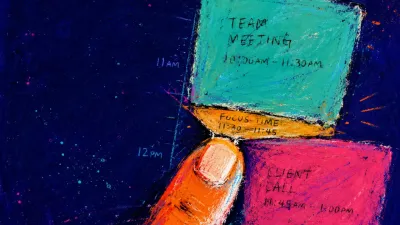
From Month-End Tab-Switching to Repeatable Anchors: Alex’s Reset
Finding Clarity in the 10:12 p.m. Kitchen Counter Spiral
If the last week of the month turns you into a tab-switching machine—calendar → inbox → banking app → “I should work out” → unsent text—welcome to end-of-month burnout.
Alex showed up on my screen from Toronto with that particular kind of late-night light: kitchen LEDs too bright, the rest of the apartment dim, kettle just clicked off in the background like a tiny punctuation mark. Their eyes looked dry from screen glare. Their shoulders sat high and forward, as if their laptop bag was still digging into them even though they were home.
“I don’t even know what starting means,” they said, rubbing the hinge of their jaw. “Work is loud. Money is… always there. My body feels gross. And I miss people, but I don’t want to be a burden. If I pick the wrong thing first, I’ll just make the rest worse.”
I could almost hear the Ctrl+Tab in their voice—like their mind was a browser with too many open windows, and every tab had a red notification dot.
Exhaustion, in Alex’s body, wasn’t an abstract feeling. It was a literal weight: like walking through Toronto in February slush with a soaked hoodie, except the slush was inside their chest, and it followed them into bed.
“I’m really glad you said it out loud,” I told them. “Because this doesn’t sound like laziness or ‘not having discipline.’ It sounds like you’re carrying four emergencies at once and trying to solve them with one brain and one nervous system. Let’s try something different tonight—let’s draw a map through the fog. Not a perfect life plan. A map to clarity and a first step that doesn’t punish you.”

Choosing the Compass: The Energy Diagnostic Map (7) · Context Edition
I’m Laila Hoshino. By day, I guide school groups through a planetarium in Tokyo—ten years of teaching people how to see rhythm in what looks like chaos. I also research the strange overlap between astrophysics and occult symbolism. Tarot, to me, is less “fate” and more like a sky chart for the psyche: patterns, cycles, pressure systems.
Before I touched the deck, I asked Alex for one small thing: “Put both feet on the floor. We’ll do a pre-meeting 3-minute cosmic breathing—nothing mystical, just a nervous-system reset.”
We inhaled slowly, like we were filling a spacesuit. We exhaled longer than felt necessary, like releasing static from a headset. On the third breath, their shoulders dropped a fraction—barely, but it mattered.
“For this question,” I said, “I’m going to use a spread I built for moments exactly like this: the Energy Diagnostic Map (7) · Context Edition.”
To you reading this: the reason I choose this spread over something bigger like the Celtic Cross is simple. Alex isn’t asking one linear question. They’re in a system problem—work, money, health, and love all pinging at once. A traditional spread can diagnose broadly, but it can blur the real need here: identifying the first stabilizing lever without turning it into a prediction.
This spread is a wheel. It makes the feedback loop visible—overload → indecision → external pressure → control strategy → isolation—then it points to the pivot: usable support, a balancing principle, and one grounded next step.
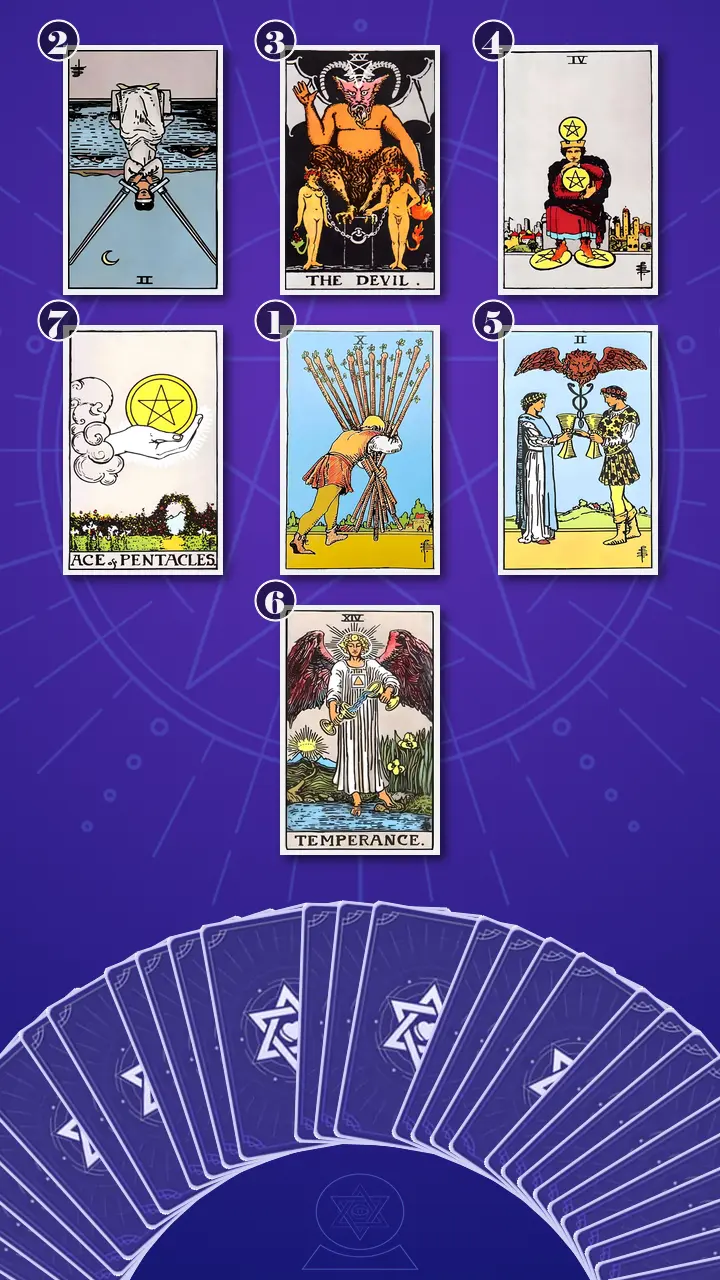
“The center card,” I told Alex, “will be the burnout snapshot—what this looks like day-to-day. Then we’ll move around the circle: your inner tug-of-war, the external pressure, the core blockage, the support you can actually use, the turning point, and finally the first lever to pull this week.”
Reading the Wheel: From Overload to Support
Position 1: The burnout snapshot you can’t unsee
“Now we’re turning over the card for Surface energy right now: the most visible end-of-month burnout pattern,” I said.
Ten of Wands, upright.
It hit immediately—because it always does. The figure in the card is competent, upright enough to keep going, but bent forward under a bundle so big it blocks their view. Town in the distance. Finish line always in the distance.
In modern life, this is exactly: the last week of the month and you’re carrying work deadlines, money anxiety, a half-started health reset, and unanswered messages like one overstuffed tote bag. You keep telling yourself you’re “almost there,” but you can’t see what matters because the load is in your face—so you default to pushing harder and staying online after dinner.
Energy-wise, this is excess—too much responsibility, too much self-reliance, too little redesign. Not a lack of effort. The problem is the weight and the lack of boundaries or delegation.
Alex let out a small, dry laugh that wasn’t funny. “That’s… literally my end-of-month posture,” they said. “And it’s kind of brutal that a card can clock that.”
“Brutal, yes,” I said gently. “But it’s also a relief, because it means the issue isn’t that you’re incapable. It’s that you’re carrying a system like it’s a single person job.”
Position 2: The inner tug-of-war that looks like ‘being responsible’
“Now we’re turning over the card for Inner tug-of-war: the specific indecision pattern behind ‘where do I start?’,” I said.
Two of Swords, reversed.
Blindfold. Crossed swords. Still water behind. In real life: you sit down to ‘start’ and immediately open four tabs—inbox, calendar, banking app, and a wellness plan. You keep rearranging your to-do list because choosing one focus feels morally loaded—like picking work means you’re neglecting love, and picking health means you’re irresponsible with money. The result is a night of planning that produces zero relief.
Reversed, the energy is blockage turning messy. Not calm balance—more like decision fatigue and mental gridlock. The mind keeps trying to get “fair” to every domain, and that fairness becomes a trap.
I said the line I’ve learned people need to hear without judgment: “Planning isn’t progress when it’s just a way to avoid choosing.”
Alex winced, then laughed again—this time with recognition. “I keep rewriting the list like it’s progress,” they admitted. “It’s… decision cosplay.”
“Exactly,” I said. “And the invitation here isn’t ‘pick the perfect priority.’ It’s ‘pick good enough for seven days.’ Just long enough to stop the spiral.”
Position 3: The pressure system you think is ‘just you’
“Now we’re turning over the card for External pressure: the systems, expectations, and comparison loops amplifying the crunch,” I said.
The Devil, upright.
Loose chains. Not welded shut—just heavy enough that people stay put. This card is never about “you’re bad.” It’s about the invisible rulebook that makes pressure feel non-negotiable.
In modern terms: month-end doesn’t just mean deadlines—it means the invisible rule that you must suffer to be safe. You answer messages instantly. You keep checking your bank balance like it’s a pulse. You scroll curated success until you feel worse—then you call the pressure “being responsible” even though it’s draining you.
Energy-wise, this is compulsion. A loop that offers short-term relief (one more email, one more check, one more plan) at the cost of long-term stability.
I watched Alex’s throat move as they swallowed. Their jaw tightened again, like their body was demonstrating the card’s chains on command.
“Pressure isn’t the same thing as safety—even if it’s what you’re used to,” I said.
That line landed. Not as inspiration—more like the uncomfortable truth you feel in your molars.
Position 4: The grip that’s trying to protect you
“Now we’re turning over the card for Core blockage: the control strategy or scarcity mindset that keeps the cycle repeating,” I said.
Four of Pentacles, upright.
This is the posture of holding on: one pentacle clutched to the chest, two pinned under the feet, one balanced on the head like a helmet. It’s stability trying to become rigidity.
In Alex’s life, it looks like tightening your grip to prevent chaos: stressing over every purchase, protecting every minute like it’s scarce, avoiding emotional conversations because they feel like unpredictable expenses. It looks like control, but it functions like a cage—your system can’t breathe long enough to recalibrate.
Energy-wise: defensive contraction. The body says “clench” even when the plan says “optimize.”
And this is where my astronomy brain always steps in—my Dark Matter Detection skill. In astrophysics, you don’t “see” dark matter. You notice its pull by watching what it does to everything else. In readings, I do the same: I look for the unseen factor creating the orbit.
“Alex,” I said, “here’s the dark matter in this loop: you’re gripping because you’re afraid that if any one area drops, it will prove you don’t have safety and control. That fear is doing more work than your calendar is.”
They went still—breath paused, fingers hovering over their mug, eyes unfocusing as if a memory replayed. Then a soft exhale. “Yeah,” they said, quieter. “If I let go, I’ll lose control.”
“And the card’s counterpoint is equally true,” I replied. “If you keep gripping, you can’t breathe. And if you can’t breathe, you can’t build a system that lasts.”
Position 5: The support that doesn’t have to be ‘another task’
“Now we’re turning over the card for Usable support: the most available resource that reduces load fast,” I said.
Two of Cups, upright.
Two people meeting eye-to-eye, offering something simple and mutual. In modern life: instead of trying to be “low-maintenance,” you allow one real connection to help—someone you can tell the truth to without making it a big dramatic thing. A low-key date, a friend who does a quick check-in, a partner who shares a meal, or even a coworker who takes one task.
Energy-wise, this is balance—not the balance of a perfect schedule, but the balance of co-regulation. The nervous system exhale that comes from being witnessed.
I watched Alex pick up their phone and put it down again—like the muscle memory of not reaching out was stronger than the desire to connect.
“I keep typing replies in group chats,” they said, “and deleting them. I don’t want to be… the burnt-out one.”
“If you’re carrying it alone, it will always feel heavier than it is,” I said. “Two of Cups isn’t asking you to dump your whole life on someone. It’s asking for one small corner of shared weight.”
When Temperance Poured Between Two Cups
Position 6: The turning point that changes the whole system
I slowed my hands before turning the next card. Even through a screen, I’ve learned you can feel it when a reading reaches its hinge moment—like the room quiets the way a planetarium goes quiet right before the stars appear.
“Now we’re turning over the card for Key transformation: the balancing principle that changes how all four domains interact,” I said.
Temperance, upright.
The image is simple and radical: an angel pouring water between two cups, one foot on land, one foot in water, a path leading to sunrise. Not a dramatic rescue. A steady transfer.
Setup—because I could see Alex’s mind trying to do what it always does at 9:58 p.m. near month-end: laptop open, calendar tab glaring, banking app warmed in your hand, and a half-typed “hey, how’s your week?” text you keep not sending—because choosing one thing first feels like letting the other three collapse.
And this is where my other lens matters—my Gravity Assist Simulation. In spaceflight, you don’t get to a distant destination by firing your engine endlessly. You borrow momentum from a planet’s gravity in a precise arc. A small, well-timed maneuver changes the whole trajectory.
I looked at Alex and said, slowly enough that their nervous system could actually hear it:
Stop treating balance as something you earn after you push through, and start ‘pouring between two cups’—small daily transfers of time and care that make work, money, health, and love support each other.
There was a pause—real silence. The kettle stopped being background noise. The HVAC hum felt louder, like the room itself was holding still.
Alex’s first reaction wasn’t relief. It was anger—small but sharp. “But if that’s true,” they said, voice rising half an inch, “doesn’t that mean I’ve been doing it wrong? Like… this whole time?”
I didn’t flinch. “It means you’ve been using the only strategy that ever felt like it worked: pushing. And it did get you through things. Temperance isn’t calling you wrong. It’s offering you a different physics.”
Reinforcement: I watched the reaction chain move through them in three steps. First, the freeze—breath held, eyes wide, shoulders braced. Then the cognitive seep—eyes drifting off the camera, like they were replaying every late-night ‘I’ll just clear a few things’ session. And then the release: a long exhale that sounded like a backpack finally sliding off the spine.
“Okay,” they whispered. A small nod. Their jaw unclenched like they’d only just noticed it was locked.
I grounded it into a practical micro-ritual, right there: “Set a 10-minute timer and do a ‘Two-Cups Pour.’ Choose ONE tiny transfer of care from work into your foundation—either (A) open your banking app and write down the current balance + upcoming bills in one note, or (B) set a realistic bedtime alarm for tonight, or (C) send one honest, low-pressure text: ‘I’m fried this week—can we do something easy?’ When the timer ends, stop—even if it feels unfinished.”
“And if you notice your jaw clenching or a shame spiral starting,” I added, “put the phone face-down and take 3 slow breaths before deciding anything else.”
Then I asked the question that turns insight into lived proof: “Now, with this new lens—pouring between two cups instead of trying to save one category—was there a moment last week when this would’ve changed how you felt?”
Alex stared at the ceiling like it held subtitles. “Thursday. 10:36 p.m. I answered one more Slack message. I told myself it was the responsible thing. And then I couldn’t sleep and I canceled a plan. If I’d just… poured ten minutes into sleep instead of work… the whole night might’ve shifted.”
“That,” I said, “is the step from shutdown and heaviness toward grounded confidence. Not because your life is suddenly easy—because you’re building a system that can breathe.”
And I let the Temperance truth land in modern language: “A rhythm you can repeat beats a reset you can’t sustain.”
Position 7: The first lever to pull this week
“Now we’re turning over the card for Next step: the first lever to pull this week that creates the biggest stabilizing ripple,” I said.
Ace of Pentacles, upright.
An open palm offering one coin. One seed. Not ten. Not four simultaneous makeovers.
In real life, it’s the opposite of the Four of Pentacles grip. It’s a single tangible habit you can do even on a hard day: ten minutes of money admin, a protected bedtime, groceries that support energy—something small enough to be real.
Energy-wise: grounded beginning. A practical start that stabilizes the whole ecosystem.
“You don’t need four perfect plans,” I reminded them. “You need one foundation that holds.”
The From-10-to-1 Reset: Actionable Advice for Your Next 48 Hours
When I zoomed out and looked at the full wheel, the story was clean:
The Ten of Wands shows you carrying your whole life like an overstuffed tote bag—capable, but overloaded. Two of Swords reversed shows your brain trying to be perfectly fair to everything and freezing. The Devil shows the external pressure system—deadlines, bills, comparison—turning into an invisible rule: suffering equals responsibility. Four of Pentacles shows the grip that follows: tightening control to feel safe, even when it cages you. Two of Cups offers an opening—support as a practical resource, not an extra chore. Temperance becomes the medicine: integration through small transfers. And Ace of Pentacles makes it real: one grounded habit, repeated.
The cognitive blind spot I named for Alex was this: they’d been treating “choosing a starting point” like a moral test. As if picking money first meant failing love, or picking health meant being irresponsible at work. That belief kept them in perpetual month-end improvisation.
The transformation direction—the shift—was simpler and kinder: stop trying to solve work, money, health, and love simultaneously. Choose one foundation-level routine you can repeat for two weeks, and let it support the rest.
To make it concrete, I offered Alex a small navigation tool from my own practice—my decision-making as interstellar navigation metaphor. “We’re not trying to teleport,” I said. “We’re plotting a stable orbit.” And to keep it practical, I used a quick constellation alignment check: Which two-week anchor would reduce panic the fastest—money clarity, sleep/body, time boundaries, or one honest connection?
We chose two actions: one Earth anchor (Ace of Pentacles) and one Water-softener (Two of Cups), each designed to take under 10 minutes so it can survive a crunch week.
- Foundation Check (10 minutes, twice this week)Open your banking app (RBC/TD/Wealthsimple—whatever you use). In one single note, write: (1) your current balance, (2) the next 3 bills, (3) their due dates. Then close the app. No optimizing, no budgeting rabbit hole.Your brain will call this “too small.” Treat that as a Devil-signal: compulsion asking for a heroic push. Set a timer. When it ends, stop anyway.
- Hard Stop Bedtime Block (one night this week)Put a calendar block on your phone titled “Hard Stop.” Set an alarm 45 minutes before your target sleep time. When it goes off, log out of work apps—Slack/Teams/email—and physically place the phone face-down.If you feel panic rise (“I’ll fall behind”), do 3 slow breaths—your spacecraft attitude adjustment—before you decide anything. The goal is one protected night, not a new identity.
- One Honest, Low-Pressure Text (Two of Cups in real life)Send one message to one person: “Month-end is chewing me up. Would you be down for something easy—takeout + a walk?” Keep it specific, and keep it small.Add an exit line if it helps your nervous system: “No worries if you’re busy.” Support works best with consent—for both of you.

A Week Later: Ownership, Not Certainty
Six days later, Alex messaged me a screenshot—not of a perfect Notion dashboard, not of a color-coded Google Calendar that looked like a box of highlighters exploded. It was one plain note: balance + three bills + due dates. Under it, they’d typed, “I stopped at 10 minutes. It felt unfinished. I went to bed anyway.”
They added a second text: “I sent the ‘fried this week’ message. We did takeout and a short walk. I wasn’t fun. It was still… good.”
Light, but not magical. Clear, but still a little tender. (They told me they celebrated by sitting alone in a coffee shop for an hour, watching streetcars slide by, feeling proud and oddly quiet—like being in a planetarium after the show ends and the lights come up.)
That’s the Journey to Clarity I care about: not certainty, not a sudden reinvention. A small rhythm that proves you can stop the month-end from turning into a four-way emergency.
When everything feels urgent at once, your body tightens like it’s bracing for impact—and picking one starting point can feel less like a plan and more like a test you’re terrified to fail.
If you trusted that one small rhythm could hold you more than one heroic push, what would you choose as your two-week anchor—money, sleep/body, time boundaries, or one honest connection?
Every reading at AceTarot is a Journey to connect with inner wisdom and empower next step.
Learn more about our Journey to Clarity.