Self-Checkout Number Shock—And How to Stop the Control Rebound

Finding Clarity in the Self-Checkout Number Shock (and the Money–Diet–Stress Loop)
If you’re 29, living in NYC, and your stomach drops when the self-checkout total jumps—like your rent, groceries, and adulthood are all grading you in real time (Sunday Scaries included).
Jordan (name changed for privacy) said that first, almost word-for-word, sitting across from me in my café after the last customer had gone. The street outside was still loud in that Manhattan way—sirens in the distance, a delivery guy’s e-bike whir—but in here it was mostly espresso and quiet clinks: the spoon hitting porcelain, the soft hiss of the machine cooling down.
They described Tuesday, 8:47 PM at a Trader Joe’s self-checkout: fluorescent lights buzzing, the scanner beeping too fast, their phone warm in their palm with Copilot Money open like a live vital sign. “The total jumps,” they said, “and my body reacts before I even think. Tight chest. Jaw locked. Like… stomach-drop, instantly.”
Then came the negotiating voice—short, sharp, relentless. Cut something. Be good. Fix it now. And the second scoreboard slides in right on cue: Tomorrow I’ll eat cleaner to make up for it.
I watched their fingers press into the paper sleeve of their to-go cup, leaving a faint crease—like they were trying to fold the feeling into something smaller. What they wanted was stability: calm money choices, steady eating, a life that didn’t require constant willpower. What they feared was that one spike—one number—proved they weren’t disciplined or safe.
“Before we even touch the cards,” I told them, “I want you to know this: That stomach-drop at self-checkout isn’t ‘drama’—it’s your nervous system reading a number as danger. We’re not here to judge you. We’re here to map the pattern so you can change it.”

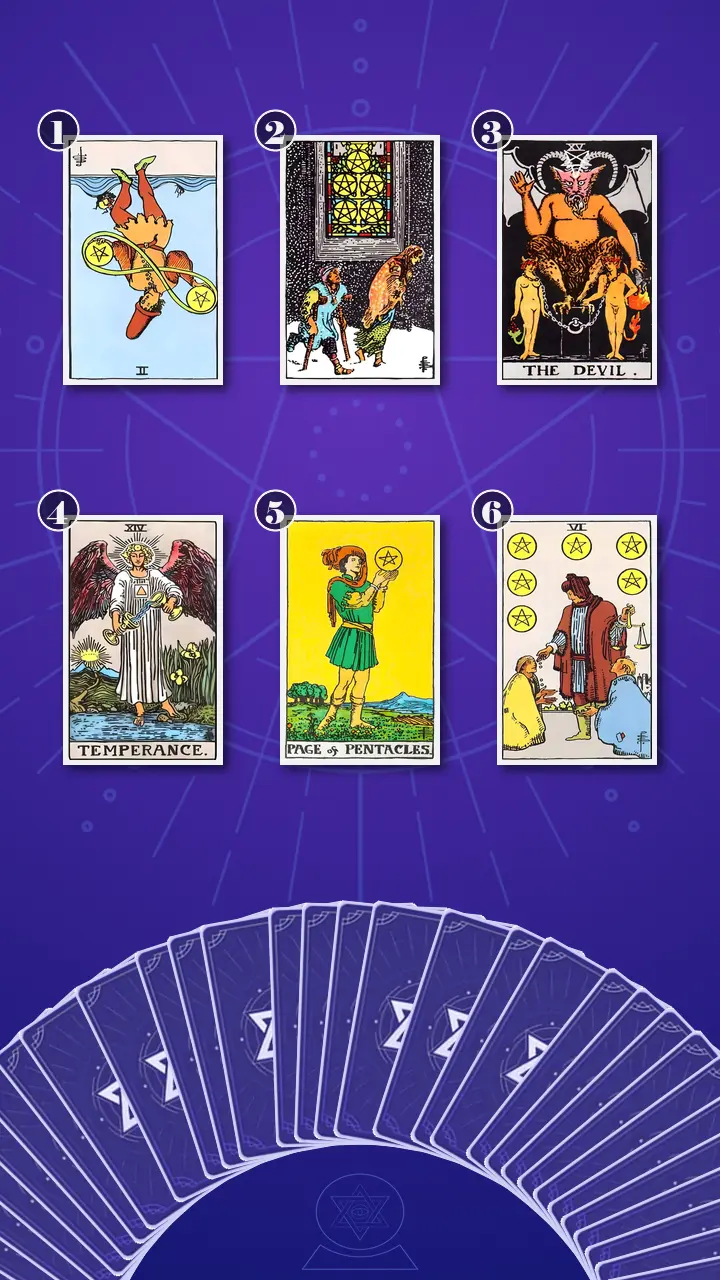
Choosing the Compass: The Transformation Path Grid (6) · Context Edition
I slid a small glass of water toward Jordan and asked them to take one breath that was slower than their thoughts. Not as a mystical thing—more like switching your phone from Low Power Mode back to normal. Then I shuffled while the café smelled like roasted beans and orange peel from the tiny bowl I keep by the register.
“Today,” I said, “we’ll use a spread I like for repeating loops: the Transformation Path Grid (6) · Context Edition.”
For you reading this: a simple linear spread can miss the way money anxiety, food rules, and stress reinforce each other. But a huge classic spread can turn a very repeatable habit loop into a fog of too-much information. This grid is minimal yet complete: it moves from the visible behavior (the loop), to the trigger (the number shock), down to the root driver (control/shame), then back up through one turning-point shift, one actionable step, and finally integration.
I explained the layout as a 2x3 grid—top row is positions 1, 2, 3; bottom row is 4, 5, 6—“like a two-story apartment,” I said, “where we go from the noisy street-level problem down into the engine room, then come back up with a plan.”
Reading the Map: The Loop, the Shock, the Contract
Position 1 (the observable loop): Two of Pentacles, reversed
“Now we’re turning over the card that captures the observable loop behavior around money, food rules, and stress when the checkout total jumps,” I said, and flipped it.
Two of Pentacles, reversed.
This is the card version of having two dashboards open—bank app and calorie app—and trying to steer your whole life by watching both needles spike at once. In Jordan’s words, it was that moment at self-checkout with a basket of adult basics—protein, produce, something quick for late nights—while their brain starts doing micro-edits: swap brands, remove the snack, debate the frozen meal. And simultaneously, a second tab opens in their head: “And tomorrow I’ll eat cleaner to compensate.”
Energetically, reversed Two of Pentacles is blockage: too many moving parts, too much mental juggling, not enough stable ground. It’s not “lack of discipline.” It’s overload—like running twenty Chrome tabs until the whole system freezes and then calling it a personal failure.
Jordan let out a small laugh that wasn’t amused. It had a bitter edge. “Okay,” they said, “that’s… rude. Like, accurate, but rude.”
“I’ll take accurate,” I said gently. “And I’ll take ‘not your fault’ too.”
Position 2 (the trigger): Five of Pentacles, upright
“Now we’re turning over the card that names the specific moment/feeling-cue that snaps you into crisis-mode—the number shock and what it represents,” I said.
Five of Pentacles, upright.
This card always feels like cold air. Not because you’re actually doomed—but because the body interprets a moment as exclusion. The trigger isn’t the price tag. It’s the feeling the price tag creates. The second the total jumps, Jordan’s brain reads it as: Not enough. Not safe. Cut it. Like the “insufficient funds” vibe without actually being insufficient—just emotionally.
I held the card so they could see it: the bright window versus the figures outside. “This is the public beep-beep pace of self-checkout,” I said, “while inside you feel locked out of safety. And once you’re in that feeling, you’ll do anything to get back inside—cut groceries you’ll miss later, or tighten rules that don’t last.”
That’s when I gave them the line I use to stop shame from taking over the room: A spike is information. A verdict is a story your Taskmaster tells about it.
Jordan’s head dipped in a tight nod—small, involuntary, like their neck recognized it before their pride could argue.
Position 3 (the root driver): The Devil, upright
“Now we’re turning over the card that reveals the deeper belief or attachment that keeps the cycle self-reinforcing,” I said, and the café seemed to get quieter in a way I can’t quite explain—like even the fridge hum stepped back.
The Devil, upright.
Under the loop is a contract Jordan didn’t consciously sign: If I control money and food perfectly, I’m a good/safe person. The Devil shows up when control turns into captivity. The chains in this card are loose, and that detail matters: the loop is maintained by belief and habit more than true necessity.
I described it as a split-screen, because that’s exactly how it plays in real life. On one side: juggling—cart edits, app toggling, Sunday-night rule rewrites, “fix tomorrow, fix tomorrow.” On the other side: chains—Taskmaster language, the courtroom tone: always/never, good/bad, earned/deserved. The relief is real—strictness does create a temporary sense of safety. But it’s short-lived, and the crash becomes “evidence” against you.
As I spoke, I had a tiny flash of my own café life: closing time, wiping down the counters, turning off the lights in a specific order. Not because the world will end if I don’t—but because a routine can signal, we are safe enough to stop now. Jordan’s “nightly rule rewrites” were the same impulse, just sharper—like using a judge’s gavel instead of a gentle closing ritual.
Jordan stared at the card and whispered, “I hate how much I believe it.”
When Temperance Poured Between Two Cups
Position 4 (the turning point): Temperance, upright
“We’re turning over the card that identifies the key psychological shift that transforms the loop into a workable, repeatable approach,” I said. “This is the bridge.”
Temperance, upright.
The room felt like a scene change—from fluorescent buzz to a quieter rhythm. Temperance isn’t a personality trait you either have or don’t. It’s an active practice: pouring, adjusting, blending. Calibration under stress.
Jordan was still caught in that familiar instant—the self-checkout total jumps and their stomach drops—before any decision is made, their body already thinks it’s in trouble.
Stop treating spikes as a verdict and start blending your choices on purpose, like Temperance pouring two cups into one steady rhythm.
I let that sit. In my café, silence has weight. It smells like coffee and honesty.
Jordan’s reaction came in a chain—three quick beats I could almost count.
First: a physical freeze. Their breath paused mid-inhale, like their ribs forgot how to expand. Their fingers stopped worrying the cup sleeve.
Second: the mind catching up. Their eyes unfocused—not on me, not on the card—like they were replaying a dozen checkout screens and bank-app refreshes with a new subtitle underneath.
Third: emotion, messy and real. Their jaw unclenched, then their throat worked like they were swallowing something that had been stuck there for months. “But,” they said, and the word came out sharper than they meant, “if it’s not a verdict… then what does it mean about me when I mess up?”
There it was—the fear that acceptance equals recklessness. I shook my head slowly. “It means you’re human in a high-cost city with a nervous system that learned to buy safety with control.” Then I gave them the sentence Temperance always insists on: You don’t need stricter rules; you need a practice that still works when you’re stressed.
This is where the real transformation sits—from shame-driven overcontrol and rebound cycles to data-driven self-trust and fair, sustainable routines. Not because you suddenly “stop caring.” Because you start treating numbers as data, not moral grades.
And because I’m me—an Italian café owner who reads patterns for a living—I brought in one of my favorite lenses: Sacred Timing. “When espresso tastes its best,” I told Jordan, “it’s not because we bullied the beans into behaving. It’s because we worked with timing—grind size, water temperature, a steady pour. Your system is like that. The goal isn’t domination. It’s extraction without burning.”
I asked them, softly: “Now, with this new lens—verdict versus data—think back to last week. Is there a moment when that insight would have changed how you treated yourself?”
They blinked hard. “Wednesday. Bank app. I saw groceries plus a subscription charge and decided I had to cut everything and eat less. Like my body was part of the spreadsheet.”
“Exactly,” I said. “Temperance is the part of you that refuses to make your body pay your budget. It blends. It adjusts. It keeps you on the same team.”
Then I gave them a tiny homework moment—an immediate bridge from insight to action: “Within the next 10 minutes, open Notes. Two columns: ‘Verdict language’—always/never, good/bad, deserve/earned. And ‘Data language’—notice/adjust/try. Translate one sentence. If you feel activated, stop after one. You’re not required to push through discomfort to prove anything.”
The One-Coin Week, Then the Scales
Position 5 (a practical next step): Page of Pentacles, upright
“Now we’re turning over the card that gives a concrete, low-pressure action you can try this week,” I said.
Page of Pentacles, upright.
This card is such a relief after the Devil, because it doesn’t demand a personality overhaul. It asks for apprenticeship. A small, skill-building experiment. One coin held with full attention.
In Jordan’s real life, it looks like this: this week is not about proving you’re disciplined. It’s about choosing one practice—one grocery template, one default lunch, one category cap—and treating it like learning a tool, not building a new identity.
Energetically, Page of Pentacles is balance through beginner mindset. And it lands as medicine for decision fatigue: fewer scoreboards, fewer dramatic resets, more repeatable reps.
Jordan frowned. “My brain is already like, ‘But we have to fix everything at once.’”
“That’s the loop protecting itself,” I said. “And this is where we do the opposite.”
Position 6 (integration): Six of Pentacles, upright
“Now we’re turning over the card that shows what the healthiest, most grounded version of this system feels like once the shift is practiced,” I said.
Six of Pentacles, upright.
This is the card where numbers become scales instead of weapons. It’s balanced stewardship—giving and receiving in proportion. It’s the moment when a budget stops being a punishment plan and becomes a support plan. When meals stop being a purity contest and become fuel that respects your actual week.
I pointed to the scales. “Your new metric isn’t ‘perfect.’ It’s ‘fair.’ Fair spending. Fair meals. Fair rest.”
Jordan’s shoulders lowered—just a fraction—but it was the first time that night their body looked like it believed relief could be practical.
Actionable Advice for a Loop That Lives in Your Jaw
I pulled the whole grid together for Jordan the way I’d summarize a regular’s usual order: simple, specific, no shame. “Here’s the story your cards told,” I said. “A money–diet–stress loop gets triggered by a number shock. Scarcity hits first, fast, and physical. Then you try to juggle two scoreboards to buy safety. Underneath is a shame-contract that says your worth equals your control. Temperance breaks it—not with stricter tracking, but with calibration. The Page turns that into one small practice. And the Six shows the destination: fairness and support.”
The blind spot was clear: Jordan kept treating spikes like a moral grade, so their nervous system responded as if they were on trial. The transformation direction was equally clear: from verdict-thinking to data-thinking; from harsh resets to repeatable regulation.
Then I gave them three small next steps—designed to work even on a bad day:
- The Two-Minute Checkout ResetOnce this week, when the self-checkout total appears, keep your hands off the screen for 10 seconds. Drop your shoulders, soften your jaw, and take one slow exhale before you remove anything. Then say (quietly or in your head): “This total is information, not a grade.” If you still need to edit, remove only one non-essential item—never necessities like protein, produce, meds, or transit.Make it invisible: breathe while the machine processes. If you feel exposed, pay first and step aside to reassess—no public self-punishment required.
- One-Coin Week (Pick One Metric)For 7 days, track only ONE thing lightly: either spending categories or meal structure. If money: set one grocery ceiling for the week and stop nightly re-optimizing. If food: set one default breakfast and one default lunch that survive stress days, and let dinner be flexible.Your brain will argue for “fix everything.” That’s the Two of Pentacles reversed talking. Lower the bar on purpose: the goal is repeatability, not improvement.
- The 9 PM Café Closing Rule (No New “Tomorrow Rules”)After 9 PM, you don’t rewrite budgets or calorie rules. Instead, do a 60-second “closing ritual”: close the apps, wipe down your mental counter with one sentence—“I’m not negotiating with my Taskmaster tonight”—and make tomorrow’s first step tiny (like packing one default lunch item).If you can’t sleep without planning, write one line only. One. The point is to stop turning bedtime into a performance review.
I also offered one of my personal tools that doesn’t look like “self-help” but works like it: Aroma Anchoring. “Pick a scent you associate with safety,” I told Jordan—coffee, citrus, even your hand lotion. “Use it during the Checkout Reset. Over time, your body learns: this smell means I pause, I breathe, I choose. Temperance, but in real life.”
A Week Later: Fair, Not Perfect
Six days later, Jordan texted me a photo from a self-checkout screen—no total showing, just the corner of a Trader Joe’s kiosk and a blurry cart. The message was: “I did the 10-second pause. Jaw unclenched. I kept the berries. I removed one snack, not my actual dinner. I didn’t go home and punish myself with new rules.”
It wasn’t fireworks. It was something better: a system staying online.
They added one more line, almost sheepish: “I still had the thought ‘what if I’m messing everything up?’ the next morning. But it didn’t run the day.”
That’s the Journey to Clarity, in the way it actually happens—small, repeatable, human. Not the absence of spikes, but the end of treating spikes as identity. Not perfect control, but steadier self-trust.
When a single number makes your chest tighten and your brain start negotiating like it’s an emergency, it’s not because you’re reckless—it’s because you’re trying to buy safety with control.
If you treated the next spike as data—not a verdict—what’s one tiny adjustment you’d be willing to try, just once, to keep yourself on the same team?
Author Profile