From Dating-App Numbness to Emotional Presence: A Slower Way In

The Match That Didn’t Land
“You’re a late-20s Toronto office girlie who can handle a packed calendar and a messy client deck, but one ‘Want to meet up?’ message makes you go emotionally offline—classic dating app numbness,” I said, and Alex gave me a tiny laugh that didn’t quite belong to humor.
She’d booked a late slot after work, the kind you take when you’ve been holding yourself together all day and only start hearing your own thoughts once the laptop is shut. She told me it wasn’t heartbreak, exactly. It was worse in a quieter way.
“It’s 8:56 on a Monday,” she said, “I’m microwaving leftovers in my condo kitchen. The fan’s humming. My phone vibrates on the counter. I open the app, see ‘It’s a match,’ and my face doesn’t change. The screen is bright, my food smells like garlic, and my chest feels… oddly heavy—like I’m watching my own dating life through glass.”
She paused, then added, almost irritated with herself: “I get matches, but I feel nothing. And then I keep scrolling anyway. Like—why?”
The numbness she described wasn’t abstract; it had weight. A muted pressure in chest and throat, as if warmth were trying to rise and found a closed door. I’d heard versions of it across cities and decades—different technologies, same human nervous system finding a way to stay safe.
“Nothing is still a signal,” I told her. “Not a verdict. But a signal. Let’s treat this like a journey to clarity—not to force a feeling, but to understand what the numbness is protecting, and what a workable next step looks like.”

Choosing the Compass: Celtic Cross · Context Edition
I asked Alex to put her phone face-down for a moment and take one slow breath she could actually feel. Not a performance-breath—just a physiological shift. While she exhaled, I shuffled, the familiar rasp of cardstock doing what it always does in a session: giving the mind something simple to follow so the deeper material can surface without theatrics.
“Today, we’ll use a spread called the Celtic Cross · Context Edition,” I said. “It’s especially useful when the question isn’t just ‘what should I do?’ but ‘why is this happening now, and what older pattern is this replaying?’”
For you reading this: the classic Celtic Cross works because it creates a chain of causality—symptom → obstacle → root → past imprint → integration. This particular version keeps the structure intact and sharpens two positions for modern life: one explicitly names the past pattern replay, and another names the external loop—the fact that app design and dating culture can amplify a pattern that already exists.
“We’ll start with what the numbness looks like in real time,” I said, tapping the center of the spread. “Then we’ll name what blocks emotional engagement. Then we’ll go underneath—root driver and past script. And we’ll climb the staff on the right like a ladder: how you show up, what the environment reinforces, what you hope for and fear, and finally the most grounded direction forward.”
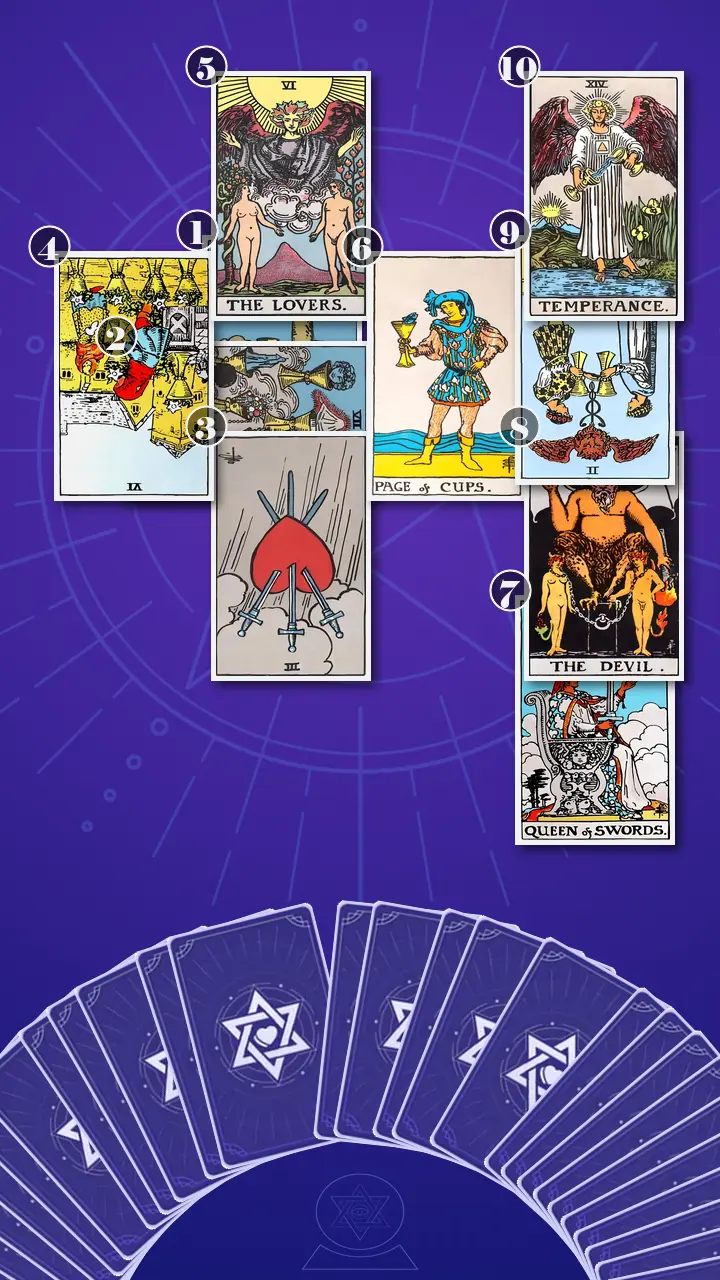
Card Meanings in Context: From Static to Signal
Position 1: The present symptom — what the numbness looks like in real-time
“Now flipped over is the card representing the present symptom: what the numbness looks like in real-time behaviors on dating apps,” I said. “Four of Cups, upright.”
The image is famously simple: a figure with crossed arms, three cups already on the ground, and another cup being offered—almost politely—from a hand in a cloud.
“This is exactly what you described,” I said. “You’re on the couch after dinner, thumb hovering over Hinge or Bumble like it’s a nightly habit. A new match pops up. And you look at them the way you look at another email notification—registered, processed, emotionally blank.”
In energy terms, the Four of Cups is blocked reception. Not drama. Not despair. Just the body refusing to take in what the mind insists should matter.
Alex let out that same small laugh, this time sharper. “That’s… mean,” she said, then softened. “Like, accurate-mean.”
“Numbness isn’t the absence of desire—it’s desire behind a safety glass,” I told her. “The crossed arms aren’t laziness. They’re protection.”
Position 2: The main challenge — what turns matches into noise
“Now flipped over is the card representing the main challenge: what specifically blocks emotional engagement and turns matches into ‘noise’,” I said. “Seven of Cups, upright.”
I watched her face change in a way most people don’t notice in themselves: not sadness, but a subtle tightening at the jaw, the look of someone bracing for too many inputs at once.
“This is the infinite menu,” I said. “Profiles as clouds. Options floating. Your mind reaching upward trying to pick the ‘right’ cup in midair.”
And I used the analogy her life was already speaking: “It’s like having twelve tabs open in Chrome and calling it ‘research’ while your body quietly shuts down. You keep five conversations alive ‘just in case,’ and each person becomes a mental storyboard instead of a human.”
I could almost hear the inner monologue as she listened—the rapid-fire checklist she’d described without even meaning to: What if he’s love-bombing? What if it’s boring? What if I waste my weekend? What if I choose wrong?
Energy-wise, the Seven of Cups is excess: too many imagined outcomes. And excess imagination can create emotional flatlining, because the nervous system can’t attach to anything it never truly touches.
“More options can be an option-buffer: it feels like freedom, but it keeps you from landing anywhere real,” I said.
She nodded once, reluctantly, like someone admitting a habit is a habit. Her shoulders stayed slightly raised, as if the card itself had added weight.
Position 3: The root driver — the protective logic underneath numbness
“Now flipped over is the card representing the root driver: the deeper emotional logic underneath numbness,” I said. “Three of Swords, reversed.”
In my academic life, I’ve excavated sites where the most important evidence wasn’t the obvious stone wall, but the thin, darker layer of soil beneath it—the quiet stratum where the real story hid. This felt like that.
“Reversed here,” I said, “the Three of Swords doesn’t scream ‘fresh heartbreak.’ It whispers ‘pain that got packed away so efficiently you can narrate it, but you can’t metabolize it.’”
I grounded it in her modern life: “A match gets kind, direct, interested—and your emotions go offline so fast you tell yourself you ‘just aren’t feeling it.’ Underneath, there’s an older disappointment your body still treats as a live wire.”
Energy-wise, this is blocked grief. Not weakness—an attempt to recover without reopening the wound. Like keeping feelings in airplane mode: no notifications, but also no connection.
Alex swallowed, and the movement in her throat was visibly effortful. Her eyes went briefly unfocused, as if replaying a memory she didn’t want to name in full. Then she exhaled through her nose—small, controlled.
“I hate that this makes sense,” she said quietly.
Position 4: The past pattern — the earlier relational script being replayed
“Now flipped over is the card representing the past pattern: the earlier relational script being replayed in app dating,” I said. “Six of Cups, reversed.”
“This is nostalgia as a standard,” I said, and I kept my voice plain. “Not nostalgia for a person necessarily—nostalgia for a kind of feeling: effortless, immediate, enclosed, safe.”
I pointed to the enclosed courtyard in the image. “This garden is emotional safety. And it’s also a limit. Great for comfort. Not always great for adult intimacy growth.”
Then I translated it into her lived pattern: “You measure adult dating against an older template where closeness is supposed to feel innocent and obvious early. When early conversations are normal—slightly awkward, slightly uncertain—you interpret it as ‘wrong’ instead of ‘early.’”
Her mouth pressed into a line. “I literally do that,” she admitted. “If it’s not easy right away, I’m like… why am I here.”
“Because easy can be a disguise,” I said gently. “Sometimes ‘easy’ just means ‘familiar enough that you don’t have to risk anything new.’”
Position 5: The conscious longing — what you think you want
“Now flipped over is the card representing the conscious longing: what you think you want from dating, and the values you’re trying to honor,” I said. “The Lovers, upright.”
“This isn’t about chasing a dopamine spark,” I said. “It’s about alignment. Honesty. Mutuality. A relationship that fits your values so you don’t have to gamble on a feeling you can’t access right now.”
Energy-wise, The Lovers is balance—but not passive balance. It’s a values-based choice: moving from being chosen to choosing.
Alex’s face softened for the first time. “That’s… what I want,” she said. “Not fireworks. Just… something real.”
Position 6: The near-term opening — what helps the system thaw
“Now flipped over is the card representing the near-term opening: what helps the system thaw if you make one small shift,” I said. “Page of Cups, upright.”
“Good news,” I said, and allowed myself a faint, wry warmth. “This is not ‘be fearless.’ This is ‘be a beginner.’”
I translated the fish-in-the-cup into her app life: “The thaw starts small. You send a sincere message without sanding off every human edge. You let yourself be a little playful, a little warm. Feelings return as surprises when you stop demanding they arrive on schedule.”
Energy-wise, Page of Cups is deficiency turning into gentle supply: a small return of emotional curiosity.
She looked down at the card and then up at me. “So… I don’t have to feel, like, obsessed,” she said.
“Exactly,” I replied. “You don’t have to be fearless. You just have to be honest in small doses.”
Position 7: Self-positioning — the stance you take to feel safe
“Now flipped over is the card representing self-positioning: the stance you take to feel safe,” I said. “Queen of Swords, upright.”
“This is you at work,” I said. “Competent. Sharp. Pattern-spotting. Able to cut through nonsense.”
Energy-wise, the Queen is balanced discernment—until it becomes the only tool. “On apps, this can turn into scoring instead of experiencing,” I said. “You’re not wrong to have standards. But standards aren’t the same as constant evaluation.”
“A clean boundary isn’t a wall—it’s a container where feeling can actually show up,” I added, and I saw her shoulders drop a few millimeters, as if her body liked the idea of a container.
Position 8: External loop — what the environment reinforces
“Now flipped over is the card representing the external loop: what the environment reinforces,” I said. “The Devil, upright.”
“Okay,” Alex said immediately, almost relieved. “So it’s not just me.”
“It’s not just you,” I agreed. “This card is the pull-to-refresh lever. The tiny slot machine hit. Match → check → swipe → brief rush → numb.”
I pointed to the loose chains in the image. “The detail everyone misses is that the chains are loose. This isn’t moral failure. It’s design—and you can design your boundaries too.”
She told me about deleting and reinstalling the app on lonely nights “just to browse,” and I mirrored it back as a compulsion ritual, not a character defect. “It can feel a bit like a Black Mirror episode,” I said, “where the interface quietly trains what you crave.”
Energy-wise, The Devil is excess heat—compulsion that burns hot and then leaves ash. It keeps you checking for the sensation of being wanted, even when the idea of meeting someone makes your stomach drop.
Alex’s fingers unconsciously tightened around her water glass, then loosened. A small loosening—choice reappearing.
Position 9: Hope vs fear — what you secretly want, and what it might cost
“Now flipped over is the card representing hope vs fear: what you secretly hope connection will give you, and what you fear it will cost,” I said. “Two of Cups, reversed.”
“This is the ambivalence about reciprocity,” I said. “You want mutuality. But mutuality removes the exit door of ambiguity.”
I kept it specific: “When someone is consistent and available, you feel pressure—like now you have to show up too, and that exposure is scary. So you test, delay, go cold, or overthink, and the connection can’t stabilize.”
Energy-wise, Two of Cups reversed is blockage: not the absence of desire, but fear of being met—and having to meet back.
Alex stared at the card and whispered, almost to herself, “I want it… and I hate how much I want it.”
When Temperance Poured Between Two Cups
Position 10: Integration outcome — the most grounded direction for re-patterning
I slowed my hands before turning the final card. The room felt quieter—not mystical, just focused, like a seminar room right before the real question is asked.
“Now flipped over is the card representing integration outcome: the most grounded direction for re-patterning,” I said. “Temperance, upright.”
Temperance shows an angel pouring liquid between two cups, one foot on land and one in water, a path leading toward a soft horizon. It is one of the clearest images of pacing I know.
Stop demanding a spark to prove it’s real; start blending curiosity and boundaries like Temperance’s steady pour.
Alex blinked, and I saw the Tuesday-night version of her in the setup she’d described: half-watching a show, thumb moving automatically, chest not moving at all—trapped between “I want this to mean something” and “if it means something, I could get hurt.”
In my own mind, an archaeological image surfaced—one of those quiet professional flashbacks that arrives uninvited: ancient potters tempering clay with grit so the vessel wouldn’t crack in the kiln. The word temper is right there in Temperance. You don’t strengthen a vessel by rushing it; you strengthen it by mixing it properly.
“Here’s the core of it,” I said, letting the insight land as plainly as possible, without academic flourish.
Your numbness isn’t a flaw—it’s a pacing problem: you’re trying to process intimacy at the speed of swiping, so your system shuts down to stay safe.
Alex’s reaction came in a chain, not a single emotion.
First, a physical freeze—her breath caught high in her chest, and her fingers hovered mid-air as if she’d been about to adjust her sleeve and forgot why. Then the cognitive seep—her gaze went slightly distant, like she was watching herself close the app without replying, replaying it with new subtitles. Then the emotional release—she exhaled, long and shaky, and her shoulders dropped so suddenly she looked momentarily off-balance, as if letting go created its own small dizziness.
And then—an unexpected flare of protest. “But if that’s true,” she said, voice sharper, “doesn’t that mean I’ve been doing it wrong the whole time?”
“No,” I said immediately. “It means you’ve been doing what worked to keep you safe. Temperance isn’t calling you careless. It’s calling you skillful. Moderation isn’t settling. It’s an antidote.”
I leaned in slightly. “Now—use this new lens for a real moment. Last week, when someone showed genuine interest, what did you do within the next sixty minutes? Not the story. The sequence.”
Alex closed her eyes for a second. “I drafted a reply,” she said. “Reread it. Then I… swiped three more people. Then I put the phone down like it burned me. And ten minutes later I reopened it.”
“That’s Temperance’s whole message,” I said. “You were trying to pour an intimacy-sized emotion into a swipe-speed container. The system protects you by going offline.”
And I named the transformation in the simplest terms: “This isn’t just about dating. It’s a move from numb detachment toward grounded presence—one small, honest step at a time—without demanding certainty first.”
The One-Week Temperance Schedule: Actionable Advice for Dating App Numbness
I gathered the spread into a single narrative, because insight without integration can become another tab left open.
“Here’s the story the cards tell,” I said. “On the surface, you’re in Four of Cups—matches arrive and your body stays behind glass. The obstacle is Seven of Cups—too many options, too much imagined outcome, so you stay in spectator mode. Underneath is Three of Swords reversed—old disappointment stored as shutdown. In the past pattern, Six of Cups reversed keeps comparing adult uncertainty to an older ‘it should feel easy’ template. Yet consciously, The Lovers shows what you actually want: values-based connection. Your strength is the Queen of Swords—discernment and boundaries. The environment, The Devil, is engineered to hook you into validation fatigue. Two of Cups reversed reveals the core tension: you want mutuality, but reciprocity feels like exposure. Temperance says: don’t force spark; build a pace your nervous system can tolerate.”
“So what’s my blind spot?” Alex asked.
“That you’ve been treating the app like a self-worth test and treating ‘spark’ like proof,” I said. “That makes you demand certainty from the very first messages—when what you actually need is a container: boundaries plus curiosity, mixed slowly.”
She gave a small, tired smile. “Okay. But I don’t have time for, like, a whole new dating life.”
“Good,” I said. “We’re not building a new identity. We’re running an experiment.”
Then I gave her the next steps—small enough to start, specific enough to measure, and gentle enough to not trigger the old shutdown.
- The 72-hour One-Conversation ContainerPick one active chat. For the next 72 hours, no new swipes and no browsing the match queue. You can open the app only to respond in that one thread.If your brain panics (“fewer options = fewer chances”), remind yourself: it’s a 3-day trial, not a life sentence.
- A Page-of-Cups Message (Warm, Small, Real)Send one single-sentence message that contains mild warmth and a clear bid, e.g., “I’m enjoying talking with you—want to pick a day to meet?”If you hear “this is cringe,” shrink it. One sentence beats a perfect paragraph you never send.
- Temperance Pacing + a Clean BoundaryBefore you hit send, do a 20-second body check: notice throat/chest; name it as sensation (heavy/tight/blank), not as a verdict. Then send the message that matches your capacity. After sending, set a 30-minute “no re-open” boundary.Use a real gatekeeper: Screen Time limit or Focus Mode. The goal is choice, not willpower.
- The “Inscription” You Keep VisibleIn your Notes app (or as a phone wallpaper), write one line like a carved inscription: “Curiosity first. Boundary second. No spark required.” Read it once before opening the app.This is my Inscription Affirmations strategy: short enough to survive a stressed brain, steady enough to retrain your reflex.
Alex stared at the list like it was shockingly reasonable. “So I’m not promising anyone anything,” she said.
“Exactly,” I replied. “You’re not promising a relationship. You’re practicing emotional presence at a tolerable pace.”

A Week Later: The Quiet Proof
Six days later, Alex sent me a message with no preamble: “I did the 72-hour container. I picked one chat. I sent the warm sentence. My chest still did the heavy thing… but it didn’t turn into static.”
Then: “He suggested meeting. I offered a one-hour coffee walk in my neighborhood. I set a time cap. I didn’t reopen the app for 30 minutes. I took a shower instead. It sounds tiny but… I felt kind of proud.”
Her final line was the most human part: “I still woke up the next morning thinking, ‘What if I’m wrong?’ But I also laughed a little, because at least I can feel something now.”
I thought of Temperance’s path toward the horizon—never a dramatic leap, always a steady direction. In archaeology, you don’t find the city by sprinting. You find it by returning to the same square meter, carefully, until the outline becomes undeniable.
When someone finally offers you real interest and your chest goes heavy instead of warm, it’s not that you’re broken—it’s that part of you is trying to avoid the old humiliation of caring and not being met.
If you didn’t need the app to guarantee safety first, what would one small, honest step toward one real conversation look like for you this week?