From Anxious Doc-Checking to a Bounded Review Cycle in Shared Docs

The 8:07 AM Comment Spiral
'I can hear the comments before I even open the file,' Jordan (name changed for privacy) told me, and I knew exactly what she meant. It was 8:07 on a grey Tuesday in her London flat: the kettle had just clicked off, the laptop glow was cold, and the Google Doc was already swollen with red bubbles before the first sip of coffee. Her shoulders crept up toward her ears as her thumb hovered over Refresh, as if the cursor itself might accuse her.
She works as a content strategist at a startup, so her day lives in Slack, Google Docs, and review meetings that leave more notes than decisions. What she wanted was a clean, finished draft; what she feared was that any visible rough edge would trigger a fresh round of critique and expose incompetence. In that moment, the shared doc felt less like a tool and more like a live audition.
It had the texture of trying to breathe through a scarf made of static: tight chest, tense shoulders, and the restless urge to reopen the file even when nothing new could possibly have appeared.
I told her, gently, 'A comment is not a verdict. Let's see what pattern is actually running here, and draw a map instead of arguing with the fog.'

Choosing the Energy Diagnostic Map
I asked Jordan to put her phone face down, take one slower breath, and let me shuffle without rushing the silence. That small pause matters. It is the difference between reacting to the thread and actually seeing it.
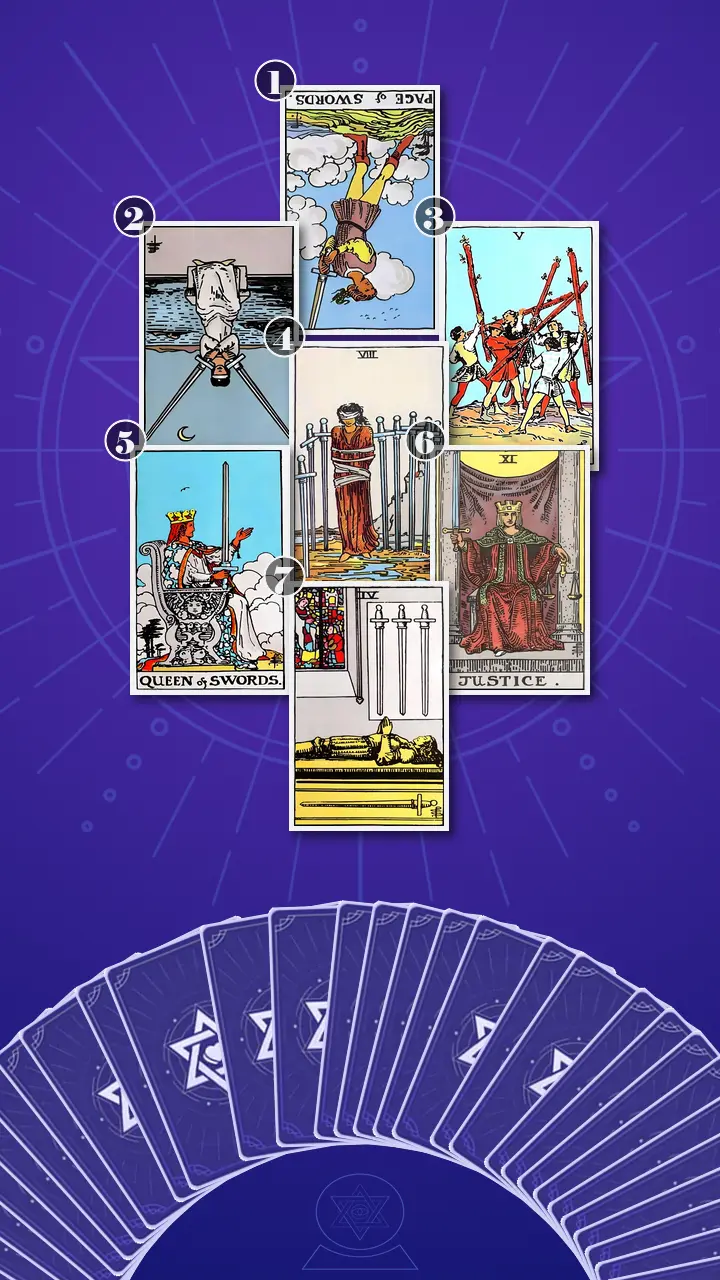
This is how tarot works for me in a case like this: not as a fortune machine, but as a structured way to see where the loop is feeding itself. I did not reach for a broad life spread. I chose a custom seven-card Energy Diagnostic Map because this question is a live review cycle, not a personality quiz. I wanted the layout to trace the surface habit, the inner split, the outside pressure, the hidden cage, the resource already available, the pivot that changes the logic, and the first practical pause.
Card one would show me the visible behaviour. Card four would show me the belief that turns a comment into a trap. And card six would be the hinge: the place where a fair standard can replace panic.
Reading the Map: The First Whisper
Position 1: The Cursor That Won't Settle
Now I turned over the first card, the one for visible surface pattern and reactive behaviour: Page of Swords, reversed.
The modern-life version of this card could have been lifted straight from Jordan's morning: the doc open before coffee, comments refreshed like a live feed, every tiny wording change read as if it were a hidden performance review. In reversed form, this is Air with no landing gear. Too much scanning. Too little sorting. It is the part of the mind that treats motion as safety.
You refresh, you re-read, you answer before the question has even settled, and the thread stays alive because your nervous system refuses to let the file be only a draft.
Jordan gave a short laugh that had more vinegar than humour. 'That is me,' she said. 'That is painfully me.' Her mouth twisted, and she looked away from the table for a second as if the card had caught her in the act. I nodded. Even the laugh had the shape of recognition. The first useful move, I told her, is to slow the response long enough to separate the actual question from the noise around it.
Position 2: The Hand Half-Raised
Next I turned over the second card, the internal push-pull between replying and stepping back: Two of Swords, reversed.
Its modern-life scenario was almost too exact. You are at the kitchen counter with half a coffee, staring at whether to reply now or let the note breathe, and the indecision itself is draining the battery. One part of you wants the thread to stop; the other wants to stay available so nothing can be called unresolved.
Reversed, this is the crack in a stalemate. The swords are no longer held in perfect balance, which means the body starts paying the cost. Jordan's fingers tightened once around her mug, then loosened. 'If I don't answer, it feels like I'm being careless,' she said, and I could hear the hidden rule underneath it: protect the draft, but also protect yourself. The problem is that anxiety is a terrible project manager.
I told her the card was asking for one grounded criterion, not one more opinion. If a note does not change the brief, the facts, or the audience fit, it does not need to steer her day.
Position 3: The Three-Voice Arena
Position three, the external pressure around the doc, was Five of Wands upright.
Three teammates editing the same paragraph in three different directions is not sabotage; it is friction without a shared brief. One wants shorter, one wants more context, one wants a different tone. In isolation each note makes sense. Together, they turn the doc into a miniature arena, and every ping feels louder than the issue itself. It had the energy of a kitchen scene in The Bear, except the heat was all in the notifications.
Jordan exhaled through her nose and gave me the smallest nod. 'That's exactly it,' she said. 'Nobody is wrong, but the thread gets bigger anyway.'
This is why the spiral feels personal even when it is not: the environment itself is producing more commentary than closure.
Position 4: The Locked Room
When I turned to position four, the room went very still. Eight of Swords, upright.
The modern-life translation here is brutal in its accuracy: at 10:38 PM in a small London flat, the draft is still open and your brain is treating one imperfect line like evidence that the whole thing is weak. You keep staring at the page because the real feeling is not unfinished; it is trapped. The cursor is blinking, the file is editable, and yet the mind has already put bars around it.
This is the browser-refresh habit turned into a cage: badge count, cursor hover, rereading tone in punctuation, drafting a defence before the question is even clear. The swords are real enough to sting, but most of them are self-made.
The echo landed hard. Jordan's first reaction was physical: a tight swallow, then a small twitch in one shoulder. After that came the recognition, sudden and uncomfortable; her eyes dropped to the table as if she were replaying her own evenings in real time. Then the release, a thin breath that sounded almost annoyed.
'Yes,' she said quietly. 'That is the loop.'
I did not soften that too much. Some cages only open when you admit you built them for safety.
Position 5: The Clear-Edged Hand
Position five was the resource already in her hands: Queen of Swords, upright.
If Page of Swords reversed is the messenger who cannot stop running, Queen of Swords is the editor who knows the difference between a useful correction and a personality test. Her modern-life scenario is simple: step back, return once the adrenaline has dropped, answer the actual question, trim the extra context, and watch the thread lose some of its grip.
As an archaeologist, I have seen this kind of clarity before. A conservator does not strengthen an artefact by polishing it until the surface disappears; she preserves the line that matters and removes the noise around it. That is Queen of Swords energy: clean judgment without self-defence.
I had the peculiar thought that this was not so different from excavating a Roman threshold. You do not dig faster because the outline is uncertain. You slow down, brush carefully, and let the shape tell you what it is.
Jordan's shoulders lowered by a fraction. 'So I don't need to explain the explanation?' she asked, half-laughing.
'Exactly,' I said. 'The clean sentence is not cold. It is respectful.'
When Justice Finally Spoke
Position 6: Justice, Upright
By the time I reached position six, Jordan had stopped fidgeting but was still carrying the old script: I need to make this airtight before anyone sees it. If I miss something obvious, I will prove I am not as sharp as they think. That was the old engine humming under the table, the one that turned a document into a test.
You do not need every comment to agree before you move; let Justice's scales weigh what matters, and make a clean call from there.
For a second she did not speak. Her eyes stayed on the card, then moved to the notepad where I had drawn two columns: blocker and preference. The courtroom atmosphere of the thread seemed to drain out of the room. Her mouth parted, then she let out a long breath that seemed to come from deeper than her chest. Her shoulders slid down. One hand, which had been curled into a fist since she sat down, opened flat on her knee.
'Oh,' she said, very quietly, and the word carried both relief and a little anger. Not at me. At the amount of energy she had spent pretending every note deserved equal weight. Justice did not ask her to ignore people; it asked her to sort. Is this about the brief? the audience? the deadline? If not, it can be parked. That was the feel of the card: not a verdict against her, but a standard that finally made the room breathable.
In my mind I saw Themis at the edge of a crowded archive, weighing evidence instead of personalities. That is the mythic archetype here: not the punishing judge, but the one who restores proportion. And proportion is what a shared-doc review spiral has been missing all along.
Then I asked her to look back at last week and name one moment when that rule would have changed everything: one comment, one Slack ping, one late-night rewrite that could have waited. She closed her eyes for a beat, and when she opened them the old panic had lost its shine.
This was the step from anxious vigilance and self-doubt toward calm discernment and bounded collaboration. Not perfection. A boundary. A comment is a sorting prompt, not a verdict.
Position 7: The Pause That Lets the Thread Go Quiet
Position seven was the practical landing point: Four of Swords, upright.
The modern-life translation is almost comically simple: the laptop finally closes, notifications go quiet, and the doc is allowed to be unfinished until tomorrow. In a review spiral, that is not laziness. That is neurological first aid.
I told Jordan to build a real pause into the loop: close the doc for twenty minutes before any reply, walk or make tea, and then return once, not ten times. If she needed a physical cue, I suggested a small clay disc beside the keyboard, something she could touch while naming the exact question before she typed. That was my Clay Disc Meditation in plain clothes: a tiny calibration ritual that tells the body the room is still safe.
The nod she gave me then was smaller than the exhale after Justice, but steadier. Four of Swords always looks unglamorous to people who confuse motion with progress; to me, it looks like the moment the nervous system remembers it does not have to stand guard all night.
From Verdict to Working Draft
What the spread showed me was a loop with a very specific logic. Page of Swords reversed keeps checking the file like a live feed. Two of Swords reversed cannot choose between answering and retreating. Five of Wands keeps the review environment noisy. Eight of Swords turns that noise into a prison. Queen of Swords gives the discernment she already has. Justice sets the rule. Four of Swords closes the loop long enough for the whole thing to settle.
The cognitive blind spot was easy to name once the cards lined up: Jordan had been treating every comment as evidence of her competence. That is the false premise. The transformation direction is much cleaner. Stop treating every comment as a verdict. Sort feedback by relevance. Let the thread end when the work is ready enough for this round.
In other words, the doc does not need more defence. It needs a criterion. The thread is not the work, and the review cycle is not supposed to last forever.
I gave her three small moves, and I built them the way I would label finds in the field: one inscription, one pause, one star map. The old-school version of me likes a rule you can hold in your hand.
- Inscription Affirmations — the Comment Triage FilterOn the first reply pass, write the exact question each comment asks, then label every note as must-fix / park / preference. Keep a small card beside your keyboard that says A comment is not a verdict, so you are sorting the thread rather than auditioning for approval.If the labels feel too blunt, add one parking-lot note and move on. Start with one document and one review window.
- Clay Disc Meditation — the Bounded PauseClose the doc for 20 minutes before sending any reply. Hold a smooth coin, coaster, or small clay disc, take four slow breaths, and let your shoulders drop before you reopen the file once, in one pass.The pause is not avoidance if it has a return time. If the urge to reopen spikes, wait it out before touching the tab.
- Celestial Tracking — the One-Line Reply RuleBefore you type, orient yourself by three fixed stars: the brief, the audience, and the deadline. Reply only to comments that change one of those three, and answer the question asked rather than the tone you think is hiding underneath it.Trim one explanatory sentence from each reply. If you catch yourself writing a defence brief, stop and rewrite from the exact question up.
The point was not to become less careful. It was to become more exact about where care belonged. Clarity is a boundary, and a clean boundary makes collaboration easier, not colder.

A Quiet Proof at the End of the Week
Four days later, Jordan sent me a message from a desk near King's Cross. She had written the exact question beside each comment, parked the preference notes, and closed the doc after one review window instead of living inside it. The surprising part was not that the draft became flawless; it was that the evening did.
She told me she made herself a tea, sat by the window, and let the laptop stay shut while the train rattled beneath the street. It was a small, almost stubbornly ordinary proof, but I could hear the change in it: less flinching, more authority, and just enough looseness to breathe. That is how a Journey to Clarity usually looks in real life. Not a cinematic breakthrough. A working draft that finally behaves like a working draft.
We all know that moment when a tiny comment bubble makes your chest go tight, because the visible rough edge on the page suddenly feels like proof that you are not as reliable or in control as everyone thinks. If this draft only needed to be good enough for this round, what would tell you it is safe to close the tab for now?