The Invite Wasn't a Verdict: How I Turned Panic Into Values Choice

The Plus-One Box at 11:58 p.m.
That plus-one box doesn’t feel like logistics; it feels like a spotlight—like everyone will notice what you don’t have.
Taylor said it the second we sat down on the call, like she’d been holding it in her teeth all week.
She was in her Toronto condo, hoodie on, hair still damp from a shower she took “to reset.” It was nearly midnight. The only real light in her living room was the blue-white phone glow bouncing off her cheekbones. She toggled between the wedding website RSVP page and Instagram Stories—engagement reels, ring close-ups, one of those “we bought a house” posts that always seems to show up right after you open an invite. The brightness made her eyes look sore.
Her hands kept doing this small, jittery thing—thumb tapping, then hovering, like her nervous system couldn’t decide whether to hit “Accept” or throw the whole phone across the room. Every time her gaze landed on the RSVP deadline, her throat tightened. Not metaphorically. You could hear it in the way her voice went thinner.
“It’s just an invite,” she told me, and it sounded like she was trying to convince a jury. “So why does it feel like a performance review?”
I let that land. As a radio host, I’m trained to hear what’s underneath the sentence—the rhythm, the catch in the breath. Taylor’s words were fast, but her body was even faster: tight chest, warm phone in her palm, stomach dropping like an elevator when the plus-one field appeared.
“You can be happy for them and still feel weird,” I said. “That doesn’t make you unkind. It makes you human. Let’s treat this like a ‘Journey to Clarity’—not to force a vibe, but to understand what old story the invite is pressing on, and what your next step actually is.”
Choosing the Compass: How Tarot Works with a Celtic Cross Spread
I asked Taylor to take one slow breath—not as a mystical ritual, just as a nervous-system handoff. Then I shuffled, the soft snap of cards steadying the pace of the conversation the way a metronome steadies a song.
“Today,” I said, “we’ll use the Celtic Cross.”
When people ask me how tarot works, I tell them the most practical truth: a good spread is a map. It’s a structured way to separate what’s happening now from what’s being triggered, what’s old from what’s current, and what’s fear from what’s values. Taylor didn’t need a prediction about whether the wedding would be ‘good’ or ‘bad.’ She needed to see the chain: why does this particular envelope set off timeline panic, decision fatigue, and that sudden urge to overhaul her entire life?
The Celtic Cross is perfect for that because it doesn’t pretend your future is fixed. It shows you: the presenting symptom, the immediate pressure, the deeper root, the recent conditioning, the conscious aim, the near-future emotional pattern, and then—crucially—an integration path. It’s a way to get actionable advice and next steps without making the wedding the villain.
“We’ll start with the center,” I told her. “Card 1 is what your panic looks like in real life the moment the RSVP demands an answer. Card 2 crosses it—what pressure or ‘should’ gets laid right on top of you. Then we’ll drop to the root and climb toward a decision you can respect.”
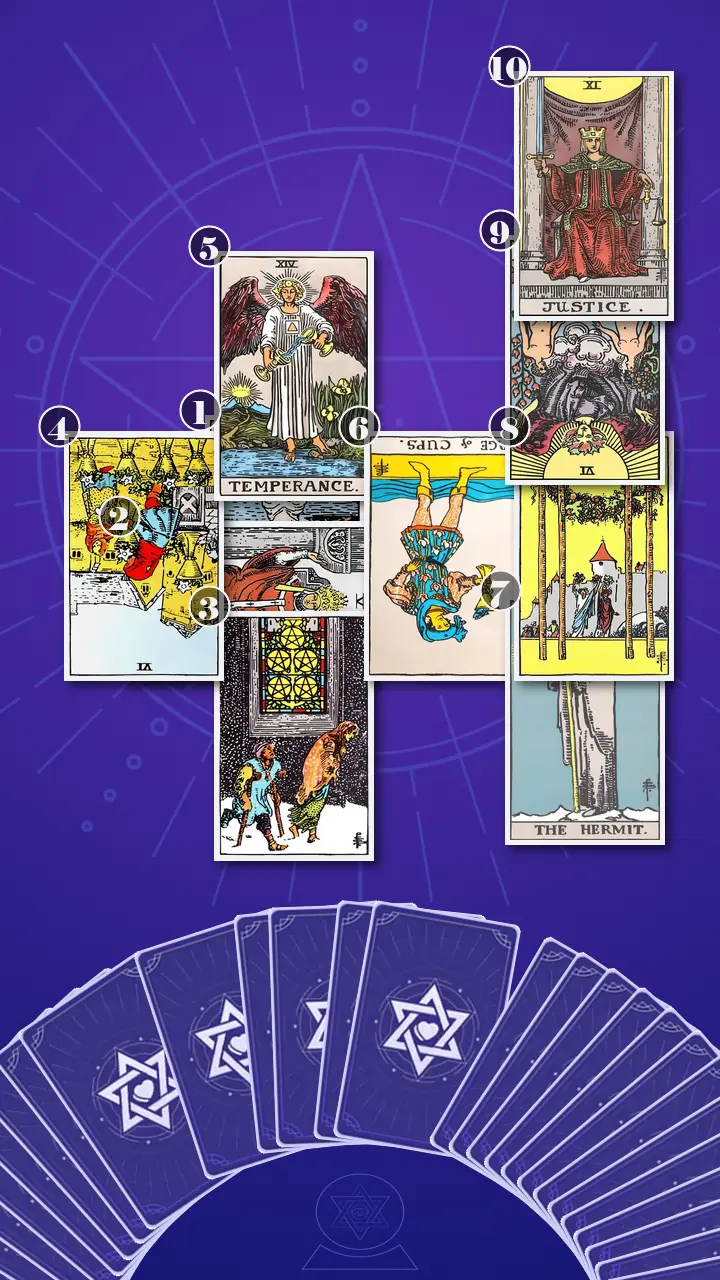
Reading the Map: The RSVP Spiral in Real Time
Position 1 — Presenting symptom: the moment your thumb freezes
“Now flipping,” I said, “is the card that represents how the panic shows up behaviorally the moment you face the invite.”
Two of Swords, reversed.
In the classic image, someone sits with a blindfold on, swords crossed over the heart, water behind them—still on the surface, but heavy with what’s not being said. Reversed, that calm stalemate doesn’t stay calm. It leaks. It turns into overwhelm.
“This is like when you have the RSVP page open on your phone while your brain runs two competing scripts—‘go and prove you’re fine’ vs ‘don’t go and avoid being seen’—and the stillness turns into pressure,” I said.
I watched Taylor’s face change in a way that was almost automatic: a tiny, tense laugh that broke into a long exhale. “Oh my god,” she said, half amused, half wrecked. “That’s… kind of brutal.”
“It’s honest,” I told her gently. “And it’s not a character flaw. It’s a protection strategy.”
Reversed Two of Swords is an Air energy excess: too much thinking, not enough settling. It’s the feeling of reopening the invite, typing and deleting a response, asking friends what they’d do, and still not choosing—because every option feels like it exposes you.
“When this card shows up reversed,” I added, “there’s also an overcorrection risk. You might snap-RSVP just to be done, then overcommit socially. Or you might decline and then isolate. Either way, it’s a decision made to end discomfort—not to support you.”
Position 2 — Immediate challenge: the invisible rulebook
“Now flipping is the card that represents the external script or pressure the invite activates—the ‘should’.”
The Hierophant, upright.
“This is the Rulekeeper,” I said. “Tradition. Institutions. Milestones. The whole unspoken vibe of ‘there is a correct timeline, and everyone else got the memo.’”
I used an image Taylor would recognize instantly. “This is like when you read the RSVP and suddenly feel you’re being graded by an invisible panel on whether you’re ‘doing adulthood right,’ even if nobody actually said that out loud.”
And then I did what I often do on-air when a guest is spiraling: I named the split-screen.
“On the left side of the screen,” I said, “you’ve got the RSVP page. Cursor blinking. Deadline highlighted. The plus-one box sitting there like a required form field that doesn’t fit your actual life—like software forcing a dropdown when your answer is a paragraph.”
“On the right side,” I continued, “you’ve got The Hierophant voice: ‘Be normal. Be approved. Don’t make anyone uncomfortable. Don’t show up without proof you’re on track.’”
In my head I could hear the Toronto layering that makes this worse: Slack notifications that don’t stop, the group chat with polls about outfits and hotel blocks, someone talking about “three weddings this summer” like it’s a sport, the late GO train home where you scroll because you’re too wired to sleep. Pressure compounds pressure.
“So your choice gets distorted,” I said. “It stops being ‘What supports me?’ and becomes ‘What will look acceptable?’ That’s compliance energy. Not connection.”
Position 3 — Root cause: the old belonging wound under the panic
“Now flipping,” I said, “is the card that represents the older belonging/worth story the trigger hooks into.”
Five of Pentacles, upright.
There’s a reason this card makes people swallow hard. It’s two figures outside in the cold while there’s light and warmth behind glass. It’s not just loneliness. It’s the felt distance between you and warmth.
“This is like the ‘outside looking in’ moment—standing in winter outside a lit restaurant where you can hear laughter through the glass,” I said. “And your body decides, before your brain does: ‘I don’t have a place.’”
Taylor went very still. The kind of stillness that isn’t calm—it’s a freeze. I saw her throat work like she was trying to swallow something bigger than words.
“This isn’t about the wedding,” I said, careful and steady. “It’s about the fear of not having a place.”
Five of Pentacles is Earth energy in deficiency—the nervous system scanning for safety and coming up empty. It’s the stomach-drop when you picture walking into the venue alone and your brain narrates, ‘Everyone has a place except me.’ Even if, in real life, you have friends and community. Being included doesn’t always feel like belonging—and that gap matters.
“Where did you first learn that being ‘without’ means being less-than?” I asked her.
“I… don’t know,” she said, but her voice softened, which told me she knew more than she wanted to say out loud yet.
Position 4 — Recent past: the old romance template that’s getting outdated
“Now flipping is the card that represents the earlier conditioning that’s being reactivated or questioned.”
Six of Cups, reversed.
“This one is subtle,” I said. “It’s not nostalgia as comfort. Reversed, it’s nostalgia as pressure.”
“This is like when you think, ‘If I were lovable enough, I’d already be there,’ which is less about today’s dating reality and more about an older rule you absorbed.”
Six of Cups reversed is a Water energy blockage—sweetness becoming a measuring stick. It can also trigger the classic overcorrection: fast-tracking intimacy, saying yes to dates you don’t want, performing happiness online, trying to recreate a ‘perfect timeline’ so you can feel caught up.
Taylor pressed her lips together. “I downloaded Hinge last night,” she admitted, like a confession. “Not even because I wanted to date. Just… to feel like I was doing something.”
“That makes sense,” I said. “Your system is trying to get back in control.”
When Temperance Poured Between Two Playlists
Position 5 — Conscious aim: what you’re reaching for
I let my hands rest on the deck for a second. Even over video, I could feel the atmosphere shift—like when a room goes quiet right before a song’s chorus hits.
“We’re turning over the most important bridge in this reading,” I told her. “The card that shows what you’re consciously aiming for—what you think you should do or feel, and the ideal you’re reaching toward.”
Temperance, upright.
Temperance is an angel making a steady pour between two cups. No drama. No performance. Just measured integration—one foot on land, one in water, a path leading toward a rising sun.
“This is like when you stop asking ‘What should I feel?’ and instead ask, ‘What would help me feel steady if I choose to go, and what would help me stay connected if I don’t?’” I said.
Setup (the stuck moment): Taylor was caught in that exact scene: envelope open, RSVP link staring, her body dropping while her brain negotiated with the plus-one box like it was a referendum on her entire adulthood. In that moment, her mind tried to force a single mood—either cheerful, or detached—because mixed feelings felt unsafe.
Delivery (the sentence that changes the frame):
Stop treating the RSVP like a verdict on your worth; start blending truth and tenderness like Temperance’s steady pour, and let that be how you choose.
I didn’t rush past it. I let the silence do what silence is meant to do: make room.
Reinforcement (the body catches up): Taylor’s reaction came in a small chain, like three beats in a song you can’t un-hear. First: she froze—breath held, eyes fixed on the card as if the image had just said her name. Second: her gaze went a little unfocused, like she was replaying a memory, scanning for every time she’d treated a social milestone like a test. Third: her shoulders dropped, not all at once, but in two soft releases—one shoulder, then the other—as if she’d been carrying grocery bags she didn’t realize were digging into her palms.
“So I don’t have to be… either totally fine or totally spiraling,” she said. Her voice wobbled on the last word, and then she gave a shaky laugh that wasn’t funny—it was relief meeting grief.
“Exactly,” I said. “Temperance is the skill of holding two truths without punishing yourself for having them.”
This is where my own work—sound energy research, music psychology—becomes more than a vibe. I hear Temperance the way I hear a mix: two tracks that don’t need to compete.
“Think of your nervous system like a commute playlist,” I told her. “If you only blast hype music to outrun what you’re feeling, you arrive shaky. If you only play sad songs, you sink. Temperance is mixing two playlists on purpose—one for steadiness, one for courage—so you’re not forcing yourself into one mood.”
Then I brought in my Space Tuning lens—my signature way of reading environments as emotional acoustics. “When you open the invite,” I asked, “where are you usually sitting?”
“On my couch,” she said. “Or in bed.”
“Okay,” I said. “That space has learned the sound of spiraling—phone buzz, tabs flipping, the silence after scrolling. Tonight, before you touch the RSVP again, we’re going to retune the space. Not spiritually—acoustically. Put your phone face down. Turn on one steady sound: a low-volume brown noise track or a slow ambient playlist. The point is to give your body a consistent baseline so your thoughts don’t run the whole show.”
And because her symptoms were so physical—tight chest, tight throat—I added a simple Chakra Sound Therapy tool without turning it into mysticism. “If your throat tightens,” I said, “hum gently on an ‘mmm’ for three slow exhales. Feel it in your lips and chest. That vibration is a direct cue to your vagus nerve: ‘We’re safe enough to choose.’”
Then I asked her, “Now—using this new perspective—can you think of one moment from last week when this insight would’ve made you feel different?”
She looked down at her phone like it was suddenly less powerful. “Thursday,” she said. “I opened it, saw the plus-one box, and immediately went to Instagram. If I’d… blended truth and tenderness, I would’ve just admitted, ‘This makes me feel exposed.’ And then chosen from that, instead of trying to fix my whole life at midnight.”
That was the shift happening in real time: from panic and comparison toward naming the old script with tenderness. From treating the invite as a verdict toward treating it as a prompt for values and self-respect. That’s what finding clarity actually looks like—small, bodily, specific.
Position 6 — Near future: the tender feeling you’re tempted to dismiss
“Now flipping,” I said, “is the card that represents the next emotional pattern likely to arise.”
Page of Cups, reversed.
“This is like when you feel a sudden sting of envy or loneliness and instantly tell yourself you shouldn’t feel that way,” I said, “which makes the feeling louder rather than clearer.”
I described the micro-moment close-up I see all the time in modern dating and milestone pressure: “A sting hits. Then the immediate self-talk: ‘Stop being dramatic.’ Then the rebound behavior: opening Hinge, over-editing a profile prompt, or texting three friends to see who else is going.”
Page of Cups reversed is Water energy in distrust. Not that your feelings are wrong—more that you don’t trust them to be valid unless they’re socially acceptable. So you try to perform composure. And then you wonder why you feel disconnected.
Taylor nodded once, slowly. “I do that,” she said. “I mock myself, and then I’m shocked that I feel worse.”
“Right,” I said. “Your turning point isn’t more thinking. It’s emotional literacy.”
Position 7 — Self stance: the part of you that needs quiet more than advice
“Now flipping is the card that represents how you’re positioning yourself internally—your self-talk and identity lens.”
The Hermit, upright.
“This is like when you turn your phone off for an hour and suddenly know what you want to do,” I said, “not because the fear vanished, but because the noise stopped.”
The Hermit is Earth balanced with Air: solitude with purpose. It’s the opposite of crowdsourcing your decision in the group chat, the opposite of letting the algorithm feed your insecurity once you watch one engagement reel and suddenly your phone serves you fifty more. The Hermit says: you don’t need a hotter take. You need your own lantern.
“Your panic softens when you stop outsourcing the answer,” I told her.
Position 8 — Environment: the social reality (and why it feels so visible)
“Now flipping is the card that represents the social context actually around you.”
Four of Wands, upright.
“This one is almost literal,” I said. “It’s genuinely a communal celebration.”
“This is like when you know you’re invited and included, but the public nature of the event makes you feel exposed, as if everyone can see what you worry you lack.”
Four of Wands is Fire energy in brightness. Warmth, music, photos, toasts. It’s beautiful. And it can also turn up the temperature on comparison. This card matters because it shows the mismatch: externally, there is belonging. Internally, Five of Pentacles tells a story of exclusion. That mismatch is what makes the invite feel like a spotlight even when it’s meant as warmth.
Position 9 — Hopes and fears: longing versus the fear of losing yourself
“Now flipping is the card that represents what you secretly long for—and what you fear it will cost.”
The Lovers, reversed.
“This is bigger than the wedding,” I said. “It’s about values-based commitment—not just to a person, but to a path.”
“This is like when you aren’t only deciding about one event; you’re silently deciding whether you believe love is a place of freedom or a test you have to pass.”
Lovers reversed is Air and Fire out of alignment. It can feel like: If I’m chosen, I’ll have to compromise myself. If I stay true to myself, I’ll be alone. It’s the emotional knot behind timeline anxiety: the fear that belonging requires self-abandonment.
“Temperance says you don’t have to choose between connection and self-respect,” I reminded her. “You can practice both.”
Position 10 — Integration: the clean, self-respecting choice
“Now flipping,” I said, “is the card that represents the healthiest way to hold this trigger and make a self-respecting choice.”
Justice, upright.
Justice sits with scales and an upright sword. Balanced evaluation, then a clean cut. Not harsh—clear.
“This is like when you stop asking, ‘What will people think?’ and start asking, ‘What’s the most honest choice for me—and how do I communicate it cleanly?’”
Justice is Air energy in balance. Not the frantic, leaking Air of Two of Swords reversed. This is Air that can write one respectful sentence and hit send without reopening it twelve times after.
“Clean boundaries beat perfect vibes,” I said. “Your goal isn’t to feel flawless. Your goal is to choose something you’ll respect yourself for.”
The One-Page RSVP Clarity Plan (Truth + Tenderness + a Clean Cut)
I brought the whole spread together for her like a story you can finally follow.
“Here’s the chain,” I said. “The invite hits, and your mind freezes (Two of Swords reversed) because it thinks a wrong choice will expose you. The social rulebook voice gets loud (Hierophant), so the RSVP becomes compliance instead of choice. Under that is an old ‘outside looking in’ imprint (Five of Pentacles) that tells your body belonging is conditional. An outdated romance template flares (Six of Cups reversed), so you try to fast-track proof. Temperance offers regulation—the middle path, the blended playlist—so your feelings can be heard without running the show. Then Justice takes that steadiness and turns it into one clean, self-respecting decision.”
“Your blind spot,” I told her, “is treating the RSVP like a courtroom. Like you owe a defense. But the transformation direction here is simple: regulate first, then choose. The invite is not a verdict. It’s a choice prompt.”
Then I gave her actions—small enough to do on a Tuesday night, specific enough to break the loop.
- The 20-Minute “Temperance Pour” ResetSet a 20-minute timer. In your Notes app, make two headings: “If I go” and “If I don’t go.” Under each, write only two lines: “I want to feel ____.” and “I will protect that by ____.” Do this before you look at the RSVP page again.Expect the thought “This is dumb, I should just decide.” That’s the Two of Swords reversal. Keep it tiny: 20 minutes, not an all-night spiral. If your chest tightens, pause for three slow breaths with a hand on your sternum.
- Pick One Middle-Path Boundary (Not a Fantasy Boundary)Choose one boundary you will actually keep: arrive after the ceremony, leave by 10:30, budget for a rideshare, take a five-minute bathroom break if you get flooded, skip alcohol if it spikes your anxiety, or coordinate with a supportive friend to check in.“Don’t decide while you’re flooded—regulate first, then choose.” If you’re dysregulated, your boundary is to close the tab and come back later.
- The Justice Text: One Clear Sentence + One Warm SentenceSend the RSVP or text with clean communication—no paragraphs, no apology spiral. Example yes: “Thank you so much for inviting me—I’d love to celebrate you. I’ll be there, and I’m planning to head out around 10:30.” Example no: “I’m so grateful you included me—I won’t be able to make it, but I’m cheering you on and would love to take you out for a toast after.”If you’re prone to over-explaining, draft it, wait 10 minutes, then send it with zero extra justification unless it makes it simpler.
And because sound is my native language, I offered one optional layer that matched her body symptoms without adding pressure: my 21-Day Sound Bath strategy.
“For the next three weeks,” I said, “do a daily three-minute sound reset before you open anything wedding-related. Put on one grounding track—slow ambient, gentle piano, or brown noise. While it plays, hum softly on your exhale. You’re teaching your body a new association: the invite doesn’t equal danger.”
“That’s… doable,” Taylor said, and I heard something new in her voice: not hype, not perfection—just steadiness.

A Week Later: Ownership, Not Certainty
A week later, Taylor texted me a screenshot: her RSVP confirmation, sent without the usual hour of rewriting. Under it she wrote, “I’m going. I’m leaving by 10:30. And I already budgeted a rideshare so I don’t have to do the TTC-spiral on the way home.”
Then, almost as an afterthought: “I still woke up this morning with ‘what if I look pathetic?’ in my head—but I didn’t obey it. I put on the playlist, did the humming thing, and it passed.”
That’s what a real Journey to Clarity looks like. Not the absence of fear—just the first quiet proof of self-trust. A clean choice. A boundary you’ll actually keep. A nervous system that learns you won’t abandon it.
When a wedding invite hits your inbox and your chest tightens, it’s not because you’re ‘bad at being happy for people’—it’s because part of you is terrified that being seen without a neat timeline means you don’t truly belong.
If you treated the RSVP as a chance to practice self-respect (not self-proof), what would your most honest yes—or your cleanest no—sound like this week?