From Analysis Loops to Self-Trust: A Shelter Hold Day Choice

Finding Clarity in the 9:38 p.m. Tab Spiral
If you’re a 20-something/30-something in NYC with a startup calendar and a shelter hold ending today, and you’ve been reopening your budget sheet like it’s going to give you an answer—yeah, this is that kind of decision.
Alex (name changed for privacy) sat down across from me with their laptop still open, like the screen was a life support machine. They lived in a walk-up; I could almost hear it from their voice alone—how you learn to carry your week up narrow stairs and pretend it’s fine. When they started talking, the words came out fast and neat, like a Slack update.
“The hold ends today,” they said. “I can… adopt the dog. Or I can keep my solo routine. And I keep doing this thing where I’m ‘being responsible’ but actually I’m just… spiraling.”
They described 9:38 p.m. on a Monday: radiator clicking like a metronome that never lands on a steady beat, blue laptop light washing their hands. Shelter email on one side. Lease pet-clause PDF bookmarked. A spreadsheet tab labeled “dog costs” open like evidence. Their knee bouncing under the coffee table. Their jaw so tight it looked like they were holding a secret between their teeth.
Every time they pictured the dog waiting by the door, their stomach dropped—fast, clean, involuntary—like the moment an elevator lurches before your brain can catch up.
“I want the love part without losing my life,” Alex said, and then they went quiet, like they didn’t trust how true it sounded.
I nodded, slow. “That makes so much sense. A shelter deadline can turn a tender want into a timed exam. Let’s not treat this like you have to ‘solve’ a living relationship with perfect logistics. We’re going to make a map through the fog—toward clarity, not toward a verdict.”

Choosing the Compass: The Decision Cross Spread
I asked Alex to take one breath that was a little longer on the exhale than the inhale—nothing mystical, just a way to signal to the nervous system: we’re here, we’re safe, we’re focusing. While they held the question in mind, I shuffled slowly, the way I used to on long transoceanic nights when travelers would come to me at the edge of sleep, searching for one honest sentence to hold onto.
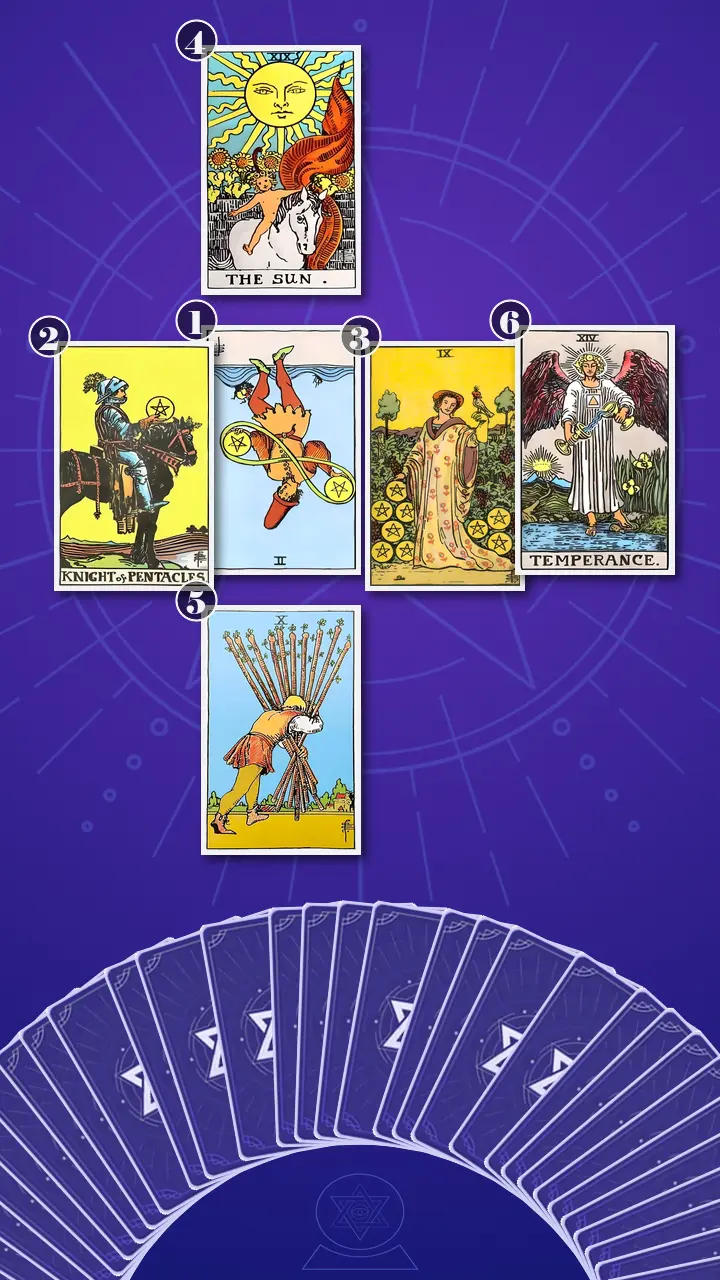
“Today, we’ll use a spread called the Decision Cross,” I told them.
For anyone reading along who’s ever Googled ‘tarot spread for a decision with a deadline’: this is one of the smallest structures that still tells the full psychological truth. It separates the visible overwhelm from the two real options, then reveals the deeper longing and the core fear underneath. It’s ethical because it doesn’t pretend to predict whether adoption will ‘work out.’ It shows what each path asks of you, and how to make a capacity-based decision without turning it into a character verdict.
“Card 1,” I said, tapping the center, “is the pressure point—what the panic looks like in real life. Cards 2 and 3 are the left-right paths: adopt vs keep the solo routine. Card 4 is what you’re truly seeking. Card 5 is the fear-story that makes this feel high-stakes. And Card 6 is the integration—how to decide in a sustainable way that rebuilds self-trust.”
Reading the Map: The Tabs, the Body, the Loop
Position 1: The Present-Day Pressure
“Now flipping over,” I said, “is the card that represents the present-day pressure and observable decision-paralysis behavior around the shelter deadline.”
Two of Pentacles, reversed.
Even before I translated it, Alex gave a small, brittle laugh—like they’d been caught on camera doing the thing they swore they weren’t doing.
“Okay,” they said. “Yeah. That’s literally me.”
I kept my voice steady. “This card is the juggler losing rhythm. Reversed, it’s overload—too many variables competing at once. And it often shows up as motion that looks responsible.”
I described it in the only way that matched their life: “You’re on your couch in a small NYC apartment with three screens going: shelter email, a dog-cost spreadsheet, and your lease PDF. You keep switching between pet insurance quotes, training videos, and Google Calendar—then switching back—because the motion makes you feel responsible for 30 seconds. Underneath, your jaw is clenched and your stomach dips every time you imagine the dog depending on you daily.”
Alex’s knee bounced faster, then stopped. They pressed their tongue against the inside of their cheek, like they were trying to hold their own brain in place.
“Here’s the thing,” I added, gentle but direct. “Refreshing your calendar isn’t the same as making a decision.”
I watched their face do that tiny shift—recognition first, then a little shame, then relief that I wasn’t going to scold them for it. “This energy,” I continued, “is blocked—the ability to balance is there, but right now the system is glitching under deadline pressure. It’s like treating adoption like a product launch you have to QA with infinite edge cases—so you keep shipping nothing.”
Alex exhaled sharply through their nose. “That… hurts. But yes.”
Position 2: Path A — If You Adopt
“Now flipping over,” I said, “is the card that represents what adopting the dog would ask of you in daily life, and what kind of commitment energy it activates.”
Knight of Pentacles, upright.
“This is the slow, reliable caretaker energy,” I told Alex. “Not hype. Not a personality makeover. It’s consistency over intensity.”
I anchored it to the modern life scenario: “If you adopt, it looks less like a dramatic life transformation and more like two repeatable anchors you can keep: a short morning walk before Slack and an evening reset walk after work. It’s buying the same food consistently, setting one vet plan, and choosing training that fits your real bandwidth. The relationship grows because you show up when it’s boring, not just when it’s cute.”
Energetically, this card is balanced Earth—steady, paced. It’s the antidote to the Two of Pentacles reversed. “The Knight doesn’t juggle,” I said. “The Knight commits to what’s real.”
Alex’s shoulders dropped by about half an inch. Their eyes softened, but their mouth still held tension, like they didn’t want to trust relief too quickly.
“I can do boring,” they said. “I think. I just… I’m afraid my ‘boring’ will still collapse during crunch weeks.”
I nodded. “That fear matters. We’ll name it directly when it shows up in the spread.”
Position 3: Path B — If You Keep Your Solo Routine
“Now flipping over,” I said, “is the card that represents what keeping your solo routine protects or preserves, and what it offers you right now.”
Nine of Pentacles, upright.
“This card doesn’t moralize,” I told Alex. “It honors autonomy as a real resource.”
I connected it to their life: “Keeping your solo routine means quiet mornings, spontaneous nights, and the kind of control that keeps you sane in a fast city. You can travel without complicated logistics, recover after crunch weeks, and keep your apartment feeling like your own sanctuary. The shadow is the apartment getting a little too silent on weekends—where independence starts to look like insulation.”
Energetically, this is balanced Earth too—self-sufficiency, cultivated stability. “It’s like noise-cancelling headphones,” I said. “Peace that’s real… and sometimes makes you miss what you actually want to hear.”
Alex swallowed. Their fingers tapped once on the table, then stopped. “That’s the part I don’t like admitting,” they said. “That my routine is… a fortress sometimes.”
Position 4: What You’re Truly Seeking
“Now flipping over,” I said, “is the card that represents the deeper need/longing you’re trying to meet through this choice—the emotional ‘why’ beneath the logic.”
The Sun, upright.
The room felt brighter just looking at it—like my Venice childhood memories of stepping from a shaded calle into open light on the water. I’ve seen this card land in front of people who’ve been rationing joy like it’s a luxury item, something they have to earn by being ‘good.’
“Under the logistics,” I told Alex, “you’re craving a home that feels alive.”
I shifted us out of spreadsheets and into sensation, exactly as the card asked: “Keys in the door. A quiet hallway. A dog tail thumping against the floor like a tiny drum. Warm light in the kitchen at 6:30 p.m.—not a highlight reel, just a Tuesday night that feels warm.”
Alex blinked, slow. Their breathing deepened without them noticing.
“You’re not trying to win adulthood,” I said. “You’re trying to feel more alive in your own week.”
The Sun’s energy is balanced Fire—clarity, vitality, uncomplicated truth. It doesn’t argue. It doesn’t need twelve tabs. It’s the part of you that says, softly, “I want warmth and connection,” and doesn’t add, “and I must prove I deserve it.”
Alex’s face softened, then tightened again—the familiar snap-back. “Joy isn’t a highlight reel. It’s a Tuesday night that feels warm,” they repeated, like they were trying the sentence on for size. “And then my brain is like, okay but vet bills, travel, dating, training—can I do this perfectly?”
I met their eyes. “That’s the loop trying to reclaim control. Let’s see what the fear-story says.”
Position 5: The Cost/Fear That Weighs It Down
“Now flipping over,” I said, “is the card that represents the core fear/cost that makes the decision feel high-stakes—what you worry you’ll lose or be stuck carrying.”
Ten of Wands, upright.
Alex didn’t laugh this time. Their throat moved like they were swallowing something too large.
“This,” I said quietly, “is the mental montage.”
I made it concrete, because this card is never abstract in a city like New York: “Late Slack pings. Laundry you keep forgetting to fold. A bodega run that turns into a line that eats your only break. The MTA deciding, for no reason, that you’ll arrive 22 minutes later than your nervous system can tolerate. And layered on top: vet appointments, training setbacks, walks in February wind, and the dog needing you right when work is loudest.”
I tapped the card gently. “In that montage, you are always the only adult in the room. No backup. No paid help. No friend who can cover. Just you bent under the weight, silently resenting the thing you wanted.”
Energetically, this is Fire as excess—pressure that becomes self-imposed burden. “Commitment doesn’t have to mean carrying everything alone,” I said, careful to make it a door, not a lecture.
Alex stared at the card for a second too long. Then they looked away, eyes unfocused, like a memory was replaying. Their fingers curled into their palm, released, curled again.
“I hate how accurate that is,” they said. “Because I’m already tired. And the idea of being tired forever… that’s what makes me freeze.”
I let that land. Then I said the reframe that often changes everything: “What if your fear isn’t responsibility… but being alone with responsibility?”
When Temperance Poured Between Two Cups
“We’re turning over the final card,” I said, and I felt the room shift into a quieter register—the way it used to on cruise ships when the ocean went smooth and everyone could finally hear their own thoughts. “This is the integration. The most sustainable way to decide.”
Position 6: Integration Advice — The Next-Step That Restores Self-Trust
“Now flipping over,” I said, “is the card that represents integration advice: the most sustainable way to decide and the next-step approach that restores self-trust without forcing a prediction.”
Temperance, upright.
I showed Alex the image: the angel, one foot on land and one in water, pouring between two cups. Measured. Patient. Not dramatic. Not panicked.
“Temperance is a recipe test,” I told them. “It’s not a personality switch. It’s proportion. It’s system design. It’s mixing two playlists so it still sounds like you.”
I grounded it in their modern scenario: “Instead of forcing a binary identity—‘dog person’ or ‘solo person’—you design a recipe. If you adopt: you keep one sacred solo ritual and you set up support: walker backup, a friend on call, realistic training. If you don’t: you still build warmth into your week on purpose—recurring plans, volunteering, a routine that gets you outside. Either way, you decide like a systems designer—not like someone on trial.”
Then I felt them leaning toward the old pattern—toward asking me to declare the “right” answer. I’ve seen that longing in thousands of faces: Please tell me what to do so I can stop being afraid. As a Jungian psychologist, I don’t take that power. As a reader, I translate it.
So I brought in my Choice X-Ray—my way of revealing hidden costs and benefits across multiple dimensions, the way Venetian merchants once evaluated trade not just by price, but by risk, timing, and what it did to your future routes.
“Let’s X-ray the decision,” I said. “Not to find certainty. To find sustainability.”
“When you imagine adopting,” I continued, “the obvious benefit is companionship. The hidden benefit is The Sun: daily aliveness, a warmer home, a reason to move your body even when the city makes you want to disappear. The obvious cost is time and money. The hidden cost is Ten of Wands—if you insist on doing it alone, it becomes a burden story, not a love story.”
“When you imagine not adopting,” I said, “the obvious benefit is autonomy and recovery time. The hidden benefit is self-respect if you choose it cleanly, without calling yourself a coward. The obvious cost is missing the dog. The hidden cost is the Nine of Pentacles becoming a fortress—peace that slowly turns into insulation.”
Alex’s eyes flicked to their laptop, then away—like they suddenly understood the laptop wasn’t going to absolve them.
Setup, I thought—because this was the turning point. Alex was still caught in the belief that they needed a future-proof answer today, and that whichever choice they made would become evidence in the lifelong case of “Am I competent or not?”
And then I delivered the sentence that Temperance always carries for people like Alex—people whose minds sprint for certainty while their hearts quietly beg for a home that feels alive.
Not a frantic juggle for the perfect answer—choose a livable blend, like Temperance pouring one cup into the other until the rhythm fits your real life.
The words sat in the air. Outside, a car horn blared and then faded, like even the city was willing to give us a three-second pause.
Alex’s reaction came in a chain—small, involuntary, honest.
First, a freeze: their breath caught mid-inhale and their fingers hovered above the trackpad like they’d forgotten what clicking was for.
Then, cognitive seep: their gaze unfocused, not on me, not on the card—somewhere between, as if their brain was replaying the last week like security footage: the calendar refresh, the budget redo, the YouTube “first week with a rescue dog” playlist, the way their jaw locked every time they opened the shelter email.
Then, emotional release: their shoulders dropped, their mouth opened slightly, and they let out a shaky exhale that sounded like a laugh trying not to turn into tears.
“But if I do that,” they said, and here came the unexpected edge—anger, not relief—“doesn’t that mean I’ve been doing it wrong? Like… I’ve wasted all this time spiraling?”
I didn’t flinch. I’d heard that exact question on ships, in therapy rooms, in late-night voice notes from people who thought insight had to come with self-punishment.
“No,” I said firmly. “It means you’ve been protecting yourself the only way you knew how—by trying to buy certainty. The loop wasn’t laziness. It was a safety behavior.”
I softened. “And now you have a different option. Temperance doesn’t shame the juggler. It teaches rhythm.”
I leaned forward a little. “Now, with this new lens—livable blend, not perfect answer—can you think of a moment last week when this would’ve changed how you felt?”
Alex didn’t answer right away. They put a hand to their jaw, almost unconsciously, as if the card had given them permission to notice their body. “Thursday night,” they said finally. “I was on Instagram watching my friend’s gotcha day post. Confetti, sunshine, perfect grin. And I had this exact thought: ‘I want the love part without losing my life.’ Then I opened my lease PDF again. Like… it was going to save me.”
They swallowed, then gave a small, stunned smile. “If I had thought ‘livable blend’ then, I think I would’ve… texted my friend and asked what they actually do on crunch weeks. Instead of pretending I have to solve it alone.”
That was the shift—the real one. Not dog vs no dog, but panic vs self-trust. In the language of transformation: this was Alex moving from deadline-driven panic and analysis loops toward a grounded, capacity-based decision with steadier self-trust.
From Insight to Action: The Livable Blend Plan
I drew the whole spread together for them, like stitching a seam so it wouldn’t rip under pressure.
“Here’s the story I’m seeing,” I said. “Right now, the Two of Pentacles reversed is running your nervous system—tab-toggling that feels like responsibility, but actually keeps you from choosing. Both options in the middle are valid Earth paths: the Knight of Pentacles says adoption can work if it’s built on boring consistency, not bursts of perfectionism; the Nine of Pentacles says your solo routine is a real, earned ecosystem, not a failure. The Sun reveals what’s underneath: you want warmth, aliveness, and a home that feels less like a performance review. And the Ten of Wands is the blocker: the assumption that commitment equals doing everything alone. Temperance resolves it by translating desire into structure: support, rhythm, and boundaries.”
“Your cognitive blind spot,” I added, “is that you keep treating this like a binary identity swap—dog person vs solo person—instead of a design problem: chaos vs rhythm. You’re not choosing ‘dog vs no dog.’ You’re choosing ‘chaos vs rhythm.’”
Then I switched into what I call my Port Decision Model—a strategy I learned not in a textbook, but on ships. When you dock, you don’t wait for perfect weather in every possible forecast model. You decide based on the best available conditions, your crew’s capacity, and your backup plans. You choose a safe, workable window and commit to the maneuver.
“The shelter hold ending today is your docking window,” I told Alex. “So we’re going to create a plan you can actually keep—fast, simple, and honest. Not a two-hour Notion template that becomes a punishment.”
- The Two-Slot Care System (7-day rehearsal)Open Google Calendar and block two daily windows for the next 7 days—one AM, one PM—labeled “Care Slot.” Make them small (15–25 minutes). Keep them even if you don’t adopt; use the slot for a walk, dishes, or a reset so you’re rehearsing rhythm, not fantasy.If your brain tries to expand this into a color-coded masterpiece, stop. The point is a livable baseline: “What can I keep on my worst week?”
- One Support Text (Ten of Wands antidote)Text one dog-friend tonight: “Hey—quick question. If I adopt, could I put you down as an emergency backup once in a while during crunch weeks? Totally okay to say no.”Asking for support isn’t a moral failure—it’s logistics. If sending spikes anxiety, draft it first and sit with it for 10 minutes before you hit send.
- The One-Pass Budget Rule (stop the loop)Price the baseline once: food + routine vet + insurance + one backup option (Rover/dog-walker). Write the total. Then close the tab. No redoing the numbers more than once today.Expect your mind to argue “this isn’t enough.” That’s the Two of Pentacles reversed trying to keep you in motion. One pass is the practice.
- A 48-hour Reality Test (before you overbuild)Use a tiny checklist for the next 48 hours: (1) Do the AM/PM care slots, (2) send the support text, (3) write a “Worst-Week Version” of care—three bullets you can keep even during late nights. Then decide: call the shelter with your plan, or choose a clean “not today” without opening another tab.This doesn’t need a perfect answer. It needs a livable plan.
Alex stared at the list the way people stare at a dock from the deck: not with certainty, but with a sense of “Oh. There’s land. There’s a way in.”
“I don’t know if I can do all of that,” they admitted, and their voice went smaller. “I barely have time to breathe on some weeks.”
“That’s why it’s small,” I said. “These are not ‘new lifestyle’ commitments. They’re stabilizers. Two tiny slots. One text. One pass. Forty-eight hours. If you can’t do the small version, that’s information—not a failure.”

A Week Later: Ownership, Not Certainty
A week later, Alex sent me a message that made me smile at my phone in the middle of my own ordinary evening.
“Blocked the two care slots,” they wrote. “Did them three days in a row. Sent the support text—my friend said yes, no drama. Called the shelter. I adopted. And I slept an entire night.”
Then, in the next line: “This morning I still thought, ‘What if I’m wrong?’—but I laughed. Like… okay. I’m allowed to be new at things.”
That’s what clarity often looks like in real life: not fireworks, not certainty—just ownership. A decision made from capacity, boundaries, and support instead of panic. A nervous system that can finally unclench enough to follow through.
When a choice has a deadline, it’s easy to confuse panic with truth—like if you don’t get it perfectly right, you’ll be trapped in the consequences and judged by your own life.
If you didn’t need a perfect answer—just a plan you can keep—what would your next small, honest step look like in the next 24 hours?