From Payday Restlessness to a Steadier Week: Money, Rest, Dating

The 12:06 Deposit That Turns Into a Personality
You’re a late-20s city professional who sees the direct deposit hit and immediately feels like the money has to mean something—and that’s where the Payday Dopamine Loop starts.
Jordan (name changed for privacy) showed up to my little Italian café on a grey Toronto afternoon with that exact look I’ve seen a thousand times from people who are “fine” in public and fried in private. She chose the corner table by the window—the one that catches the cold light and makes your phone screen feel even brighter.
“It’s like… payday happens,” she said, pulling her sleeves down over her hands, “and I become a different person for 24 hours.”
As she talked, I could hear her week like a montage: Friday at 12:06 PM under fluorescent office lights, the microwave beep in the kitchen, her banking app flashing DIRECT DEPOSIT. Relief—so clean it almost feels holy. Then her thumb flipping to Sephora or SSENSE like it’s muscle memory. One-tap checkout. A group chat lighting up. “Down for dinner?” A quick yes so she won’t be the person with an empty night. And then the crash: Thursday-you at 6:42 PM, still hunched over a laptop, Slack pings popping like fireworks, takeout smelling too sweet-salty, jaw tight from clenching your way through the week.
Jordan stared into her Americano like it was going to give her a spreadsheet. “I don’t even buy big things,” she said, voice thin with frustration. “So why does my money disappear. And why do I keep stacking dates and plans like—” she made a little helpless circle with her finger—“like I’m trying to outrun something.”
I watched her mouth as she spoke. The tension wasn’t abstract. It was mechanical: a tight jaw that looked like it had been holding a door shut all week, and that wired-tired buzz that leaves a heavy, sinking feeling the day after you go out—like your body is paying interest on your own choices.
“We’re going to be very practical today,” I told her gently. “No shame. Just clarity. Because what you’re describing is a real contradiction: wanting financial stability and real rest—while also being scared you’ll miss out or end up alone.”
I set my hands on the table between us, palms down, like placing a map flat. “Let’s try to draw the pattern instead of arguing with it. Our journey today is about finding that next step—the one that makes tomorrow morning feel a little more livable.”

Choosing the Compass: How Tarot Works When You Feel Stuck
I don’t treat tarot like a cosmic verdict. I treat it like a well-designed conversation—one that’s good at separating what’s happening on the surface from what’s driving it underneath.
I asked Jordan to take one slow breath while I shuffled. Not as a “ritual” to impress the universe—just a way to transition her mind from spiraling to observing. In my café, that’s how most real changes start: a pause you can actually feel.
“Today, we’ll use a spread I call the Energy Diagnostic Map (7) · Context Edition,” I said.
If you’ve ever Googled how tarot works and ended up with vague answers, here’s the straightforward version: spreads are structures. This one is built for repeating loops—especially ones that cross domains like money, burnout, and dating. A payday spiral isn’t a single decision; it’s a system with a trigger and a predictable crash. So instead of a timeline, we use a diagnostic.
This spread keeps the reading coherent by separating: (1) your surface pattern, (2) your inner tug-of-war, (3) external pressures, and then it puts (4) the core blockage in the center—the knot that ties everything together. The bottom row translates insight into something useful: (5) resources you already have, (6) the transformation pivot, and (7) a grounded next step you can try within a week. You leave with an experiment, not a prediction.
“We’ll start with what payday looks like on your phone and in your body,” I said, “then we’ll find the knot, and then we’ll design a reset that doesn’t rely on white-knuckling it.”
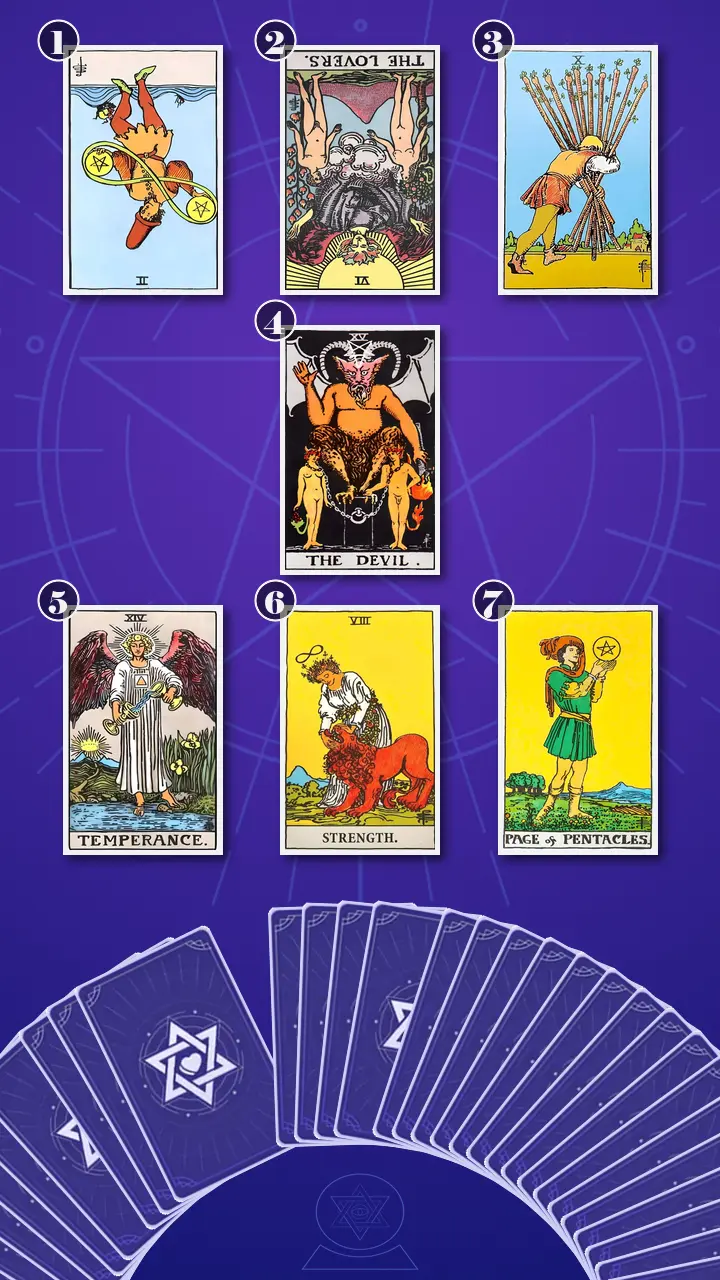
Reading the Circuit: From Juggling to Chains
Position 1: The Surface Pattern After Payday
“Now we turn over the card that represents your surface pattern after payday: the most observable behavior spiral.”
Two of Pentacles, reversed.
I angled the card toward her. “This one always makes me think of having ten browser tabs open—bank app, shopping cart, group chats, dating app, calendar—and your laptop fan is screaming. The Two of Pentacles reversed is that moment when juggling becomes over-juggling.”
I used the exact modern translation that fit her life: payday afternoon, bouncing between the banking app, a cart, and multiple chats, making fast micro-decisions to keep the high going. Then midweek hits, and the tracking stops—not because you don’t care, but because the system in your body is overloaded.
Energetically, reversed here is a blockage—not a lack of skill. It’s rhythm collapsing. You’re trying to move money, time, and connection all at once, and the pace is too fast to sustain.
Jordan let out a laugh that wasn’t happy. It had a little bite to it. “Okay, wow,” she said, shaking her head. “That’s… too accurate. Like, almost rude.”
“I know,” I said softly. “But here’s the good news: if the pattern has a sequence, it’s not random. And if it’s not random, we can catch it earlier.”
Position 2: The Inner Tug-of-War
“Now we turn over the card that represents your inner tug-of-war: stability and rest versus excitement and connection.”
The Lovers, reversed.
Jordan’s eyes flicked up fast, like she already knew where this was going.
“This isn’t about romance as a fantasy,” I said. “The Lovers is about alignment—what you choose when you’re rested and clear. Reversed, it’s what you choose when you’re tired and urgently trying to feel okay.”
I named the scenario as it shows up now: accepting a date or a night out because being wanted feels safer than being alone, even if it costs your sleep, budget, or standards. The next day, you realize the choice didn’t match what you actually value—calm, consistency, mutual effort.
Reversed here is an energy of deficiency—not enough connection to your own values in the moment of decision. Your “higher self” perspective (the angel on the card) gets drowned out by the serpent’s temptation: reassurance right now.
I kept my voice plain. “A ‘yes’ that costs your tomorrow isn’t a real yes.”
Jordan swallowed, her fingers tightening around the paper cup. “If my calendar is empty,” she admitted, “my brain treats it like an emergency.”
“That’s the inner conflict in one sentence,” I said. “Not ‘Do I want love?’ but ‘Can I sit with one quiet night without turning it into a crisis?’”
Position 3: The External Pressures
“Now we turn over the card that represents external pressures: what in your environment amplifies the cycle.”
Ten of Wands, upright.
“This card is pure overload,” I told her. “It’s carrying your week like a bundle you can barely see around. And when your view is blocked, you don’t make values-based choices—you default to whatever changes your state fastest.”
In modern terms: Slack after-hours pings, the expectation to be responsive, the cost of living that makes every plan a price tag, and the constant background hum of comparison—IG stories, rooftop patios on King West, everyone looking like they’re thriving. This is your decision fatigue engine.
Upright here is an energy of excess. Too many wands. Too much “on.” It turns payday into the only moment you feel allowed to reward yourself, which makes the binge-and-crash more likely.
Jordan nodded slowly. Her shoulders rose toward her ears without her noticing.
“Before we go to the center,” I asked, “when does the pressure hit hardest? Is it right after work? Late night? Midweek?”
“Thursday,” she said immediately. “Thursday is when I start bargaining with myself.”
Position 4: The Core Blockage
“Now we turn over the card at the center—your core blockage: the mechanism that binds budget blowups, burnout, and reactive dating into one loop.”
The Devil, upright.
I didn’t dramatize it. The Devil doesn’t need theatrics. It needs honesty.
“This isn’t a character flaw. It’s a loop with a trigger,” I said, using the phrase the way I use it for customers who think they’re the only ones who do this. “The Devil is what happens when you start using ‘Buy Now’ and ‘Plan confirmed’ as emotional regulation buttons—fast relief with hidden fees later.”
I described it like a phone screen montage, because that’s how it lives now: banking app → shopping cart → group chat → dating app → calendar refresh. And in between each tap, the body cue: jaw tightens, stomach drops, shoulders climb. That’s the moment the chain tightens.
The Devil upright here is bondage through reactivity: stress makes you spend or overbook; spending and overbooking makes you tired; tired makes you crave reassurance; reassurance-seeking leads to more spending and faster yeses. The next morning, the discomfort returns—plus consequences—so your brain drafts a harsher rule set, which then backfires into another rebound.
Jordan went very still. Not blank—more like she was replaying a week in her mind at 2x speed.
“I hate that this is me,” she said quietly.
“I hear that,” I replied. “But naming it is how the exit appears. Notice something important in the card: the chains are loose. The moment you see the mechanism, you’re already not fully inside it.”
When Temperance Poured Between Two Cups
Position 5: Usable Resources
“Now we turn over the card that represents your usable resources: what already exists in you that can stabilize the system.”
Temperance, upright.
The whole feeling at the table changed. Maybe it was the late-afternoon light softening. Maybe it was Jordan’s shoulders lowering half an inch. Either way, Temperance always shifts the sensory palette for me: slower, quieter, like the café after the lunch rush when all you can hear is the espresso machine settling.
“Payday doesn’t have to be a dopamine event. It can be a landing,” I said.
Temperance upright is balance. It’s not “no fun.” It’s fun you can recover from. In her modern-life scenario, it’s a blended week plan: one intentional treat, one intentional social plan, one intentional recovery block—and protecting all three like they matter equally.
“You have this capacity already,” I told her. “You’ve just been treating moderation like deprivation. Temperance is the opposite. It’s integration.”
Jordan exhaled—an actual release. “That sounds… doable,” she admitted. “Not miserable.”
When Strength Put a Calm Hand on the Lion
Position 6: The Key Transformation
“We’re turning over the most important card in this reading,” I said, and I meant it. “This one represents your key transformation: the mindset that breaks the loop without relying on willpower alone.”
Strength, upright.
Right away, I watched Jordan’s eyes go to the lion, then to the woman’s hands. People always expect Strength to look like force. It rarely does.
In modern life, this is that moment right before you check out, say yes to drinks, or start a late-night swipe session: you notice the urge in your body (tight jaw, restless chest), and you choose a slower option without shaming yourself. It’s self-trust built by repetition.
Strength upright here is steady regulation—not suppression. The “lion” isn’t your desire. It’s your urgent need for relief. Strength doesn’t kill the lion. She trains it to stop yanking you down the street.
This is where my café brain always joins my tarot brain. I’ve been opening the doors before sunrise for twenty years. I know what happens when you try to rush extraction: bitter, chaotic, too hot, too fast. So I offered Jordan one of my signature lenses—what I call Sacred Timing. In coffee, there’s a narrow window when the flavor peaks. In your nervous system, there’s a window after an urge hits when you can either react—or let it crest and pass just enough for you to choose.
And then I brought in the other tool I’m known for, Grounds Divination: “When you pour espresso, the grounds leave a pattern,” I said. “Not because they’re magic—because they show you flow. Your payday spiral leaves sediment too: the same taps, the same bargaining phrases, the same jaw tension. Strength is learning to read the sediment early, before you’ve already spent the money or booked the night.”
Stop trying to outsmart the spiral with more rules; start taming it with quiet courage and consistency—like Strength’s calm hand on the lion.
We let the sentence sit between us, like a cup set down gently on a saucer.
Setup (the trapped moment): I could see Jordan’s mind at the exact second after payday hits—relief flipping into urgency, filling carts and calendars like silence is dangerous, telling herself she just needs one more plan or one more “upgrade” to feel okay.
Reinforcement (the body-level shift): Jordan’s reaction came in layers. First, a brief freeze—her breath paused, her fingers hovering above the rim of her cup like she forgot what she was holding. Then her gaze unfocused, not zoning out but turning inward, as if she was replaying a recent moment: her thumb over Apple Pay, the tiny rush, the immediate dread. Finally, her shoulders dropped in a slow wave, and her jaw unclenched so suddenly she pressed her lips together like she was surprised by the sensation. “But…” she started, and there was a flash of anger under the vulnerability, “if I’m not stricter, doesn’t that mean I’ve been doing it wrong? Like I needed rules and I just—failed?”
I kept my voice calm. “It means you’ve been trying to solve a nervous-system problem with a punishment strategy,” I said. “And it’s not working because you’re not lazy—you’re overloaded. Self-trust isn’t built by punishment. It’s built by repeatable gentleness.”
“Now,” I asked her, “use this new lens and look back at last week. Was there a moment—right before a checkout, right before agreeing to a late date, right before a 10:57 PM swipe—where a 20-minute pause would have changed how you felt?”
She nodded, eyes bright. “Wednesday. I said yes too fast. I didn’t even like him like that. I just… didn’t want the night to feel empty.”
“That,” I said quietly, “is you stepping from restlessness and self-judgment toward steadier self-trust. Not perfect. But real.”
Position 7: The Next Grounded Step
“Now we turn over the card that represents your next grounded step: one practical action within a week.”
Page of Pentacles, upright.
“This is apprentice energy,” I told her. “Not ‘be fixed by Monday.’ More like: learn a skill.” The Page is focused attention—one pentacle held with care, instead of a dozen reactive options.
In her world, it looks like one simple system for seven days: a Payday Landing ritual, one recovery night, one dating boundary—tracked with a tiny checklist in Notes. Stability as practice, not a personality trait.
I tapped the card gently. “Pick one small rule you’ll actually keep—even on a tired Thursday.”
The One-Week Reset: Actionable Advice for the Payday Spiral
Here’s the story your spread told, start to finish: after payday, you’re in Two of Pentacles reversed—juggling too many tiny choices too quickly, until you drop tracking altogether. Inside, The Lovers reversed pulls you toward reassurance instead of alignment, so dating and plans become a shortcut to feeling chosen. Outside, the Ten of Wands piles on pressure—work, cost-of-living, social momentum—until you can’t see what matters. In the center, The Devil binds it all into a compulsion loop: you use spending and booking as a lever to change your state fast, then you feel trapped by the consequences. Temperance shows you the stabilizer you already have—pacing, blending, designing a week you can recover from. Strength is the pivot: gentle, consistent self-regulation. And the Page of Pentacles lands it into a small practice you can repeat.
The cognitive blind spot I want you to notice is this: you’ve been treating payday like a test of whether you’re okay. So you try to “prove” you’re okay with a cart, a calendar, or a match. But that turns stillness into risk—so the loop keeps winning.
The transformation direction is clear: shift from using payday as emotional anesthesia to using it as a values-based reset—with one small, grounded commitment in each area (money, rest, connection).
I gave Jordan three small experiments—simple enough to do in a high-cost city, in a real work week, without pretending she’ll suddenly become a monk.
- The 15-Minute Payday LandingOn payday, before you browse or say yes to plans: set a timer for 15 minutes. Move one fixed amount to bills/savings first. Then choose one planned treat (under a cap you decide) and one planned social plan for the week. Write both in your Notes app.If 15 minutes feels impossible, do a 5-minute version and only move the bills/savings amount. You’re building a landing, not performing a full life overhaul.
- The 24-Hour Date + Spend BufferIf a date idea costs both money and sleep (late drinks, Uber, outfit pressure), wait 24 hours before committing. Offer a logistics-only alternative: “That night doesn’t work—want to do Saturday afternoon for a coffee walk?”No explanation required. Boundaries land better when they’re calm and practical.
- One Recovery Night (Protected Like a Meeting)Block one night this week (e.g., Tuesday 7:30–10:30 PM). Phone on the charger across the room. Simple food. The goal is “tomorrow-me comfort,” not productivity. If you live with roommates, tell them: “I’m taking a quiet night.”Use my café-style Energy Cleaning closing ritual at home: wipe one counter, dim the lights, and make one warm drink. You’re teaching your body that the day can end without earning it.
To make it stick, I offered Jordan one more tool from my own strategy kit: Aroma Anchoring. “Pick one scent,” I said, “that becomes the signal for ‘I’m safe to slow down.’ Maybe it’s a specific tea, a cinnamon candle, or even the smell of fresh coffee. Use it only on Recovery Night or during your Strength pause. Your brain learns faster with cues.”

A Week Later: The Quiet Proof
Five days later, Jordan messaged me a photo—not a dramatic transformation, just a Notes app screenshot with four tiny checkboxes and one line at the top: Experiment Log (not a verdict).
Under it: “Bills moved ✅ / Treat chosen ✅ / Recovery night protected ✅ / ‘Saturday afternoon coffee walk?’ sent ✅.”
She added: “I still wanted to swipe at 11, and I still felt that itchy FOMO. But I did the 20-minute pause, made tea, and my jaw unclenched. I went to bed. I woke up and didn’t hate myself.”
That’s what I love about this kind of tarot reading. It doesn’t promise a perfect life. It offers a map out of decision fatigue and into something steadier—a rhythm where money, recovery, and dating choices support each other instead of fighting for dominance.
When the deposit hits and you suddenly feel both excited and terrified—like you have to buy, book, or be chosen right now—it’s not because you’re broken; it’s because stillness has started to feel like risk.
If payday didn’t have to be a rush to prove you’re okay, what’s one tiny choice you’d want to try—just once—that would make tomorrow morning feel a little more like home in your own body?