My 'Budget Hack' Was Actually Avoidance: How I Built an Afterpay Pause Rule
Finding Clarity in the 11:32 p.m. Checkout Glow
If you’ve ever selected Afterpay at checkout, then immediately opened the instalment schedule and did the mental maths three times—welcome to the spend-shame-scroll loop.
Alex (name changed for privacy) sat down across from me on a video call from her London flat. She had that particular late-evening stillness around her—the kind that comes after a day of Slack pings, Figma tweaks, and being “on” for everyone, then suddenly being alone with your own brain.
She told me, quietly, “It’s not even the money. It’s the spiral afterward.”
I asked her to walk me through one recent moment, not the whole story—just a single time-stamped slice. Her eyes flicked up and left the way people do when they’re replaying something they wish they hadn’t done.
“11:32,” she said, almost like she was reading a receipt. “Lamp off. Phone brightness turned down. Three tabs open ‘just to browse.’ I hit Afterpay and I get this tiny… relief. And then I open the schedule and I check it again. And again. Like it’s going to magically make me feel… less guilty?”
Underneath her words, I could hear the body story: that tight, buzzy chest; hands that don’t know where to land; the stomach drop that arrives the second the mind imagines future reminder notifications.
Her contradiction was clean and brutal: she wanted immediate comfort—proof she could have nice things—while also fearing the identity-hit of being “bad with money.”
Shame sat on her shoulders like a wet coat she kept putting back on, even when it was freezing her.
“We’re not here to moralise your spending,” I told her. “We’re here to map the pattern—so you can interrupt it without having to become a different person overnight. Let’s see if we can find clarity in the loop, not more judgment.”

Choosing the Compass: An Energy Diagnostic Map for a Spend-Shame-Scroll Loop
I invited Alex to take one slow breath, then another—nothing mystical, just a nervous system handoff from ‘performing competence’ to ‘telling the truth.’ While she breathed, I shuffled, listening for the point where my hands stopped moving like habit and started moving like attention.
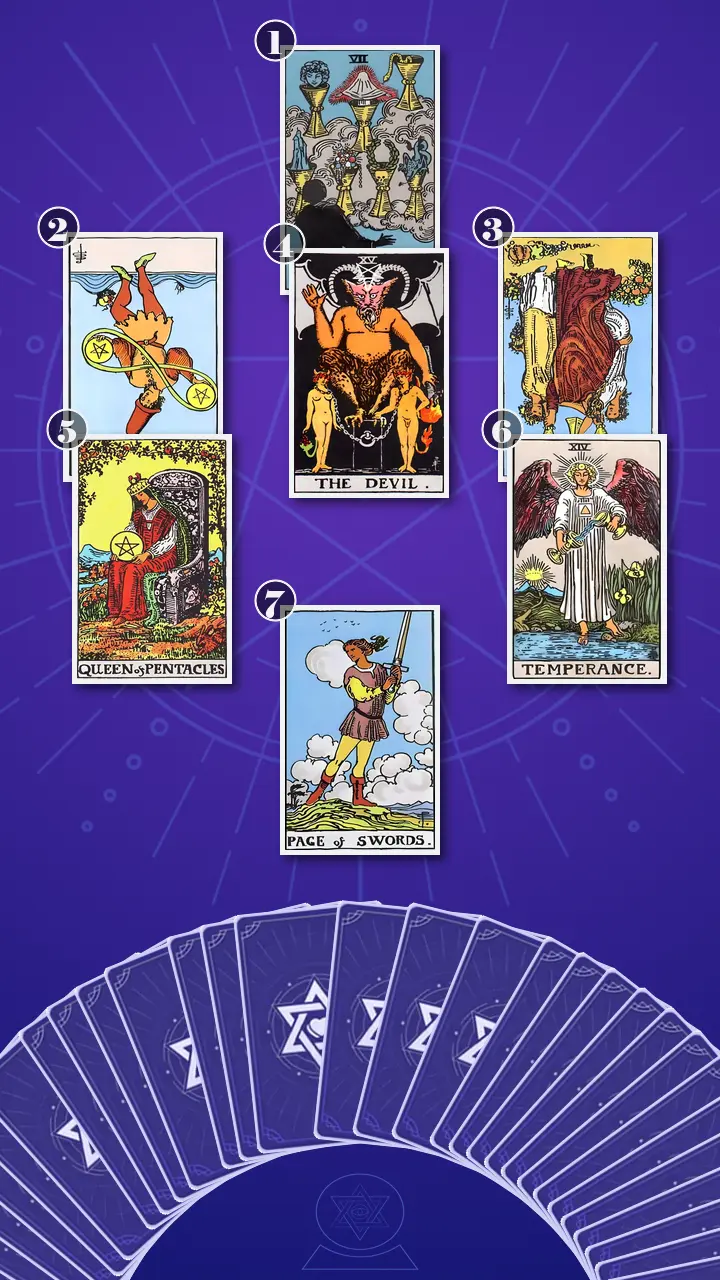
“For this,” I said, “I’m going to use a spread called the Energy Diagnostic Map (7) · Context Edition.”
Here’s why I choose it when someone asks, “Afterpay triggers shame—what pattern is this?” Because this isn’t a single decision problem. It’s a repeating behavioural-emotional loop with an inner tug-of-war (comfort vs control) and an outer amplifier (feeds, comparison, ‘must-have’ content). This spread is the smallest structure that still shows: what you do, what you’re trying to feel, what’s priming you, what’s hooking you, and what you can actually do next week.
I previewed the map like I would for a client—and like I would for you reading this: “The first card shows the surface pattern: what the loop looks like in real time. The center card names the core blockage—the hook. And the last card gives a week-sized next step, so we leave with actionable advice, not vibes.”
Reading the Map: How Tarot Works When the Problem Is a Pattern
Position 1: Surface pattern — what the loop looks like in real time
“Now turning over,” I said, “is the card that represents your surface pattern: what the spend-shame-scroll loop looks like in real time—the observable behaviours and the immediate payoff.”
Seven of Cups, upright.
This one is almost painfully modern. In the traditional image, a figure stares at seven floating cups—each one holding a different promise. In Alex’s life, it’s: you’re tired and under-stimulated after a long day, so you open ASOS and beauty tabs “just to browse.” Every item feels like it could solve something different—confidence, comfort, the fantasy of being more put-together—so you keep adding and saving instead of deciding. And Afterpay makes each choice feel low-stakes, which keeps you in endless maybe mode.
I described it to her in a split-screen, because that’s how it feels when you’re inside it: on the left, seven shiny versions of you in a feed—“soft life,” “new season glow-up,” “she has it together.” On the right, your real bed, real time, real tired brain trying to feel better without admitting you need anything.
And the inner monologue goes like this: “I’m not buying, I’m researching.” → “It’s basically on sale if it’s split.” → “Why am I still scrolling?”
Seven of Cups upright is not “bad choices.” It’s choice overload—desire without a container. Balanced imagination becomes a browser with 27 tabs. And the energy of it? Water everywhere: soothing, seductive, unfocused.
Alex let out a quick laugh—embarrassed, but not defensive. Then she nodded once, small and exact, like I’d just read her open tabs out loud.
“That’s… honestly a bit rude,” she said, and her smile had a thread of bitterness in it. “But yes. That’s my exact browser situation.”
Position 2: Inner tug-of-war — what you’re trying to balance when Afterpay appears
“Now turning over,” I continued, “is the card representing your inner tug-of-war: what you are trying to balance internally when Afterpay appears—needs versus limits.”
Two of Pentacles, reversed.
In modern life, this looks like: after you pick Afterpay, your brain turns into a background spreadsheet. You re-check dates, recalculate your next two weeks, and keep toggling between the schedule and your bank app like one more refresh will create calm. Instead of feeling flexible, you feel like you’ve hired yourself for a second job: tracking future-you’s commitments.
Reversed, the Two of Pentacles isn’t “you can’t manage.” It’s over-management turning into chaos. The balancing energy is blocked. The juggling becomes exhausting. It’s not the money, it’s the mental bandwidth.
Alex’s mouth tightened the way it does right before someone admits something they’ve been calling “normal.”
“I literally do that,” she said. “I open Monzo and I’m like… okay, okay, okay. And it’s never okay.”
“Because you’re asking your midnight brain to do CFO work,” I said gently. “Midnight brains aren’t built for that. They’re built for survival and comfort.”
Position 3: External pressure — what keeps the loop primed
“Now turning over,” I said, “is the card for external pressure: what in your environment—especially social feeds and norms—keeps the loop warmed up and ready to run.”
Three of Cups, reversed.
In Alex’s real life, it’s this: you’re alone in bed, but your feed feels like a party you weren’t invited to unless you show up with the right products. Outfit hauls, beauty must-haves, “things I’m obsessed with,” YouTube favourites—suddenly buying becomes a shortcut to “I belong.” And the shame hits because it doesn’t feel like a choice anymore—it feels like pressure.
Reversed, this isn’t “don’t have friends.” It’s “your inputs are performative connection.” A toast that tastes like comparison.
Alex’s shoulders lifted an inch, like she’d been bracing for blame. When it didn’t come, they dropped back down. “It makes me feel behind for, like, twenty seconds,” she said. “But twenty seconds is enough.”
Position 4: Core blockage — the hook that binds desire to shame
“Now turning over,” I said, “is the card representing the core blockage: the binding mechanism that links desire to shame and keeps your attention trapped in the loop.”
The Devil, upright.
Some cards arrive with a kind of hush. Even over video, the room seemed to go quieter on her side; I could hear the distant London street noise more clearly, like the city leaned in.
In modern life, The Devil here is simple and precise: Afterpay isn’t just a payment method. It’s the hook that makes desire instantly actionable when you’re stressed or depleted. The purchase gives a quick relief hit, then shame shows up to “correct” you, and that shame drives you back to scrolling for numbness or another fix. Your attention stays chained to the schedule, the feed, and the self-critique—even when the item isn’t even here yet.
The old story people tell themselves is: “If I shame myself hard enough, I’ll stop.” But the card shows the trap: the chains look tight, yet they’re loose enough to slip off. There is a choice point.
I named it exactly where it lives: “The tiny moment between tapping Afterpay and tapping confirm—the half-second your hand hesitates.”
Alex’s throat bobbed as she swallowed. Her fingers—restless a moment ago—went still, pressed flat to her own palm.
“Shame isn’t your budget plan—it’s part of the loop,” I said. Not as a slogan. As a diagnosis.
Her eyes went wet, not quite tears—more like the body recognising itself. “That’s the part that freaks me out,” she whispered. “Because the shame feels like… me trying to be responsible.”
“I know,” I said. “It’s wearing responsibility’s clothes.”
And this is where my own background—my family’s Highland way of reading seasons, weather, and human nature—always wants to step in. In the Highlands, we don’t call the storm ‘bad.’ We call it information: pressure shifting, air changing, a front arriving. The Devil card is a front. Not a verdict.
Position 5: Usable resources — what you already have that can stabilise you
“Now turning over,” I said, “is the card representing usable resources: what you already have—values, skills, routines—that can stabilise money and self-worth.”
Queen of Pentacles, upright.
This is the part of Alex that exists even when she’s doomscrolling: the steward. The version of her who can build comfort that isn’t purchase-dependent. In modern life, it’s: you eat something real, you check your actual cash flow once, you set a ‘good enough’ plan you can keep, and you protect future-you without humiliating present-you.
The Queen doesn’t clutch the pentacle like a test. She holds it like a living thing. That’s a different relationship with money entirely.
Alex exhaled through her nose, slow. “I can do ‘steward,’” she said, sounding surprised. “I do that at work. I just… don’t do it at 11:30.”
Position 6: Key transformation — the new pattern that counteracts the hook
“Now turning over,” I said, “is the card representing your key transformation: the new pattern to practice that directly counteracts the core blockage.”
Temperance, upright.
Temperance is the card I reach for when someone is trapped between extremes—no-spend vows versus impulse checkout; discipline versus collapse. The angel pours between two cups: not chugging, not starving—mixing. One foot on land, one in water: feeling and structure at the same time.
And because my work is rooted in what I call my Nature Empathy Technique, I always translate Temperance into the natural world before I translate it into a habit. Temperance is a stream meeting a stone: it doesn’t scream at the stone. It moves around it, consistently, until a new channel exists. Middle path > harsher rules.
Setup (the moment you know too well): It’s 11:30 p.m., lights off, phone on low brightness—three tabs open “just to browse.” You hit Afterpay, feel that tiny rush, then immediately start re-checking the instalment schedule like it might calm you. Your mind tries to solve discomfort with numbers, and when that fails, it tries to drown discomfort with scrolling.
Delivery (the sentence I want to land in your body, not just your head):
Not an all-or-nothing vow—choose measured mixing like Temperance, and let each purchase pass through a small, balancing pause before it becomes a chain.
Alex’s reaction wasn’t instantly peaceful. It was complex—human. First, she froze: breath held, jaw tightening, eyes locked on the screen like she was bracing for a scold that didn’t arrive. Then the meaning seeped in: her gaze unfocused for a second, like an internal replay started—every late-night “I’ll never do this again” promise, every rebound cart, every quiet shame. Then emotion moved: her shoulders dropped, but her voice sharpened.
“But if I do a pause,” she said, a flash of anger, “doesn’t that mean I’ve been doing it wrong this whole time?”
I didn’t rush to soothe her out of it. “It means you’ve been doing what your nervous system could access,” I said. “And now you’re building a new access point. There’s a difference.”
I watched her hands—restless before—slowly unclench. Her eyes reddened at the corners; she blinked hard once. The anger didn’t vanish. It softened into grief, then into something steadier: relief that didn’t require pretending.
“Okay,” she breathed out, and it sounded like the first time she’d stopped arguing with her own wanting. “Wait… I don’t have to choose between never buying and spiralling.”
“Exactly,” I said. “Now—use this new lens and look back. Just once. Last week, was there a moment where a balancing pause would have changed how you felt?”
She nodded, looking down. “Sunday. Bathroom light buzzing. I was brushing my teeth and I could feel myself… sliding. I could’ve paused there.”
And that was the shift: from shame-driven urgency and compulsive instalment-checking toward measured self-trust. Not perfection. A new channel in the stream.
Position 7: Next step — a week-sized experiment that makes the loop visible
“Now turning over,” I said, “is the card representing your next step: one actionable, week-sized experiment that makes the pattern visible and interruptible.”
Page of Swords, upright.
This is the part of you that can look without flinching. In modern life: you treat the loop like a design problem. You track what time it happens, what you were feeling, what content primed you, and what you were actually needing. Instead of attacking yourself, you get curious.
For a junior UX designer, this is almost poetic: the Page of Swords is analytics for your habits. Not to shame you—to show you what’s actually happening. Data, not drama.
Alex’s face changed in a way I’ve seen a hundred times: the moment someone stops thinking they are the problem and starts seeing the system.
The Temperance Pause: Actionable Next Steps That Don’t Require a New Personality
I pulled the whole map together for her in plain language, the way I would if we were pinning it to a wall like a real subway map.
“Here’s the storyline,” I said. “Seven of Cups shows the dreamy lure: infinite options, each promising a mood fix. Two of Pentacles reversed shows what happens inside you: the juggling tips into overwhelm, and your brain starts refreshing instalments like a second inbox. Three of Cups reversed shows the outside fuel: comparison content that turns ‘belonging’ into a purchase. The Devil is the hook: relief and shame lock together, chaining your attention. Then Queen of Pentacles reminds you there’s another version of you available—the steward. Temperance is the bridge: the middle path where comfort and structure happen in the same decision. And the Page of Swords makes it practical: observe the pattern so you can interrupt it earlier next time.”
The blind spot the cards kept pointing to was this: Alex had been using shame as a control tool. It felt like discipline, but it was actually part of the chain. The transformation direction was clear: from “reduce discomfort now” to “protect self-trust with a visible, pre-decided pause rule.”
Then I gave her next steps—small enough to start, specific enough to work.
- The 10-minute “Temperance Pause” before checkoutBefore any Afterpay checkout this week, set a timer for 10 minutes. Open Notes and write: “Full price = £___; Next payment date = ___; Emotion right now = ___.” Then ask: “What’s the smallest version of this that still feels satisfying and safe?” (save it, buy one item not three, set a 24-hour hold, or choose a cheaper alternative).If your body goes buzzy or your thoughts turn cruel, end early. Put your phone face-down and do 5 slow breaths. The goal is visibility, not perfection.
- Pin a “BNPL Reality Check” note (full-price clarity beats instalment comfort)Create one pinned note titled “BNPL Reality Check.” Keep: total BNPL commitments, next payment dates, and one line: “I’m building self-trust, not a perfect budget.” Open this note before you open a shopping app—especially after 10 p.m.If your brain argues “I don’t have time,” write a one-sentence version. One sentence counts. Add a boundary line: “No insults allowed.”
- A 7-day “Data, not drama” trigger log (Page of Swords)For 7 days, keep a one-note log: time, trigger (stress/boredom/comparison), feeling-before (one word), what you opened (app/site), and what you actually needed. When you catch yourself re-checking the instalment schedule, label it: “This is my control-check,” then put the phone down for 30 seconds.Treat it like a UX diary: you’re running an experiment, not building a case against yourself. If you miss a day, don’t restart—just continue like a streak doesn’t exist.
Before we ended, I offered one piece of my own protection practice—simple enough to do in a London flat, no incense required. “Tonight,” I said, “try my 3-minute bedtime energy review. Not to judge. To close the day. Ask: ‘What did I take in? What did I spend—money, attention, energy? What do I want to release so it doesn’t follow me into bed?’ It’s like shutting down tabs on purpose.”
And because she lives in a city where silence is rare, I also offered a strategy from my toolkit that works beautifully for people whose brains seek noise: a walking meditation using environmental sounds. “Five minutes,” I said. “Tomorrow. No music. Just name what you hear—bus brakes, footsteps, kettle click, distant siren. It re-trains attention to come back to the present, which is the opposite of the Afterpay loop.”

A Week Later: The Quiet Proof (and the Bittersweet Edge of Change)
A week later, Alex messaged me. Not an essay—just a screenshot.
It was her pinned note: “BNPL Reality Check.” Under it, a line she’d added herself: “I can want this and protect future-me.” Temperance, in her own words.
“I did the pause,” she wrote. “I didn’t even buy the thing. I just… stopped. And I didn’t hate myself after.”
Her change wasn’t cinematic. It was quiet and real: she slept a full night, then woke up and her first thought was still, “What if I mess up?”—but this time she noticed the thought, exhaled once, and got out of bed anyway.
That’s the journey I care about: not a perfect budget, but a steadier relationship with wanting. Not a new identity, but a calmer choice point—one that protects self-trust more than it protects a purchase.
When you want a little comfort so badly that you’ll split the price to make it feel safe, then punish yourself for needing the split, it’s not the item that owns you—it’s the fight inside you about what wanting says about you.
If you didn’t have to choose between “never buy” and “spiral after,” what would a genuinely balanced pause look like for you the next time your thumb hovers over Afterpay?