From Streak Shame to Calm Pride: Learning to Return After a Miss

The 11:59 p.m. Toothpaste Lesson
You’ve done the 11:59 p.m. Duolingo lesson with toothpaste foam in your mouth—not because you’re inspired, but because watching the streak break feels like failing a character test.
Jordan (name changed for privacy) said that to me like it was a confession and a joke at the same time—one of those laughs that tries to outrun the heat in your face. She was 27, Toronto, a fast-paced hybrid corporate job that kept her brain half in Slack and half in Outlook even when she was technically “off.”
She described the scene with the kind of exactness you only have when your body remembers it. Thursday, 11:57 p.m., condo bedroom. The bedside lamp was on but it might as well not have been; the phone screen did all the talking. The air felt dry from the heat, her eyes stung, and she was half under the duvet with her thumb hovering over the little green owl like it could bite. When she saw the streak had reset, she said her chest went tight and her stomach dropped—then came the restless, keyed-up need to “fix it” like the reset was a kitchen fire.
“It’s embarrassing,” she said, rubbing her palm over her sternum as if she could smooth the feeling flat. “A little app can make me feel like I failed at being a person. I want to learn a language, not feel graded every night.”
As she spoke, I watched the pattern form in the air between us: wanting language learning to be joyful and self-directed versus fearing that inconsistency proves you lack discipline—and worth. That contradiction is a powerful engine. It can drive you forward, or it can drive you into a wall over and over.
“You’re not behind,” I told her, keeping my voice steady and un-dramatic. “You’re just human. And shame has a way of turning something small into a verdict. Let’s make today about finding clarity—about drawing a map of what’s actually happening when that counter drops to zero.”

Choosing the Compass: The Four-Layer Insight Ladder Tarot Spread
I invited Jordan to take one slow breath—not as a ritual for the gods, but as a clean transition for the nervous system. Then I shuffled. The sound of the cards was dry and papery, like turning pages in an old library. It’s a sound I’ve loved since my academic days at Cambridge: the gentle insistence that meaning is found by looking carefully, not by forcing conclusions.
“Today,” I said, “we’ll use a spread I call the Four-Layer Insight Ladder · Context Edition.”
For the reader: this case isn’t really about choosing between two options. It’s about decoding an inner shame-response loop triggered by a gamified metric—habit-tracker shame that behaves like a glitchy alarm system. A ladder-style inner work spread fits better than a timeline or decision layout because it moves cleanly from what’s visible to what’s driving it, and then down into what you can actually do next. The spread reads like a descent: symptom → meaning → root belief → protection strategy → medicine → one-week integration. It mirrors the experience of spiraling—and then rebuilding from a steadier foundation.
“The first card,” I told Jordan, “shows the surface symptom—what happens in the first sixty seconds after the reset. The middle cards will explain the ‘why corridor’: what the reset symbolizes, what belief hooks you, and how you protect yourself. Then we’ll land on the medicine—the inner quality that breaks the loop—and finally a grounded one-week practice.”
She nodded, but it wasn’t the cheerful kind. It was the nod you do when you’re bracing for an email thread you already know will be unpleasant.
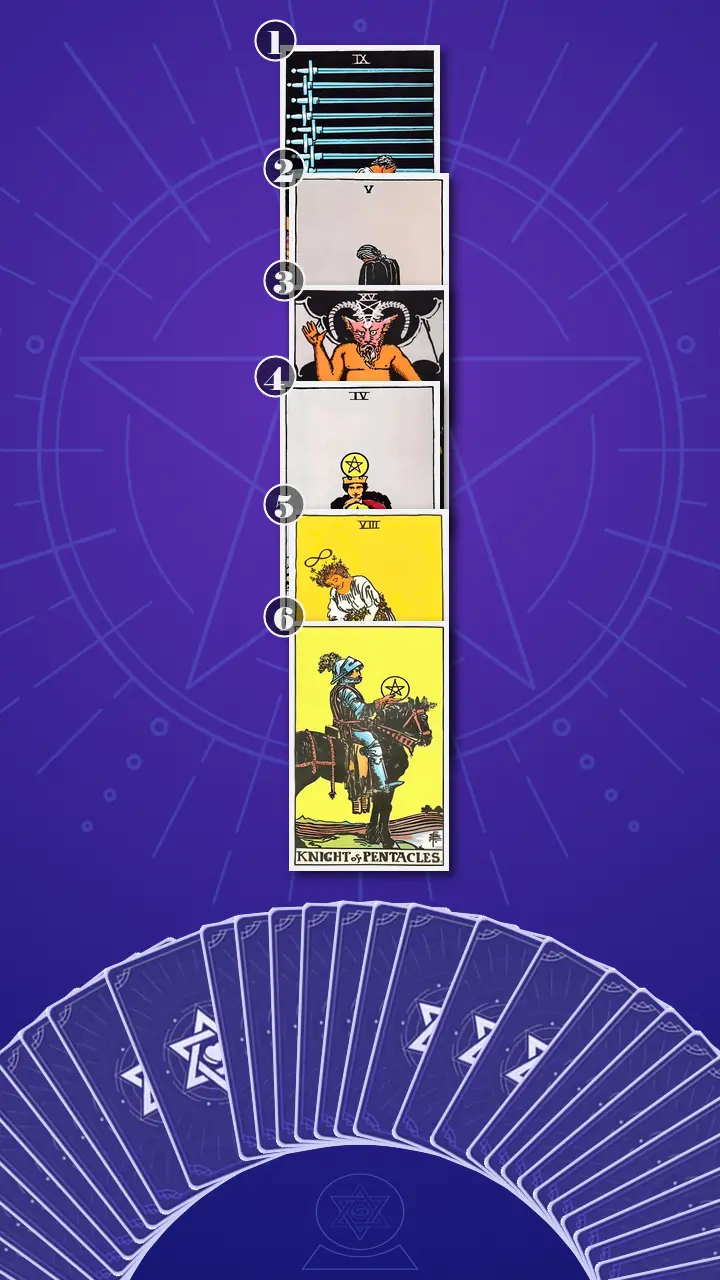
The Spiral in Night Mode
Position 1 (Surface symptom): the immediate shame/rumination response
“Now flipped,” I said, “is the card that represents the surface symptom: the immediate, observable shame/rumination response after the streak breaks.”
Nine of Swords, upright.
This card is almost obnoxiously accurate for modern life: you wake up, open Duolingo before you’re fully conscious, and see the streak reset. Before you even sit up, your mind starts running an internal performance review—replaying why you missed, stacking it with other ‘failures,’ and treating a missed day like evidence you can’t be trusted to follow through.
Energy-wise, the Nine of Swords is excess Air: thinking that doesn’t inform you—it prosecutes you. One missed day becomes a whole courtroom drama at 2:13 a.m. Blue-light phone glow. Duvet half-kicked off. Slack notifications still echoing in your head like a stubborn song you can’t stop humming. And the rumination has a very particular sentence-pattern: If I can’t do ten minutes, what else am I failing?
I looked at Jordan and asked the question this position demands: “Right after you notice the streak is gone—what’s the first sentence your brain says about you, word for word?”
She didn’t answer immediately. She did something more revealing: a short, bitter laugh. “This is literally me at night,” she said. “And it’s… kind of mean? Like my brain is trying to scare me straight.”
“Yes,” I said. “And here’s the line I want you to keep: The midnight lesson isn’t discipline—it’s a peace treaty with shame. It’s you negotiating with a number so you don’t have to feel that sinking, exposed feeling.”
Position 2 (Emotional meaning): what the lost streak is symbolizing
“Now flipped,” I said, “is the card that represents the emotional meaning: what the lost streak is symbolizing in the moment—what feels ‘lost.’”
Five of Cups, upright.
In real life, this is the moment where you look at the reset and emotionally discount everything you did before it—like the lessons only counted if the number stayed unbroken. You can remember the exact moment the icon changed, but you can’t access the plain fact that you still learned vocabulary, patterns, and confidence that didn’t vanish overnight.
The Five of Cups is blocked Water: grief that’s narrowed into a single point of focus. So I used the technique I trust here—a deliberate camera pan. “Yes,” I said, “three cups are spilled. The number is gone. But the card insists on a second shot: two cups still standing behind you.”
I leaned back slightly, as if giving her nervous system a little more room. “Name three concrete things you’ve gained that still exist even with a reset. Not ‘progress’ as a vibe. Actual evidence.”
Jordan’s gaze flicked up and to the side—the searching look of someone scrolling an internal file cabinet. “I can recognize a bunch of words now,” she said. “I can catch some patterns. And… I can actually say a couple sentences without freezing.”
Her shoulders dropped a few millimeters. Not relief exactly—more like the judgment loosened its grip.
Position 3 (Root pattern): the belief that turns a missed day into an identity threat
“Now flipped,” I said, “is the card that represents the root pattern: the attachment or belief that turns one missed day into an identity threat.”
The Devil, upright.
Jordan inhaled through her nose—small, sharp. It’s the same inhale I’ve heard from students when they realize the evidence doesn’t support their favorite excuse.
In modern terms, this card shows up like this: the streak has quietly become a character reference letter. When it breaks, you don’t just feel disappointed—you feel exposed, like you got caught not being ‘disciplined.’ You keep checking the app because part of you believes the number is the only thing holding your self-control together.
Here the energy is excess binding: a false authority that feels like safety. It’s the psychological equivalent of being on probation with yourself—like the app is your boss, the streak is your KPI, and the reset is a public demotion. You start making rules, moving calendar blocks around, bargaining: five lessons tomorrow, stricter schedule, “no excuses.” Anything to repair the feeling of being unapproved.
I tapped the image gently. “Notice the symbol people miss,” I said. “The chains are loose. This bondage is optional. You keep signing the contract.”
Then I said the sentence that punctures the spell without shaming the person: A streak is a tool. It’s a terrible judge.
Jordan stared at the card, then let out a half-laugh that didn’t quite land as humor. “I do treat it like a character reference,” she said softly. “Like… if I’m unbroken, I’m allowed to feel proud.”
Position 4 (Protection strategy): how control shows up to prevent the feared feeling
“Now flipped,” I said, “is the card that represents the protection strategy: how control shows up behaviorally to prevent the feared feeling from surfacing.”
Four of Pentacles, upright.
After the reset, this is the clamp. You tighten: stricter schedule, bigger goals, ‘no excuses’ energy. You force lessons when you’re depleted or try to lock practice into a perfect time slot, because adapting to real life feels like losing control over yourself.
The Four of Pentacles is excess Earth: holding so tightly that nothing can move. It’s the body-level grip Jordan had already described—chest tight, jaw set, the nervous little ritual of checking the streak icon first like it gets to decide whether you’re a competent adult today.
I asked, “After the reset, what rule do you immediately want to tighten—and what feeling is that rule trying to prevent?”
She answered quickly, like the truth had been waiting behind her teeth. “I want to add more. Like, ‘Fine, I’ll do five lessons tomorrow.’ And the feeling is… that I’m out of control. That I can’t be trusted.”
I nodded. “That makes sense. And it also explains why the habit gets fragile. If the only thing keeping it alive is a clenched fist, the moment your grip slips, everything feels like it collapses.”
When Strength Spoke: Meeting the Lion Gently (Finding Clarity)
Position 5 (Medicine): the inner quality that dissolves the shame loop
Before I turned the next card, the room got noticeably quieter—one of those small shifts where you can tell we’re approaching the hinge of the whole story.
“Now flipped,” I said, “is the card that represents the medicine: the inner quality that dissolves the shame loop and restores self-leadership.”
Strength, upright.
Strength is not the gym-bro version of strength. It’s not domination. It’s regulated courage—contact without cruelty. It’s the gentle hand on the lion: the part of you that can meet the shame spike without attacking yourself, bargaining with the metric, or disappearing from the practice altogether.
And because I’m an archaeologist by training, I can’t help seeing an old story inside it. Across the ancient world—from Greek vase paintings of Heracles and the lion to Roman reliefs where power is shown through restraint—mature strength is never the clenched fist. It’s the steady hand. The leader who doesn’t need a spectacle to prove authority.
Setup (the familiar trap): Jordan was still living inside that late-night calculus—11:58 p.m., brushing her teeth with one eye on the mirror and one eye on her phone, calculating whether she could squeeze in a “quick” lesson before midnight—like the number was a moral deadline instead of a language app.
Then I slowed down, and I delivered the line exactly as it needed to be delivered—like reading an inscription aloud so it can be heard in the chest, not just understood in the head.
Stop treating the reset like a verdict, start treating it like a lion you can meet with a gentle hand—Strength is consistency without self-punishment.
I let silence do its work. I’ve spent enough time in excavations to trust pauses: sometimes the ground has to settle before you can see the shape of what you’ve uncovered.
Reinforcement (the body learns first): Jordan’s reaction came in a small chain, like dominoes. First, a brief freeze—her breath caught, and her fingers stopped moving against her coffee cup. Second, a flicker of mental replay—her eyes went unfocused, as if she was watching herself on the TTC platform, phone warm in her palm, seeing the reset and immediately drafting a case against herself before breakfast. Third, the release: a long exhale, almost shaky, and her shoulders sank as if she’d been holding up a heavy bag she forgot she was carrying.
Then—unexpectedly—her face tightened again. A flash of defiance. “But if I’m gentle,” she said, voice sharper, “doesn’t that mean I’m letting myself off the hook? Like… was I wrong to care?”
I didn’t correct her. I widened the frame. “Caring isn’t the problem,” I said. “It’s the leadership style. There’s a difference between accountability and metric-based self-worth—between learning and proving.”
I leaned forward a touch, the way I do when I’m about to offer something practical. “Let’s test Strength in the moment it matters—the reset moment. A ten-minute ‘Return, Not Perfect’ reset.”
“(1) Open Duolingo and pause before tapping anything. Notice where shame lands in your body—chest, stomach, jaw. (2) Set a two-minute timer and do the smallest lesson you can without rushing. (3) After you finish, write one sentence in Notes like an inscription you’re carving into stone: ‘I returned—today counts.’ If your nervous system spikes, you’re allowed to stop after step one. We’re building a restart reflex, not forcing productivity.”
She blinked, slow. “That… feels doable,” she said, quieter. “And also kind of sad that I need permission.”
“That sadness is honest,” I replied. “And it’s also a sign you’re stepping from the shame spike into something else—into calm pride in returning imperfectly.”
I asked the question that seals the reframe into memory: “Now, with this new lens—can you think of a moment last week when this would’ve changed the way you treated yourself?”
Jordan nodded, almost imperceptibly. “Monday morning,” she said. “St. George station. I saw the reset and… it was like I got caught. If I’d paused—just paused—I wouldn’t have spent the whole commute feeling like trash.”
The Knight’s Baseline: Returning Within 24
Position 6 (One-week integration): a grounded practice that builds consistency
“Now flipped,” I said, “is the card that represents one-week integration: a grounded, doable practice that builds consistency without perfectionism.”
Knight of Pentacles, upright.
This is my favorite kind of card for a modern career crossroads—especially when the crossroads is internal. The Knight doesn’t do drama. He does repeatable. He’s the antidote to bingeing and vanishing. In modern terms, he looks like this: you stop trying to earn back your identity with a perfect streak and build a routine that survives late meetings, commute exhaustion, and social plans. Your baseline is simple (2–5 minutes), and success is defined by returning—so one miss doesn’t collapse the entire meaning of the habit.
The energy here is balanced Earth: stable, not rigid. The Knight holds one pentacle—one small unit of effort you can repeat even when your week is chaotic. And the key metric changes from “never missing” to something kinder and more intelligent: return within 24 hours.
Jordan’s face did something subtle: less pinched, more practical. The “I can do that” look. “So… I don’t have to make up the number,” she said, as if saying it out loud might break a spell.
“Exactly,” I said. “Don’t punish your future self for missing yesterday. That punishment is how habits die.”
And I gave her the line that bridges Strength into action: Consistency isn’t ‘never missing.’ It’s ‘returning.’
From Insight to Actionable Advice: The Return-Not-Perfect Protocol
Here’s the story the ladder told, in one thread. The Nine of Swords showed the immediate mental prosecution: one missed day, and your mind sentences your character. The Five of Cups revealed how the loss feels total, as if the learning only counts when it’s unbroken. The Devil named the hidden contract—your self-esteem tethered to a gamified counter, as if discipline is only real when it’s publicly measurable. The Four of Pentacles showed the behavioral clamp: you tighten rules to feel safe, which makes the habit fragile. Then Strength arrived as the handoff in leadership—from Taskmaster to Coach—and the Knight of Pentacles grounded it into a baseline that can survive real life.
The cognitive blind spot, as I see it, is this: you’ve been treating your relationship with practice like it’s interchangeable with the metric that measures it. That’s scoreboard self-esteem. It makes the app feel like a judge, when it’s just a tool.
The transformation direction is precise: shift from protecting the streak number to protecting your relationship with practice by defining consistency as returning, not never missing. When you do that, a missed day becomes data—sleep, workload, priorities—instead of a verdict.
I offered Jordan a small set of next steps, designed to be low-friction and painfully realistic—because if advice only works on your best day, it’s not advice, it’s fan fiction.
- Minimum Viable Lesson BaselineOpen Notes and write one rule: “I’m consistent if I return.” Choose your baseline as 1 Duolingo lesson OR 2 minutes of review. This is your Knight of Pentacles unit—small enough for a late meeting night.Make it smaller than your perfectionism. If you think “that doesn’t count,” that’s the Taskmaster talking. Two minutes counts.
- Return Within 24 RuleIf you miss a day, the only requirement is to do your Minimum Viable Lesson within 24 hours—no “making up,” no bingeing. Your goal is habit resilience, not a spotless record.Boundary phrase: “Don’t punish your future self for missing yesterday.” Say it once before you open the app.
- Taskmaster vs Coach Script (3 sentences each)Write a split-screen note: on the left, what your Taskmaster voice says the morning after the streak breaks. On the right, what your Coach voice would say. Keep each to 3 sentences. Use body cues (“tight chest,” “hot face,” “restless scrolling”) and a real scene (TTC platform, Tim Hortons cup warming your hands).If compassion language feels fake, use neutral coaching: “Next rep. Two minutes. Then we’re done.” Your brain trusts structure.
Then I folded in one of my own field-tested tools—something I’ve used with students, colleagues, and myself when the mind wants a grand transformation and the body needs one small anchor. I call it Celestial Tracking, not because you need to learn astronomy, but because ancient travelers oriented themselves by a few reliable points—not by panicking at every cloud.
“Pick two ‘fixed stars’ in your day,” I told Jordan. “Not midnight. Not ‘when I feel motivated.’ Two stable cues: right after you plug in your phone to charge, or right after your first coffee. Your practice lives there. The streak can do whatever it wants.”
Finally, I gave her an Inscription Affirmation—a sentence meant to be carved into the mind through repetition, the way ancient people carved vows into stone so they wouldn’t have to renegotiate them daily. “When you reset,” I said, “write this exactly: I returned—today counts. Not as hype. As record-keeping. As truth.”

A Week Later: The Quiet Proof
A week later, Jordan messaged me. No dramatic breakthrough. No “I’m healed forever.” Just one line that mattered: “Lost the streak again on Tuesday. Did the two-minute version on Wednesday morning. Wrote: ‘I returned—today counts.’ Didn’t spiral.”
She added, almost as an afterthought: “I slept. Like… an actual full night.”
Clear but still a little vulnerable: she slept through the night, but when she woke up, the first thought was still, “What if I mess up again?”—and then she exhaled, took one sip of coffee, and opened the app anyway.
That, to me, is the whole Journey to Clarity in miniature: not certainty, but ownership. Not a perfect streak, but a steadier relationship with practice—one that doesn’t collapse when real life happens.
When a tiny digital counter drops to zero and your chest tightens like you’ve been caught, it’s not the language app that hurts—it’s the hidden rule that says you’re only allowed to feel proud when you’re unbroken.
If you let “consistency” mean “returning within a day,” what would your next restart look like—small enough that you could do it even on a messy, late, real-life Tuesday?