From LinkedIn Headline Anxiety to Posting a 90-Day Snapshot Bio

The 9:38 p.m. Cursor Spotlight
“You open LinkedIn to just tweak your headline, and 45 minutes later you’ve reread the same line 30 times, still not hitting save—classic personal brand anxiety.”
Taylor didn’t even look embarrassed when I said it. She looked relieved in that specific way people do when someone names the thing they’ve been trying to pass off as “being thoughtful.”
She’d come straight from her hybrid office in Midtown to my café—my little Italian corner that’s been perfuming this street with coffee for twenty years. Outside, New York did what it does: horns arguing with each other, a siren folding the air in half, somebody laughing too loud like it was a shield. Inside, the espresso machine hissed softly, steady as a metronome.
“It’s literally one sentence,” she said, palms open like she was presenting evidence. “So why does it feel like a personality test with consequences?”
She told me the scene like she’d watched it happen from outside her body: 9:38 p.m. on a Tuesday, on her couch in a Brooklyn walk-up. Radiator clicking. Laptop fan ramping up. Slack closed but still somehow haunting her peripheral vision. LinkedIn’s blue-white glow turning her living room into a tiny interrogation room.
“My fingers just… start backspacing,” she said. “And then I go to Notes. And then I look at other people’s profiles for ‘inspiration’ and suddenly I’m an hour deep in someone else’s life. And I still don’t save.”
I watched her swallow, like the words had to squeeze past a narrowing in her throat.
Some people describe self-doubt as a mood. On Taylor it looked like a bodily reflex: a tight band across the top of her chest, restless hands that couldn’t decide whether to hold the phone or put it face down, and a jaw that kept setting like she was bracing for impact. It was as if that blinking cursor wasn’t a cursor at all—it was a spotlight that made her entire identity feel publicly searchable.
“I want it to be true,” she added, voice dropping. “But I’m scared one line will lock me into a version of myself other people can judge.”
I set a small cup of espresso in front of her—not as a prop, just as a comfort. “Okay,” I said gently. “Let’s not treat this like you have to solve who you are in one sentence tonight. Let’s treat it like we’re mapping a loop. We’re going to do a Journey to Clarity—one that gives you a next step, not a verdict.”

Choosing the Compass: The Celtic Cross for a Modern Identity Loop
I didn’t light candles or say anything dramatic. I asked Taylor to put her phone on airplane mode—just for ten minutes—and to take one slow breath that actually reached her belly.
“This part,” I told her as I shuffled, “isn’t mystical. It’s a transition. Like closing a million tabs so we can hear one thought all the way through.”
“Please,” she muttered, and that one word held the exhaustion of a thousand almost-edits.
“Today we’ll use a spread called the Celtic Cross · Context Edition,” I said. “It’s one of the best ways to answer questions like: Why does this tiny thing keep triggering a big spiral? It doesn’t just show what’s happening. It traces the chain—present symptom, the pressure point that intensifies it, the deeper belief underneath, and then an integration direction that’s more like an orientation than a prediction.”
For anyone reading along who’s ever Googled “how tarot works” at 1 a.m. and gotten lost in metaphysical jargon: this is the practical version. The spread gives us positions with jobs. Each card is answering a specific question, so we don’t end up free-associating.
“We’ll pay special attention to three places,” I added, tapping the cloth on the table. “First: the card that shows your lived experience right now—the exact stuckness. Second: the card that reveals what’s intensifying it—the force that makes a small bio edit feel high-stakes. And at the end: the integration direction—what changes when you stop treating identity like something you have to finalize.”
Taylor nodded, eyes fixed on my hands. Her shoulders were still up near her ears, but her breathing had slowed enough that the room felt like it had space again.
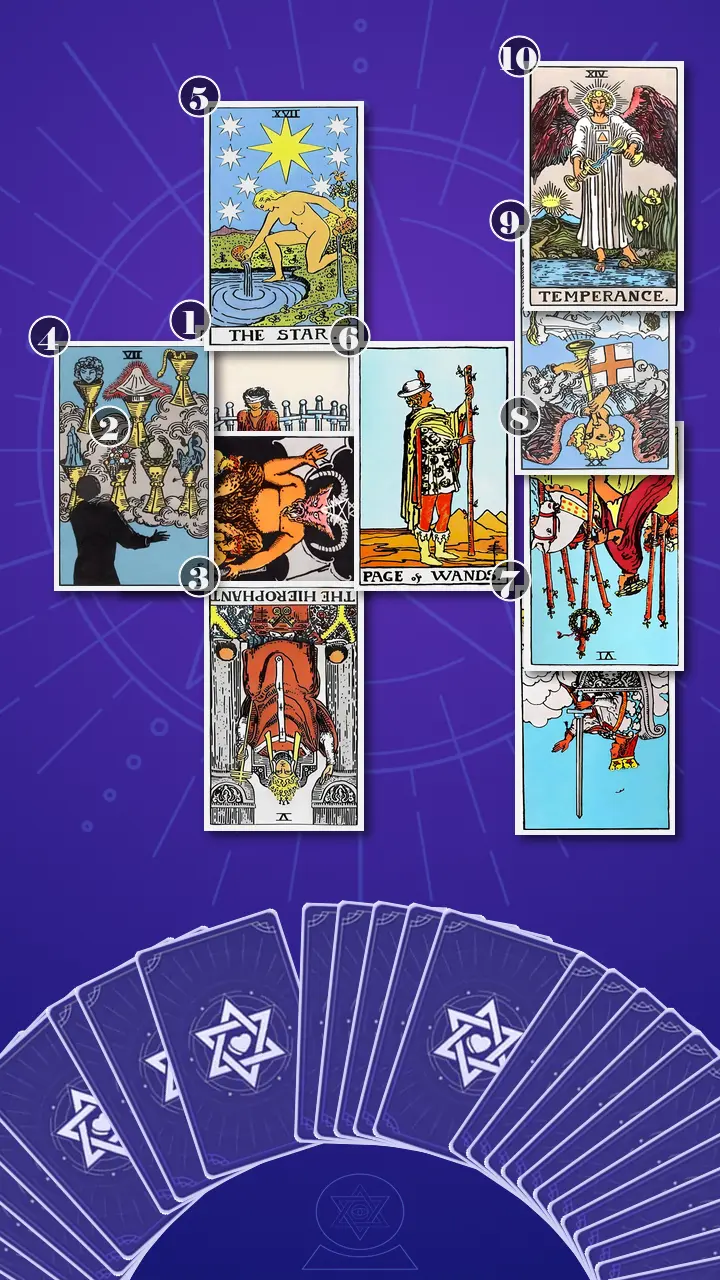
Reading the Map: LinkedIn Headline Anxiety, in Card Meanings and Real Life
Position 1: The lived experience of the bio-triggered identity spiral right now
“Now flipping over,” I said, “is the card that represents the lived experience of the bio-triggered identity spiral right now—the observable stuckness and self-restriction.”
Eight of Swords, upright.
In the illustration, she’s blindfolded. Bound. Surrounded by swords like a ring of judgment.
“This,” I said, “is like when you open the bio editor and instantly feel you must ‘get it right,’ then stare at the cursor as if it’s a spotlight—forgetting you can change it later.”
Eight of Swords is Air energy in a blocked state: not the clean kind of clarity, but the trapped kind—thoughts circling like they’re protecting you, while actually keeping you immobile.
“You’re treating a short description like a binding contract,” I continued. “So every word feels dangerous. You keep backspacing instead of publishing. The blindfold is the belief: ‘If I write it wrong, I’ll regret it and everyone will remember.’ The bindings are loose, though. That’s important. The trap is maintained more by rule than by reality.”
Taylor let out a small, bitter laugh—half a wince, half a finally. “That’s… so accurate it’s kind of rude,” she said. Then she pressed her fingertips to her throat like she’d noticed, for the first time, how tight it got.
Position 2: What intensifies the spiral
“Now we look at what’s crossing you,” I said. “This is what intensifies the spiral—the force that makes a small edit feel high-stakes.”
The Devil, upright.
I didn’t soften it. I never soften The Devil. I translate it.
“This is the part where your identity gets treated like a product tagline,” I said. “Like you’re doing SEO for your soul. And suddenly the bio isn’t about communicating—it’s about earning approval.”
The Devil is attachment energy in excess: sticky, hot, compulsive. In a bio spiral, it looks like refreshing profile views like they’re a scoreboard that decides whether you’re real. It looks like writing for an imagined audience—recruiters, ex-coworkers, a college acquaintance who’s weirdly successful—rather than for your actual life.
“Notice the chains in the card,” I said. “They’re real, but they’re loose. That’s the kicker. The grip is maintained through consent and habit.”
Taylor’s mouth tightened. “Yeah,” she said. “It’s like… if it doesn’t sound impressive, I’ll lose credibility.”
“And then the loop kicks in,” I said, and I kept my voice steady because this is where shame likes to hide. “Compare → collect phrases → delete → postpone. Editing isn’t progress when it’s just fear wearing a blazer.”
She looked down at the Eight of Swords again, like she was seeing the blindfold as a choice instead of a curse.
Position 3: The deeper pattern underneath the spiral
“Now,” I said, “this is the root: the deeper pattern underneath the spiral—the hidden rule driving the reaction.”
The Hierophant, reversed.
“This one is about scripts,” I told her. “About what counts as ‘legitimate.’ When it’s reversed, it often means: you resist preset labels… while still feeling you must fit a recognizable script to be taken seriously.”
In modern life, it’s that invisible panel of “professionals” judging whether your wording qualifies—even when you don’t fully believe in that system.
“So you get identity whiplash,” I said. “One part of you rejects boxes. Another part of you keeps searching for the ‘correct’ way to name yourself.”
Hierophant energy is structure. Here it’s inverted—structure as pressure, gatekeeping, the fear that if you don’t speak in the right dialect of adulthood, you won’t be taken seriously.
Taylor’s eyes flicked up. “That’s LinkedIn,” she said, immediately. “It’s like… if I don’t have a clean title, I’m not allowed in the room.”
Position 4: The recent backdrop that set up this trigger
“This next card,” I said, “shows the recent backdrop—what set this up.”
Seven of Cups, upright.
“This is your many-lanes life,” I said. “Courses, side projects, shifting responsibilities, interests that genuinely span multiple lanes.”
The Seven of Cups is choice overload in excess. Beautiful possibilities—ungrounded. Like having too many open tabs and your brain overheating. Like a Notion life dashboard full of future selves that is somehow still paralyzing.
“When you try to compress all of that into one bio line,” I said, “abundance becomes noise. You end up second-guessing every direction.”
She exhaled through her nose, almost laughing again, but softer this time. “I always feel like choosing one emphasis betrays the other parts of me.”
“Yes,” I said. “And that’s not a character flaw. That’s a system problem. Too many valid selves, not enough grounding.”
Position 5: What you think you need from a bio
“Now we move to the crown,” I said. “This card shows what you think you need from a bio—your conscious goal.”
The Star, upright.
The room felt quieter when The Star appeared. Even the espresso machine seemed to pause between breaths.
“This tells me your desire is sincere,” I said. “You’re not trying to perform. You’re trying to feel aligned. You want the sentence to feel like a clear window into your current direction, not a billboard trying to sell a perfect identity.”
Star energy is hope in balance—steady, not frantic. Transparent. A slow truth-telling.
As I spoke, Taylor’s shoulders dropped a fraction, like her body recognized the difference between “impressive” and “honest.”
“I just want it to feel… like me,” she said. “Not like a template.”
Position 6: A near-term, practical next step to interrupt the loop
“This is the practical one,” I said. “It represents a near-term next step you can take this week to interrupt the loop.”
Page of Wands, upright.
I smiled, because Page of Wands is always the friend who says, We don’t need certainty, we need momentum.
“This is the prototype mindset,” I told her. “Posting a bio for one week the way you’d ship a V1 at work. Not ‘The One.’ The one you’re testing.”
Fire energy shows up here as relief: movement through trying, not thinking. Curiosity as medicine.
Taylor’s face softened. “That sounds… doable,” she admitted, like she didn’t want to jinx it.
Position 7: How you are relating to yourself in the spiral
“Now,” I said, “this card represents how you are relating to yourself in the spiral—your inner voice and stance.”
Queen of Swords, reversed.
“This is the inner editor,” I said, keeping my tone warm but exact. “A sharp mind that protects you from embarrassment, but can also silence your living voice.”
Reversed, her energy becomes precision as a weapon—clarity turned into a courtroom.
“This is you rereading the same line and deleting adjectives, worrying they sound pretentious or incorrect,” I said, “until your bio becomes a list of empty nouns.”
Taylor’s eyes went glassy for a second—like the words landed too close to home. She rubbed her thumb against her index finger, a tiny self-soothing motion, and nodded once.
“It really does feel like court,” she said. “Like if there’s a loophole, someone will find it.”
“And the sentence is not supposed to be bulletproof,” I replied. “It’s supposed to be communicative.”
Position 8: The surrounding culture and feedback cues that shape the spiral
“This card shows your environment—the external influences.”
Six of Wands, reversed.
“This is the ‘unseen achiever’ energy,” I said. “Recognition feels conditional. Inconsistent. Hard to access. So you write from scarcity: ‘If I don’t look accomplished, I won’t be taken seriously.’”
It’s workplace norms. Platform dynamics. LinkedIn headline discourse. The quiet pressure to sound ‘clear’ and ‘senior’ in 120 characters.
Taylor gave me a look that said: yes, and also I hate that it works.
Position 9: The emotional stake—hopes and fears
“Now the tender one,” I said. “This is your hopes and fears—what you secretly hope the bio will solve, and what you fear being exposed.”
Judgement, reversed.
“This is where the save button becomes a final exam,” I said. “Like the bio is a Scantron for adulthood.”
I watched Taylor’s throat tighten again at the phrase, like her nervous system understood it before her mind did.
“You hope a perfect bio will finally settle who you are,” I continued. “And you fear that any version will be judged as wrong—by others, but especially by Future You.”
For a second she stared at the table like she was watching the mental movie: an old coworker screenshotting, a recruiter deciding, a friend quietly thinking, huh.
“Yeah,” she whispered. “I literally imagine myself cringing later.”
When Temperance Spoke: The Two-Cup Bio Blend
Position 10: Integration direction—what changes when you shift the pattern
I let my hands rest on the deck for a beat. The café behind us kept moving—steam, cups, soft Italian pop from someone’s playlist—but our table felt like its own pocket of stillness.
“We’re flipping over the card that represents integration direction,” I said. “Not a fate. An orientation. What becomes possible when you stop treating identity like something you have to lock.”
Temperance, upright.
Her angel stood with one foot on land and one in water, pouring between two cups like the point was the blending itself.
For Taylor, I translated it immediately into the modern move that her nervous system could actually use: “Two tabs open,” I said. “One is ‘what I do.’ One is ‘what I’m about.’ Your bio is the combined sentence. Not the perfect label.”
She opened her mouth like she wanted to argue—then shut it again. I could see her hovering on the edge of the old rule: If it’s not permanent, it’s not real.
Here’s the setup, because this is the exact moment the spiral usually grabs the wheel: you open LinkedIn “just to tweak” one line, and suddenly you’re rewriting like it’s legally binding. Your throat gets tight, your hands keep backspacing, and every option feels like it will trap Future You.
Stop treating your bio like a verdict and start treating it like a blend—pour what’s true now between two cups until it tastes like you.
The sentence hung between us the way a good espresso aroma hangs—present, undeniable, impossible to rush.
Taylor’s reaction came in a chain, not a single emotion.
First: her breathing paused—just a small freeze. Her fingers stopped moving like they’d been caught mid-scroll. Second: her eyes went unfocused, like she was replaying a dozen late-night editing sessions in fast-forward, seeing the pattern instead of the content. Third: her face softened, and she let out a breath that sounded like the first time someone finally put down a heavy bag they didn’t know they’d been carrying.
“But if I make it a ‘blend’…” she started, and there was a flicker of anger—an unexpected heat. “Doesn’t that mean I’ve been doing it wrong? Like I’ve wasted so much time?”
I nodded, because that’s honest. “It means you’ve been trying to get safety from the wrong tool,” I said. “You used precision to try to guarantee belonging. That’s a very New York survival strategy. It’s not stupid. It’s just… expensive.”
She blinked hard, eyes glossy, then laughed once—quiet, almost embarrassed by her own emotion.
I leaned in a little, like I was telling her a recipe. “Temperance is the tarot meaning for integration,” I said. “For identity and self-presentation, it’s the permission to be coherent without being final.”
And this is where I brought in my own craft—not just tarot, but the way I’ve always read people through daily rituals.
“In my café, there’s a tiny window right after you pull a shot,” I told her. “The crema is at its peak. The flavor is most honest right then—before it cools, before it oxidizes, before your mind starts bargaining with it. I call that Sacred Timing. The truth has a freshness window.”
“Your bio needs a freshness window too,” I continued. “If you wait until it feels perfect, it won’t be truth—it’ll be armor.”
“So here’s your Temperance version of ‘saving’—a blend, and a time stamp.”
I slid her a small card from my notepad with a simple structure—two cups, one line each.
“Now,” I asked her softly, “with this new lens—definition versus communication—think back to last week. Was there a moment when you opened the editor and your body tightened? If you’d told yourself, ‘This is accurate for 90 days,’ would anything have felt different?”
She didn’t answer immediately. Her gaze dropped to the Temperance card. Then she nodded, slowly. “Sunday,” she said. “I was doing the whole ‘new week, new me’ thing. And I started writing like it had to carry my entire future.”
“That’s the shift,” I said. “This isn’t about finding the one sentence that proves you’re real. It’s moving from spiraling self-scrutiny to steadier self-trust. From ‘I can’t define myself’ to ‘I can communicate where I am right now.’”
From Insight to Action: The 90-Day Snapshot Method (with Coffee Boundaries)
I gathered the story the cards had told—because tarot is only useful when it becomes coherent.
“Here’s the pattern, start to finish,” I said. “Seven of Cups gives you too many valid versions of you. Eight of Swords turns that into a mental cage: ‘If I choose a word, I’m that kind of person forever.’ The Devil adds the approval-grip—writing for the algorithm, the recruiter, the imagined jury. Queen of Swords reversed makes it a courtroom in your head. Six of Wands reversed makes you feel like recognition is scarce, so every line has to fight for respect. Judgement reversed makes the save button feel like a final exam. And The Star tells me the thing underneath all of it is actually beautiful: you want alignment, not applause.”
“Your blind spot,” I added, “is thinking that clarity comes from final wording. But your transformation direction is different: clarity comes from time-stamped communication plus small experiments. That’s how you build trust with yourself.”
Then I gave her the next steps the way I’d give a barista the closing checklist: simple, doable, and designed to stop the loop from sneaking back in.
- The 9-Minute Snapshot DraftSet a timer for 9 minutes. Write only two lines in Notes: (A) “I work in/with ___, currently focused on ___.” (B) “I care about ___ / building toward ___.” Then stop—no polishing.Do it during your first coffee of the day—my Sacred Timing rule. Fresh mind, less imagined jury. If your throat tightens, that’s your cue to simplify, not perfect.
- One Platform, One Week (V1 Bio Prototype)Pick one platform (LinkedIn or Instagram). Update only that bio for one week using a two-part blend line: one concrete role phrase + one values/focus phrase.Your goal is not “the best bio.” Your goal is “a saved bio.” Treat it like shipping V1: you learn more from publishing than from infinite drafts.
- The 72-Hour No-Edit / No-Metrics BoundaryAfter you hit save, commit to 72 hours of not reopening the edit screen and not checking profile views. If the urge hits, write the urge in a “Bio Parking Lot” note instead.If you break the boundary, don’t punish yourself—do a quick “café closing” reset: close tabs, wipe the mental counter, and return to one offline action that matches your direction (one email, one calendar hold, one page of notes).
I paused, then added one last piece—because I know New York nights, and I know how the spiral loves the hours when you’re tired.
“If you want to make this easier on your nervous system,” I said, “use Aroma Anchoring. Brew a small coffee or smell something warm—vanilla, cinnamon, espresso—right before you draft. Your brain learns: this scent means ‘I’m safe enough to be visible.’ It sounds simple because it is. Simple is powerful.”

A Week Later: The Quiet Proof of Finding Clarity
Six days after our reading, Taylor messaged me a screenshot—no essay, no apology. Just a clean, two-part line and a small note underneath: “Accurate for the next 90 days.”
“I did it,” she wrote. “I saved it. I didn’t die.”
The next text came ten minutes later: “Also I keep wanting to edit, but I’m doing the 72-hour rule. My chest is still weird about it, but it’s… less dramatic.”
It wasn’t fireworks. It was something better: a small proof that the problem was a process, not her identity.
In my mind, that’s the whole Journey to Clarity: moving from a throat-tightening verdict mindset to a steadier snapshot mindset—identity as something you practice and communicate in iterations.
Later that afternoon, she stopped by the café on her lunch break. She didn’t announce it like a milestone. She just ordered an iced latte and sat alone by the window, scrolling once, then putting her phone down. The win looked quiet. Also, a little lonely. But real.
When a one-line bio makes your throat go tight, it’s rarely about the sentence—it’s the fear that one snapshot could trap you in a version of yourself you’re not allowed to outgrow.
If you let your bio be a 90-day snapshot instead of a permanent definition, what’s the smallest true line you’d be willing to save today?