From Banking-App Shame to Neutral Check-Ins: Building a Money Ritual

The 8:07 a.m. Banking-App Flinch
“If you’re a late-20s city professional who can manage complex work projects, but a bank balance check makes you freeze in shame like it’s a report card… you’re not alone.”
I said it softly, not as a slogan, but as a handrail.
Taylor sat across from me with that particular Toronto tiredness you can’t quite blame on weather alone—the kind that comes from being competent all day and privately bracing for one small, humiliating moment. They were 28, early-career marketing, the sort of person who could talk me through campaign metrics with calm precision… and yet a number in a banking app could make their throat lock like a subway door refusing to open.
They told me about a weekday morning scene that played on repeat: coffee brewing, the overhead light a touch too bright, phone warm in their palm. “I tap the app,” they said. “And I literally hold my breath while it loads. Like I’m about to be… assessed.”
As they spoke, I watched their shoulders subtly creep up—an old nervous system habit, practiced and fast. I could almost see the moment: the balance appears; their stomach drops; their thumb swipes up to close the app before their eyes fully focus. A peek-and-close so quick it’s barely information, but it’s enough to ignite hours of inner punishment.
“I know it’s just a number,” Taylor added, voice tightening. “But it feels like a grade.”
That was our core contradiction laid bare: wanting financial clarity and control, while fearing the balance will confirm you’re failing as an adult.
Shame, in my experience, is rarely dramatic. It’s physical. It’s the tight chest and throat, the breath held hostage for three seconds while a screen loads—like standing outside a brightly lit room you’re convinced contains a verdict, so you keep cracking the door open and slamming it shut.
I leaned in a fraction, keeping my tone plain and human. “We’re not here to lecture you into being ‘better with money.’ We’re here to understand the pattern—why checking your bank balance triggers shame—and to find a way to look at reality without turning it into a moral trial. Let’s see if we can turn this fog into a map. A real journey to clarity.”
Choosing the Compass: Celtic Cross · Context Edition
I asked Taylor to take one slow breath—not to summon anything mystical, but to mark a transition. In archaeology, we don’t start digging by lunging at the ground. We pause, orient ourselves, and decide what we’re actually looking for. Tarot, used responsibly, works the same way: a structured way to name what’s already happening.
I shuffled with an unhurried rhythm, the sound like paper wings. “Today,” I said, “we’ll use a spread called the Celtic Cross · Context Edition.”
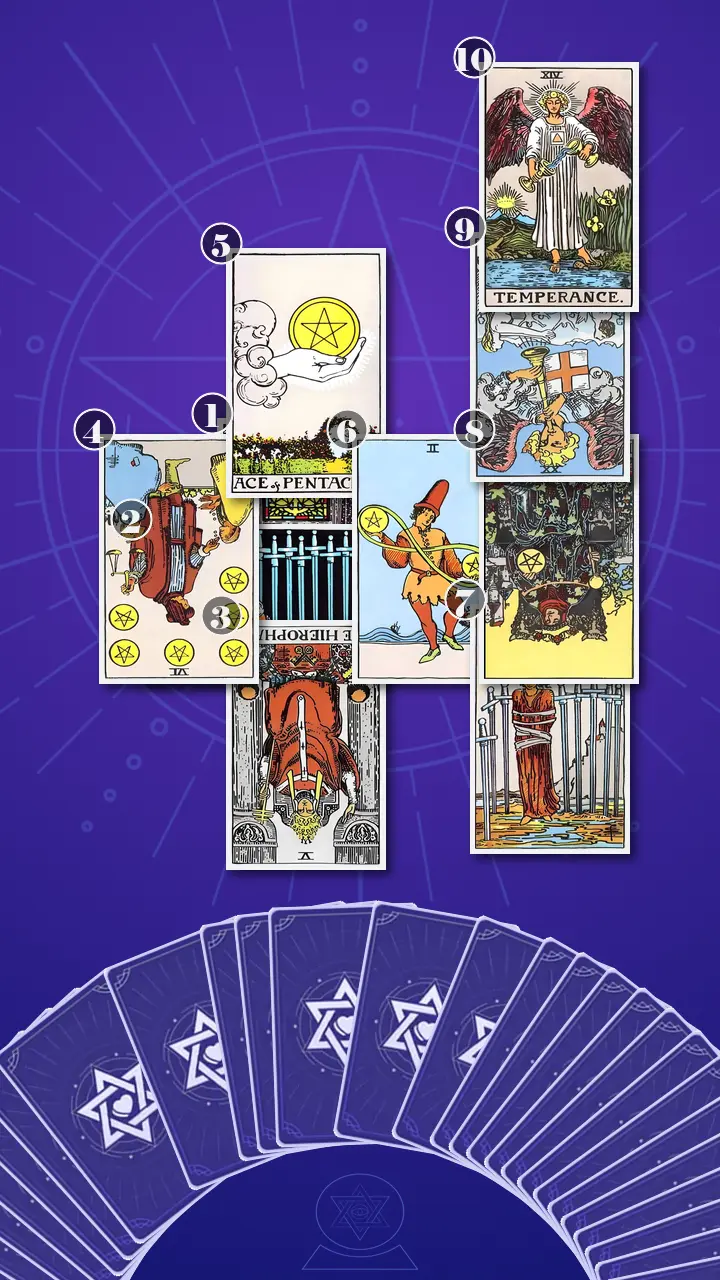
And for you reading along—this is why that choice matters. A money-shame loop isn’t only about the present moment. It’s a chain: the flinch, the thought spiral, the deeper rule you learned somewhere, the social pressure that intensifies it, and the practice that could actually change it. The Celtic Cross is built for that full arc: symptom → obstacle → root belief → conditioning → intention → near-term shift → self stance → environment → hopes/fears → integration.
I pointed to the layout as I placed the cards. “The center card will show the present pattern—what your balance-check looks like as a micro-behavior. The crossing card shows what hijacks you in that moment. The root card gets at the internal rule underneath all of it. And the final card at the top isn’t a prediction; it’s an integration path—the healthiest direction, as a practice.”
Taylor nodded, lips pressed together, as if part of them expected the cards to scold them. That, too, was information.
Reading the Map: How Tarot Works for a Money-Shame Loop
Position 1 (Present pattern): Five of Pentacles, upright
“Now we turn to the card that represents your present pattern—the moment checking the balance turns into an identity-level shame response.”
Five of Pentacles, upright.
I’ve seen this card make high-achievers go quiet. Two figures in snow, hunched and limping, outside a warm stained-glass window. It’s not simply ‘low funds.’ It’s the feeling of being outside—outside stability, outside belonging, outside some invisible club called Adulthood.
“This,” I told Taylor, “is exactly what you described: opening the banking app and instantly feeling ‘on the outside’ of stability, then closing it before you can receive any real information or support.”
In energy terms, Five of Pentacles is Earth (money reality) experienced as contraction: scarcity mindset turning a neutral number into a story about worth. It isn’t that you can’t handle data. It’s that the data arrives wrapped in exile.
Taylor let out a small laugh that had no humor in it—more like a wince that learned to speak. “That’s… kind of brutal,” they said. “It’s accurate. But brutal.”
I nodded. “It’s a pain mirror, not a punishment. And I want to underline something: Peek-and-close isn’t laziness. It’s a nervous system flinch wrapped in an ‘adulting’ story.”
Position 2 (Core obstacle): Nine of Swords, upright
“Now we turn to the card that represents your core obstacle—what hijacks the moment and keeps the pattern stuck.”
Nine of Swords, upright.
The image is someone sitting up in bed, face in hands, with swords lined along the wall like accusations. This isn’t the spending. This is the after: the hours of mental prosecution after a two-second balance check.
“This is like,” I said, “when you check your balance and then spend hours re-litigating every purchase as if you’re on trial—Uber, dinner, a ‘small treat’—instead of making one small plan.”
Energetically, this is Air in excess: thoughts multiplying into a courtroom montage. Receipts become evidence. A normal expense becomes a crime scene. And the verdict is always the same: guilty of not being a ‘real adult.’
I asked, “After you check, what’s the first repeating sentence your brain uses to punish you—word for word?”
Taylor didn’t even have to think. “Normal adults don’t do this,” they said. Then, quieter: “I’m irresponsible.”
They rubbed their thumb against the edge of their phone case, as if trying to erase the feeling by friction.
Position 3 (Root cause): The Hierophant, reversed
“Now we turn to the card that represents the root cause—the internalized rule underneath the shame trigger.”
The Hierophant, reversed.
I exhaled slowly. This one often reveals the hidden architecture beneath shame: not the number itself, but the rulebook that turns the number into morality.
“Reversed here,” I said, “this looks like an inherited script of what a ‘responsible adult’ should look like. And when you don’t match that script, shame shows up like a strict lecturer.”
Then I staged it, exactly as the spread demanded—a little scene that made Taylor’s eyes sharpen with recognition.
“Picture your phone screen as a pulpit,” I said. “Your inner critic climbs up and delivers a money sermon: ‘You should have a cushion by now. Responsible people don’t need reminders. Responsible people don’t freeze.’”
Taylor’s jaw tightened. Their gaze slid away from the cards as if they were seeing an older room, an older voice.
“If your inner voice sounds like a sermon,” I added, “you’re not budgeting—you’re being judged.”
In energy terms, Hierophant reversed is authority in blockage: a standard you never consciously agreed to, still ruling from inside. When the standard is rigid, the balance can only ever be evidence of failure or proof of worthiness—never neutral data.
Position 4 (Recent conditioning): Six of Pentacles, reversed
“Now we turn to the card that represents your recent conditioning—what shaped money as a worth issue in the recent past.”
Six of Pentacles, reversed.
The card shows scales, coins, giving and receiving. Reversed, the balance feels… off. Not just financially, but emotionally—like your social life is quietly keeping score.
“This,” I said, “is like saying yes to the pricey plan so you won’t seem difficult—then checking your balance later and feeling both regret and humiliation, like you bought belonging with money you didn’t have.”
Energetically, Six of Pentacles reversed is Earth in distortion: reciprocity warped by comparison, obligation, or unspoken resentment. It feeds the Five of Pentacles feeling of being outside—because every dinner bill becomes a membership fee you’re afraid you can’t afford.
Taylor swallowed. “I do that,” they admitted. “I’ll cover something small so I don’t feel… behind. And then I’m mad at myself later.”
“That’s not a character flaw,” I said. “That’s a strategy to manage belonging. And it’s expensive—not only in dollars.”
Position 5 (Conscious desire): Ace of Pentacles, upright
“Now we turn to the card that represents your conscious desire—what you want money to represent instead.”
Ace of Pentacles, upright.
A hand offers a single coin above a garden path. The message is refreshingly un-dramatic: start small. One seed. One structure. Not perfection.
“This is like,” I told Taylor, “wanting a simple, repeatable system—one small seed action—so checking the balance stops being emotional roulette.”
Energetically, Ace of Pentacles is Earth in balance: practical opportunity, the kind you can hold. This card doesn’t ask you to become a different person. It asks you to pick up one tool.
Taylor’s face softened by a millimeter. “I want that,” they said. “A fresh start that doesn’t feel like I’m being audited.”
Position 6 (Next practical direction): Two of Pentacles, upright
“Now we turn to the card that represents your next practical direction—the near-term shift that can make this workable.”
Two of Pentacles, upright.
The figure juggles two coins in an infinity loop, waves behind them. This is not the fantasy of a perfect month. This is the skill of an irregular week.
“This is like,” I said, “stopping the wait for conditions to be perfect and building a rhythm that can handle fluctuation.”
I used a metaphor I knew would land in 2026 city life. “Think of it as a playlist tempo,” I told them. “Not a moral crusade. A recurring calendar event. Ten minutes on a Tuesday. Timer ends. You stop on purpose.”
Energetically, Two of Pentacles is Earth in motion: flexible management. It’s the antidote to the freeze because it gives your mind a container. Anxiety hates containers. It prefers infinity. This card offers a gentle boundary: enough to begin, enough to end.
Taylor nodded—small, but real. Like their body understood the word “timer.”
Position 7 (Self-position): Eight of Swords, upright
“Now we turn to the card that represents your self-position—how you show up internally when triggered.”
Eight of Swords, upright.
Blindfold. Loose bindings. A ring of swords that looks like a cage until you notice the ground is open and the ropes aren’t tight.
“This is like believing there’s only one acceptable financial state,” I said, “so any other number feels like there’s nothing to do except hide.”
Energetically, this is Air in blockage: thoughts acting like bars. The trap is interpretive. The number isn’t physically restraining you; the story about what it means is.
I asked, “If the balance couldn’t comment on your character—couldn’t call you good or bad—what would one small action be?”
Taylor stared at the table for a moment, then said, “I could… cancel one subscription. Or move ten bucks. Something that proves I’m allowed to respond.”
“Exactly,” I said. “Options exist. The blindfold is the verdict-story.”
Position 8 (Environment): King of Pentacles, reversed
“Now we turn to the card that represents your environment—how social and cultural pressure intensifies the shame.”
King of Pentacles, reversed.
When this king is reversed, he becomes less a builder and more a status manager. His coin turns into a badge. Stability becomes performative.
“This,” I said, “is like being surrounded by ‘everyone’s doing great’ signals—Instagram Stories, rooftop patios, ‘new place reveal’ posts—and then treating your bank balance as a reputation metric, not a planning tool.”
Energetically, this is Earth in excess but aimed at image: pressure to look sorted. And comparison culture is an algorithm that keeps serving you proof you’re behind.
Taylor’s mouth twisted. “I don’t even enjoy the scrolling,” they said. “It’s like… I’m looking for evidence to hurt myself.”
“A human habit,” I replied. “Not a personal failure. But we can change what evidence you feed your nervous system while you rebuild your own definition of enough.”
Position 9 (Hopes and fears): Judgement, reversed
“Now we turn to the card that represents your hopes and fears—the knot you long to untie and the dread that keeps it tight.”
Judgement, reversed.
The trumpet of awakening, the rising figures—reversed, it becomes fear of review. Not because you can’t face facts, but because you expect facts to become condemnation.
“This is like wanting a reset,” I said, “but being unable to do a calm review because you expect the balance to announce you’re failing.”
I let the earlier Hierophant scene return, because these two cards—both reversed—form the spine of the pattern.
“Hierophant reversed is the money sermon,” I said. “Judgement reversed is the fear of the final exam. Together, they turn the simplest task—checking a number—into a moral trial.”
Taylor went still. There was a three-beat sequence I recognized: (1) breath paused; (2) eyes unfocused as if rewinding memory; (3) a tiny shake of the head, like realizing they’d been obeying a law they never signed.
“Wow,” they said, almost offended on their own behalf. “That voice isn’t even… me.”
“That’s the root,” I said. “Not your intelligence. Not your work ethic. The inner jury.”
When Temperance Poured Between Two Cups
Position 10 (Integration path): Temperance, upright
I touched the final card lightly before turning it—an old habit from fieldwork, when you brush dust from an inscription and you know the next mark will change the whole translation.
“Now we turn to the card that represents your integration path—the healthiest direction for rebuilding your relationship with money as a practice.”
Temperance, upright.
The angel pours water between two cups, one foot on land, one in water. A path to a rising sun. It’s patient, almost boring—until you realize boredom is exactly what shame never allows. Shame demands drama: punish or avoid. Temperance offers a third thing: regulated steadiness.
Setup: I looked at Taylor and spoke to the moment I knew best—coffee brewing, app loading, breath held like the screen is about to tell you what kind of adult you are. That bracing is the whole problem. You’re trying to survive a verdict, not read data.
Delivery:
Stop treating the balance like a guilty sentence, and start blending feeling with action—like Temperance pouring steadily between two cups until it becomes a rhythm you can trust.
I let the sentence sit between us. The room felt quieter—not mystical, just the way it gets quiet when something finally fits.
Reinforcement: Taylor’s reaction came in layers. First, a brief freeze—eyes widening a touch, as if their brain had to make space for a new rule. Then their shoulders dropped on a slow exhale they seemed surprised to have. Their hands, which had been gripping their phone like it might accuse them, loosened. Their mouth opened, closed, then opened again—like a person learning that the door they’ve been slamming isn’t locked.
“So I’m not supposed to… fix it,” they said, voice quieter, more vulnerable. “I’m supposed to… do the next thing.”
“Exactly,” I said. And here my own mind flashed—an archaeologist’s reflex. In a dig, you don’t condemn yourself because a layer contains ash. Ash is information: there was a fire. Your job is to record it accurately, then decide the next careful move. That’s what Temperance is offering: a humane site report on your finances.
Then I used my Mythic Archetypes lens—the tool I reach for when someone’s inner story has become punitive. “In myth,” I told Taylor, “the most powerful transformations are rarely lightning bolts. They’re rituals—small acts repeated until the nervous system believes it’s safe. Temperance is the archetype of the alchemist: not turning lead to gold overnight, but learning the correct ratio so nothing spills.”
Taylor blinked fast once, eyes a bit shiny, then gave a small, incredulous laugh. “That’s actually… doable.”
I nodded. “Now, with this new perspective—can you think back to last week? Was there a moment when the balance check could have been a weather report instead of a sentence?”
Taylor stared at the edge of the table, then said, “Friday. After Queen West. I checked in the hallway, and I felt disgusting. If I’d done one action—cancelled one subscription or scheduled a bill—maybe it wouldn’t have turned into an all-night spiral.”
“That,” I said, “is the shift from shame-flinch to agency. Not from ‘bad’ to ‘good’—from punishment to practice.”
And I named it plainly, because clarity likes direct language: “This is you moving from self-doubt and verdict-thinking toward steady self-respect and calm. From ‘the balance owns my identity’ to ‘the balance is data I can work with.’”
From Insight to Action: The No-Verdict Review You Can Actually Start
I gathered the spread into one story, the way I would summarize a site to students: layers, not labels.
“Here’s what the cards are showing,” I told Taylor. “The Five of Pentacles is the exile feeling—‘I’m outside financial adulthood.’ The Nine of Swords is the inner courtroom that follows. Underneath, Hierophant reversed is the rigid adulting script you never consented to, and Judgement reversed is the fear that review equals condemnation. The environment—King of Pentacles reversed—adds comparison pressure, like stability has to be performed. But your conscious goal—Ace of Pentacles—is modest and sane: one seed. Two of Pentacles says you don’t need a perfect system; you need rhythm. And Temperance says the way out is integration: feel the shame, then do one small action anyway.”
“Your cognitive blind spot,” I added gently, “is thinking this is primarily a money-skills problem. The spread suggests it’s primarily an inner feedback problem—how you’re being spoken to in your own head. A bank balance is data, not a diagnosis of your worth.”
Taylor frowned, then gave me an extremely modern objection—the kind that shows they were taking this seriously. “But I can’t even find five minutes,” they said. “My days are back-to-back. And when I get home, I’m cooked.”
I didn’t argue. I adjusted—Temperance-style. “Then we won’t ask for five minutes as a moral achievement,” I said. “We’ll ask for two minutes as a practice. Consistency beats intensity: ten calm minutes can change more than one guilty hour.”
Then I offered concrete next steps—low-barrier, specific, and timed. And I folded in one of my personal strategies, because ancient tools were often designed for exactly this: turning a moment of fear into a repeatable ritual.
- The 7-Minute “Temperance Check” (once in the next 48 hours)Do it standing in your kitchen while something neutral happens (kettle, coffee, toaster). Open your banking app and exhale while it loads. Write the balance + date in Notes (facts only—no adjectives). Then do ONE micro-action under 2 minutes: transfer $5–$20 to a buffer, cancel one forgotten subscription, or schedule a bill payment.If shame spikes (tight chest, heat in face), close the app on purpose (not as an escape). Put a hand on your ribcage for 10 seconds, and come back later. The win is a non-punitive review, not forcing yourself through distress.
- Two of Pentacles Rhythm: Two 10-minute money blocks this weekSchedule two calendar events right now: for example, Wednesday 6:10 PM and Saturday 11:30 AM. In each session, do only two things: (1) check balance, (2) handle one small item (one bill, one transfer, or one category note). Stop when the timer ends—even if you want to keep “fixing.”Play a Spotify lofi focus playlist so your body learns “money admin isn’t danger.” If you miss a session, don’t make up for it with a longer one. Just return to the next scheduled block.
- Inscription Affirmation: Replace the sermon with one carved sentenceWrite one line on a sticky note and place it where you check your balance (or set it as a phone widget): “End the check with one action, so it doesn’t end with a sentence.” When the inner prosecutor starts up, read the note out loud once and return to facts + one step.Think of it like an archaeological inscription: short, durable, meant to survive stress. Keep it brief enough that you’ll actually use it when your brain is loud.
Before we closed, I offered one more tiny frame—my Ancient Reflection approach, stripped of ceremony and made practical. “Once this week,” I said, “do a two-sentence review. Not a budget. A review. Sentence one: ‘Here is the number.’ Sentence two: ‘Here is my next small move.’ That’s it. No verdict.”
Ownership, Not Certainty
A week later, Taylor sent me a message that was almost aggressively simple: “Did the Temperance Check. Exhaled. Wrote the number. Cancelled one subscription. Didn’t spiral.”
They added, after a pause: “It was weirdly emotional to do something that small.”
I could picture it: not a transformation montage, not a sudden ‘soft life’ glow-up. Just a kitchen light, a held breath released, and one quiet click that proved they were allowed to respond instead of repent.
And there was a bittersweet honesty in what they said next: they’d suggested a cheaper plan in the group chat once. They hit send, stared at the typing bubbles for three long seconds, heart thumping—then someone replied, “Honestly thank you, I’m down for that.” Relief, and a small grief for all the times they’d paid for belonging with silence.
When I think of Taylor’s journey to clarity, I don’t think of a bigger balance. I think of Temperance’s steady pour: the moment a number stops being a verdict and becomes workable data—Earth no longer hijacked by punishing Air, but regulated into a calmer rhythm.
When a number on a screen makes your chest tighten like you’re about to be graded as a person, it makes sense that you only peek—because part of you is trying to avoid a verdict, not avoid the truth.
If you let your next balance check be a neutral “weather report” instead of a trial, what’s the smallest next step you’d want to take—just to prove to yourself you’re allowed to respond, not repent?