From Read-Receipt Panic to Self-Respect: Pause Before Texting

Finding Clarity in the 8:52 a.m. Flip to “Read”
You’re a 20-something in a big city doing your job just fine—until an iMessage flips to “Read” and your body acts like an alarm went off (hello, read receipt anxiety).
Alex said it almost word-for-word as we settled into our video call. They were 27, in Toronto, a marketing coordinator with a calendar full of meetings and a brain that could run three campaigns at once—until a single UI label made everything else blur.
They described Monday at 8:53 a.m. in the Union Station concourse: coffee too hot to sip, AirPods in, crowd moving like a tide. Their phone was already unlocked. The thread switched to Read 8:52. The fluorescent lights felt harsh, like they were buzzing right against the back of Alex’s eyes. Their chest tightened, and their thumb hovered over the keyboard like it was about to defuse a bomb—because they wanted to look calm and also needed the reassurance now.
“It’s embarrassing,” Alex admitted, rubbing their palms together. “I’m literally fine—then I see ‘Read’ and it’s like my stomach drops through the floor. I start re-reading what I sent for mistakes. I’m counting minutes. I’m drafting the follow-up. I hate that I’m like this, but I can’t just let it sit there.”
I watched their hands: restless, reaching off-frame toward the phone even when they tried not to. “That makes so much sense,” I told them. “Panic has a very particular logic—tight chest, buzzing skin, and the urge to fix the feeling right now. Let’s not shame that part of you. Let’s understand it. We’re going to make a map of what happens in you the moment that ‘Read’ appears, and find a path back to clarity.”

Choosing the Compass: The Celtic Cross · Context Edition
I asked Alex to take one slow breath—not as a mystical ritual, just as a clean transition from “my nervous system is driving” to “I’m observing.” I shuffled while they held the question in mind: Why do iMessage read receipts trigger panic—what pattern is this?
“Today we’ll use the Celtic Cross · Context Edition,” I said. “It’s a classic spread, but we’re tailoring it to a modern problem: how a tiny digital cue becomes a full-body response.”
For you reading this: this is how tarot works when it’s used well. Not as a yes/no fortune, but as a structured mirror. The Celtic Cross gives a clean arc—present trigger → immediate obstacle → deeper subconscious script → near-term regulation → integration. It’s ideal for pattern-based questions like anxious texting, because it shows why your brain grabs a meaning and how to change what you do next.
I previewed the anchors: “The first card will name the trigger moment—what ‘Read’ activates in you right now. The crossing card shows the blocker that turns discomfort into urgency. The root card goes underneath, into the subconscious story. And the final card—position ten—will be your integration: the healthiest practice that builds self-trust no matter what the other person does.”
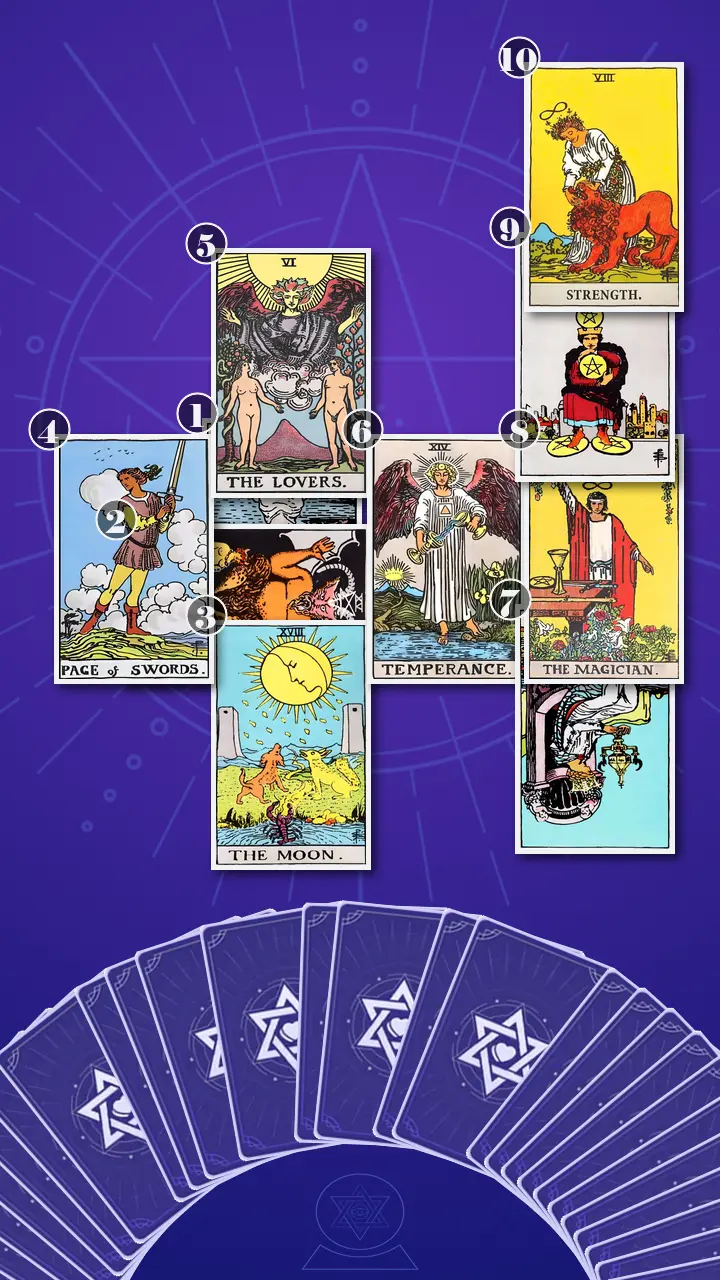
The Cross in the Middle of the Screen
As I laid the first cards, I noticed something I’ve learned from years of reading—people don’t only listen with their minds. They listen with their shoulders, their breath, the way their gaze snaps to the camera or slips away. Alex’s shoulders were already up near their ears, like they were bracing for impact.
Position 1 — The trigger moment: what the “read receipt” activates
“Now we turn over the card that represents the trigger moment—what the ‘read receipt’ activates in your mind and behavior right now.”
Two of Swords, reversed.
This is the card of stalemate and inner debate—reversed, it’s the moment the debate stops being theoretical and starts being a bodily lock. I told Alex exactly what the card translated to in modern life: You’re at your laptop at 11:12 AM, phone face-up beside your trackpad. Your message shows “Read,” and instantly you’re split: one part of you wants to send a follow-up to regain control, another part is terrified of looking needy. You keep reopening the thread, rereading your wording, and doing mental courtroom arguments about what the delay ‘means,’ while your body locks up (tight chest, shallow breath).
Energetically, this is a blockage in Air: thinking becomes a shield. The blindfold in the card is the not-knowing. The crossed swords over the chest are self-protection through analysis. The still water behind the figure is the calm you want—right there—but you can’t access it while you’re locked in the argument.
Alex let out a small laugh that had no humor in it. “That’s… brutally accurate,” they said. “Like, okay, rude.” Their fingers tightened around their mug, then loosened, like their body was admitting the truth before their pride could object.
I nodded. “And here’s a line I want you to borrow whenever shame tries to hijack this: A read receipt isn’t a truth source—it’s a trigger that your nervous system learned to take personally. Not because you’re ‘too much.’ Because your brain is trying to keep you safe.”
Position 2 — The immediate blocker: what turns discomfort into urgency
“Now we turn over the card that represents the immediate blocker—what turns discomfort into urgency and compulsive action.”
The Devil, upright.
I described it the way it shows up in Alex’s real world: The discomfort turns into urgency: you can’t focus on your work or your night because relief feels one notification away. You unlock, check, lock, repeat—then draft a ‘casual’ second text (a meme, a joke, “all good?”) not because you have something new to say, but because you need to break the silence.
This is excess energy—too much attachment to one outcome: “I get a reply and I feel okay.” The Devil is not a person in this story. It’s the loop.
And because Alex lives a double-screen life—Slack open, Messages hovering—this loop can feel like a slot machine you carry in your pocket.
I leaned in slightly. “Connection without coercion is still connection—anything else is just panic negotiating.”
Alex swallowed. Their eyes flicked down and back up. “I hate that you called it negotiating,” they said, quieter. “Because that’s exactly what it feels like.”
In my family, we have an old phrase from the Highlands: when fear grips, it tightens the hand before it tightens the story. The Devil always shows me hands first—thumb refreshing, fingers hovering, jaw clenched—because the body knows the chain before the mind admits it.
Position 3 — The subconscious script: the deeper fear underneath
“Now we turn over the card that represents the subconscious script—the deeper fear driving the panic.”
The Moon, upright.
I watched Alex’s face change even before I explained. The Moon has that effect: it makes people recognize their own night thoughts.
Here’s the modern translation I gave them: Under the panic is a familiar script: when you don’t have clear information, your brain writes a story anyway—and it’s usually the worst one. A read receipt is ‘partial certainty,’ so your mind fills the gap with projection: “They saw me reaching out and chose not to respond.”
This is distortion rather than truth—moonlight, not daylight. The Moon doesn’t say “you are being rejected.” It says “your nervous system is reading ambiguity as danger.”
I asked Alex to do the Moon in Notes, plain and almost boring—because boring is medicine for the Moon:
Facts: They read it. It’s been 23 minutes. They haven’t replied yet.
Interpretations: They’re mad. They hate me. I’m about to be forgotten.
Alex stared at their own hands for a beat, like their eyes had gone slightly out of focus. Then their shoulders dropped a fraction. “Okay… yeah,” they said. “When you put it like that, it’s obvious I’m… making it mean something.”
Position 4 — Recent conditioning: what trained you to scan for signals
“Now we turn over the card that represents recent conditioning—the habits and experiences that trained your nervous system to watch for signals.”
Page of Swords, upright.
This one is painfully modern: You’ve been trained by modern communication to scan for signals: read receipts, typing bubbles, ‘active now,’ quick replies in group chats. You’re mentally on guard—half your attention on Slack, half on Messages—ready to respond ‘correctly.’
Energetically, it’s excess vigilance—Air that never lands. The Page isn’t malicious. They’re smart. But they’re wind-swept, always checking the horizon for the next cue.
Alex nodded fast, like they’d been waiting for someone to say, “Yes, your brain is doing surveillance.”
Position 5 — Your conscious goal: what you think you need to feel safe
“Now we turn over the card that represents your conscious goal—what you believe you need in order to feel safe and settled.”
The Lovers, upright.
I smiled a little, because this card often arrives like a relief. “This isn’t about texting etiquette,” I told them. “It’s about feeling chosen.”
The modern life translation fit Alex perfectly: What you consciously want isn’t a faster reply—it’s mutuality: to feel chosen, respected, and clear about where you stand. You’re trying to protect the possibility of real connection, but the panic pushes you toward tactics that don’t match your values.
Energetically, The Lovers is alignment. It says your north star isn’t “How do I get them to respond?” It’s “How do I show up in a way that matches my self-respect and the kind of relationship I want?”
Alex’s voice cracked just a bit: “I don’t need a novel back,” they said. “I just need something.”
“And beneath that,” I said gently, “you need to know you matter without having to perform for proof.”
Position 6 — Near-term shift: what helps you regulate soon
“Now we turn over the card that represents the near-term shift—what helps you regulate and respond differently in the next stretch of time.”
Temperance, upright.
This is pacing as power. You see “Read,” feel the surge, and instead of reacting, you set a timer and do one grounding thing. You let the discomfort exist without turning it into a second message.
Energetically, Temperance is balance: mixing facts with compassion, not facts with self-attack. And it’s where your key shift becomes practical: Treat “Read” as a timestamp plus a cue to self-soothe—nothing more, nothing less.
I could almost see Alex testing that phrase in their mouth like a new boundary. “Cue to self-soothe,” they repeated. “Not a verdict.”
“Exactly.”
Position 7 — Your stance: what you can own without self-blame
“Now we turn over the card that represents your stance—how you’re showing up in this pattern, and what part you can own without punishing yourself.”
Queen of Cups, reversed.
When this Queen turns upside down, it’s not ‘you’re too emotional.’ It’s: your empathy is leaking. Their response time starts controlling your mood and self-image. You absorb silence as meaning. You might shape-shift into ‘the chill version’ of yourself to earn a reply, or go detached to protect yourself—either way, you’re leaving yourself behind to manage the relationship.
Energetically, this is deficiency in boundaries. Too much intake, not enough container.
Alex looked away from the screen and blinked hard. “I literally decide how I’m going to act based on what I think they’ll like,” they admitted. “And then I feel gross about it.”
“That’s the reversed Queen,” I said. “Not a moral failing. A nervous system strategy.”
Position 8 — The container: the digital environment shaping the pattern
“Now we turn over the card that represents the container—the digital and relational environment that shapes this pattern.”
The Magician, upright.
I tapped the table in the card image, where all the tools sit laid out. “Your phone is a Magician’s table,” I said. “Read receipts, typing bubbles, Focus mode, lock-screen previews—tools everywhere. The problem is, tools can start to feel like they’re the only way to make yourself feel safe.”
Energetically, this is potential—but only if you use the tools intentionally. The Magician says: you can change the environment that keeps feeding the loop. You’re allowed to design your digital life around your mental bandwidth.
Position 9 — Hope and fear in one: longing for security, terrified of loss
“Now we turn over the card that represents hope and fear in one—what you’re longing to receive and what you’re terrified it means if you don’t.”
Four of Pentacles, upright.
This is the grip. You want emotional security so badly you try to hold it like a physical object. A slow reply feels like the ground shifting.
Energetically, it’s excess holding—tight fists around something that can’t be controlled. And the card’s body language matters: the pentacle pressed to the chest. This isn’t a “texting problem.” This is a safety problem.
Alex exhaled through their nose. “I feel like if I let go, I’ll lose them.”
“And yet,” I said, “the tighter you grip, the less you can breathe.”
When Strength Spoke: The Lion Under Your Ribcage
When we reached the final card, the room felt quieter—even through a screen. Alex stopped fidgeting for the first time since we began, as if something in them knew this part mattered.
Position 10 — Integration: the healthiest takeaway and practice
“Now we turn over the card that represents integration—the healthiest takeaway and practice that builds self-trust regardless of response time.”
Strength, upright.
I said it plainly first: your power isn’t in getting a faster reply—it’s in regulating your response and keeping your self-respect intact.
Setup (the moment before the insight): Alex was living inside the instant the read receipt appears—phone face-up, workday in motion, and their chest tightening so fast their hand reached for the screen before they’d even decided to check. In that moment, the story feels automatic: if I don’t act, I’ll be left.
Delivery (the sentence that changes the frame):
Stop treating the “Read” label like a verdict, start meeting the surge with patient strength, like the lion that calms under a steady hand.
Reinforcement (what happened in Alex’s body): Alex went still in a three-beat sequence I’ve seen a thousand times. First, a tiny freeze—breath held, fingers suspended mid-air like they’d been caught reaching for the phone. Then their eyes unfocused, as if they were replaying every “Read 11:05” and every spiraled follow-up in fast-forward. And then the release: their shoulders lowered, their mouth opened slightly, and a shaky exhale came from deep in the chest, not the polite kind.
“But if I don’t do anything,” they said, and for a second there was anger in it, not sadness, “doesn’t that mean I was wrong this whole time? Like… I made it all up?”
“No,” I answered, steady. “It means your nervous system was trying to protect you with the only tool it trusted: control. Strength doesn’t shame the lion. It doesn’t wrestle it. It places a gentle hand on it.”
This is where my Nature Empathy Technique comes in—not as poetry, but as a diagnostic tool. “In the Highlands,” I told them, “weather changes fast. You don’t argue with the wind. You read it. You adjust your pace. Panic is weather in the body. Strength is you becoming the one who can notice the pressure shift and say, ‘Ah. Storm coming. I can make a shelter without burning down the village.’”
I asked them softly, “Now, with this new lens, think back to last week. Was there a moment when you saw ‘Read’ and immediately tried to fix it—where a tiny pause could have protected your dignity?”
Alex nodded once. “Thursday. I was on the streetcar, rain on the windows. I sent the meme. I didn’t even want to. I just… couldn’t sit with it.” They pressed a palm to their sternum without me prompting, like their body had already understood the assignment.
“That,” I said, “is you moving from being hijacked by uncertainty to building self-trust and boundaries. Not perfect calm. A steadier attachment.”
A Timer, a Note, and a Walk Between Streetcars
I gathered the whole spread into one thread for Alex: the trigger is indecision and mental lock (Two of Swords reversed). The blocker is compulsion—the belief that relief is one notification away (The Devil). Underneath, ambiguity turns into worst-case storytelling (The Moon), reinforced by a life trained to scan for cues (Page of Swords). What Alex actually wants is aligned, values-based connection (The Lovers), and the near-term path is pacing and regulation (Temperance). Their blind spot is how often they treat responsiveness as emotional security (Four of Pentacles), and how easily they abandon their own center to manage someone else’s silence (Queen of Cups reversed). The way out isn’t more data. It’s Strength: a dignified pause that keeps self-respect intact.
“Your cognitive blind spot,” I said, “is treating the ‘Read’ timestamp like it contains intent. It doesn’t. The transformation direction is exactly what you came in asking for: shifting from verdict-thinking to self-soothing—so you can choose what to do next instead of being compelled.”
Alex frowned. “But I can’t do a 30-minute no-check window at work,” they said quickly. “If my boss Slacks me, I need to see it.”
“Perfect,” I replied. “That’s real. We’re not building a fantasy life. We’re building a nervous-system-friendly one.”
Here are the next steps I gave them—small, specific, and designed to work inside a Toronto workday:
- The 10–30 Minute No-Check WindowThe first time you notice “Read,” set a timer for 10 minutes (workday version) or 30 minutes (evening version). Put your phone face-down. If you need Slack, keep Slack accessible but move Messages off your home screen or into a folder you can’t mindlessly tap.Your brain will say the timer is “fake.” Let it complain. The goal is a tiny pause, not winning an argument with yourself.
- Two Lines in Notes (Moonlight vs Daylight)Open Notes and write: “The story I’m telling myself is…” then “The facts I actually have are…” Keep it brutally simple—no paragraphs, no analysis.If you’re in public, type it without judging it. You’re separating data from fear, not trying to sound emotionally mature.
- The Sound-Walk Reset (My Walking Meditation Shortcut)For 3–5 minutes, stand up and walk—hallway, sidewalk, office kitchen. Name three sounds you can hear (HVAC, kettle click, street noise), then take one slow exhale with your hand lightly on your chest. After the timer ends, choose one respectful next step: wait, or send one clear non-fishing message.This is energy protection in modern form: you’re shielding your attention from the phone’s pull without having to “be chill.”
Before we ended, I added a bedtime practice from my own toolkit—because the Moon loves midnight. “Tonight,” I told Alex, “try a 3-minute bedtime energy review. Just ask: ‘Where did I give away my peace today? Where did I keep my dignity?’ No fixing. Just noticing. That’s how intuition develops—by learning your own weather patterns.”

A Week Later: Ownership, Not Certainty
Six days later, Alex messaged me: “Okay. I saw ‘Read’ yesterday. I did the Notes thing. Timer for ten minutes. I didn’t send the meme. I still hated it, but I didn’t spiral as hard. Also I turned off lock-screen previews and it helped way more than I expected.”
They added one more line: “I slept through the night, but I still woke up and thought, ‘What if I’m being dramatic?’ And then I kind of… laughed. Like, okay, even if I am, I can still take care of myself.”
That’s the real Journey to Clarity: not the absence of fear, but the presence of a steadier self who can hold fear without obeying it. Strength doesn’t promise instant certainty. It promises you won’t trade your dignity for a timestamp.
When “Read” lights up and your chest tightens, it can feel like you’re being evaluated in real time—caught between needing reassurance right now and hating how much you need it.
If you treated “Read” as a timestamp—not a verdict—what’s one small, dignity-protecting pause you’d be willing to try the next time your thumb goes to unlock the phone?