From Notion Shame-Tracking to Grounded Self-Trust: A Gentler Week

The 8:06 a.m. Dashboard Clench
If you open Notion on Sunday night to ‘get ahead’ and somehow end up redesigning the template for an hour instead of actually resting (hello, Sunday Scaries), this is for you.
Taylor showed up on my screen from her Toronto apartment with that particular kind of weekday-morning light—grey, flat, practical. The kettle clicked off behind her at 8:06 a.m., and she poured coffee like it was a tiny life raft. Then she opened her laptop, and I watched her thumb hover over the trackpad the way a person’s hand hovers over a hot stove they’ve touched before.
“It’s stupid,” she said, already a little tight in the jaw. “I click my dashboard to feel organized. And then I… don’t do anything. I just tweak. Icons, categories, formulas. And the second I see one blank checkbox, my brain goes full courtroom.”
Her shoulders had that lifted, braced posture—like she was trying to hold her own nervous system up by force. Self-judgment wasn’t an abstract feeling in her body; it looked like a clamp: teeth pressed, neck rigid, a restless buzz that made “fixing the tracker” feel urgent and “starting the task” feel impossible.
“I don’t even want a perfect life,” she admitted, letting out a laugh that didn’t land as a joke. “I just want a perfect tracker.”
I nodded slowly. “That makes a lot of sense. And it’s not stupid. When a tool starts acting like a scoreboard, your whole system responds like it’s being graded.” I let my voice soften. “Let’s try to map the fog. Not to shame you—just to find clarity about what’s actually happening, and what to do next.”
Then I asked the question the room was already holding: “When did your tracker stop being a tool and start feeling like a grade?”

Choosing the Compass: The Celtic Cross · Context Edition
I invited Taylor to take one slow breath—not as a mystical ritual, but as a clean transition. “Just long enough to let your shoulders drop a millimeter,” I told her. “We’re not trying to become a different person in one inhale. We’re just shifting the container.”
I shuffled while she held her question in mind: Why do my Notion trackers trigger perfectionism—what next?
“Today,” I said, “I’m using the Celtic Cross · Context Edition.”
For anyone reading along who’s wondered how tarot works in a grounded, practical way: a spread like this is essentially a diagnostic map. The classic Celtic Cross is perfect when the problem isn’t one single choice—it’s a chain: present behavior, the pressure point intensifying it, the deeper root underneath, and then the most useful next-step integration. In this ‘Context Edition,’ I pay special attention to the digital environment (because yes, Notion culture and productivity content are an external influence), and I frame the outcome as integration rather than fate—because you still have agency.
“Here’s what we’ll listen for,” I added. “The first card will show the everyday loop—the moment you open your dashboard and get pulled away. The crossing card will reveal what’s actively hooking you. And the final card—what we’ll integrate—will show the healthiest energy to embody so the tracker becomes supportive again.”
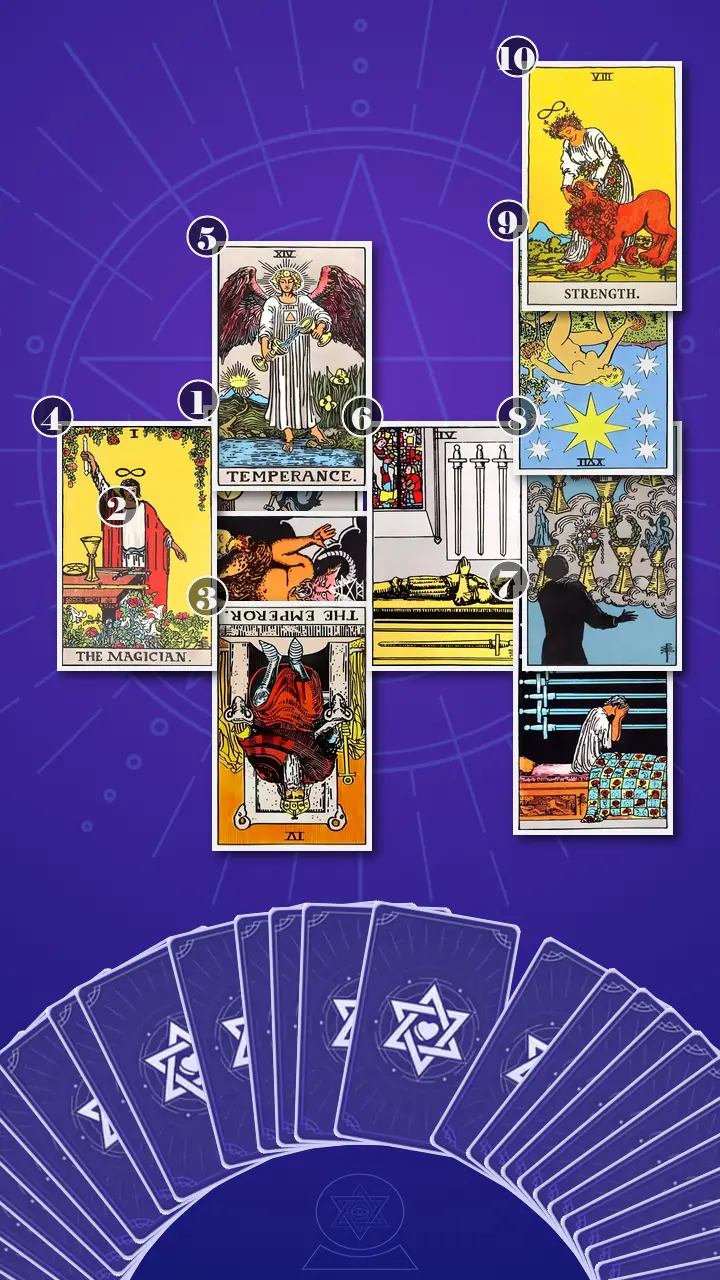
Reading the Map: Card Meanings in Context for Notion Perfectionism
As I laid the cards out in the cross and the staff, my mind did what it always does—my family calls it my Nature Empathy Technique. I notice patterns the way you notice weather: pressure systems, sudden drops, the moment a season turns. Not because it’s romantic, but because the body tells the truth in cycles.
Position 1: Current stuck behavior with Notion trackers
“Now turning over,” I said, “is the card that represents your current stuck behavior with Notion trackers—the perfectionism loop in daily life.”
Eight of Pentacles, reversed.
I tapped the image lightly. “This is the apprentice at the bench—tools out, repeating the same coin again and again. Upright, it’s practice. Reversed, it’s effort that turns into nitpicking. It’s that moment you open Notion for a quick check-in, and suddenly you’re thirty minutes deep in icons and formulas while the real task sits untouched.”
I made it concrete, because that’s where the spell breaks. “I can practically hear it: trackpad clicks getting faster, laptop fan warming up, coffee going cold. You’re ‘working’—but it’s the kind of work that never ships.”
Taylor’s face did the exact thing I see when someone feels painfully seen: she nodded, then let out a half-laugh that tasted like discomfort. “I literally do that,” she said, like it was both confession and evidence.
“And notice the energy state here,” I added. “This is blocked Earth—the part of you that wants steady progress gets trapped in ‘perfecting the container’ instead of doing the practice.”
I held her gaze through the screen. “If the system needs perfection to work, it doesn’t work.”
Position 2: What is actively intensifying the tracker perfectionism
“Now we turn over the card that represents what is actively intensifying the tracker perfectionism—the hook.”
The Devil, upright.
“This is the attachment card,” I said plainly. “Not ‘bad.’ Not a moral diagnosis. It’s compulsion—when something meant to serve you becomes something you serve.”
I leaned into the details that matter: the loose chains. “The thing about these chains is they’re not locked. Which is why this card hits so hard for productivity perfectionism. It’s not forced captivity. It’s a nervous system that learned, ‘If I obey the tracker, I get a hit of safety.’”
Then I gave her the scene I could feel under her words—like a camera feed. “Notion becomes a personal surveillance camera pointed at your habits. The inner monologue is: If the dashboard looks clean, I’m safe. If it’s messy, I’m exposed. Freedom versus safety. Self-respect versus compliance.”
Taylor flinched—small, almost invisible—then exhaled slowly like she’d been holding her breath for weeks. “Oh,” she said. “Yeah. That’s… that’s the loop.”
Position 3: Subconscious driver—the deeper need for control
“Now we look beneath the surface,” I told her. “This card represents the subconscious driver—the deeper need for control that makes tracking feel high-stakes.”
The Emperor, reversed.
“The Emperor upright is stable structure—leadership,” I said. “Reversed, it’s management without trust. Structure that doesn’t feel safe inside, so it clamps down harder outside.”
I gestured as if I could point to her laptop through the screen. “That’s why the tracker becomes a rulebook you’re afraid to violate. It’s not really about productivity. It’s about trying to guarantee you won’t fall apart.”
And because I’m who I am, I let my Highlands training speak in modern language. “In my family, we watch seasons to understand control. Winter doesn’t force the ground to bloom. It protects what’s alive by slowing down. That’s healthy authority. This reversed Emperor is the opposite: it tries to bully growth out of you with rigid rules.”
Taylor’s mouth tightened again, then softened. She didn’t look away—she looked tired. Like she’d been the strict manager living in her laptop for too long.
Position 4: How this started—the promise that made tracking feel exciting
“Now we turn to how this started—the original motivation that made the system feel necessary or exciting.”
The Magician, upright.
“This,” I said, and I let myself smile, “is why Notion felt like a rush at first. The Magician is agency. Tools. The feeling of, ‘I can actually design my life.’”
I pointed to the table of tools in the card. “It’s the all-in-one promise: calendar, habit tracker, project board, budget—everything on one table.”
Taylor nodded quickly. “Exactly. It felt like… relief. Like I could finally manage myself.”
“And that’s real,” I said. “The trap is when we start believing the right setup can remove uncertainty. But life will always have TTC delays, shifting meetings, low-energy evenings. The system can support you through that—if we don’t turn it into a performance standard.”
Position 5: Your conscious aim—what you actually want from the system
“Now we look at what you actually want—your conscious aim for balance and sustainability.”
Temperance, upright.
“Temperance is moderation,” I said. “Not ‘less ambition.’ More like: sustainable rhythm. The angel pours water between two cups—blending extremes.”
“Here’s the reframe that tends to unlock this for people dealing with Notion tracker perfectionism: Stop treating the dashboard like a judge; start using it like an instrument panel. An instrument panel doesn’t yell at you for being human. It gives feedback so you can steer.”
I paused, listening to the silence that followed. Outside Taylor’s window, traffic hissed faintly—wet tires, winter-grey city sound. Environmental conspiracy at its finest: the world reminding us that motion doesn’t need to be loud to be real.
“Temperance says your next growth edge isn’t tighter rules,” I continued. “It’s calibration. ‘Good-enough’ data. A tracker you can still use on messy days.”
Position 6: Near-term shift—the next helpful move
“Now we turn over the near-term shift—not a prediction, a direction. The next helpful move that changes your relationship with tracking.”
Four of Swords, upright.
“This is the pause card,” I said. “Rest as an interrupt. A deliberate mental reset after strain.”
To make it tangible, I cut the scene like a video edit: “Endless tabs… and then one quiet window. One page. No metrics pinging you all day.”
Taylor’s brows lifted with relief mixed with suspicion. “Wait,” she said. “Doing less might help?”
“A pause isn’t quitting,” I answered, keeping it calm, no hype. “It’s changing the container. You don’t need to be perceived by metrics all day.”
Her shoulders lowered on their own, just a fraction—like her body recognized the idea before her mind fully trusted it.
Position 7: Your inner experience—private pressure and self-talk
“Now we look at you—how this perfectionism lands inside.”
Nine of Swords, upright.
“This is the 11:52 p.m. card,” I said gently. “Phone glow in a dark room. You see one blank checkbox and your brain writes a whole character assessment.”
I described the spiral staircase the way it actually moves: “I missed a day → I’m inconsistent → I can’t be trusted → I’m behind in life.”
Then I said the line I wanted her to borrow the next time her mind sharpened into a blade. “A tracker is supposed to hold data—not hold your self-worth.”
Taylor went quiet. Not performatively quiet—real quiet. “Ouch,” she whispered, almost like she didn’t mean to say it out loud.
Position 8: Digital environment and comparison cues
“Now we turn over the card for external influences—your digital environment, templates, feeds, productivity culture.”
Seven of Cups, upright.
“This is NotionTok,” I said, blunt and kind. “This is the ‘ultimate dashboard 2026’ rabbit hole. Too many options. Too many ideal versions competing for your attention.”
I nodded toward the imagery—floating cups in a cloud. “This card doesn’t say you’re weak. It says the environment is designed to keep suggesting a better version. Like algorithmic doomscrolling: the feed always offers an upgrade, but you still have to live the day you’re in.”
Taylor rubbed her forehead. “I save templates like it’s going to fix something,” she said, half embarrassed.
“It fixes anxiety for about ten minutes,” I replied. “And then the pressure returns—because the problem wasn’t lack of options.”
Position 9: Hopes and fears—the hinge of meaning
“Now we look at your hopes and fears—what you’re afraid imperfect tracking will mean, and what you hope tracking will finally give you.”
The Star, reversed.
“This is the dimmed-hope card,” I said. “Not hopelessness—more like: you’ve tied hope to perfect proof.”
I offered her the comparison that hurts because it’s accurate: “There’s the glowy ideal week—perfect routines, pastel dashboards, no delays, no low-energy nights. And then there’s the real week: transit hiccups, hybrid-work whiplash, Slack pings, a meeting that runs long, a night where you eat cereal and call it dinner.”
“When the streak breaks,” I continued, “you feel like the future breaks. And that’s why the urge to do a dramatic Monday reset gets so loud—new system, new rules, new you—until it collapses by Wednesday.”
Taylor’s expression softened, like something inside her stopped arguing. “I thought it was just productivity,” she said quietly. “But it’s… hope stuff.”
Position 10: Integration and next best step—the healthiest energy to embody
I let my hands rest on the deck for a second before turning the final card. The room on my end was still; outside my window, a light rain tapped the glass in a steady rhythm—patient, repetitive, not asking permission to be imperfect.
“We’re turning over the integration card now,” I said. “This is the heart of your ‘what next.’”
Strength, upright.
Setup: Taylor had been living in the moment where she opens Notion to ‘just check in,’ and suddenly she’s thirty minutes deep in icons and formulas—jaw clenched—while the one real task sits untouched. The pressure in her chest wasn’t about the checkbox; it was about what she believed the checkbox proved.
Stop treating the tracker like a chain you must obey, and start treating it like a lion you can guide with gentle hands.
She froze in a three-part wave I’ve learned to respect. First: her breath paused, like her body didn’t know whether to defend or agree. Second: her eyes unfocused for a second, as if she was replaying every midnight backfill and every “I’ll start after I fix the template” morning. Third: her shoulders dropped—slowly, unwillingly—like a clenched fist realizing it can open.
Then the unexpected reaction hit—clean, sharp. “But—” Taylor’s voice tightened, a flash of anger underneath. “If that’s true, doesn’t it mean I wasted all that time? Like I did it wrong?”
I didn’t rush to soothe it away. “No,” I said, steady. “It means you were trying to take care of yourself with the tools you had. You chose the chain because it promised safety. Strength isn’t punishment for that. Strength is an upgrade in how you lead yourself.”
And I brought in the piece that’s been in my family’s hands for generations—practical, not performative. “In the Highlands we don’t fight a storm by yelling at the sky. We watch for the shift—the wind changing, the birds going quiet—and we adjust. That’s intuition: not magic, just attunement. Strength asks you to notice the moment your jaw tightens at a blank box, the way you’d notice a sudden drop in temperature. That’s your cue: not ‘be stricter,’ but ‘use gentle hands.’”
I asked her the question that turns insight into a lived thing. “Now, with this new lens—can you think of one moment last week when this would’ve changed how you felt? Even by five percent?”
Taylor swallowed. Her eyes were brighter, but she wasn’t collapsing—she was getting real. “Wednesday,” she said. “I saw the blank. I could’ve just left it. But I treated it like… proof.”
“Exactly,” I said. “This is the shift from shame-tinged pressure toward grounded self-trust. Not by perfect data—by kinder self-leadership that can tolerate imperfect data.”
From Scoreboard to Instrument Panel: Actionable Advice That Actually Holds
I gathered the whole spread into one story, the way I’d describe weather moving across a map.
“Here’s the arc,” I said. “You started with genuine agency (The Magician): building a system because you wanted clarity. But underneath, control didn’t feel safe inside (The Emperor reversed), so the system became rigid. That rigidity fed a compulsion loop (The Devil): checking for reassurance, chasing a clean dashboard to feel okay. The environment made it worse (Seven of Cups): endless templates, comparison cues. And the pressure landed privately at night (Nine of Swords), where a blank checkbox turned into a verdict. Your conscious self actually wants balance (Temperance)—and the near-term release valve is deliberate rest and fewer check-ins (Four of Swords). The integration is Strength: gentle hands, not tighter rules.”
“Your cognitive blind spot,” I told her, “is thinking the tracker can prove you’re disciplined. That makes every imperfection feel like identity evidence.”
I paused to let it be simple. “The transformation direction is this: shift from using trackers as proof of worth to using them as low-stakes feedback—with deliberately imperfect data allowed.”
Taylor nodded, then raised a practical obstacle immediately—because she lives in the real world. “Okay,” she said, “but I don’t have time for a whole new system. My days are chaos. Slack, meetings, TTC… I can’t fit another thing in.”
“Good,” I said, and I meant it. “Then we won’t build a new system. We’ll build a boundary and a minimum. Strength loves the smallest repeatable action.”
- The 7-Day Minimum Viable Tracker (MVT)For the next 7 days, write one plain-text line per day in Notion: “Today’s one thing: ___.” No colors, no formulas, no streaks. If you miss a day, leave it blank—no backfilling.Expect your brain to say, “This is too simple to count.” That’s the scoreboard voice. Write any redesign urge into a single bullet on a page called “Template Ideas (Not This Week),” then close it.
- The No-Backfill Pact (a gentle rule)Put a sticky note on your laptop that says: “Blank means blank. Not bad.” Keep it there all week. When you notice a blank day, you’re allowed to feel the discomfort—but you’re not allowed to rewrite history.If you slip and backfill once, don’t restart the week. Just write one line: “I backfilled because I wanted relief.” That’s honest data, not failure.
- A Review Window + a Walking Sound ResetChoose one daily “review window” (even 3 minutes counts—like 6:37–6:40 p.m.). Outside that window, you don’t open the tracker. If you get the urge, take a 2-minute walking meditation: stand, walk to the kitchen or hallway, and let environmental sounds lead you (HVAC hum, street noise, kettle, elevator ding) while you unclench your jaw.Make it ridiculously small. This is energy protection in modern form: you’re shielding your attention from constant self-monitoring, not relying on willpower.
- The 3-Minute Bedtime Energy Review (instead of midnight backfilling)Before sleep, do a 3-minute review with no dashboard open: (1) Name one thing you did anyway. (2) Name one thing that felt hard. (3) Choose one gentle rule for tomorrow: “I’m allowed to log messy.”If you feel the itch to open Notion in bed, treat it like a weather alert: “Pressure spike.” Put the phone down after step (1). You’re practicing a new relationship.

A Week Later: The Quiet Proof of Gentle Hands
A week later, Taylor messaged me a screenshot—not of a perfect dashboard. Of a plain page with seven lines. One of them was blank. And next to the blank day, she’d typed: “Blank = no data, not a moral grade.”
“I didn’t backfill,” she wrote. “I wanted to. Like, badly. But I didn’t. And I still did the actual thing that day.”
She added, almost as an afterthought: “I slept through the night twice. I still woke up and thought, ‘What if I’m doing it wrong?’ But it didn’t spiral. I made coffee and started anyway.”
I sat with that for a moment—the kind of moment my ancestors would call a turning of the tide. Not dramatic. Just real.
When your tracker has you clenching your jaw over a blank checkbox, it’s not really about productivity—it’s about trying to earn self-respect through perfect proof.
If you let your data be a little imperfect this week, what’s one gentle rule you’d want to lead yourself by instead?
Every reading at AceTarot is a Journey to connect with inner wisdom and empower next step.
Learn more about our Journey to Clarity.