The Tube Ring Selfie—And the Two-Line Note That Loosened My Spiral

The Victoria Line Ring Selfie, and the Comparison Loop
If you’re a late-20s London girl who opens Instagram on the Tube “to decompress” and ends up in a full-body shame spiral after a ring photo, you’re not imagining how fast it hits—hello, comparison loop.
Taylor said it almost like she was confessing a crime. “It’s embarrassing. I’ll be standing there on the Victoria line, one hand on the pole, and I see ‘I said yes!!!’ in that bubbly font. And my chest just… locks. Like someone zipped it shut.”
As she spoke, I watched her thumb hover over an invisible screen, the way your body remembers a habit even when your phone isn’t in your hand. She described the carriage smell—faintly metallic, warm breath in a crowded tunnel—and the weird heat of the phone against her palm. Then the drop in her stomach. Then the speed of her mind.
“I’ll tap back and rewatch,” she said. “Like the post contains a clue I missed. Then I’m on their profile, then their partner’s, then I’m in my own camera roll like… I don’t know, like I’m looking for evidence I’m not behind.”
She swallowed. “I am happy for them. I really am. And then five seconds later it’s like my brain turns it into a verdict on me. I start doing life math I didn’t consent to. And then I’m rewriting a dating text I wasn’t even going to send, just to prove I’m still… in the game.”
The shame in the room wasn’t a concept; it was physical—like thick air right before a storm. Tight chest. Sinking stomach. Fast thoughts ricocheting off the walls of her skull. A kind of contraction that makes even dinner feel optional.
“You can be happy for them and still feel it sting—both can be true,” I told her. “And the fact that your body reacts this fast doesn’t mean you’re petty. It means something tender in you is getting poked. Let’s not punish that part. Let’s map it.”
Choosing the Compass: The Celtic Cross · Context Edition
I’m Giulia Canale. I grew up with Venetian canals outside my window—water that looks calm until you learn how quickly a current can pull. These days I work as a Jungian psychologist and tarot reader, and for years I trained intuition on international cruises: thousands of people, mid-ocean, no escape routes, learning in real time how a single emotional trigger can change the whole inner weather.
With Taylor, I didn’t need incense or theatrics. I invited her to place both feet on the floor and take one slow breath that reached her belly—not to “clear energy” in a mystical way, but to give her nervous system a starting line that wasn’t already sprinting.
“Today,” I said, “we’ll use a spread called the Celtic Cross · Context Edition.”
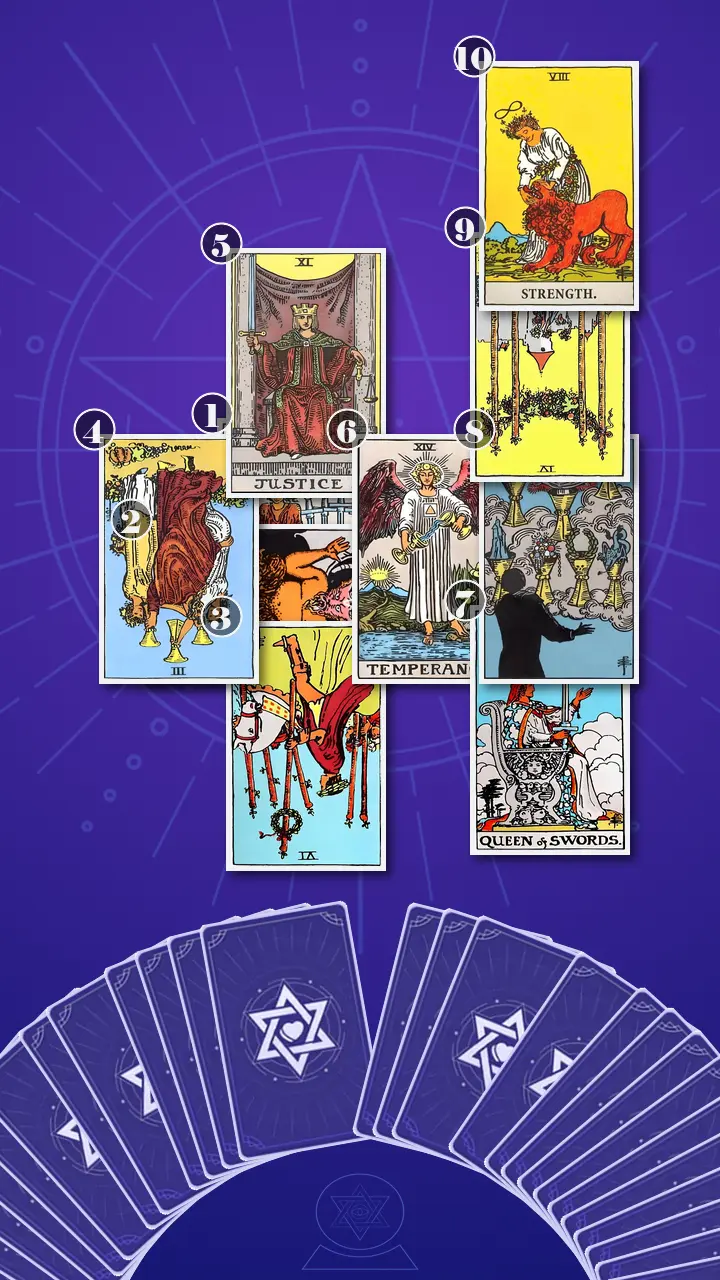
For you reading this: the Celtic cross works well when the question is ‘Why do I do this?’ because it traces a chain. It starts at the surface moment (the trigger), crosses it with the main challenge (what keeps the loop gripping), drops down into the root belief underneath, then climbs upward into practical integration. In this Context Edition, the final card isn’t treated as a fixed prediction; it’s reframed as an integration stance—a sustainable way to hold yourself when the trigger shows up again. That keeps the reading self-exploratory, not fate-y.
I showed Taylor the structure in simple terms: “The first card is what happens in you in the first sixty seconds after the ring photo. The crossing card is what keeps you hooked. The foundation card is the deeper belief the trigger attaches to. And the final card is how we hold your self-worth in a way that doesn’t get renegotiated by someone else’s highlight reel.”
Reading the Map: Card Meanings in Context
Position 1 — The immediate spiral: what happens right after you see engagement posts
“Now we flip the card that represents the immediate spiral—what happens in you right after you see engagement posts,” I said.
Eight of Swords, upright.
“This is the tunnel,” I told her, keeping my voice plain on purpose. “The moment you see the engagement post, your attention narrows like a single-track line: you rewatch the story, hop profiles, check comments, then open your own camera roll as if you’ll find proof you’re not behind. You feel trapped, but it’s mostly the blindfold of one assumption: ‘This means something about me.’”
In tarot terms, Eight of Swords is not a literal cage. It’s a perception cage. The energy here is blocked Air: thoughts moving fast but not going anywhere, circling the same point until they feel like fact.
Taylor let out a short laugh—sharp, almost bitter. “That’s… rude,” she said. “Like, it’s too accurate. It’s not even ‘mystical,’ it’s just… exposing.”
“I know,” I said gently. “And I want you to notice something: the card’s bindings are loose. The trap feels inevitable because the mind loves certainty, even painful certainty. But the exit starts with naming the blindfold.”
Position 2 — The main blocker: what keeps the spiral gripping you once it starts
“Now we flip the card that represents the main blocker—what keeps the spiral gripping you once it starts,” I said.
The Devil, upright.
Her eyes flicked to the card and then away, like she didn’t want to be seen recognizing herself in it.
“This is the ‘scroll-to-soothe’ contract,” I said. “You tell yourself you’re ‘just checking’ social media, but it becomes an hour of compulsive comparison—then a pivot into dating apps, old threads, and message rewrites to regain control. The hook isn’t the post; it’s the contract: ‘If I can find the missing fix, I’ll feel worthy again.’”
And here’s where my own toolkit kicked in—the one I’ve used on ships at 3 a.m. with someone crying quietly in a corridor, and in therapy rooms with people who call their pain “just being dramatic.” I call it Energy State Diagnosis: environment, relationships, self.
“Environment leak,” I said, “is the late-night bright screen in a dark room. Your body is tired, your defenses are down, and the algorithm becomes a loudspeaker. Relationship leak is the imagined audience—comment sections as a scoreboard, likes as ‘proof.’ Self leak is the way you turn hurt into a research project so you don’t have to feel it.”
“Scrolling isn’t your flaw—it’s your nervous system bargaining for certainty,” I added, letting that sentence land.
As the echo of it settled, I could almost see the late-night scene she’d described without prompting: duvet half off, neighbour’s TV through the wall, thumb moving even as the body feels heavy. The moment that feels “productive”—Googling average age engagement UK—followed by the smaller feeling when the phone finally goes down.
Taylor’s shoulders rose, then dropped a fraction. A tiny, reluctant nod. The kind that says, Oh. That’s the loop.
Position 3 — The root pattern: the deeper belief about worth and being chosen
“Now we flip the card that represents the root pattern—the deeper belief about worth and being chosen that the trigger hooks into,” I said.
Six of Wands, reversed.
“Under the spiral is a quiet rule,” I told her. “Love ‘counts’ when it’s visible. So engagement posts don’t just share news—they look like public proof of being chosen. When you don’t have that proof, you unconsciously treat it like losing status, and your self-worth takes the hit.”
In the Rider–Waite image, there’s a crowd and a laurel wreath—applause as safety. Reversed, the energy is deficiency: recognition is never enough, and silence feels like rejection.
This is also where I used my other diagnostic lens: Limiting Belief Manifestation. “The belief is: ‘If I’m not being chosen, something is wrong with me.’ Once that belief is running, your brain looks for confirming evidence. It will interpret ‘quiet season’ as ‘failure’ because it’s trying to keep the belief coherent.”
Taylor stared at the edge of the card. “It’s like everyone got the memo except me,” she said softly.
“Exactly,” I replied. “And that memo is basically: be lovable, be chosen, and make it visible. But that’s a cultural script—not a truth about you.”
Position 4 — What’s been shaping this recently: the social context that primed the trigger
“Now we flip the card that represents what’s been shaping this recently—the social context and comparison cues that primed the trigger,” I said.
Three of Cups, reversed.
“Your context has been primed,” I said. “Group chats that turn into wedding-planning threads overnight. Weekend plans stacked with birthdays and engagements. The subtle feeling of being out of rhythm. So when a post lands, it doesn’t just sting—it taps into ‘am I still in the circle?’ energy, and you start withdrawing.”
Reversed, Three of Cups turns a toast into a closed circle. The energy is imbalance: community becomes comparison, celebration becomes a test.
Taylor exhaled through her nose. “I’ll stop replying,” she admitted. “Not because I don’t care. Because I don’t want to be seen wanting what they have.”
“That’s a very human protective move,” I said. “But it also feeds the loneliness that makes the next trigger hit harder.”
Position 5 — Your conscious aim: what you’re trying to understand by asking “what pattern?”
“Now we flip the card that represents your conscious aim—what you’re trying to understand or achieve by asking ‘what pattern?’” I said.
Justice, upright.
The room felt clearer immediately—like someone cracked a window.
“This is your best self showing up,” I told her. “Justice says you’re ready for clarity, fairness, and self-honesty rather than an emotional self-trial.”
“A ring photo is a fact. The verdict is optional,” I said, and Taylor’s eyes lifted like that sentence gave her somewhere to stand.
Here’s the micro-practice Justice wants—clean and almost boring: “Mid-scroll, you pause and split the moment into FACT versus STORY. Not ‘positive thinking.’ An audit. Like a fair hearing. You’re not prosecuting yourself. You’re separating reality from projection.”
My mind flashed—briefly, without drama—to a ship’s staff training years ago: a young bartender panicking because a guest didn’t tip, turning it into “I’m terrible at my job.” I’d taught him the same move. Fact: no tip. Story: I’m worthless. The ocean doesn’t care which story you tell, but your nervous system does.
Taylor took a small exhale—barely audible, but real. The grip loosened by a millimetre.
Position 6 — Next available shift: the most realistic short-term movement
“Now we flip the card that represents the next available shift—the most realistic short-term movement if you work with the insight,” I said.
Temperance, upright.
“Temperance is an emotional volume knob, not an on/off switch,” I said. “Instead of swinging between ‘I’m fine’ and ‘I’m ruined,’ you choose a middle path: you let the sting exist without feeding it. You set a timer, close the app on purpose, and transition to one grounding action—water, food, a short walk—so your nervous system can recalibrate.”
This is where my Venetian brain always shows up. “In Venice, you don’t yell at the water for moving,” I told her. “You regulate the flow. Little gates. Little channels. You don’t need to win against the tide; you need to guide it.”
Temperance energy is balance: not suppressing emotion, not obeying it. Blending.
Position 7 — Your stance: how your identity and coping style participate in the loop
“Now we flip the card that represents your stance—how your identity, habits, and coping style are participating in the loop,” I said.
Queen of Swords, upright.
Taylor laughed again, but this time with affection. “That’s me. Too much me.”
“You are sharp,” I agreed. “You analyze. You spot patterns. You can articulate exactly why the spiral is irrational.”
Queen of Swords energy is excess in the mind when it’s unpaired with tenderness. “The shadow risk,” I said, “is trying to cut the feeling away instead of asking what it needs. Your best move is pairing discernment with a boundary that protects your heart.”
Her fingers rubbed the side of her mug. A protective gesture. A quiet yes.
Position 8 — The mirror around you: what your environment is reflecting back
“Now we flip the card that represents the mirror around you—what social media and your wider environment are reflecting back at you,” I said.
Seven of Cups, upright.
“Social media becomes a projection machine,” I said. “One photo turns into a whole imagined package—security, status, ‘home,’ being chosen forever. You compare that fantasy bundle to your real, messy life, and of course reality loses.”
Seven of Cups energy is overwhelm: too many meanings, too little ground. “The environment isn’t neutral,” I said. “It invites you to fill in missing context with fear. So the work is asking: Which story am I selecting from the cloud right now?”
Taylor’s eyes narrowed thoughtfully. “I literally build a whole relationship from one ring selfie,” she said. “Like a Netflix series I didn’t even watch.”
“Exactly,” I smiled. “And your brain is a brilliant producer. We’re just updating the script.”
Position 9 — The emotional knot: hopes and fears about what it would prove
“Now we flip the card that represents the emotional knot—what you secretly hope will happen and what you’re afraid it would prove if it doesn’t,” I said.
Four of Wands, reversed.
“The knot is belonging,” I told her. “You want a ‘homecoming’ moment and you’re scared that if it doesn’t happen, it proves you’ll always be outside the doorway.”
Reversed Four of Wands energy is instability in homecoming: celebrations that feel like thresholds you don’t have the key for. “So invitations, engagement parties, and celebratory posts can feel like a room where you’ll be measured—even if nobody is excluding you.”
Taylor’s throat bobbed as she swallowed. “I’ve literally paused outside a pub before engagement drinks,” she admitted. “Like… hand on the door. Heart racing. Rehearsing how to answer, ‘So, anyone?’”
“That image matters,” I said. “Because it tells me the spiral is not about the ring photo. It’s about the doorway.”
When Strength Put a Hand on the Lion
Position 10 — Integration: a sustainable way to hold self-worth when triggers show up
I let my hands rest on the deck for a second before flipping the last card. The room got quiet in that specific way it does when someone realizes we’re about to name the thing behind the thing.
“Now we flip the card that represents integration—a sustainable way to hold self-worth when triggers show up,” I said.
Strength, upright.
In the image, the figure doesn’t fight the lion. She doesn’t run. She touches it—steady, calm, present.
Setup. I looked at Taylor. “Here’s the moment you know too well: you’re on the Tube, you open Instagram to switch off your brain, and a ring photo flips a switch—tight chest, sinking stomach, and suddenly you’re doing life math you didn’t ask for.”
Delivery.
Stop treating other people’s celebrations as proof you’re lacking, and start practicing Strength—hand on the lion, breath in the body, choosing kindness over self-punishment.
I didn’t rush past it. I let it sit between us like a bell that keeps ringing even after you stop striking it.
Reinforcement. Taylor’s reaction came in layers—exactly the way truth arrives when it’s both relieving and terrifying. First: a tiny freeze. Her breath stalled mid-inhale, her fingers suspended over her mug. Second: her gaze unfocused, as if her mind replayed a highlight reel of every time she’d made herself the villain for feeling hurt. Third: her face softened and her eyes went glassy—not dramatic crying, just that thin sheen you get when you finally stop arguing with your own pain.
Then she frowned, suddenly protective. “But if I do that… if I’m kind to myself… doesn’t that mean I’m just jealous? Like I’m admitting I’m… I don’t know, bitter?” There was a flash of anger in it, like she wanted to defend her goodness.
“No,” I said, steady. “Strength isn’t pretending you don’t care. Strength is letting the lion exist without letting it drive the car.”
I placed my own hand lightly over my chest to model it. “Try it now, for five seconds. One hand on your body. Feel where the shame shows up—tight chest, sinking stomach, whatever it is today. Three slow breaths. And name the feeling in plain words: ‘Ouch—this is shame + envy.’ Not a moral judgement. A weather report.”
This is also where Jungian shadow work becomes practical, not academic. “The lion is the part of you that wants belonging,” I told her. “The shadow isn’t ‘ugly jealousy.’ It’s the exiled need you learned to hide—because you thought needing meant you were failing. Strength brings that need back into relationship. That’s how your worth gets stronger: not by reaching a milestone fast enough, but by meeting your inner experience without self-attack.”
She breathed. Her shoulders lowered like a coat sliding off. Her jaw unclenched. And then, quietly, she nodded—once, like she was agreeing with her own body.
“Now,” I asked her, “with this new lens: last week, was there a moment when you saw a post and went straight into fixing yourself? A moment where this could have changed how you felt—even five percent?”
Taylor blinked hard. “Tuesday,” she said. “On the commute. I opened the comments like they were going to tell me if I’m… acceptable.” She looked down, then up. “I could’ve done the hand thing. I could’ve just… gotten off the app.”
“Yes,” I said. “That’s the shift: from treating engagement posts as evidence about your worth to treating them as a trigger that reveals your unmet needs and values—then meeting those needs directly.”
And in that moment, I could feel the emotional transformation taking its first step: from a self-worth that gets negotiated through highlight reels, toward grounded self-trust—imperfect, in-progress, but real.
From Verdict to Canal-Gates: Actionable Next Steps for Finding Clarity
I gathered the spread into one story, the way I would on a ship when someone needed the fog to have edges.
“Here’s the chain,” I said. “The Eight of Swords is the first sixty seconds: tunnel vision and a blindfolded assumption. The Devil is what turns it into a spiral: compulsion dressed up as ‘problem-solving.’ Underneath, Six of Wands reversed says your worth has been trying to live with an audience—like love only counts if it’s publicly confirmed. Three of Cups reversed shows how your social world has been priming that ache, and Four of Wands reversed names the real tenderness: you’re longing for homecoming, and you’re scared the doorway won’t open.”
“Justice is your lever,” I continued. “It gives you a fair audit: fact versus story. Temperance shows the regulating middle path. And Strength is the integration: your worth isn’t a milestone; it’s a relationship with yourself that gets stronger when you meet triggers with courage and gentleness instead of self-attack.”
The cognitive blind spot I saw most clearly was this: Taylor was treating her emotional sting like a courtroom verdict—then using analysis to prosecute herself harder. The transformation direction was the opposite: name the sting, separate fact from story, regulate, then choose one values-based action. Practice worth, not prove worth.
Taylor hesitated. “Okay,” she said. “But… I genuinely don’t have time. Like, I’m commuting, I’m tired, I’m answering Slack, my brain is fried. I can’t do a whole ritual every time.”
“Perfect,” I said. “Then we don’t do a ritual. We do Instant Adjustment Techniques—coffee-break sized. Sixty seconds. Two lines. Three breaths. That’s it.”
- The 60-Second Justice Split-ScreenOn the Tube or at your desk, open Notes and write two lines only: (1) FACT: “They got engaged.” (2) STORY: “This means I’m behind / unchosen.” Stop there—no debate, no fixing.If you think “this is cringe,” label that as The Devil bargaining. Make it even smaller: write just the word FACT and one sentence.
- The Strength Pause (Hand on the Lion)Once per trigger: put one hand on your chest or belly, take three slow breaths, and name it plainly: “Ouch—this is shame + envy.” Then make one choice you don’t have to justify (close the app, look out the window, or text a supportive friend).If it spikes you, stop immediately and ground: feet on the floor, cold water on wrists, or find 5 red objects in the room. Your nervous system gets a vote.
- Temperance Timer + Venetian Canal-GatesAfter work, set a 7-minute scroll timer. When it ends, do a physical transition—stand up, drink water, wash your face, or step outside for 2 minutes. Think of it as closing a canal gate before the current pulls you too far.Start with 3 minutes if 7 feels impossible. Put your phone across the room when the timer ends so your body can feel the boundary.
- Private Wins (Worth Without an Audience)Before bed, write two lines that cannot be posted: one thing you did today, and one thing you protected (a boundary, rest, honesty). Optional: do a tiny digital detox by organizing 10 photos in your camera roll into a folder called “My Life, Quietly.”Do the 2-line version only if you’re exhausted. Consistency matters more than depth.

A Week Later: Ownership, Not Certainty
Six days later, I got a message from Taylor—short, like she didn’t want to jinx it.
“Had a ring post on the Victoria line. Did FACT/STORY. My stomach still dropped, but it didn’t turn into a whole trial. I muted #weddingtok for 48 hours. Also… I ate dinner sitting down. Small win. But it felt like I got myself back.”
I pictured her doing it: not glowing, not magically healed—just steadier. Clear enough to choose one kind thing. Clear enough to stop bargaining with the feed for proof. Clear enough to let her life be quiet without treating quiet as failure.
That’s the real Journey to Clarity I see again and again: not certainty, but ownership. Not a milestone, but an inner relationship that stops collapsing every time someone else celebrates.
When an engagement post makes your chest go tight and your stomach drop, it’s not because you’re bitter—it’s because a part of you is scared that being ‘not chosen yet’ secretly means you’re not enough.
If you treated the next engagement post as a moment of information—not about your worth, but about what you’re longing for—what’s one small way you’d want to meet that longing today?