From Shame-Spike Autopilot to Intentional Rest: The 60-Second Pause

Finding Clarity in the 10:37 p.m. Netflix Glow
If a “Still watching?” pop-up makes you feel like you got caught doing something wrong, and you click “Yes” out of pure reflex—welcome to autopilot procrastination disguised as downtime.
Maya (name changed for privacy) showed up to our session from her small Toronto apartment, camera angled just enough that I could see the edge of her couch and the familiar cluttered triangle of modern life: throw blanket, coffee table, and a laptop that never quite leaves the room. She told me it was 10:37 p.m. the last time it happened—the TV washing everything in that cold-blue light, the Netflix ding a little too crisp in the quiet, and her phone face-down… until it wasn’t.
“That pop-up makes me feel like I got caught doing something wrong,” she said, and her mouth did that half-smile people make when they’re trying to turn a sting into a joke. “And I click ‘Continue’ so fast I don’t even… see myself do it.”
Her shoulders were slumped in a way that wasn’t relaxation—it was more like gravity had filed a claim. When she described the prompt, her throat tightened visibly, then she rubbed at her sternum as if trying to smooth out an invisible crease.
“I call it relaxing,” she added, “but it doesn’t actually recharge me. I don’t even want to keep watching, I just don’t want to stop.”
I knew that exact contradiction by another name: want real rest and decompression versus fear of confronting what you’re postponing the moment the screen goes dark. Shame is crafty that way—it doesn’t always shout. Sometimes it’s a tiny rectangle on a screen that makes your body flinch like a reprimand.
“We’re not going to treat this like a character flaw,” I told her. “We’re going to treat it like a moment your nervous system has learned. And tonight, we’re going to map it—so you can find clarity in the exact moment it’s been disappearing.”

Choosing the Compass: The Four-Layer Insight Ladder Spread
I asked Maya to take one slow breath in, and then a longer breath out—not as ceremony, but as a clean threshold. In archaeology, you don’t rush from daylight into a tomb and expect your eyes to adjust. You pause. You let the senses catch up. The mind follows later.
I shuffled while she held the question in plain language: “Why does ‘Still watching?’ trigger avoidance—what pattern is this?”
“Today,” I said, “I’m using a spread I designed for trigger-moment avoidance: the Four-Layer Insight Ladder · Context Edition.”
For you reading along: it’s built for moments that are small on the surface but huge in the body—exactly the kind of micro-prompt that sparks decision fatigue and that freeze-or-numb response. The ladder structure moves from what you do, to what it means, to what you believe, to what you fear—then it offers a single inner shift and one repeatable action. It keeps the reading empowering and actionable, rather than predictive.
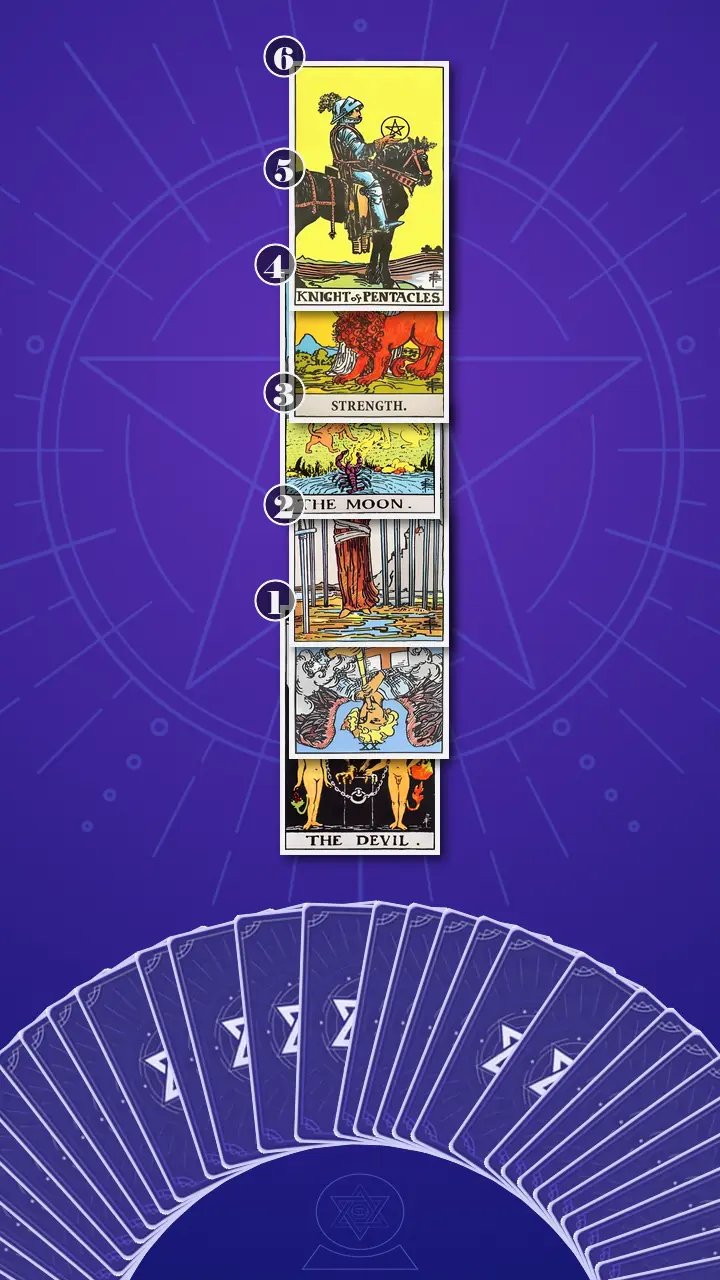
“We’ll read upward,” I told Maya, “like climbing out of a late-night trance. The first card will show the observable loop—the two seconds after the pop-up appears. The second card is the trigger meaning—why it feels so personal. Higher up we’ll find the belief that locks it in place, then the deeper fear beneath the need for noise. Then we’ll look for the medicine—the inner shift that actually breaks the shame-to-autopilot connection. And finally, we crown it with one practical step you can repeat for a week.”
Climbing the Ladder: Autoplay, Verdicts, and the Dark Hallway
Position 1: The observable loop — The Devil (upright)
“Now we turn over the card that represents the observable loop: what you do the moment ‘Still watching?’ appears.”
The Devil, upright.
I didn’t dramatize it. The Devil isn’t always a villain; in modern life, it’s often a default setting.
“This,” I said, “is 10:30 p.m. on the couch: you’re not even that invested in the show, but you’re deeply invested in not having to transition. The pop-up appears and your thumb hits ‘Continue’ like muscle memory. The TV keeps talking so your brain doesn’t have to. Your laptop stays half-open in your peripheral vision, and you tell yourself this is self-care—while some part of you knows it’s a quiet cage made of ‘just one more.’”
I could almost feel the scene through the screen: the remote under a blanket, the warm laptop fan, the blue TV glow painting everything the color of late-stage indecision.
“Energetically,” I went on, “this is blockage-by-comfort. The Devil is attachment and compulsion, but the detail people miss is the looseness of the chains. The trap is partly comfort, partly habit. Nothing is physically forcing you. Autoplay is a comfort default, not a personal failure. But defaults decide your night if you never touch them.”
Maya let out a short laugh—one of those half-laughs that has a bitter edge, like she’d just been read by her own browser history.
“That’s… rude,” she said softly. Then, quieter: “Accurate. It’s like I’m annoyed the pop-up exists, but I’m also… kind of hoping it’ll save me.”
“Be honest,” I asked, borrowing a framing I use often, “when it hits, are you more annoyed at the app… or at yourself?”
She didn’t answer immediately. She pressed her lips together, then gave a small nod that said, Yes. Both.
Position 2: The trigger meaning — Judgement (reversed)
“Now we open the card that represents the trigger meaning: what the prompt emotionally represents in that instant.”
Judgement, reversed.
“I’m going to say this plainly,” I told her. “Judgement reversed is the refused wake-up call. It’s not that the pop-up is powerful—it’s that it lands like a verdict.”
I used an analogy that tends to get a quick, painful laugh from anyone with a smartphone: “It’s like an iPhone Screen Time alert you didn’t ask for. It’s supposed to be a dashboard. But in that moment, your body reads it like a performance review.”
Then I mirrored the two-beat inner monologue the card showed me—short, exact, mercifully common:
“Beat one: a hot flash of self-awareness—‘I’m doing it again.’ Beat two: immediate self-protection—‘Nope, not doing this right now.’ So you swipe it away by clicking ‘Continue.’”
“A check-in isn’t a trial,” I said, letting the sentence sit where shame usually sits.
Maya’s reaction was exactly the kind that makes me trust a reading: a quiet, slightly embarrassed nod; a small exhale. She didn’t look at the camera. She looked down and away, as if the idea had turned a light on inside her.
“Yeah,” she whispered. “It feels like a verdict.”
“And if it’s a verdict,” I said, “of course you’d avoid. Who wants to stay present for their own sentencing?”
Position 3: The limiting belief — Eight of Swords (upright)
“Now we turn over the card that represents the limiting belief that makes continuing feel like the only option.”
Eight of Swords, upright.
“This is the ‘no-choice feeling,’” I said. “The mind narrowing the options until the easiest path becomes the only one you can see.”
And I gave it to her in the exact modern shape it takes at midnight: “In the moment you consider stopping, your mind presents a trap: either keep watching or immediately become a perfectly disciplined person who cleans, answers emails, plans tomorrow, and goes to bed like a productivity influencer. Because that second option feels impossible at midnight, you conclude you’re ‘stuck’—and you let autoplay decide. You don’t see the smaller exits (pause, brush teeth, set one tiny plan) because overwhelm narrows your vision.”
“So it’s not even a real choice,” she said, brow tightening. “It’s like… a fake menu.”
“Exactly,” I replied. “The Eight of Swords looks like a prison, but the binding is lighter than it feels. Your brain is doing what brains do when they’re overcapacity: it stops rendering alternatives.”
I asked her the question this position always asks, whether it’s a tarot spread or an excavation trench: “What’s the smaller third option you’re not letting yourself see—between ‘keep binging’ and ‘fix my entire life tonight’?”
Her eyes went unfocused for a moment, as if she were searching for something on a shelf that had always been there. “Maybe… just… stand up,” she said. “Like, physically.”
“That,” I said, “is already an off-ramp.”
Position 4: The deeper fear — The Moon (upright)
“Now we open the card that represents the deeper fear you don’t want to meet when the screen goes dark.”
The Moon, upright.
The Moon always changes the room, even through Zoom. It’s the card of ambiguity—of emotional weather that doesn’t come with labels.
“Here’s the cinematic cut,” I said, keeping it gentle. “The TV clicks dark. The room noise returns. You can hear the hum of the fridge. And feelings rise.”
Then I translated it directly into her weeknight reality: “The TV isn’t just entertainment; it’s a night light for your nervous system. If you turn it off, the room gets quiet and the mind’s ‘swampy’ feelings rise—pressure, loneliness, vague dread, the sense of being behind. It’s not that you love the next episode; it’s that you don’t want to walk the moonlit hallway between ‘day mode’ and ‘sleep mode’ where nothing is solved and everything is felt.”
Maya swallowed. Her shoulders lifted by a millimeter—an almost imperceptible brace. There was a heavier silence on her end of the call, the kind that tells me we’ve reached something true.
“If I turn it off,” she admitted, “the silence is too loud.”
“That’s The Moon,” I said. “Not danger. Unsortedness. Ambiguity. The fear isn’t the show ending—it’s what shows up in the first two minutes after.”
I didn’t ask her to fix those feelings. I asked her to respect them enough to notice them.
When Strength Put a Hand on the Lion
“We’re turning the next card,” I said, and I slowed down on purpose. “This is the heart of the reading—the card that represents the key inner shift that breaks the shame-to-autopilot connection.”
Strength, upright.
In the Rider–Waite–Smith image, it’s not a battle. It’s a human being with a calm hand on a lion’s mouth—no violence, no white-knuckling. It’s regulation. Containment. Compassion with a spine.
I spoke in present tense, as if we were standing beside her couch together, right at the prompt:
“The pop-up appears. The shame spike hits. And instead of racing to erase it, you stay. You put the remote down for one breath. You name the urge without arguing: ‘I want comfort.’ Then you respond like a steady coach, not an inner judge: ‘Of course you do. Let’s choose the kind that actually helps.’ In that tiny pause, the episode stops being a trance and becomes a choice.”
This is where my own work—my odd pairing of archaeology and tarot—always surfaces. I’ve spent decades looking at layers of human habit in soil: one fire built over another, one floor laid over another. Most patterns aren’t dramatic. They’re repeated. And the way out is rarely a grand epiphany; it’s a different relationship to the exact moment the pattern starts.
“There’s a mythic archetype here,” I told her, leaning into the part of my toolbox that has never failed me. “Every culture has a story where the hero meets the beast. But the oldest versions aren’t about domination—they’re about befriending the animal part. Strength isn’t ‘be better.’ It’s ‘be present.’ Your lion is the impulse to numb. Your steady hand is thirty seconds of not-clicking.”
When I was a younger archaeologist, I once found a small clay disc pressed with a simple mark—no grand inscription, just a repeated symbol, like someone practicing a letter. It wasn’t art. It was training. Strength feels like that: not glamorous, but profoundly human.
And then, I moved us into the moment the card was designed to create.
Because here is the setup, as you know it: it’s 10:30 p.m., the laptop is still half-open on the coffee table, and the “Still watching?” box pops up like it’s watching you back—your throat tightens, and your thumb goes to “Yes” before you even think. You’re trapped in that split-second: part of you wants real rest, and part of you can’t bear the silence that comes after.
Stop treating the pop-up like a guilty verdict and start using it like Strength’s steady hand on the lion—one calm pause that turns impulse into choice.
Her body reacted before her words did—always the honest order of things. First: a small freeze, breath caught, fingers hovering as if she were holding an invisible remote. Second: her gaze unfocused, like the mind rewound a dozen late nights at once. Third: the release—an exhale that sounded like a door unlatching. Her shoulders dropped. Her jaw unclenched so visibly that I felt a matching softness in my own face, mirroring her without thinking.
“But… that’s so small,” she said, voice thin with something that wasn’t quite hope yet. “Just… a pause?”
“Yes,” I answered, and I kept my tone steady. “Because you don’t break the ‘Still watching?’ loop by bullying yourself into control; you break it by practicing one gentle, repeatable moment of self-direction right at the prompt.”
I watched her eyes glisten—not in a dramatic way, but in the way they do when someone realizes they’ve been at war with themselves over something that could have been practice.
“Let’s make it concrete,” I said. “Next time the prompt appears, don’t answer it for 30 seconds. Put the remote or phone down. One hand on your chest or stomach. Take one slow breath in and a longer breath out. Then quietly name one sentence: ‘I’m avoiding ___.’ The email. The bedtime transition. The unfinished task. The silence.”
“Then choose on purpose,” I continued. “Either you press continue for one intentional final episode and set a visible timer for when you’ll stop, or you turn it off and do a two-step shutdown—bathroom, then lights. And if your body spikes into panic or shame, you’re allowed to stop the exercise and just choose the gentlest next move. This is practice, not a test.”
Then I asked the question that turns insight into memory: “Now—use this new lens and look back at last week. Was there a moment when the pop-up appeared and this would have changed how it felt in your body?”
She blinked hard once. “Sunday,” she said immediately. “Sunday Scaries. I remember thinking, ‘If I stop, the weekend’s officially over.’ It felt like… being graded.”
“That’s the shift,” I said. “From shame-triggered autopilot avoidance to compassionate, intentional choice at the exact transition moment. Not perfect discipline. A different relationship with the doorway.”
Position 6: The one-week integration — Knight of Pentacles (upright)
“Now we turn over the card that represents a one-week, repeatable behavioral step that turns insight into a new pattern.”
Knight of Pentacles, upright.
“This is the unsexy hero,” I told her, and she gave a tired smile that said she trusted unsexy more than motivational speeches. “The Knight of Pentacles is consistency. It’s self-trust built in boring, repeatable choices.”
I tied it to her reality, exactly as the card demanded: “Instead of relying on midnight willpower, you build an off-ramp that repeats: one episode after 10:30, timer on, then a two-step shutdown. You don’t try to ‘fix your whole life’ in one night. You just do the same small ending most nights. After a week, the brain starts trusting the transition because it’s predictable—less chaos, less bargaining, fewer broken promises with yourself.”
“So I don’t have to quit streaming,” she said, relief in her voice.
“No,” I replied. “The goal isn’t to quit. It’s to stop letting shame make the choice for you.”
The Pattern, Excavated: From Trigger to Choice
I summarized what the ladder had shown—because insight without a story is just trivia.
“Here’s the through-line,” I said. “At the bottom, The Devil is the comfort-default loop: autoplay, the couch, the blue light, the ‘just one more’ momentum. Then Judgement reversed turns a neutral check-in into a moral score, so you swipe it away before you can feel seen by yourself. Eight of Swords tightens the mental frame until the only options you can perceive are dramatic—binge or become a new person tonight—so you pick numbness. The Moon reveals the root: when the screen goes dark, ambiguity and unsorted feelings rise, and your body treats that as unsafe. The medicine is Strength: thirty seconds of steadiness, not punishment. And the integration is Knight of Pentacles: one small rule, repeated, until your nervous system trusts the transition.”
“Your cognitive blind spot,” I added, “is that you’ve been treating the prompt like an accusation. If it’s an accusation, your only move is defense. The transformation direction is simpler and kinder: treat ‘Still watching?’ as a neutral check-in, and practice a 30–60 second pause to name what you’re avoiding before choosing intentionally to stop or continue.”
Then I offered her something from my own method—one of my “archaeologist’s tricks” disguised as a modern tool. “Inscriptions used to be carved for the moments memory fails,” I said. “Not poetry. Reminders. So we’ll make you one.”
- The 30-Second Choice PointWhen “Still watching?” appears, don’t touch anything for one slow breath. Put the remote/phone down. Hand on chest or stomach. Quietly name: “I’m avoiding ___.” Then choose on purpose.If 30 seconds feels impossible, do 15. If saying it out loud feels cheesy, whisper it or type one sentence in Notes. Treat resistance as part of the loop, not a personal failure.
- The “Check-in, Not Trial” InscriptionWrite “CHECK-IN, NOT TRIAL” on a sticky note and place it on the remote or the TV stand—somewhere your hand has to pass. When the prompt hits, read it once before you decide to continue or stop.Think of it like a carved reminder for “future you” at 11:30 p.m. It’s not motivation; it’s orientation.
- The One-Episode Timer + Two-Step ShutdownIf you choose “one last episode,” set a timer for the exact length (or 45 minutes) and put the phone face-down. If you choose “stop now,” do only two steps: (1) bathroom/brush teeth, (2) lights dim + phone on charger.No extra tasks. This isn’t about winning the night; it’s about making the transition predictable enough that your brain stops treating it like a cliff.

A Week Later: Ownership, Not Certainty
Six days after our session, I received a message from Maya. It wasn’t long. It didn’t need to be.
“The pop-up came up,” she wrote. “I did the hand-on-chest thing. I literally said ‘check-in, not trial’ and it was… weirdly calming. I still watched one more episode, but I set the timer. And when it went off, I shut it down and actually brushed my teeth. I didn’t feel like I was being chased.”
She added a second text a moment later: “I woke up and my first thought was still, ‘What if I mess this up tonight?’ But I kind of smiled. Because now I know what to do in the moment.”
That’s what a Journey to Clarity looks like in real life: not a new personality, not a perfect routine—just one small, repeatable choice that proves you can be with yourself at the doorway.
When a tiny “Still watching?” box makes your throat tighten, it’s not because you’re lazy—it’s because part of you wants real rest, and another part is terrified that the moment the screen goes dark you’ll have to face everything you’ve been avoiding and what that might ‘say’ about you.
If “Still watching?” were just a neutral check-in for one week, what would you want your next 30 seconds to look like—so the choice feels like yours again?