From Unread Badge Dread to Steady Self-Trust: A Workweek Experiment

The Cold-Blue Badge Before Coffee
You’re a late-20s project manager in a city like Toronto and the Outlook/Gmail unread badge hits like a tiny panic button—classic email anxiety, but somehow it feels personal.
Jordan said it like she was confessing to a weird habit she couldn’t explain without sounding dramatic. We were on a video call, but I could still see her Monday morning: 8:46 a.m. in a Liberty Village apartment, laptop open on the kitchen counter while the kettle clicked off. The fridge hummed a steady low note, and her screen threw that cold-blue light across her face like a second, harsher sunrise.
“I haven’t even had coffee,” she told me, fingers already hovering near the trackpad. “And my chest tightens the second I see the number. Like… my day is already behind before it starts.”
I watched her eyes flick—badge, subject line, badge again—like she was scanning for danger. Not reading, not deciding. Monitoring. The kind of monitoring that feels like being responsible but lands in the body like a threat response.
“It’s stupid,” she said, then immediately corrected herself. “Not stupid. It’s just… the number itself feels like a grade. If I don’t check now, I’ll miss something important. I can’t relax until I know what’s in there.”
In my work—radio, music therapy, a decade of studying how sound and attention shape the nervous system—I’ve learned something that always matters here: alarms don’t have to be loud to be effective. A tiny red circle can still train your body to brace.
Jordan’s core contradiction was clear as soon as she said it out loud: she wanted to feel on top of responsibilities, but she feared that one missed message could expose a lack of control.
And the anxiety wasn’t abstract. It sounded like a restless, twitchy urge to check the screen, and it lived in her body like a band cinched around her chest—tight enough to change how she breathed, subtle enough that she’d call it “just being busy.”
“Let’s make this practical,” I said gently. “We’re not here to judge your habits. We’re here to map them. Today is a Journey to Clarity—so email becomes a tool again, not an alarm system.”
Then I added the line I’ve said to so many people who’ve been quietly suffering under modern notification design:
That unread badge isn’t a moral score—it’s a notification design problem hitting a human nervous system.

Choosing the Compass: The Celtic Cross · Context Edition
I asked Jordan to take one slow breath in through her nose and exhale like she was fogging up a mirror. Not as a ritual for the universe—just a clean boundary for her brain: we’re switching modes now.
While she focused on the question—Why does the unread email badge spike anxiety—what’s my next step?—I shuffled my deck the way I do before every reading: steady, audible, a soft paper sound like a metronome finding tempo.
“Today,” I told her (and you, if you’ve ever lived inside the inbox spiral), “we’re using the Celtic Cross · Context Edition.”
I like this spread for problems that are loops—badge → threat interpretation → checking/deferring → bigger badge—because it doesn’t just describe your feelings. It shows the chain: what’s happening on the surface, what’s crossing you, what’s underneath, what trained you into it, and—most important—what the next-step integration practice is.
How tarot works, at least the way I practice it, is less fortune-telling and more pattern recognition with imagery. The cards give us a language for mechanisms your nervous system already knows, but you might not have words for yet.
I previewed the structure so Jordan wouldn’t feel like we were wandering in the dark:
“Card one will show what the unread badge is doing to you right now—the visible loop. Card two will name the main block that turns a number into urgency. The last card—position ten—won’t ‘predict your future.’ It will give us an integration direction: the next-step practice that stabilizes your relationship to email.”
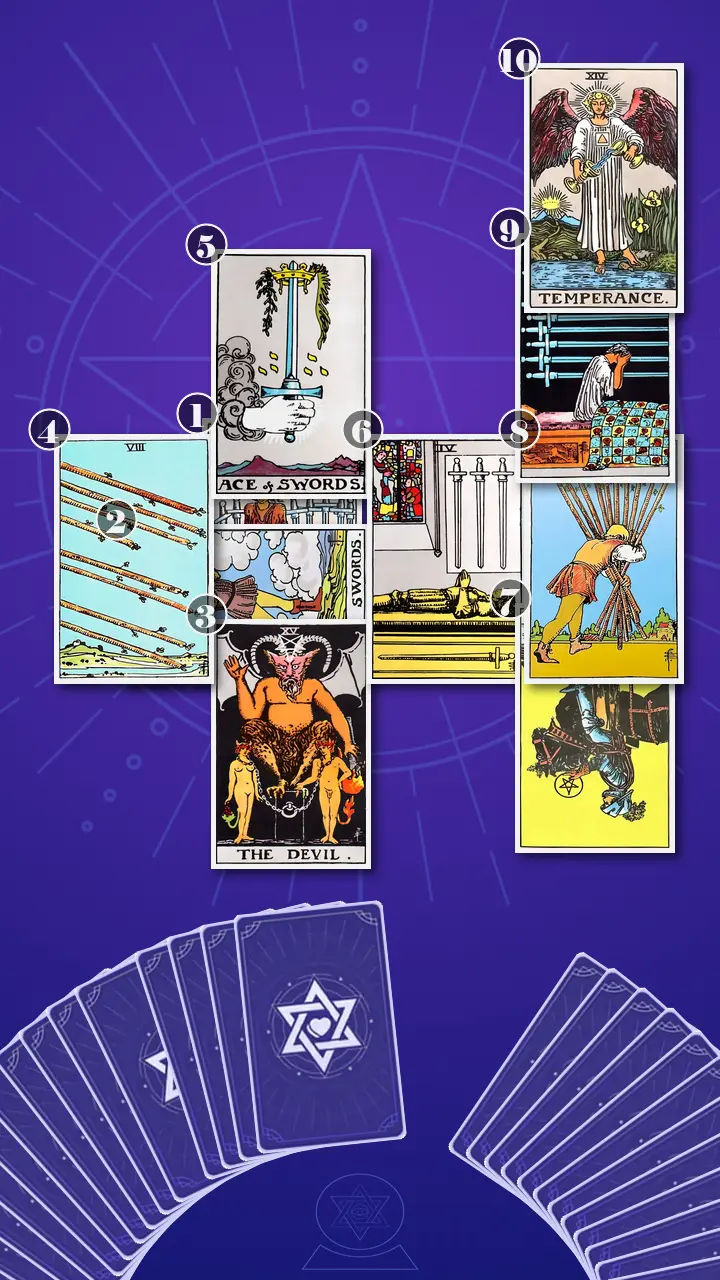
Reading the Map: Why “Checking” Doesn’t Create Control
Position 1: What the unread badge is doing to you right now (the visible loop)
Now flipped open is the card representing what the unread badge is doing to you right now (the visible loop).
Eight of Swords, upright.
I didn’t have to reach far to connect it to her life, because the translation was already her morning: it’s 9:00 a.m. and your inbox unread badge is staring at you like a warning label. Nothing is actively on fire, but you feel unable to start your actual project work until you “check.” You open emails, then back out, mark them unread again, and keep yourself in limbo—trapped by what the messages might demand rather than what they actually say.
In this card, the figure is blindfolded, hands loosely bound, surrounded by swords like a fence. The detail I always linger on is the looseness: the ties are not tight enough to be a prison. But the mind feels trapped anyway.
Energetically, this is Air (thought) in blockage. Not because you’re incapable—because your brain is forecasting consequences before you’ve even gathered facts.
I asked Jordan, “In the first ten seconds when you see the badge, what are you trying to avoid feeling?”
She let out a quick laugh that had no humor in it. “Oh my god. That’s… too accurate. It’s almost cruel.”
Then—softer—“I’m avoiding the moment where I open something and realize I don’t know what to do.”
Position 2: The main block—what makes the badge feel urgent and hard to ignore
Now flipped open is the card representing the main block: what makes the badge feel urgent and hard to ignore.
Page of Swords, reversed.
This is the “radar screen” card when it shows up reversed. The modern-life scenario lands instantly: you keep the inbox tab open like a radar screen. You refresh after every tiny task, scan subject lines for risk, and half-read emails to “get the gist” without choosing what to do. Then you either rush-reply to feel in control or postpone decisions—so the badge grows and your brain stays braced.
Here’s the inner monologue I hear in this card, and I said it out loud so Jordan could recognize it:
“I’ll just scan for urgent… I’ll respond when I’m ready… I’ll feel better once I know.”
Then the micro-action scene that keeps the loop alive: refresh. half-read. mark unread again. switch tabs. Slack pings. refresh again.
Energetically, this is Air in excess—information-gathering without landing. And the cost is suspended decisions. You don’t feel calmer after you check; you feel more activated because nothing has been completed.
“Refreshing is a coping move, not a plan,” I told her, keeping my voice steady, non-judgmental.
Jordan nodded, tight. A little wince, like she could feel the truth in her shoulders.
“And I need you to hear this distinction,” I added, because it’s a leverage point: Read-only is not the same as respond-now.
Position 3: The root driver beneath the habit (the deeper attachment or fear)
Now flipped open is the card representing the root driver beneath the habit (the deeper attachment or fear).
The Devil, upright.
In modern terms: email stops being a tool and starts being a compulsion. You check to reduce discomfort, then feel shame for checking, then check again to relieve the shame. The unread badge becomes tied to self-worth—being reachable feels like being safe, and not checking feels like risking judgment.
The Devil is often misread as “bad,” but I treat it like a spotlight on the part of you that made a deal under stress. It promised relief. It delivered a three-second exhale. And it quietly asked for your freedom in return.
In the card, the chains are loose. That’s not an accident. It’s the whole point: this pattern feels absolute, but it’s changeable.
I asked Jordan, “If you imagine missing an email, what’s the feared consequence your mind jumps to first?”
She didn’t hesitate. “That people will think I’m not competent. Or that I’m not on top of my projects. Like I’m… sloppy.”
That right there is the hook: the inbox as a self-worth scoreboard.
Position 4: What recently trained your nervous system to treat email as an alarm
Now flipped open is the card representing what recently trained your nervous system to treat email as an alarm.
Eight of Wands, upright.
This is fast inflow, rapid updates, reply-alls—communication with momentum. The modern scenario: recent weeks trained your nervous system to expect messages to arrive fast and keep coming. Even when an individual email isn’t urgent, the speed of the channel taught your body to treat every new unread like a time-sensitive threat.
Energetically, this is Fire in the environment—not necessarily your choice, but your context. A fast-paced PM role, stakeholders, fuzzy ownership, and the pressure of seeing someone reply in a thread within two minutes.
“So it’s not just ‘you,’” I told her. “Your nervous system was trained.”
She looked relieved and irritated at the same time. “Yeah. That’s… exactly it.”
Position 5: What you think you ‘should’ do about it (the conscious strategy or ideal)
Now flipped open is the card representing what you think you ‘should’ do about it (the conscious strategy or ideal).
Ace of Swords, upright.
This is the “clean, sharp solution” card. The scenario is painfully modern: you want the perfect system, the perfect wording, the perfect moment when you finally “have it together.” You chase certainty before acting—so you rewrite replies, keep drafts open, delay sending until it feels flawless.
Energetically, this is Air trying to become control. The Ace is a gift, but it becomes a trap when “clarity” turns into “I must be certain before I act.”
I said, “The Ace isn’t asking you to be perfect. It’s asking you to make one clean cut. Define what a ‘good enough’ response means today.”
Jordan swallowed. “I don’t know if I can do ‘good enough’ at work.”
“You already do,” I said. “You just don’t call it that.”
Position 6: Near-term momentum—what helps interrupt the loop if you let it
Now flipped open is the card representing near-term momentum: what helps interrupt the loop if you let it.
Four of Swords, upright.
This card always changes the sound in the room. Even over video, I could feel Jordan’s pace slow down. The modern-life translation is simple: a deliberate pause becomes your pattern interrupt—one protected block with notifications off, inbox closed, and a single task that rebuilds steadiness. The moment the pings stop, your body realizes it doesn’t have to stay on call.
As I spoke, I did what I do instinctively as someone who lives in audio: I listened for her breath. It had been shallow and fast. Now it lowered, like a song dropping into a calmer tempo.
“Not checking is an active practice,” I told her. “Not neglect.”
Her shoulders visibly dropped. A small exhale. “Okay,” she said. “I could try 30 minutes.”
Position 7: Your role in the pattern—how you respond when the badge appears
Now flipped open is the card representing your role in the pattern: how you respond when the badge appears.
Knight of Pentacles, reversed.
This one is about follow-through getting sticky. The scenario: you carry “unread” like a heavy task token all day. You keep telling yourself you’ll reply when you have more time (and more certainty), so the same emails stay parked. Then you swing between rigid inbox marathons and total avoidance.
Energetically, this is Earth in deficiency—not because you lack discipline, but because everything feels too high-stakes to start. The horse doesn’t move because it’s waiting for “the right way.”
“This isn’t laziness,” I said carefully. “This is your reliability identity turning into inertia. Because ‘doing it right’ got too expensive.”
Jordan’s eyes flicked away from the screen for a second. She pressed her lips together like she didn’t want to cry over something as stupid as email. That reaction made perfect sense to me: you’re not crying about email. You’re crying about what email has been allowed to mean.
Position 8: External pressures and norms shaping your email behavior
Now flipped open is the card representing external pressures and norms shaping your email behavior.
Ten of Wands, upright.
This is real overload. Too many stakeholders, too many follow-ups, too many threads. The unread badge becomes anxiety-producing because it visually bundles all responsibility into one number—like carrying a stack of invisible obligations that blocks your view of what actually matters.
Energetically, this is Fire as burden. Not exciting momentum. Weight.
“So the pressure isn’t imaginary,” I said. “But the badge is a bad interface for it. It turns ten different kinds of emails into one heavy lump.”
Position 9: What you secretly hope for and fear about being reachable
Now flipped open is the card representing what you secretly hope for and fear about being reachable.
Nine of Swords, upright.
The modern scenario is the 12:41 a.m. mind-inbox: even when the laptop is closed, the inbox stays open in your mind. You replay what you didn’t answer, imagine the disappointed tone in someone’s next message, wake up with dread. From “I can’t act” to “I can’t rest.”
As I described it, the room seemed to quiet even more, like a studio engineer pulling down the fader on background noise.
Jordan whispered, “It’s the shower that gets me. I’ll be washing my hair and suddenly I’m drafting a reply to an email I didn’t even fully read.”
I nodded. “That’s the brain trying to finish a loop so it can feel safe. But it’s doing it in the worst possible place—your recovery time.”
When Temperance Turned the Badge Into a Metronome
Position 10: Integration direction—the next-step practice that stabilizes your relationship to email
We flipped the final card, and I felt that subtle shift I always notice when a Major Arcana lands—the sense that the reading has moved from “what’s happening” into “what kind of person are you becoming through this?”
Now flipped open is the card representing integration direction: the next-step practice that stabilizes your relationship to email.
Temperance, upright.
In real life, Temperance looks like this: instead of chasing inbox zero, you build a calm, repeatable cadence—set response windows, separate reading from replying, and stop on purpose. The unread badge becomes neutral information because you trust the ritual that handles it. Your control comes from rhythm, not vigilance.
And because I’m Alison Melody—someone who’s spent years watching human brains respond to tempo, tone, and sound cues—I couldn’t not say what I saw in this angel pouring between two cups.
“Jordan,” I said, “your inbox is basically playing you a playlist with jump scares. The badge is the jump scare. Temperance is a steady tempo. And you don’t fix a jump-scare playlist by staring at the track list harder. You fix it by changing the workflow—intake, label, respond—at a rhythm your nervous system can trust.”
This is where I use my signature lens: Space Tuning. In my studio, when a sound keeps spiking people—an HVAC rattle, a harsh mic frequency—we don’t blame the listener. We tune the environment and the signal. Your laptop, your phone, your notification settings, your kitchen counter setup: that’s an acoustic environment. Right now it’s tuned for vigilance.
I asked her to imagine her inbox as a soundboard. “If the unread badge were a frequency,” I said, “it’s too sharp and too loud in your mix.”
She blinked. “That is… weirdly accurate.”
Setup (the moment before the insight): I asked her to picture that Monday moment again—coffee going cold, Outlook open, her chest tightening at the unread badge before she’d even read a single line—like the day was already losing and she had to sprint just to be acceptable.
Delivery (the sentence that changes the frame):
Stop treating every unread as an emergency; start blending response and rest like Temperance pouring two cups into one steady flow.
I let it hang for a beat.
Reinforcement (what her body did with the truth): Jordan’s face went still first—like her brain had paused the usual scroll. Her breath caught for half a second, and her eyes unfocused the way they do when someone is replaying a memory, not looking at a screen. Then her shoulders lowered in a slow drop, almost imperceptible, like she’d been holding a backpack strap for too long and finally set it down. Her jaw unclenched. She swallowed once, and when she exhaled it sounded shaky, not because she was falling apart, but because she was letting go of the idea that the only way to be competent was to stay braced.
Then—here was the complicated part—her brow tightened again. “But if I stop treating it like an emergency,” she said, a flash of anger under the fear, “doesn’t that mean I’ve been doing it wrong? Like… I made it worse?”
I met her eyes through the camera. “No,” I said. “It means you did what humans do when they don’t feel safe: you monitored for danger. It worked short-term. Now we’re upgrading the system.”
I continued, making it concrete the way Temperance demands: “Try a 10-minute ‘Temperance pour’ today: set a timer, do a read-only pass and label each email (reply now / schedule / delegate-ask / archive). When the timer ends, stop—even if it’s imperfect. If your body spikes with discomfort, you can pause, breathe, or shorten it to 5 minutes. The point is practicing choice, not forcing calm.”
And then I asked the question I always ask when insight arrives, because insight has to be tested against real life: “Now, with this new lens—can you remember a moment last week when the badge pulled you, and this could have made you feel different?”
Jordan stared at her desk for a second. “Wednesday,” she said quietly. “I had a planning block. I kept checking ‘just in case.’ If I’d done read-only and stopped… I might’ve actually finished the plan.”
This was the shift in the emotional journey: not from anxiety to perfect confidence, but from constant monitoring to a simple, repeatable triage ritual that earns self-trust.
The Temperance Triage Ritual: Actionable Advice for Your Next Steps
I pulled the spread together for her in one clean story, because this is where tarot stops being “interesting” and becomes useful.
“Here’s what your cards say,” I told Jordan. “The Eight of Swords shows the trap: the badge makes you feel like you can’t start your real work until uncertainty is gone. The Page of Swords reversed is the mechanism: scanning and half-reading keeps decisions suspended, so the badge grows and your nervous system stays on alert. The Devil underneath it is the deal you made with control and shame—checking to feel safe, then feeling worse, then checking again. And it all got trained by fast inflow and overload—Eight and Ten of Wands—so your body now mistakes speed for urgency.”
“The Four of Swords offers the first interruption: pause on purpose. And Temperance is the integration: you don’t need inbox zero. You need a rhythm you can trust.”
Then I named the cognitive blind spot I saw threading through her whole reading:
“Your blind spot is thinking that monitoring equals responsibility. But monitoring is just staying braced. Responsibility is making clean, repeatable decisions.”
Jordan nodded, then hit me with the real-world obstacle—exactly the one that would break a too-pretty plan.
“Okay,” she said. “But I can’t do these nice blocks. My calendar is wall-to-wall. If I disappear for 90 minutes, someone will ping me. And then I’ll feel worse.”
I loved the honesty, because it meant we could design something that worked in her environment, not in an imaginary productivity video.
“Then we do Temperance the way adults do it,” I said. “Small, repeatable, realistic. And we use sound as the doorway, because your body is reacting before your thoughts even finish a sentence.”
Here are your next steps—the kind you can actually try this week:
- The Two-Pass Inbox Check (Temperance Pour)Once per workday for five days: Pass 1 is read-only for 10 minutes—categorize each email: “Reply <2 min,” “Schedule,” “Delegate/Ask,” “Archive.” Pass 2 is reply-only for 20 minutes—answer all “Reply <2 min” emails and one scheduled item. Then stop.If you feel the “just one more refresh” itch, say out loud: “Read-only is not the same as respond-now,” and finish the timer anyway.
- Minimum Viable Email (Rebuild Self-Trust)For one week: do one meaningful reply + two clean closes (archive or schedule) per day. Do it even if the badge stays. Treat stopping as part of the system.Make it absurdly doable: pick the meaningful reply before lunch. If you miss a day, restart the next—this is an experiment, not a personality test.
- A 3-Minute Sound Gate (My 21-Day Sound Bath, Work Edition)Right before you open your inbox, set a 3-minute timer. Inhale for 4 counts, exhale for 6. On the exhale, hum a single comfortable note (quietly) or breathe with a soft “mmm.” Then open the inbox only for Pass 1 or Pass 2—no free-scrolling.This isn’t about being zen. It’s about telling your nervous system, “We’re not in danger.” If humming feels awkward at home, do silent “mmm” breath through closed lips.
And one Space Tuning tweak that makes a shocking difference in real life: change your notification sound (or go fully silent) during deep work, and move the inbox icon off your phone’s home screen. Not because you’re weak—because your environment is currently engineered to interrupt you.

A Week Later: The Badge Is Still There—But You’re Not Braced
Five days later, Jordan messaged me on a Tuesday afternoon.
“Did the 10-minute read-only thing,” she wrote. “My chest still did the little spike at first. But I labeled everything, stopped when the timer went off, and… the world didn’t end. Also I finished my project outline for the first time in weeks.”
The badge hadn’t magically disappeared. Her workload hadn’t become a cozy indie job with no stakeholders. But something real had shifted: her body was learning that control can come from a rhythm she trusts, not from constant monitoring.
That’s the quiet truth of this Journey to Clarity: you don’t need to win against email. You need to stop letting it set your tempo.
And if you’re reading this with your own unread badge glowing somewhere—on your laptop, on your phone, in the back of your mind—remember this: When the unread badge lights up, it can feel like your whole competence is on the line—so your body braces, your mind scans, and you keep checking not to be productive, but to prove you won’t get caught off guard.
So let me turn it gently toward you, the way Temperance always does: If you didn’t need zero unread to be ‘in control,’ what’s one small rhythm you’d want to trust—just for this week?