From a Late-Night 'Miss You' Spiral to Daylight Self-Respect

Finding Clarity in the 11 p.m. Ex-Text Spiral
When Jordan (name changed for privacy) sat across from me, I said the line I’ve ended up saying to more late-20s women than you’d think: if you’ve ever closed Figma, done your skincare, and then lost the whole night staring at two words in iMessage, this is that late-night ex text paralysis.
She gave me a tired half-smile and turned her phone face down on the table as if that alone might restore order. Then she told me about Wednesday, 11:08 p.m., in her downtown Toronto condo kitchen: the phone beside the sink, then back in her hand two minutes later; the fridge humming too loudly; a streetcar scraping past outside; blue light washing the counter while she opened the same chat again. By daylight, she could hold a boundary. By 11:07 p.m., two words could make the whole room feel negotiable.
“My ex texted ‘miss you’ at 11 p.m.,” she said. “Do I reply, or do I keep no contact?”
Then the rest came fast, almost embarrassed by its own honesty. She had typed three different replies. Deleted all of them. Reopened old threads. Considered sending a screenshot to friends so they could act like a jury. “I know it is just two words,” she said, “but it does not feel small.”
I believed her. It is not “just a text” if your whole nervous system heard a history in it. In her body, the dilemma was already physical: a chest pulled tight like laces yanked too hard, hands buzzing with unused electricity, that ugly elevator-drop feeling in the stomach. The longing in her felt like being barefoot on cold tile while one line of a song keeps looping before the chorus resolves—no forward motion, just ache and replay.
I leaned in a little and kept my voice warm. “That torn feeling makes sense. You’re not choosing between ‘care’ and ‘no care.’ You’re caught between replying for relief and staying silent for clarity. Let’s not make the text larger than it is, but let’s not shame how activated you feel either. We’re going to make a map for the fog.”

Choosing the Compass: A Decision Cross for No Contact
I asked Jordan to take three slow breaths and hold the question exactly as it was, without polishing it into something wiser. Then I shuffled slowly, the cards making that soft paper-whisper I’ve loved for years. In my work, that moment isn’t about theater. It’s a transition. A way of getting the nervous system out of the group chat and back into the room.
For her, I chose the Decision Cross · Context Edition. It’s my favorite spread for an either-or relationship question like this because the surface issue is binary, but the real task is boundary clarity, not prediction. This is how tarot works best in a late-night ex-text spiral: not by pretending to read the ex’s mind, but by showing the emotional mechanics already operating inside the person holding the phone.
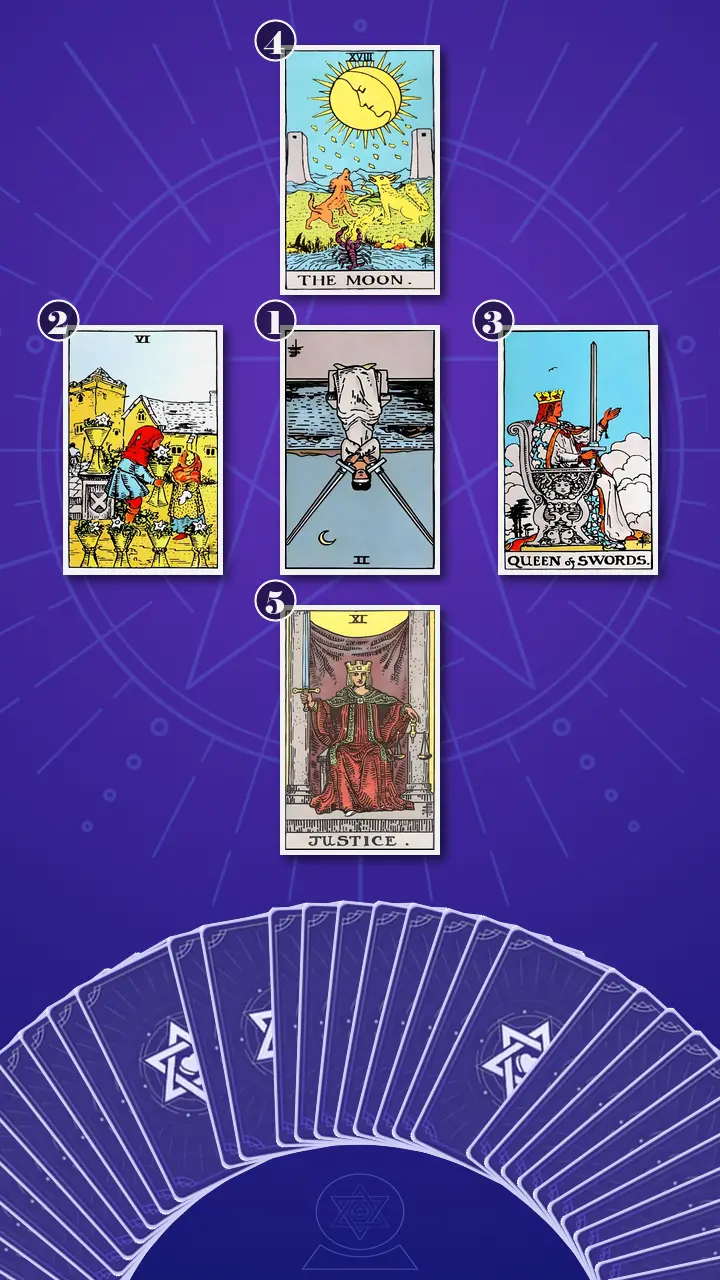
I explained the structure as I laid the cards down in a cross. The center would show the immediate knot: what the text was doing to her in real time. The left and right cards would reveal the emotional function of replying versus keeping no contact. The top card would uncover the hidden fog beneath the message. And the bottom card—the most important one in this reading—would point us toward the most self-respecting next step. Clean logic. Current symptom, pull of each path, blind spot, grounded guidance.
It looked, once arranged, exactly like what it was: a road sign at a crossroads, with one vertical line acting as the inner compass.
Reading the Road Sign
The Tab Left Open: Position 1 — Two of Swords Reversed
I turned the first card and said, “Now I’m opening the position that presents the immediate late-night decision spiral and the observable paralysis you described.”
It was the Two of Swords, reversed.
I always look at the blindfold first on this card, and then at the crossed swords over the chest. In Jordan’s life, the image translated almost too cleanly: 11:17 p.m., barefoot in the kitchen, chat open, typing “hey,” deleting it, drafting a longer careful paragraph she also doesn’t send, locking the phone, unlocking it again, leaving the conversation window there like an unresolved tab because staying suspended feels safer than choosing.
“This is blocked Air,” I told her. “Not lack of intelligence. Too much mental friction. The energy here is jammed—like having twenty-seven browser tabs open because closing any of them would mean committing to one answer.” I could see it land. She had been treating clarity like something that had to arrive before a boundary could be chosen, instead of understanding that sometimes the boundary is what creates clarity.
“If I reply, I lose,” I said gently. “If I don’t reply, I also lose. That’s the loop this card is describing.”
Jordan let out a short laugh with a bitter edge to it and shook her head. “That is… annoyingly accurate.” Her fingers drifted toward the phone, then stopped. That tiny stop mattered. I told her, “The card isn’t calling you weak. It’s showing the freeze state. The cursor blinking in the message box because suspension feels safer than consequence.”
The Soft Version of the Past: Position 2 — Six of Cups Upright
I moved to the left card. “This position reveals what replying is trying to recover, soothe, or secure emotionally in this specific dilemma.”
The card was the Six of Cups, upright.
“Replying,” I said, “is offering you familiarity more than repair.” I described the feeling in ordinary life: the text leading to old photos from a cottage weekend, a soft old playlist, the remembered version of the relationship that felt warm before it got complicated. It was less about the relationship as it exists now, and more about the relief of stepping back into a room that once felt known.
This is where I brought in one of the sound frameworks I use all the time, something I call my Melodic Mirror. “What did you play after the text came in?” I asked her.
She blinked, then looked almost embarrassed. “A playlist from last summer,” she admitted. “The really soft one.”
That told me more than the message did. Personal playlists are often emotional x-rays. They show what state the heart is trying to return to. “Exactly,” I said. “Your system reached for a familiar key before it looked for evidence. That’s Six of Cups. Warmth, tenderness, emotional memory.”
The energy here was excess Water—feeling flooding the room until familiarity started reading as safety. I said the line she most needed at that point: “Being wanted and being safe are not the same thing.”
Her eyes dropped to the card. She rubbed her thumb along the rim of her mug and went quiet in that very specific way people do when a sentence hits somewhere older than the current problem.
The Adult Note in Daylight: Position 3 — Queen of Swords Upright
I turned to the right side of the cross. “This position shows what keeping no contact protects, preserves, and requires in this dilemma.”
The card waiting there was the Queen of Swords, upright.
I loved seeing her here. “No contact,” I told Jordan, “is not punishment. It’s not coldness. In your case, it’s structure.” I translated the card into her real life: reopening the note where she had written why distance existed in the first place, letting the message remain unanswered until the midnight adrenaline spike had passed, refusing to give access before evidence. One text, in other words, not becoming a rewrite of the whole story.
The Queen’s energy was balanced Air—clear, adult, honest. Not numb. Not harsh. Just discerning. Like muting a chaotic Slack thread so you can finally read the actual brief.
For a second, I had one of those private flashes my work gives me. Years in radio taught me the difference between signal and static; some voices only become true once the hiss is stripped away. The Queen of Swords always feels like that to me: the clean channel after emotional interference.
“She can grieve and still keep standards,” I said, tapping the card’s upright sword. “That’s what no contact has been protecting. The version of you who already knew what was unsustainable.”
Jordan’s shoulders loosened a fraction. “So it wasn’t dramatic,” she said. “Setting it in the first place.”
“No,” I said. “It was intelligent.”
Then I added, because she needed it plain: “You do not owe a late-night feeling immediate access to you.”
When the Story Machine Gets Loud: Position 4 — The Moon Upright
I lifted the top card. “This position uncovers the blind spot, projection, or unmet need underneath the text that may be distorting perception.”
The card was The Moon, upright.
“There it is,” I said softly. “The story machine.”
I described it exactly as it happens in a midnight ‘miss you’ dilemma: one vague text becoming maybe they changed, maybe this is regret, maybe this is the real apology, maybe this is the one moment I can’t miss. Dark room. Phone glow. Old photos. Group chat typing bubbles. The mind leaping from two words to an entire imagined reconciliation arc because uncertainty feels harder to sit with than fantasy.
The Moon is excess, undifferentiated Water. Not intuition at its cleanest, but the emotional weather that makes instinct, memory, fear, and hope all speak at once. “This is like an algorithm auto-completing the story from incomplete data,” I told her. “And of course it serves you the version that hits the hardest.”
Then I gave her the reframe that sits at the heart of this whole kind of reading: “A midnight text is data, not destiny.”
Jordan went very still. First her breathing paused. Then her gaze unfocused, like she was replaying some private clip in her head. Then came the long exhale. “I hate this card,” she said, almost under her breath. “Because I do that. I turn two words into a whole future.”
“Yes,” I said. “And that doesn’t make you irrational. It makes you activated. But this card is asking you to separate what was actually said from what your nervous system is building around it.”
When Justice Took the Phone Out of the Night
The Scale That Holds Up in Daylight: Position 5 — Justice Upright
Before I turned the final card, I reached over and lowered the ambient music I usually keep barely audible in the room. The silence that replaced it felt deliberate. Years in sound work have made me trust silence; it lets the real line come through.
“This,” I said, “is the guidance card. The framework for the most aligned next step, and the one that restores self-trust.”
The card was Justice, upright.
I smiled the minute I saw it. “This is discernment. Proportionality. Self-respect. In practical terms, it means running the decision through daylight QA before it gets shipped.” I saw her give the tiniest involuntary smile at the UX language. Good. That meant she was still with me.
Then I slowed down. “At 11:11 p.m., the apartment is quiet, the fridge is humming, your phone is warm in your hand, and somehow two words have made the whole room feel smaller. That is usually the moment the text starts getting asked to answer everything.”
This is not about letting a midnight message outweigh your lived experience; it is about holding the scales like Justice and choosing the response that still feels true in daylight.
I let the sentence sit there for a beat.
Then I brought back my Melodic Mirror, because this was the exact moment it could do real work. “When you opened that old playlist,” I said, “your nervous system didn’t press play on the whole relationship. It cued the chorus. The sweetest part. The line that makes contact feel warm again.” I tapped Justice. “This card asks for the full track list. The verses. The bridge. The part where no contact became necessary. One text is not allowed to testify for the entire relationship.”
Jordan’s face changed fast. First her jaw set. Then a flash of resistance crossed it. “But if I stop giving the text that much meaning,” she said, sharper now, “doesn’t that mean I made it too big in the first place?”
I shook my head. “No. It means you were hit where you were still tender. That’s human. Hope is allowed in the room. It just doesn’t get the deciding vote.”
Her breath caught. Her eyes drifted away from me for a second, as if she were replaying one of those nights with the group chat open and the message box blinking. Then the emotion moved through her in a visible wave: shoulders dropping, fingers unclenching, the tiniest stunned laugh at the end of a long exhale. Relief was there, but so was that strange little dizziness that comes when the path gets clearer and responsibility comes back with it.
“Okay,” she said quietly. “So I don’t need to decode what he means before I decide what I allow.”
“Exactly,” I said. “Now, with this new perspective, was there a moment last week when this insight would have made you feel different?”
She looked at her phone again, but this time not like it owned the room. “I wouldn’t have sent the screenshot first,” she said. “I would’ve asked myself what I wanted to protect.”
That was the real turn of the reading: not from confusion to certainty, but from midnight emotional hook and second-guessing to the first solid taste of daylight self-respect and calmer conviction. From decoding to discernment.
From Facts Before Fantasy to Next Steps
Once all five cards were on the table, the story they told was clean. The Two of Swords reversed showed the freeze: a nervous system treating one text like a final exam. The Six of Cups showed why replying felt so tempting: it promised comfort, tenderness, and a shortcut out of loneliness. The Moon revealed the biggest distortion: ambiguity filling up with fantasy and fear until the message seemed larger than life. Then the Queen of Swords and Justice stepped in together and changed the whole frame. No contact was protecting clarity, not performing cruelty. Guidance wasn’t asking her to guess his motives. It was asking her to choose in a way that would still make sense tomorrow.
I told Jordan the real blind spot wasn’t that she lacked intelligence or instincts. It was that she kept outsourcing self-trust. Screenshot to friends. Old threads. Timing analysis. Punctuation analysis. As if being correct mattered more than being clear. That was the habit to interrupt.
“Your shift,” I said, “is from asking what this text means about him or about the whole relationship to asking what action protects your clarity, dignity, and actual healing. If it doesn’t hold up in daylight, it doesn’t get to run the night.”
Then I gave her the smallest next steps that could actually work in a real apartment, with a real phone, on a real lonely night:
- The Daylight RuleTonight, mute the conversation or set Do Not Disturb, and make a private rule that any decision about this text happens tomorrow between 10 a.m. and 6 p.m.—not from bed, not in the dark, not while the room feels small.If twelve hours feels impossible, start with a thirty-minute no-send window. You are not making a forever decision, just a tonight decision.
- The Access Standard NoteTomorrow morning at your kitchen table, open Notes and write two headings: “My boundary exists because…” and “Access to me requires…” Under the second, list three standards for real reconnection—accountability, a clear daytime conversation, and consistency beyond one emotional text. If you choose to reply later this week, draft only one sentence that matches those standards.Write it for yourself first. Clarity is not cruelty, and your boundary does not need the other person’s agreement to count.
- Facts Before Fantasy CheckBefore reopening the chat, make two columns: “What was actually said” and “What I am adding to it.” Keep the first brutally literal: “They texted ‘miss you’ at 11 p.m.” Then list every story your mind is generating. If your body is still spiking, put the phone in another room and do a sixty-second reset to a steady 60–70 BPM song—an Emotional BPM reset, slow enough to bring your system out of urgency and back into proportion.If the full exercise feels like too much, do the minimum version: one fact, one story, one long exhale. The goal is containment, not perfection.
Jordan looked at the list, then back at me. “So the move tonight is probably no reply,” she said.
“The move tonight,” I said carefully, “is no activated reply. Based on these cards, silence is cleaner than a midnight answer. But the deeper win is not silence for its own sake. It’s choosing from your boundary instead of from the spike.”

A Week Later, the Room Felt Bigger
Five days later, Jordan sent me a message in the middle of the afternoon. That detail alone made me smile.
“Muted the chat that night,” she wrote. “Did the note the next morning. Under facts I wrote exactly what happened. Under stories I wrote like eight things my brain added. By 10:30 a.m., the text looked way smaller. I didn’t reply.”
Then she added one more line: “I still woke up the next day thinking, what if I missed something? But I made coffee, read my note, and the feeling passed.”
That was enough. Not a cinematic ending. Not total closure. Just the first real proof. The room had gotten bigger again.
I’ve never believed tarot is at its best when it hands out verdicts. At its best, it restores scale. It gives language to what the body already knows and helps someone hear their own standard over the midnight static. Jordan didn’t become powerful because a card told her what to do. She became steadier because she stopped asking one message to decide her worth, her healing, or the fate of the entire relationship.
When two words can hijack a quiet room and make your chest argue with your standards, it makes sense to feel torn between being wanted and being safe.
So if you stopped asking what this text promises for a second, what tiny choice tonight would protect the daylight version of you—the one who has to live with the whole album, not just this one chorus—tomorrow?
Every reading at AceTarot is a Journey to connect with inner wisdom and empower next step.
Learn more about our Journey to Clarity.