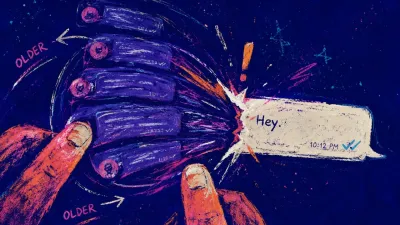
Feeling Worse After Your Ex Texts—and How to Take Real Space

Finding Clarity in the 11:18 p.m. Scroll
If you're a late-20s creative, half off Slack but still mentally online, reopening your ex's chat at 11 p.m. while searching 'should I stay friends with my ex' or 'no contact guilt,' you are already standing in the exact doorway this reading was built for.
When Maya (name changed for privacy), a 27-year-old content strategist from Toronto, sat down with me, she brought me that precise species of post-breakup boundary confusion. At 11:18 p.m. in the small bathroom off her Queen West apartment, with the white sink light humming, toothpaste mint in the air, and one sock half on, she had reread 'hope you're doing okay' so many times the phone felt warm against her palm.
'I don't want to be dramatic,' she told me. 'I just don't know if staying in touch is helping.' That was the heart of it: wanting to keep some connection after the breakup, and needing enough distance to let her own body stop reliving it.
Her longing had the shape of a hand braced against a closing subway door—part hope, part strain, no real way to keep standing there forever. Every check-in brought five minutes of relief and the rest of the night in replay mode: tight chest, stomach drop, jaw locked around meanings that were never actually said. You tell yourself this is just being mature, but your body does not experience it as neutral.
I told her, as I tell many people at this crossroads, that wanting space does not cancel the care. Then I laid my hand lightly on the deck and said, 'Let's make a map for the fog. Our whole journey today is toward clarity, not performance.'

Choosing the Compass: The Decision Cross for Staying Friends or Space
We began simply. I asked her to take one slow breath, put both feet on the floor, and hold the real question in plain language while I shuffled. Not as theatre. As focus.
For this session I used the Decision Cross · Context Edition. For anyone who has ever wondered how tarot works in a breakup question—especially one as specific as 'Should I stay friends with my ex if I still have feelings?'—this is one of the cleanest spreads I know. It does not try to predict whether the ex returns or whether a friendship will magically work later. It separates emotional fog from actual relational needs and shows what inner state is making the choice.
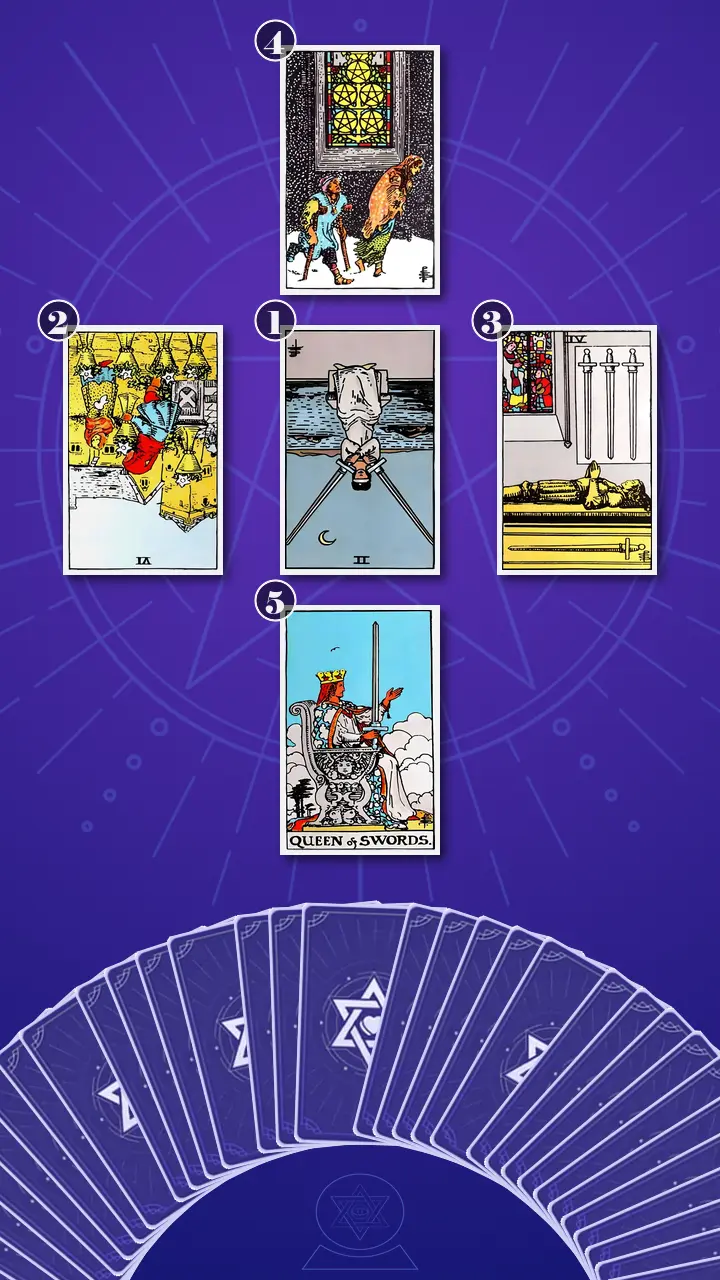
I told Maya where we were going. The center card would name the present knot. The left and right cards would show what staying friends and taking real space were really doing in her life. The upper card would reveal the hidden attachment fear shaping her judgment. The final card, at the base of the cross, would offer grounded guidance—the stance that could turn confusion into direction.
Reading the Knot That Calls Itself 'Mature'
The Draft That Never Ends
Now I turned over the card representing the current symptom cluster: post-breakup ambiguity, mixed contact, and the choice paralysis at the heart of the issue. It was the Two of Swords, reversed.
In modern life, this is the exact moment of lying in bed with your phone over your face, toggling between the honest boundary you want to send and the softer reply that keeps access open. It looks reasonable from the outside. Inside, it is like keeping an email in draft forever so nobody can answer and nothing has to become real. The reversed energy is blocked Air—thought turned into armor. Maya was not neutral. She was guarding her chest through indecision.
I asked her what happened after the last check-in text. Did she actually feel steadier, or did she spend the next two hours reopening the thread in bed? She gave a short laugh that held no amusement. 'That is almost cruelly accurate,' she said, her thumb circling the paper cup. That was the point: polite is not the same as healed.
The Comfort That Quietly Sends You Backward
Next came the card examining what staying friends is really serving right now, including the emotional benefits, costs, and blind spots of keeping access open. It was the Six of Cups, reversed.
This is the friendly coffee in a familiar neighbourhood, the warm joke, the shared reference, the little Normal People ache of tenderness after the label is gone. For an hour it feels as though you might keep the sweetness without paying the old cost. Then you ride home replaying one compliment and one pause like evidence. This reversed energy is backward-facing Water: nostalgia dressed up as friendship.
I told her the danger was not tenderness itself. It was the closed loop tenderness creates when grief is still alive. 'Is this actually friendship,' I asked, 'or is it breakup pain with better manners?' Her eyes dropped to the left-hand card and stayed there. One shoulder lifted, then fell. She already knew the answer.
The Silence That Starts Acting Like Medicine
Then I turned the card showing what taking real space would make possible for healing, nervous-system recovery, and boundary clarity. It was the Four of Swords, upright.
In ordinary life, this looks wonderfully unglamorous: muting the thread, no longer checking for story views, archiving the chat, putting the phone on Focus mode before the apartment goes blue and quiet. By day two or three, the body begins to distinguish missing someone from being repeatedly reactivated by access. This is balanced Air recovering from overload. It is not punishment. It is a recovery container.
I have seen this principle in excavation trenches as well as in relationships: if you keep walking across disturbed ground, you learn nothing except how easy it is to blur the layers. Maya's shoulders dropped a fraction when I said, 'Space is not punishment when contact keeps reopening the wound.' She took the first full breath I had seen from her all session. 'It sounds empty,' she admitted, 'but also... less exhausting.'
The Lit Window and the Fear of Being Left Outside
The fourth card revealed the hidden attachment wound and core fear underneath the decision, especially the fear of losing the bond completely. It was the Five of Pentacles, upright.
This is the moment a clean boundary text suddenly feels less like self-respect and more like volunteering to be the one left outside: the cold sidewalk, the lit condo windows, the private conviction that everyone else knows how to stay wanted while you are the one standing in the weather. The card's energy is scarcity made bodily. If distance gets translated into exclusion, then even scraps of contact start to look valuable.
Maya went very still. First her breath paused. Then her eyes unfocused, as though she were watching some Tuesday-night elevator-drop of dread replay behind them. Then came the quiet release. 'Ouch,' she said, almost under her breath. I nodded. 'Yes. Because the fear beneath this is not really friendship. It's this: if I ask for space, I become the one left.' Her jaw unclenched, but only after tightening first. Naming the wound had landed.
When the Queen of Swords Raised the Sword of Clarity
The Kindest Honest Sentence
When I turned over the final card, the room seemed to clear around it. A strip of winter light caught the edge of the card, and even the radiator had gone quiet. This was the position offering the integrating guidance and next-step stance that supports self-respect, emotional honesty, and clearer boundaries. The card was the Queen of Swords, upright.
Emotional Historiography and the Layer You Cannot Keep Disturbing
Because I am an archaeologist by training, I often use a lens I call Emotional Historiography. My mind went, as it often does, to a trench I once supervised in Cyprus: one careless boot could smear two centuries into nonsense. A site only tells the truth when its layers are allowed to remain distinct. The season of intimacy is one layer. The breakup is another. The imagined friendship that arrives too soon is a third. When those layers are churned together by late-night texting, grief starts speaking in the voice of civility, and longing dresses itself up as maturity. The Queen of Swords asks for clean stratigraphy: not coldness, but accuracy.
In modern life, she is the moment Maya stops trimming the truth into something endlessly palatable and sends one direct, respectful message that actually matches her limits. The raised sword and open hand matter together. This is clear language without punishment, honesty without character attack, care without endless access.
At 11:18 p.m., the apartment is finally quiet, and the text thread is glowing in your hand again. You tell yourself replying is the mature thing to do, even though your chest already knows you'll feel better for five minutes and worse for the rest of the night.
You do not have to keep access open to prove you cared; let the Queen of Swords raise the sword of clarity and choose the boundary that tells the truth.
Maya froze first in the smallest way: a held breath, fingers suspended against her sleeve. Then the thought moved through her face; her gaze drifted past me, as if she were suddenly back in that sink-lit bathroom with one sock half on and the mint of toothpaste in the air. The next feeling was not relief. It was anger. 'But if that's true,' she said, voice sharpening before it shook, 'then I've been keeping this half-open on purpose.' I answered as gently as I could. 'Not on purpose. In self-protection. There is a difference.' The fight went out of her shoulders all at once. She gave a wet laugh, rubbed once under one eye, and looked down at the Queen again. What arrived then was release mixed with vulnerability—the slight dizziness of someone who has been standing in a doorway for weeks and has just realised she can step fully into one room. I asked, 'Now, with this new perspective, think back to last week: was there a moment when this insight could have made you feel differently?' She nodded immediately. 'Tuesday,' she said. 'If I'd believed that, I would've put the phone down.' That was the real shift: not from caring to coldness, but from longing-driven signal-scanning and guilt to self-respecting distance and steadier calm. Wanting space does not cancel the care.
From Emotional Fog to Actionable Next Steps
By the time the whole Decision Cross tarot spread lay open, the story was remarkably coherent. At the center, indecision had been acting like armor over a bruised chest. On the left, staying friends was giving Maya warmth, familiarity, and the appearance of maturity, but it was also keeping the breakup emotionally unfinished. Above that sat the real weather system: fear of exclusion, fear of being forgotten, fear that less contact meant less worth. On the right, Four of Swords showed the medicine: cleaner distance, nervous-system quiet, and enough silence to hear what was true. The blind spot was simple and painful—she had been measuring kindness by access. The transformation was to measure kindness by truth, to shift from using friendship to soften the loss toward using boundaries to hear what she actually needed.
I also told her something important about the future. If friendship is ever going to exist later, it must pass what I call the Amphora Balance test. In the ancient world, a vessel carried well only when the weight was distributed properly. A post-breakup friendship works the same way. It cannot be one person carrying all the restraint, all the emotional cost, and all the hope-management alone.
When I suggested muting the thread, she frowned. 'But won't that look dramatic?' she asked. I shook my head. 'No. We cordon off an archaeological site not because the ground is guilty, but because something fragile should not be trampled while we learn what is there. Your healing deserves the same respect.'
- Build a 72-hour Recovery ContainerTonight, mute the chat thread, move it out of pinned conversations, and put your phone on Focus mode at a set hour for the next three nights. Before bed, write one line in Notes: 'How do I feel when there is no contact right now?'If 72 hours feels too sharp, start with 24. This is nervous-system triage, not a verdict on the relationship.
- Use Pictogram Dialogue for the boundary textDraft one plain sentence: 'I need some real space for a while, so I won't be available for texting or catch-ups right now.' Read it out loud once and delete any line that exists only to manage their reaction rather than express your limit.If sending it this week feels too big, save the final version in Notes or text it to yourself. Clear is kinder than endlessly available.
- Make a proof-free weekend planText one friend today and put one quiet-window plan in your calendar before the loneliness arrives: Sunday coffee, a walk after work, or a FaceTime before bed. Then remove one easy trigger this week—mute the ex's profile, hide mutuals' stories, or archive the chat.Choose only one trigger to remove if a full reset feels like too much. Environment design is not overreacting; it is support.

A Week Later: The Quiet Proof
A week later, Maya sent me a short message: she had used the saved script, muted the thread, and then sat alone with a flat white on Ossington, half relieved and half strangely seasick. But she slept through the night, and on Sunday she did not reopen the chat just to look.
That is what a real Journey to Clarity usually looks like in practice. Not a cinematic ending. Not instant certainty. Just the first clean evidence that the body is no longer living on notification-level alert, and that self-trust can return in small, ordinary increments.
A lot of us know this feeling: your chest tightens not only because you miss them, but because asking for space can feel like stepping outside the last warm room.
If you treated space as your recovery room instead of a verdict on your worth, what would you want it to protect in you first?