From Over-Explaining to Steady Self-Respect: A Boundary After 'Drama'

The 11:38 p.m. WhatsApp Thread (and the Tightness in Your Throat)
If you’ve ever rewritten the same text 12 times just to sound ‘calm’ after someone hit you with “you’re being dramatic,” you’re not alone in that boundary confusion.
Taylor showed up to our session the way people do when they’ve been trying to swallow something sharp for days. Twenty-eight, London, marketing brain always on. She told me she’d been standing in her flatshare kitchen at 11:38 PM—harsh extractor fan light overhead, radiator clicking like it was counting seconds, tap dripping with that maddening patience—rereading the same WhatsApp thread until her phone felt warm and slightly slick in her hand.
“I keep hovering between sending a five-paragraph explanation and… just acting normal,” she said, eyes fixed on a spot on my table like it could keep her steady. “I’m not asking for a big thing. I just want to be taken seriously. But if I say it the wrong way, they’ll make it about my tone instead of what happened.”
The hurt didn’t sound like a dramatic outburst. It sounded like a tight throat and chest, a jaw set hard enough to make your molars ache, and restless hands reaching for the phone like it might hand you an appeal letter for your own feelings.
I leaned forward a little, keeping my voice low and ordinary—no theatre, no judgment. “That loop makes a lot of sense,” I told her. “Wanting emotional validation while fearing you’ll be seen as ‘drama’ can turn a simple boundary into a whole court case. Tonight, we’re not here to win the argument. We’re here to find clarity—and to draw a map you can actually use.”
Choosing the Compass: The Celtic Cross · Context Edition
I asked Taylor to take one slow breath, not as a ritual for the universe, but as a reset for her nervous system. “Just enough to bring you back into your body,” I said. Then I shuffled—steady, practiced. Years ago, on transoceanic voyages, I learned how quickly people confess the truth of their lives when the horizon is nothing but water. Cards are like that, too: they give the mind somewhere honest to land.
“Today we’ll use a spread called the Celtic Cross · Context Edition,” I explained, placing the deck down between us.
For you reading this: I use this version when the problem isn’t only what to say, but the psychological mechanism that gets triggered the second someone dismisses you. This spread walks through a clean chain—present sting, main challenge, root fear, recent pattern, conscious aim, and then a crucial reframing: position six becomes boundary in action. That keeps the reading ethical and practical. We’re not predicting whether the other person will magically mature. We’re clarifying what you will do, consistently, to protect your dignity.
“The first card will name what’s happening in you right now,” I told Taylor. “The crossing card shows the friction that makes a boundary feel risky. And the sixth card—right here—will become your next step in real life: the boundary sentence and the behavior you’ll pair it with.”
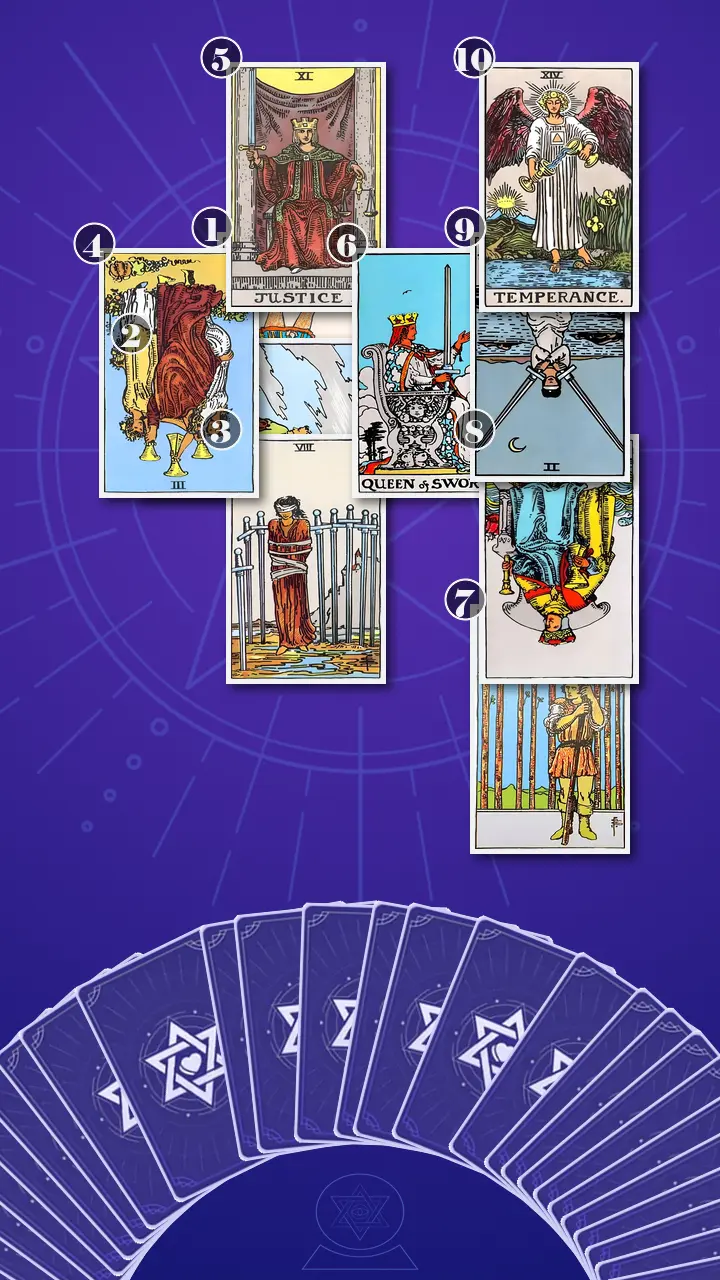
Reading the Map: Card Meanings in Context, Not in Theory
Position 1 — The moment you’re in right now
“Now we’re looking at the card that represents the moment you’re in right now: what the ‘drama’ comment is activating in you and how it shows up in real behavior,” I said as I turned it over.
Page of Cups, reversed.
“This is the exact energy of having the honest text open—‘That comment hurt’—and then deleting it and swapping in a chill version so you won’t get hit with ‘you’re being dramatic,’” I told her. “Jokes, emojis, apologetic disclaimers. Not because you don’t feel it. Because vulnerability suddenly feels unsafe.”
Reversed, the Page’s water element isn’t flowing—it’s blocked. It’s not a lack of emotion. It’s an over-awareness of how emotion might get used against you. Your inner self starts editing like it’s doing brand safety checks.
Taylor let out a short laugh that wasn’t funny. It had that bitter edge of being exposed. “That’s… too accurate. It’s almost rude,” she said, rubbing her thumb over her phone screen as if it were right there.
I nodded. “If you’re writing a courtroom brief instead of a boundary, you’re still negotiating your right to have feelings.”
Position 2 — The main challenge
“Now we’re looking at the card that represents the main challenge: the interpersonal friction or power dynamic that makes a boundary feel risky,” I said.
Five of Swords, upright.
“The conflict isn’t about the original issue anymore—it’s about who gets to define reality,” I said. “Calling your feelings ‘drama’ is a power move. It turns the conversation into a win/lose game where you’re pressured to either prove yourself calmly or walk away feeling unheard.”
In this card, Air energy is in excess—sharp, strategic, and a bit humiliating when you’re on the receiving end. It’s the vibe of a conversation becoming a performance where someone keeps grabbing the mic.
And I could practically hear it as I spoke—like the espresso machine hiss in a café, the pivot point where the topic becomes your tone. “They say something like, ‘I’m calm, you’re dramatic,’” I continued, “and your brain does that split-second scramble: replaying, drafting, over-explaining, checking when they were last online, trying to write the one message that can’t be dismissed.”
“Yeah,” Taylor said quietly. Her shoulders lifted like a reflex. “And if I push back, I feel like I’m proving their point.”
“Exactly. The Five of Swords tempts you to win back respect by debating. But boundaries aren’t for winning. They’re for ending a rigged game.”
Position 3 — The root
“Now we’re looking at the card that represents the root: the deeper belief or fear underneath the urge to over-explain or shut down,” I said.
Eight of Swords, upright.
“You know you could say, ‘Don’t call my feelings drama,’ but your brain runs every worst-case outcome—mockery, rejection, them telling others,” I told her. “So you freeze, keep the connection, and quietly accept language that makes you feel smaller. Then you tell yourself you had no choice.”
Here, the energy is blockage disguised as inevitability. The Eight of Swords looks like a trap, but the bindings are loose. Options exist. Fear just makes them feel morally unavailable.
I watched Taylor swallow, the movement tight and careful. “It’s like… I can’t find the moment,” she said. “I keep waiting for a time where I can say it perfectly.”
“The perfect time is a myth your anxiety uses to keep you quiet,” I replied, gently. “And you deserve a relationship where basic respect doesn’t require perfect delivery.”
Position 4 — The recent pattern
“Now we’re looking at the card that represents the recent pattern: what’s been happening that set the stage for this boundary moment,” I said.
Three of Cups, reversed.
“The ‘drama’ label isn’t just personal—it feels social,” I said. “You imagine the story being retold. You picture an audience. Suddenly setting a boundary feels like risking your place in the group.”
Reversed, this card’s energy becomes distorted: belonging is traded for self-silencing. It’s the smile you do automatically in a pub garden when someone says ‘drama’ as a joke, while your stomach flips because you know how easily your real feelings could become entertainment.
Taylor’s mouth tightened. “I hate that I even care,” she admitted, and then, softer: “But I do.”
“Caring isn’t the problem,” I said. “The problem is being asked to pay for belonging with your self-respect.”
Position 5 — Your conscious aim
“Now we’re looking at the card that represents your conscious aim: what you actually want this dynamic to become—your standard,” I said, and turned it over.
Justice, upright.
“This is the pivot,” I told her. “You stop asking, ‘Am I being dramatic?’ and start asking, ‘Is this respectful?’ You decide the rule: disagreement is allowed. Dismissive labels aren’t.”
Justice is balance with consequence. Its energy is clean. Not icy. Not cruel. Just structured. As a Jungian psychologist, I’ve seen how often people treat emotions like evidence in a trial—especially when they fear abandonment. Justice says: you don’t have to litigate your inner world. You can govern your life.
Taylor exhaled—small, involuntary. Her shoulders dropped by maybe half an inch, like someone loosening a strap that’s been cutting into skin all day.
“So… it’s not about making them understand,” she said.
“It’s about making the standard real,” I replied.
Position 6 — Boundary in action (Key Card)
“Now we’re turning over the card that represents boundary in action: the clearest next-step boundary statement and the behavior you’ll pair it with,” I said. The room went very still, as if even the air wanted to hear this part.
Queen of Swords, upright.
“This is direct language,” I said. “Clarity with a backbone. Not over-explaining. Not performing calm. Not punishing. Informing.”
As I spoke, an old image flickered through my mind: Venice at dusk, bridges linking narrow corridors over dark water. When I worked with travelers at sea, I used to tell them that conflict isn’t one big ocean—it’s a series of crossings. You either build a bridge that can hold weight, or you keep slipping into the canal.
“Taylor,” I said, “I want to use something I call my Bridge-Corridor Theory. In Venice, a bridge isn’t a speech. It’s a structure that decides who can cross, how, and with what load. A boundary is the bridge. The conversation is the corridor. When someone calls your feelings ‘drama,’ they’re trying to collapse the bridge so you’re stuck in their corridor—where the only way forward is explaining yourself.”
She nodded, slow. Her eyes were shiny but steady.
A boundary isn’t a debate. It’s a sentence plus a behaviour you control.
And then I gave her the sentence—the one this card always insists on when people are exhausted from proving they deserve basic care.
Stop pleading to be understood and start naming the line; let the Queen of Swords’ steady blade define what language stays in the room.
There was a pause after I said it, like a held breath.
Setup (what she was stuck in): In her mind, I could see the familiar loop: it’s 11:38 PM, the extractor fan light is too bright, and she’s about to send paragraph number six—the one that will finally make them get it, finally make her sound calm enough to be respected.
Reinforcement (what changed in her body): First, her breathing stopped for a beat—an almost-freeze. Her fingers hovered over the edge of my table as if she’d been holding a phone all night and forgot she wasn’t. Then her gaze unfocused, like she was replaying the last conversation in her head: the moment they said “drama,” the moment her throat tightened, the moment she started apologizing in her mind before she’d even spoken. Finally, something released—she drew in a shaky inhale, and on the exhale her jaw unclenched in two tiny stages, like it didn’t trust the room yet. Her shoulders lowered, but her eyes went wide with a new kind of fear.
“But if I do that,” she said, a flash of anger breaking through the hurt, “doesn’t that mean I’ve been doing it wrong this whole time? Like… I’ve been begging.”
I didn’t rush to soothe it away. “It means you were doing what you had to do to keep belonging,” I said. “And now you’re choosing a different way. That’s not failure—that’s development.”
I leaned in slightly. “Now, with this new lens—naming the line instead of pleading—think back to last week. Was there a moment where one clear sentence would’ve protected you more than the perfect explanation?”
Taylor blinked fast, then nodded once. “Monday morning. They sent a casual message like nothing happened. I replied with a thumbs-up. I felt… pathetic.”
“That’s the shift,” I told her. “From hurt and self-doubt toward grounded self-respect. Not because you feel nothing—but because you refuse to be spoken to like your feelings are entertainment.”
Position 7 — Your stance
“Now we’re looking at the card that represents your stance: the internal posture you’ll need so the boundary isn’t negotiated away,” I said.
Nine of Wands, upright.
“You’re braced,” I said plainly. “And it makes sense—you’ve been hit by minimisation before.”
This energy is protective, sometimes to the point of being over-guarded. The gift is backbone: you can hold the line when you get pushback. The risk is sounding sharper than you mean because you’re defending yourself before anything even happens.
“Boundaries are structure, not punishment,” I reminded her. “Nine of Wands is the fence that protects a garden, not a wall that locks you in.”
Position 8 — The interpersonal climate
“Now we’re looking at the card that represents the interpersonal climate: how the other person and the environment tend to respond to emotions and conflict,” I said.
King of Cups, reversed.
“They present as calm,” I said, “but the calmness functions like control. Jokes. Minimising. Subtle shaming that frames your feelings as messy. And if you get more intense to be heard, they use your intensity as proof you’re the problem.”
This is emotional energy in imbalance: a composed exterior above rough water. It doesn’t mean they’re evil. It means the environment isn’t reliably safe for tenderness—so your clarity can’t depend on their mood.
“This is why you keep trying to earn respect by being perfectly composed,” I added. “But you can’t win respect with performance. You can only insist on it with standards.”
Position 9 — Hope and fear
“Now we’re looking at the card that represents hope and fear: what you’re afraid the boundary will cost, and what you’re hoping it will protect,” I said.
Two of Swords, reversed.
“You keep waiting for the perfect moment,” I said, “checking for signs they’re in a good mood so you can avoid conflict. You rehearse five versions of the boundary, choose none, and the indecision becomes its own daily stressor.”
Here, the energy is overload. The stalemate breaks, but it breaks into mental noise—decision fatigue, doom-scrolling, opening Notes, closing Notes, telling yourself you’ll do it later.
“Clarity is kinder than endless negotiation,” I said, and Taylor’s eyes flicked up in recognition.
“I think I’m scared it’ll make me… intense,” she admitted.
“You’re not choosing intensity,” I answered. “You’re choosing not to live blindfolded.”
Position 10 — Integration outcome
“Now we’re looking at the card that represents integration outcome: what becomes possible when you keep the boundary consistent and stop arguing for your feelings’ validity,” I said.
Temperance, upright.
“This is the nervous system settling,” I told her. “It’s you becoming someone who can say ‘That’s not okay’ without spiralling—and someone who can pause a conversation without punishing.”
Temperance is balance in practice: fewer paragraphs, more steadiness. Water and Air blended—feelings expressed without pleading, clarity delivered without cruelty. Not perfect communication. Sustainable communication.
The One-Page Standard: From Proving to Informing
Here’s the story your spread told, in one line: when your feelings get dismissed (Page of Cups reversed), you get pulled into a rigged win/lose frame (Five of Swords), and an old fear tells you you have no safe options (Eight of Swords). The social anxiety of being judged—or turned into a punchline—makes you smooth it over (Three of Cups reversed). But your deeper self is trying to grow into standards and accountability (Justice), which becomes actionable the moment you adopt clean language and follow-through (Queen of Swords), held with resilient backbone (Nine of Wands), despite an environment that may prefer minimising or tone-control (King of Cups reversed). Indecision is what keeps you stuck (Two of Swords reversed). Consistency is what frees you (Temperance).
Your cognitive blind spot is thinking you need the perfect wording to be treated respectfully—like respect is something you earn through performance. That’s the trap.
Your transformation direction is the shift from proving your feelings are valid to stating the standard for how you’re willing to be spoken to.
To make this usable in real life, I offered Taylor a tool from my Venetian world: my Lace Communication Method—in Burano, lace is strong because it’s precise. Not because it’s long. A boundary sentence should be like that: short enough to hold shape, strong enough to hold weight.
- Pin the Two-Sentence ScriptIn your Notes app, write exactly two lines and screenshot them: 1) “Don’t call my feelings drama.” 2) “If it happens again, I’m ending this conversation and we can try later when it’s respectful.”If you feel the urge to add “maybe I’m overreacting,” name it: that’s the old pattern trying to keep you safe. Read the screenshot word-for-word if you freeze—you don’t have to sound perfect.
- Choose One Consistent ‘Pause’ Behavior (7-Day Test)Decide your one follow-through action: end the call, stop replying for 30 minutes, or say, “I’m going to step away now.” Use the same action every time for the next 7 days.Lower-the-bar version: if 30 minutes feels impossible, do 5. If you’ve already started arguing, you can still pause mid-thread: “I’m stepping away now.” That still counts.
- Do a 60-Second Post-Boundary Body CheckAfter you set the boundary (even imperfectly), unclench your jaw, drop your shoulders, take one slow exhale, then put your phone face down for 5 minutes—no checking, no re-drafting.This is your Temperance practice: you’re teaching your nervous system that clarity is not an emergency.

A Week Later: Ownership, Not Certainty
Six days later, Taylor messaged me. Not a paragraph. Not a panicked voice note re-recorded three times. Just a screenshot of her Notes app with the two sentences highlighted, and beneath it: “Used it. My hands were shaking, but I paused the conversation. I didn’t chase them. I slept.”
It wasn’t a rom-com ending. It was better: a small, real proof. Clear but still a little vulnerable—she told me the next morning her first thought was, “What if I’ve ruined everything?” and then she made tea anyway, like she was practicing being on her own side.
That’s the Journey to Clarity in relationships: not erasing hurt, but refusing to negotiate your right to have feelings. Not winning the frame, but stepping out of it.
When someone calls your feelings “drama,” it can hit so deep you start tightening your throat, drafting a whole defence in your head, and shrinking yourself just to keep belonging.
If you didn’t have to prove your feelings were valid, what’s the simplest standard you’d want to set for how you’re spoken to—just for this next conversation?