From Group Chat FOMO to Steady Self-Trust: One Clean Boundary Line

Finding Clarity on the TTC at 8:58 a.m.
If you’re a late-20s city person who replies to group chats like it’s a timed exam—then spends the next hour rereading your message for tone, welcome to people-pleasing FOMO.
Jordan met me on a video call from Toronto, but I could almost hear her commute in the background when she described it: 8:58 a.m. on a Monday, packed on TTC Line 1 near Bloor–Yonge. One hand on the pole, one hand on her phone. A new iMessage group chat pops up—“Girls trip planning”—and the screen glow feels too bright against the grey of the carriage. The train squeals into the station, and her chest tightens like she just got assigned homework.
“I type ‘I’m so down!!’ before the doors even open,” she told me, rubbing her thumb against the side of her phone like she could sand off the nerves. “And then I spend the whole ride thinking, what if I sounded weird?”
Her hands didn’t stop moving. They hovered, tapped, retreated, reached again—like her phone had a gravity field and her fingers were caught in its orbit. The anxiety wasn’t an abstract feeling; it was a tight band across her sternum and a restless electricity in her wrists.
I nodded, slow and steady, the way I do when I’m guiding planetarium visitors through a dark dome and I need them to trust the next step. “A group chat invite isn’t a test—your nervous system just treats it like one.”
Jordan swallowed and said the line that carried the whole contradiction in it: “I don’t want to be the difficult one. But I’m exhausted from managing the vibe.”
“Okay,” I said. “Let’s draw you a map through this. Not to make you care less—just to help you find clarity, so connection doesn’t cost you your nervous system.”

Choosing the Compass: A Celtic Cross for Group-Chat FOMO
I asked Jordan to take one breath with me—nothing mystical, just a clean handoff from scrolling brain to present-moment brain. On my side of the screen, I was sitting in a quiet staff room at the Tokyo planetarium after the last show, with a faint mechanical hum in the building that always reminds me of distant, steady machinery in space.
As she focused on the question—Why does every group chat invite trigger people-pleasing, and what boundary actually works?—I shuffled slowly. The point of the ritual isn’t magic; it’s attention. It’s a way of letting the mind stop sprinting long enough to see what it’s doing.
“Today we’ll use the Celtic Cross,” I said. “It’s a classic spread, but it’s perfect when you’re dealing with a repeatable reflex: a clear trigger on the surface, and something deeper underneath.”
For anyone reading who’s wondered how tarot works in a practical way: a spread like this doesn’t predict whether your friends will be mad. It maps the mechanism—what happens in your body, what story you tell yourself, what you do next, and what that costs you—so you can interrupt it with a real next step.
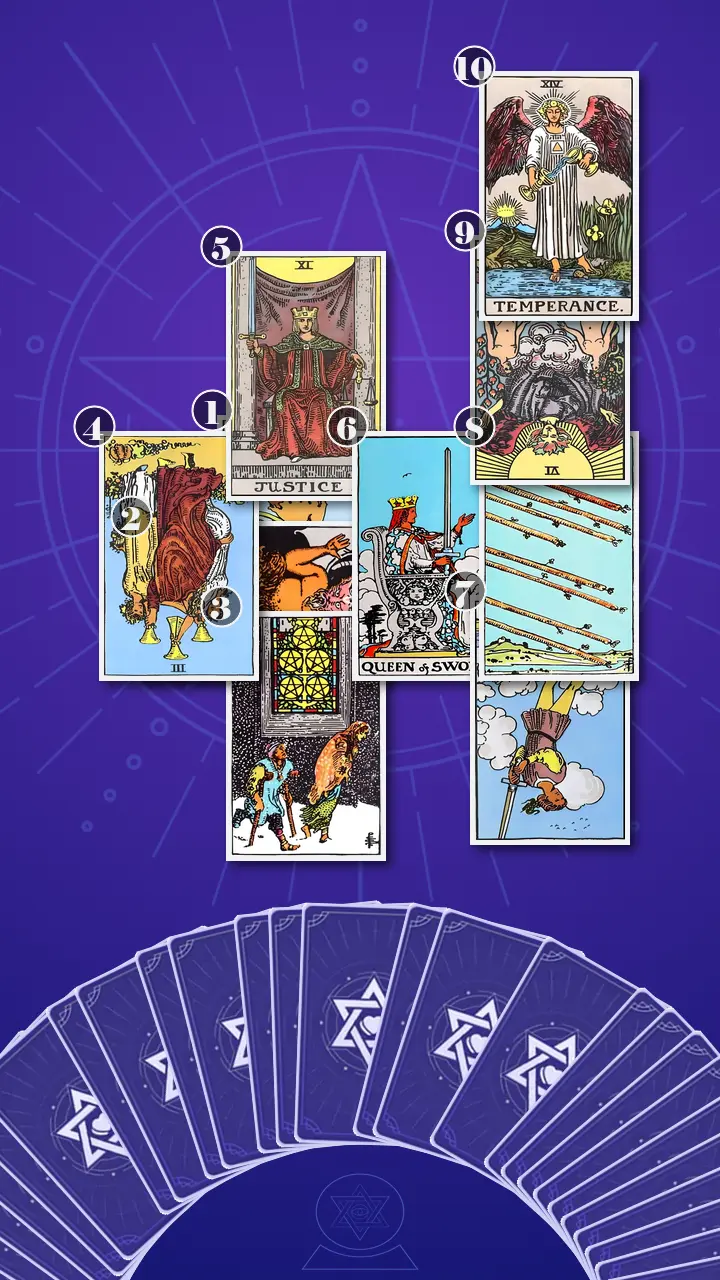
“The first two cards show the observable moment: the instant your phone buzzes and you go ‘auto-yes,’” I explained. “Card three shows the deeper driver under the reflex. And in the near-future position, we look for the turning point—what kind of boundary becomes doable in real life, in iMessage/WhatsApp speed.”
Reading the Cross: The Reflex, the Chain, the Cold Window
Position 1: Your current pattern the moment the invite lands
“Now flipped over,” I said, “is the card representing your current pattern in the moment a group chat invite lands—the observable reflex.”
Two of Pentacles, reversed.
I pointed to the image: the juggling figure, the infinity loop, the rough sea behind him. “This is like getting added to a new iMessage or WhatsApp group chat during a work break and replying ‘I’m in!’ while half-reading—then immediately juggling Google Calendar, commute time, work deadlines, and dread because you committed before you actually decided.”
Reversed, this energy isn’t balance; it’s overload—too many spinning plates, and the body trying to compensate by spinning faster. “It’s not that you can’t manage your life,” I told her. “It’s that your first move is juggling, not choosing.”
Jordan let out a short laugh that had no joy in it. “That’s… painfully accurate,” she said. “Like, I hate that it’s accurate.”
“I know,” I said softly. “And the stormy water in the background matters. Real life—sleep, work, the TTC, your actual capacity—doesn’t calm down just because the chat is moving fast.”
Position 2: What blocks you from a clean boundary
“Now we’re looking at what blocks you from a clean boundary—the main entanglement or pressure.”
The Devil, upright.
“Here’s the trap,” I said, keeping my voice plain because this card can feel dramatic if you let it. “A tag in the group chat hits like a hook. You feel socially obligated to be the easy, available one. You answer fast to avoid discomfort, and then you stay online monitoring read receipts and reactions—like approval is required for access to the friend group, even though the ‘chain’ is mostly in your head.”
I let the image do its work: the loose chains, the figures who could step away but don’t. “The Devil is a compulsion loop,” I continued. “And I want to name it in three lines, because that’s how it runs.”
“One: If I hesitate, I’ll be deprioritized. Two: you comply instantly—cheerful yes, extra friendliness. Three: you get a tiny hit of relief… and then you start monitoring, like you’re waiting for a verdict.”
Jordan winced and nodded, once, like the truth landed in her ribs. “It feels like I’m on-call for a job I never applied for,” she said. “And I’m refreshing like it’s… I don’t know… a stock price?”
“Exactly,” I said. “Except the stock is your social safety.”
Position 3: The deeper driver under the reflex
“Now flipped,” I said, “is the card representing the deeper driver under the reflex—the core fear that fuels the urge to please.”
Five of Pentacles, upright.
“This is the ‘outside the warm window’ feeling,” I told her. “Watching plans form in real time—inside jokes, quick confirmations—and your body reacts like you’re about to be left outside in the cold. Even silence feels risky, so you try to buy belonging with instant enthusiasm and availability.”
In this card, the cold is physical. “It’s the nervous system saying: get back inside, now. Not because anyone has actually locked the door—but because your body learned that exclusion is dangerous.”
Jordan’s eyes went unfocused for a second, like she was replaying a Sunday night in bed, heat humming, phone warm in her palm, refreshing twice. Her shoulders rose, then dropped a millimeter. “So it’s not… just me being dramatic,” she said.
“No,” I said. “It’s a learned alarm.”
Position 4: What recently shaped this sensitivity
“Now we’re looking at what recently shaped this sensitivity—the group dynamics that trained your nervous system.”
Three of Cups, reversed.
“Recent group dynamics have trained you to read the room constantly,” I said. “Who’s closest, who reacts fastest, who gets the most laughs. A playful thread feels like coded judgment, so you over-contribute—logistics, extra friendliness—to secure your spot, then feel small when the vibe shifts without you.”
Reversed, the celebratory circle becomes an invisible measuring stick: am I in the circle or orbiting it? I watched Jordan’s mouth press into a line. She didn’t argue—she recognized it.
Position 5: What you think you should do (your conscious ideal)
“Now we flip the card for what you think you should do—your conscious ideal of the ‘right’ way to handle it.”
Justice, upright.
“This is you drafting a legally-defensible no,” I said gently. “You start writing a long apology, then stop and think: what’s actually fair here? Justice is you choosing accuracy—matching your words to your real time, energy, and budget—without putting yourself on trial.”
I saw the first loosening in her face. Not relief exactly—more like permission. She exhaled through her nose, small and surprised. “Oh,” she said. “I’m allowed to be reasonable.”
My own mind flashed to celestial mechanics—how planets don’t ‘owe’ speed to anything. They keep their orbit by obeying structure, not mood. Justice is structure. “Fair means your words match your reality,” I added. “Not the chat’s velocity.”
When the Queen of Swords Spoke
Position 6: The next step energy available to you
I slowed down before turning the next card. “We’re flipping what I consider the turning point,” I said. “The next step energy available to you—how boundary-setting can begin to feel doable.”
Queen of Swords, upright.
“This is the boundary style,” I said. “One calm sentence that names your capacity—‘I’m not free this weekend, but hope it’s fun’—and then you close the app instead of staying online to manage everyone’s reaction. Firm, human, not a negotiation.”
I saw Jordan brace anyway. Her chin lifted a fraction, like she was preparing for impact. This was the moment she always tried to skip: the micro-silence after you say the truth.
And here is where I used my own tool—something I’ve taught anxious visitors under the planetarium dome when the stars make them feel small in the wrong way. “Before we go further,” I said, “I want to give you a timing practice I use called Pulsar Breathing.”
“Pulsars are stars that send out steady pulses—like cosmic metronomes. Your phone pings try to set your rhythm. Pulsar Breathing is you taking it back.” I held my hand up, palm open, like the Queen’s inviting hand. “When the invite lands, do four steady pulses: inhale for four counts, exhale for four. Four times. Sixteen seconds. That’s enough to create a deliberate pause.”
Jordan blinked. Then she laughed, nervous. “Sixteen seconds feels… doable,” she said, like she’d been offered a smaller cliff.
She was still stuck in the old mental loop, though—the one that says the right boundary is the one that prevents anyone from having a feeling.
Stop auditioning for approval; speak one clean truth like the Queen of Swords holding her upright blade.
There was a brief hush on the call—like the room itself leaned in.
Jordan’s reaction came in layers, fast but distinct: first a tiny freeze in her breath, her lips parting without sound. Then her eyes shifted away from the camera, as if she was watching herself type those long paragraphs in her Notes app. Then her shoulders dropped—two centimeters, not dramatic, but real—and her hands finally stopped moving.
“But if I’m that direct…” she started, and I watched the old anger flash up behind the fear. Her brows pulled together. “Doesn’t that mean I’ve been doing it wrong this whole time?”
“No,” I said immediately. “It means you’ve been doing what worked for survival. The Queen of Swords isn’t here to shame you. She’s here to update the method.”
I let her sit with it, and then I gave her the line that makes this card operational, not aspirational: “A boundary works when it’s clear, brief, and not negotiated in advance to manage everyone’s reaction.”
Jordan swallowed again, but this time it wasn’t panic—it was recognition. She nodded, slower. “So the discomfort is… not controlling how it lands.”
“Yes,” I said. “And that discomfort is the bridge from your starting state—replying before you decide and then trying to control the social outcome—to your desired state: clarity, kindness, and self-trust. This is you moving from hypervigilant scanning to grounded communication.”
I asked her, “Now, with this lens—one clean truth—can you think of a moment last week when you could’ve used it?”
Jordan looked down, then back up. “Friday drinks,” she said. “I wrote a paragraph. I could’ve just said… ‘I can’t this week. Have fun.’ And lived.” Her voice cracked on the last word, half-laugh, half-grief.
Position 7: How you see yourself in the dynamic
We returned to the staff—the ladder portion of the Celtic Cross—because insight has to survive the environment.
“Now we’re looking at how you see yourself in the dynamic—the identity role you play in groups.”
Page of Swords, reversed.
“This is keeping the chat open in the background like it’s live commentary on your likability,” I said. “Refreshing, rereading, scanning for tone, drafting follow-ups to fix imagined subtext.”
I offered her a simple sorting tool, because Air energy needs structure: “Facts: what they asked. Truth: what you can do. Stories: everything else.”
Jordan’s eyes softened with that particular kind of embarrassment that’s also relief. “I do live A/B testing on my personality,” she admitted. “In real time.”
“That’s the Page reversed,” I said. “Same element as the Queen—Air—but jittery instead of grounded.”
Position 8: The social environment that amplifies the reflex
“Now flipped is the social environment and messaging pace that amplifies the reflex.”
Eight of Wands, upright.
“This is group-chat speed,” I said. “Twenty-five messages in ten minutes. Plans changing live. The conversation racing ahead. The pace itself pressures you into quick replies—like if you don’t answer now, you’ll miss your chance to belong.”
“So it’s not just my personality,” Jordan said. “It’s the medium.”
“Exactly,” I replied. “Speed compresses choice. A pause expands it.”
Position 9: What you secretly hope for and fear at the same time
“Now we look at what you secretly hope for and fear at the same time—belonging versus rejection.”
The Lovers, reversed.
“You want genuine closeness,” I said, “but you fear honesty will cost you inclusion—so you choose harmony over alignment. You say yes to match the vibe, then feel weirdly lonely afterward because your real limits never got to exist in the relationship.”
Jordan’s gaze dropped to her lap. “I can’t tell if I’m being kind or just scared,” she whispered.
“That’s the exact question,” I said. “And it’s not a moral test. It’s a values check.”
Position 10: The integration lesson if you practice the shift
“Last card,” I said. “This represents the integration lesson—what changes if you practice the shift.”
Temperance, upright.
Even without the missing-perfect-life fantasy, this card is gorgeous in its realism. “Temperance is moderation,” I told her. “It’s staying in the chat, responding when you’re actually available, and letting friendships build over time instead of through constant instant replies. Connection as a steady pour, not an all-or-nothing dump.”
Jordan nodded, and the nod looked less like agreement and more like relief settling into her bones. “So I don’t have to disappear to be safe,” she said. “I just have to… stop performing availability.”
“Yes,” I said, and I made sure she heard it clearly: “You can stay connected without making your availability the price of admission.”
The Temperance Rhythm: Actionable Advice for Your Next 48 Hours
I pulled the whole story together for her, the way I’d narrate a constellation: not separate stars, but a pattern you can actually navigate by.
“Here’s the chain,” I said. “Your nervous system gets the ping and goes straight into the Two of Pentacles reversed: juggling, committing before deciding. The Devil crosses it: you treat approval like survival, so the juggling feels non-optional. Underneath is the Five of Pentacles—fear of being outside the warm window. You’ve had some Three of Cups reversed energy lately—subtle social uncertainty—so your system is on high alert. Justice is your conscious wish to be fair. The Queen of Swords is the antidote: one clean sentence. And Temperance is what comes after: a rhythm you can sustain.”
“The blind spot,” I added, “is thinking your boundary has to pre-handle everyone’s feelings. That’s why you over-explain. The transformation direction is simpler: shift from auto-yes to a deliberate pause, then name one clean boundary sentence that matches your real capacity.”
I kept the next steps small on purpose—because this isn’t about becoming fearless overnight. It’s about giving your nervous system new proof.
- The 20-Minute Pause RuleWhen a new group chat invite or tag lands, start a timer and wait 20 minutes before replying. Use that time to do four rounds of Pulsar Breathing (inhale 4, exhale 4) so you’re not answering from urgency.If 20 minutes feels impossible, do a 5-minute version first. Practice beats perfection.
- The 30-Second Capacity CheckBefore you type anything, open your calendar and scan the next 48 hours. Decide yes/no/maybe based on reality (work deadlines, sleep, commute), not vibe.Say out loud: “Accuracy is kindness.” It helps your brain stop treating this like a courtroom.
- One Clean Boundary Line + Close the AppWrite one reusable line in Notes and copy/paste it when needed (e.g., “I’m not free this weekend, but hope it’s fun.” / “Can’t commit right now—I’ll confirm by tomorrow at noon.”). Send it, then close the app.One sentence is still a full answer. If you need warmth, add one warm clause—not five.
- The 30-Minute No-Checking TimerAfter you send your boundary, set a 30-minute timer and do one offline task (shower, dishes, a short walk). If you need a sensory anchor, let a steady background sound (even a washing machine) become “cosmic meditation”—a reminder that not everything needs your immediate response.If you relapse and check, don’t punish yourself. Restart the timer. We’re building rhythm, not proving worth.
Jordan stared at the list like it was permission in bullet points. “I can do that,” she said, cautious but real. “I can do sixteen seconds. I can do one sentence.”

A Week Later: Ownership, Not Certainty
Eight days later, I got a message from Jordan: “Got added to a new chat. I waited five minutes. Checked my calendar. Sent: ‘I’m not free Friday, but hope it’s fun.’ Then I put my phone face down and made pasta.”
She added, “I still thought about it after. I won’t lie. But I didn’t spiral. I didn’t write the apology essay.”
In my head, I saw Temperance—not a dramatic transformation, just a steadier pour. She didn’t leave her friends. She didn’t become a different person. She changed the tempo.
When a simple group chat invite makes your chest tighten and your thumbs race, it’s not because you’re “too sensitive”—it’s because part of you learned that staying included means staying easy, even when you’re running out of yourself.
If you didn’t have to buy belonging with instant availability, what would one small, honest sentence sound like the next time the invite lands?