They Only Text for a Plus-One? Start by Reading the Pattern

The 6:14 p.m. Plus-One Buzz
If your group chat has seen the screenshots, your Notes app has seen the drafts, and you still worry that asking for clarity will make you seem like too much, I know exactly what kind of dating spiral you’re in.
Maya (name changed for privacy) brought me a question I hear constantly from late-20s city daters: they only text when they need a plus-one—what’s my next move? She told me about 6:14 p.m. on a Friday, southbound on TTC Line 1 between Bloor-Yonge and Union, wedged between winter coats and tote bags when her phone buzzed warm in her palm. The brakes shrieked, the fluorescent lights hummed, and the message on her screen was another same-day ask: “Want to be my plus-one tonight?”
“I hate that one text can change my whole mood,” she said. Part of her felt chosen for one bright second. Part of her was already scrolling up the thread, counting initiations, trying to decide whether this was genuine interest or simple convenience. Her chest tightened, her stomach dropped, and the hurt in her had the feeling of walking into a glass door you thought was open—quick hope, then impact.
I nodded. “A text can feel flattering and still be about convenience,” I told her. “You are not overreacting. You’re trying to make sense of a pattern that lands in your body before your mind can explain it. So let’s not moralize it, and let’s not romanticize it either. Let’s draw a map through the fog and find the clarity that protects you.”

Choosing the Compass: A Five-Card Relationship Spread for Mixed Signals
I asked her to put her phone face down, take one slow breath, and keep the question simple: not whether they secretly liked her, but what this dynamic actually was and what her next move needed to protect. Then I shuffled. I have never cared much for theatrical ritual; I care about focus. A good spread works the way a clean canal map does—it shows where the current is already going.
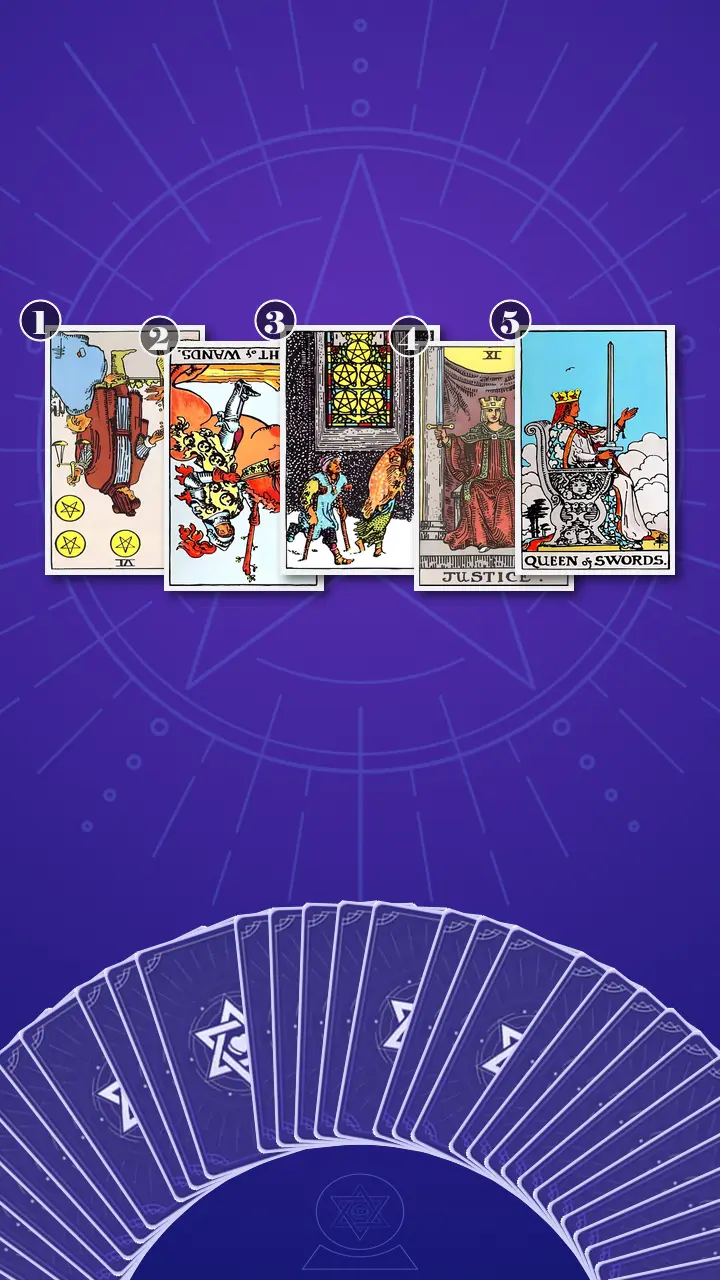
For this session, I used my Relationship Spread · Context Edition, a five-card relationship spread I trust for mixed signals, breadcrumbing, reciprocity, and the next boundary move. Five positions are enough here. This was not a sprawling fate question; it was a concentrated relationship-interaction problem with a boundary at its core. I wanted one card for the visible pattern, one for the other person’s engagement style, one for the deeper wound the pattern activates, one for the truth that cuts through overthinking, and one for the healthiest response from Maya’s side. That is how tarot works best for me in cases like this—not as mystical fog, but as a structure that turns vague pain into visible pattern.
I laid the cards in a straight horizontal line, left to right, like a sentence. The first card would show what was actually happening in the connection when hope stopped filling in the blanks. The center of the line would show what the pattern was pressing on inside her. And the fourth and fifth cards—my clarity-and-action cluster—would tell us what verdict to trust and what to do with it.
Reading the Left Side of the Line
The Thread That Only Wakes Up When They Need Something
I turned over the card representing the observable symptom: being contacted mainly when they need a plus-one and the one-sided rhythm of initiation. It was the Six of Pentacles, reversed.
I pointed straight to the scales. “This is unequal exchange,” I said. “In real life, it looks exactly like the chat thread you described—contact reappearing when they need company, an audience, or easy company for the night, then fading once the event is over. The invisible math of the thread is the whole card: who initiates, who adapts, who gets access on whose terms.”
Reversed, the energy is blocked and tilted. The giving is not mutual; it is measured out on someone else’s timing. It is like a building buzzer system where somebody expects easy access without ever asking what works for the person inside. So the question is not simply whether they texted. The question is whether she is receiving consistent care or occasional inclusion.
Maya let out one short laugh that held no real amusement. “Wow,” she said, rubbing her thumb over the rim of her mug. “That is so accurate it’s almost rude.” I smiled, because sometimes the first useful moment in a reading is that uncomfortable feeling of being precisely clocked. Her shoulders did not relax yet, but she gave me the slow nod I was looking for.
Heat Without Staying Power
The next card represented the other person’s engagement style—the impulse, convenience, or inconsistency behind the outreach. It was the Knight of Wands, reversed.
“This is the burst,” I told her. “The sudden enthusiastic text, fast planning energy, the night that feels electric, and then the cool-off once the logistics are done. The text arrives hot, the plan feels exciting, and then the connection cools off as soon as the practical need is over.”
Upright, the Knight can pursue. Reversed, that fire becomes erratic and self-focused. The horse has power, but no steadiness. So I did not read this as a villain card. I read it as volatility. Someone can genuinely enjoy her company and still only know how to reach out when they want immediate excitement, social coverage, or convenience in that exact moment. That still leaves her holding the emotional bill the next morning.
Her jaw shifted slightly to one side, the way it does when somebody recognizes the pattern before they want to admit it. “Yes,” she said quietly. “It’s always intense right before, and weirdly empty right after.” I told her that intensity and consistency are not twins, no matter how often modern dating tries to cast them that way.
The Window That Looks Warm From the Street
Being Invited Is Not the Same as Being Considered
Then I turned over the card that revealed what this pattern triggers in her—the belonging wound beneath the dating question. It was the Five of Pentacles, upright.
I always go still for this card. As a Jungian psychologist, I have a habit I call Stained Glass Decoding, and this image holds it perfectly: a lit window, cold figures outside, color and promise visible through glass. Sparse attention can make the psyche project a whole cathedral onto one illuminated pane. You can see warmth. You cannot touch it. That is why being invited is not the same as being considered.
In Maya’s life, this looked like saying yes partly because staying home felt more painful than facing the possibility that she was only being wanted conditionally. It looked like the 11:32 p.m. bathroom check after the event, bass thudding through the wall, hand soap sharp in the air, and that awful moment when no follow-up came. The card told me the real pain was not only the plus-one text. It was the older ache of being near connection without feeling securely inside it.
“I know this shouldn’t matter this much,” she whispered.
“I wouldn’t call it shouldn’t,” I said. “I’d call it a trigger with history.” Her fingers tightened, then loosened around the mug. Her gaze went briefly unfocused, as if replaying a dozen silent threads at once. When she looked back at me, her eyes had that bright edge people get when relief and shame arrive together. Naming the deeper hurt did not fix it. But it stopped her from pretending the question was only about texting etiquette.
When Justice Reset the Scales
The Verdict That Ends Breadcrumbing Math
The room changed when I reached for the fourth card. Outside my window, a thin strip of late light fell across the table in a straight line, clean as a blade. This position identifies the key recalibration: the fairness standard and inner verdict that can interrupt overthinking. I turned the card over. Justice, upright.
Before I said anything else, I reminded Maya of the moment on the TTC: the phone lighting up after four quiet days, that tiny ridiculous shot of hope before she even unlocked it, the tight chest right behind it. That is the moment I listen for in mixed-signal readings. Usually it is not proof that someone is too sensitive. It is proof that the body already knows the pattern and is bracing before the mind begins its courtroom drama.
Stop calling unequal effort potential; put this connection on Justice’s scales and let facts, not sporadic texts, set your boundary.
I let the sentence sit between us. Then I added, softer, “The pattern matters more than the possibility. If reciprocity is missing, the text is information, not proof you need to earn your place.”
“You work in marketing,” I said. “If a campaign gave you one random spike and no repeat behavior, you wouldn’t call it strong performance. You’d look at the analytics. This connection deserves the same honesty.” Justice always brings me back to structure. On cruise decks years ago, before any ship pulled away, somebody checked load distribution because vibes do not keep a vessel balanced. Seeing this card, I felt the same certainty. So I gave Maya the framework I use from my Venetian life: Bridge-Corridor Theory. “A real connection behaves like a bridge,” I said. “It is built for movement both ways. It can hold weight, return traffic, and actual meeting. A convenience dynamic behaves like a corridor. One person passes through when it suits them. This thread has been acting like a corridor, and you have been trying to decorate it into a bridge.”
She froze first—breath held, fingers suspended above the table. Then her eyes slipped slightly out of focus, as if the last five invites were replaying in brutal high definition. When the feeling landed, it did not come out as relief. She looked up at me, almost angry. “But if I judge it by that,” she said, voice tight, “doesn’t that mean I already know the answer?”
“It means you already know the pattern,” I said. “And that is different.” Her face softened by degrees: forehead loosening, jaw unclenching, shoulders dropping one notch and then another. She took one long breath that sounded shaky at the end, like her body was setting down something heavy and finding empty space underneath it. I could see the second reaction arrive right after the release—the strange little dizziness that comes when clarity removes a fantasy she was still leaning on.
I asked her, “Now, with this lens, can you think of one moment last week when the pattern would have told you more than the text itself?” She laughed once, this time from deeper in the chest. “Friday,” she said. “Immediately. If I had looked at the last three interactions instead of that one notification, I would’ve known exactly what it was.”
That was the hinge of the whole reading: not from hope to cynicism, but from hurt hyper-analysis around sporadic texts to calmer, behavior-based clarity. From waiting by the side door to deciding who gets front-door access.
One Clean Sentence, Not a Whole Emotional Case File
The Queen Who Keeps the Front Door
The final card showed the healthiest direction from her side—the clear boundary or reply style that honors reciprocity without chasing. It was the Queen of Swords, upright.
“This is not the card of punishment,” I said. “It’s the card of clean language.” In everyday life, it looks like drafting one clear reply in the Notes app, not a paragraph, not a speech, not a fake-casual message that leaves the nervous system doing overtime. The Queen’s open hand and upright sword say the same thing together: she can be receptive without being vague. She can be warm without donating access to inconsistency.
Here the energy is balanced air—discernment working properly. Not excess coldness. Not blocked speech. Just accuracy. Clarity is not doing too much; it is how she stops donating access. I told Maya that if reciprocity disappears when she names her standard, the reciprocity was never there.
She exhaled, and for the first time since the session began, I saw a visible drop in tension around her mouth. Then the practical fear surfaced. “Okay,” she said, “but I don’t know if I can even do the 30-minute pause. The second I see the notification, I spiral and just want the anxiety over with.”
“Then we make the first version smaller,” I said. “Ten minutes. Phone face down. One saved reply. This is where I use my Lace Communication Method—precision without overexplaining. We are not writing a legal brief. We are writing one sentence that lets you keep yourself.”
I offered her two examples and had her say them aloud until one felt steady in her body: “I am not really available for last-minute plus-one plans, but if you want to make an actual plan earlier, let me know.” Or the shorter version: “Not available tonight. If you want to plan ahead another time, I am open.” She repeated the second one, and the corners of her shoulders stopped trying to climb toward her ears.
From Pattern to Reply: Your Next 48 Hours
When I pulled the whole line together, the story was clean. This is exactly why I trust this five-card Relationship Spread · Context Edition for mixed signals: it moves from symptom to wound to boundary without letting wishful thinking hijack the map. The first two cards showed a relationship economy gone uneven—blocked earth and distorted fire, unequal access refreshed by bursts of exciting but unstable attention. The third card showed why that pattern hits so hard: it presses on the old fear of being useful without being securely wanted. Then Justice and the Queen of Swords formed the stabilizing spine of the spread—perception aligned with language, evidence aligned with boundary.
The blind spot was not that Maya was too intense for casual dating. It was that she had been confusing adaptability with self-respect, and decoding intermittent attention as possibility instead of evaluating repeated behavior as data. Her transformation direction was simple and difficult at the same time: stop donating premium access to low-effort outreach, and let reciprocity—not scarcity—decide the next move.
I translated that into a version of my Gondola Balance Technique small enough to use in a real Toronto workweek. If one side of the boat is carrying all the initiation, flexibility, and emotional interpretation, it does not matter how pretty the ride looks; the body already knows the load is off. So I gave her three concrete next steps.
- Build a Reciprocity LogTonight in your Notes app, write the last five interactions with three facts only: who initiated, how much notice they gave, and how you felt after the hang. No theories, no decoding, just data.If five feels annoying, do the last three. You are already analyzing; this simply makes the analysis cleaner and less self-punishing.
- Use the 30-Minute Reply PauseBefore answering any same-day invite this week, wait 30 minutes—10 if that is the honest starter version—read the log once, and ask, “Would this still feel good if I stopped trying to turn it into potential?”Put your phone on Focus, walk to the kettle, or wash one dish. You do not owe instant access just because a text arrived.
- Save a One-Line Boundary ReplyChoose one clean sentence in a calm window, not while activated. Either: “I am not really available for last-minute plus-one plans, but if you want to make an actual plan earlier, let me know.” Or: “Not available tonight. If you want to plan ahead another time, I am open.”Do not pad it with a compensating paragraph. One clear line is enough; the response you get will be useful information.

A Week Later, the Side Door Stayed Closed
A week later, Maya sent me a message. Another day-of invite had come in. This time she did not send a screenshot captioned “be honest, am I clowning?” before deciding. She opened her Notes app, looked at her log, waited twelve minutes, and sent the shorter reply.
Their answer was polite and thin. No plan for later followed. It stung, but it did not scramble her. She made dinner with a friend instead, and afterward she sat alone in a west-end coffee shop for twenty quiet minutes—still a little sad, still slightly shaky, and noticeably more inside her own life.
That is what a real Journey to Clarity usually looks like when I witness it. Not fireworks. Not instant closure. Just the first clean proof that self-respect can be steadier than hope spikes, and that calm clarity is built by small acts of accurate response.
If tonight a tiny text still makes your whole body brace because it might finally mean you are chosen, I want to say this gently: when every small text feels like it might finally mean you are chosen, it is hard to admit how much your body has learned to brace for being wanted only when you are useful. Noticing that brace is already the beginning of clarity, not a failure of chill.
If you let the pattern be the loudest thing in the room for one minute, what kind of access would your next reply protect—the easy side door, or the bridge that asks someone to meet you halfway?