Praise Feels Like Pressure: A Tarot Case for Impostor Syndrome

Finding Clarity in the 11:52 p.m. Scroll
If you’re a junior marketing person in Toronto who gets a “proud of you” text and immediately feels your stomach drop like you’re about to be audited, this is for you.
Jordan (name changed for privacy) came into my café on College Street with that specific kind of tired you can’t fix with sleep. The espresso machine hissed like it was gossiping; outside, the streetcar rumbled past in slow waves. She wrapped both hands around her cup as if the heat could keep her from floating away.
“It was 11:52 PM,” she said. “Tuesday. Radiator clicking. I was under the blue phone glow, screen brightness turned down… and the text popped up. ‘Proud of you.’”
She swallowed hard, like the memory had teeth. “And my throat just… locked. My stomach dropped. Then I opened Notes and started rewriting a reply. Like I had to make ‘thank you’ smaller. Safer.”
In her words, I could hear the real question underneath the surface one: wanting to be seen and supported—and fearing that being seen will expose you as undeserving. Shame does that. It doesn’t shout. It tightens your jaw, pulls your shoulders up toward your ears, and convinces you that warmth is suspicious.
I leaned in, gentle but direct. “We’re not here to judge whether you ‘should’ feel grateful,” I told her. “We’re here to understand why your body treats praise like a threat—so we can find clarity, not more pressure.”

Choosing the Compass: The Four-Layer Insight Ladder Spread
I asked Jordan to take one slow breath in through her nose—like she was smelling the coffee before she drank it—and to hold the exact moment of that text in her mind. Not as a mystical ritual. As a focus shift: from spiraling to observing.
“Today, we’ll use a spread I call the Four-Layer Insight Ladder · Context Edition,” I said, laying six cards in a straight vertical line, like rungs descending into a basement and back up with a flashlight.
For you reading this: this is how tarot works at its most practical. We’re not predicting what the other person “really meant.” We’re mapping an inner pattern—symptom → trigger → root fear → repeating mechanism → medicine → grounded next step. A six-position ladder is the smallest structure that still gives actionable advice without turning your life into a courtroom.
I pointed to the rungs we’d pay closest attention to: the first card (the immediate spiral moment), the middle cards (the root fear and the loop that keeps repeating), and the “medicine” card (the pivot from feeling stuck to finding clarity).
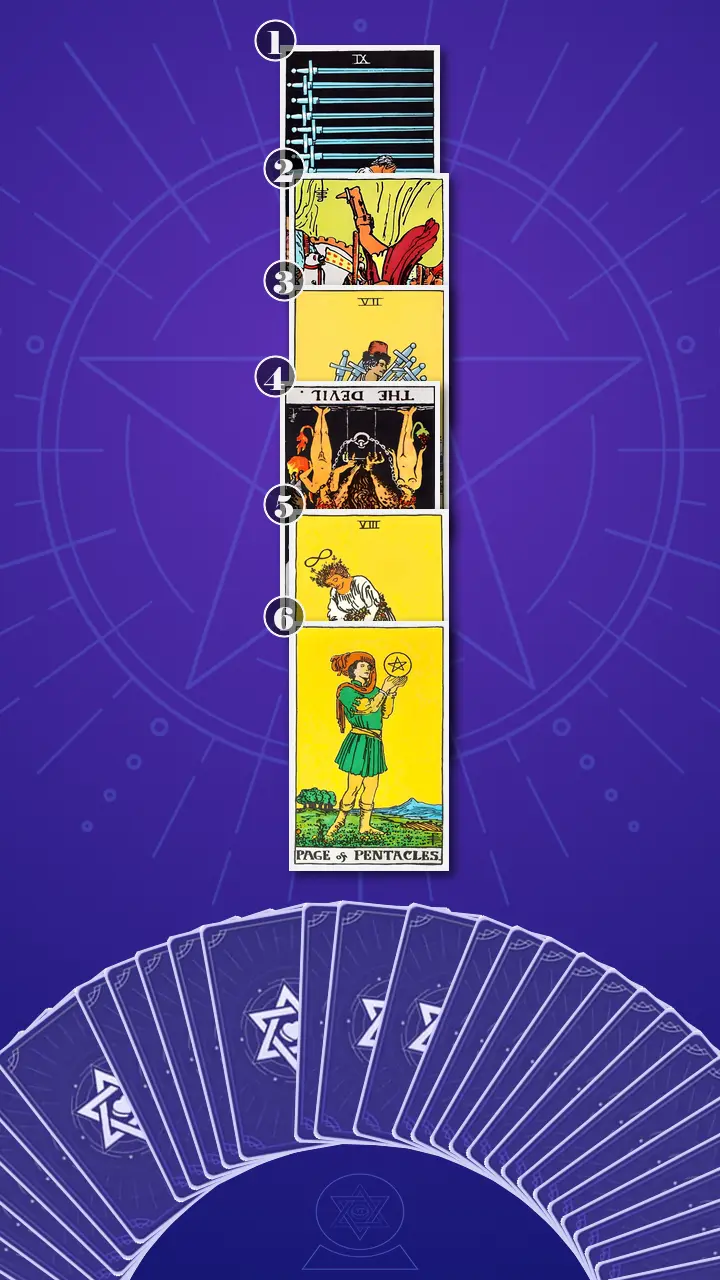
The Internal Courtroom at 1:12 a.m.
Position 1 (Surface Reaction): When Your Brain Opens “Reasons This Doesn’t Count”
“Now flipping over is the card that captures your immediate emotional-cognitive reaction after receiving the ‘proud of you’ text,” I said. “Nine of Swords, upright.”
I didn’t even have to embellish it. The card already looked like her Tuesday night: upright in bed, darkness, thoughts lined up like weapons on the wall.
“This is you in a Toronto apartment with the radiator clicking, phone brightness down, rereading ‘proud of you’ like it’s evidence you have to audit,” I translated. “Your brain opens a private Slack thread called ‘What I messed up’ and starts dropping receipts—awkward phrasing, the one question you fumbled, the moment your voice shook.”
“The key here,” I added, “is energy. This is Air energy in excess—not ‘thinking’ as a useful tool, but thinking as a self-prosecution loop. Your body braces like you’re being attacked, even though the threat is only an idea.”
Jordan gave a short laugh—sharp, almost annoyed—and then her eyes softened. “That’s… so accurate it’s kind of mean,” she said. Her fingers tightened around the cup, then loosened, like her hands didn’t know whether to defend her or let her be seen.
I kept my voice steady. “Your ‘fraud’ feeling isn’t a truth detector. It’s a vigilance habit.”
Position 2 (Trigger): Why Validation Feels Like Pressure
“Now flipping over is the card that shows what the praise specifically activates in you,” I said. “Six of Wands, reversed.”
“This is the spotlight you didn’t consent to,” I told her. “A supportive text arrives, and immediately you want to shrink it. You type ‘lol it was nothing,’ delete it, retype, add a disclaimer, delete again. You start managing exclamation points like they’re risk levels.”
“In reversal, the recognition energy is blocked,” I explained. “The laurel wreath—earned acknowledgement—feels unsafe to wear. So you knock it off before anyone can ask you to wear it tomorrow.”
Jordan’s mouth pressed into a thin line. Her gaze flicked away from the card, toward the pastry case, like she wanted to disappear into something easier than being perceived.
“You’re not rejecting them,” I said, naming it cleanly. “You’re pre-empting the pressure.”
Position 3 (Root Fear): The “Getting Away With It” Story
“Now flipping over is the card that reveals the deeper root fear underneath feeling like a fraud,” I said. “Seven of Swords, upright.”
On the card, the figure carried swords like stolen goods and glanced over their shoulder, waiting for the sirens.
“Under the fraud feeling is a sneaky story,” I said. “That your competence is something you smuggled in, not something you built. That your wins are borrowed—from luck, timing, someone else’s low standards—and any minute now, the ‘gotcha’ moment will happen and the pride will be revoked.”
“This is Air energy in deficiency of trust,” I added. “You don’t lack skill. You lack permission to count your own effort as real.”
Jordan nodded once—slowly. Not agreement like a performance review. More like recognition, the kind that lands behind the ribs.
Position 4 (Repeating Pattern): The Praise-as-a-Contract Subscription
“Now flipping over is the card that names the self-reinforcing system—the mechanism that keeps you trapped in proving and minimizing,” I said. “The Devil, reversed.”
I tapped lightly near the loose chains in the image. “This is the loop: praise triggers a hidden contract in your head—‘If I accept this, I’m agreeing to never mess up.’ So you try to buy safety with output. You open your laptop to ‘just check one more thing,’ start a new to-do list, offer to take an extra task. Like being stuck on a never-ending ‘prove it’ subscription you forgot you signed up for.”
“Reversed,” I said, “this isn’t doom. It’s a blockage starting to loosen. The chains are real, but they’re also looser than they feel—because they’re made of habit, not handcuffs.”
Jordan exhaled, and the sound surprised her—like she didn’t realize she’d been holding her breath since Tuesday. Then she frowned. “Okay, but if I stop proving it, won’t I just… get exposed?”
“That question,” I told her, “is the exact doorway out.”
When Strength Spoke: Calm Hands, Steady Breath
Position 5 (Medicine): The Antidote to the Fraud Narrative
I let the café noise blur for a second—the steam wand, the low conversations, a spoon tapping porcelain—until it all felt like background instead of pressure.
“Now flipping over is the card that provides the key shift—self-trust and self-compassion that directly counters the fraud narrative,” I said. “Strength, upright.”
“This is the antidote,” I told her. “Not more achievement—steadiness. Strength is staying present with the flinch after ‘proud of you’ without negotiating yourself down. You don’t wrestle your inner critic into silence; you hold it gently and firmly.”
As a café owner, I’ve watched thousands of people meet their own intensity over a cup. So I used my Relationship Stage Diagnosis—but not for dating. For the relationship Jordan had with praise.
“Right now,” I said, “your relationship with recognition is like taking an espresso shot on an empty stomach. It’s potent. It hits fast. And your nervous system interprets that jolt as danger. Strength is learning to receive praise more like a latte: the same coffee, but held in something softer—warmth, breath, body. Not diluted. Integrated.”
I watched Jordan’s posture. Her shoulders were still high. Her jaw still tight. She was stuck in the old reflex: if I accept this, I’m promising perfection.
Stop treating praise like a contract you must uphold, and start meeting your inner lion with calm hands and steady breath.
Silence—just long enough for the sentence to settle like coffee grounds in the bottom of a cup.
Jordan’s reaction came in a chain. First, a freeze: her breath paused, her eyes fixed on the card like it had just said her legal name. Then cognition seeped in: her gaze went slightly unfocused, as if replaying Tuesday night with a new camera angle—less prosecutor, more witness. Then the release: her shoulders dropped a few millimeters, and she let out a shaky exhale that sounded half like relief, half like grief for how long she’d been carrying this alone.
“But if I do that,” she said, voice small and a little sharp, “doesn’t it mean I’ve been doing it wrong the whole time?”
I shook my head. “It means you were surviving with the tools you had.” I kept my tone practical. “And now you have a better tool. Praise isn’t a verdict. It’s data.”
“Now,” I asked her, “with this new lens—can you think back to last week? Was there a moment when someone validated you, and this insight could’ve changed how it felt in your body?”
Jordan blinked hard. “In the meeting room,” she said. “Someone said ‘great job’ and I smiled, but inside I was already listing everything I’d fix. If I’d… met it with breath first? Maybe I wouldn’t have sprinted back to my desk like I’d stolen something.”
That was the step across the threshold: from shame-driven self-prosecution after praise to the first taste of calm ownership of effort. Not perfect confidence—just a steadier place to stand.
The One-Cup Protocol: Actionable Advice for the Next 7 Days
I gathered the ladder into a single story for her: “Your mind goes into an Air-heavy courtroom the moment praise arrives (Nine of Swords). Recognition hits the trigger switch from comfort to obligation (Six of Wands reversed). Underneath is the fear you’re ‘getting away with it’ (Seven of Swords). The repeating mechanism is the contract story—the prove-it subscription (Devil reversed). And the way out is Strength: nervous-system steadiness first, then grounded proof built from real effort (Page of Pentacles).”
“Your cognitive blind spot,” I told her, “is that you’re treating a kind text like it contains fine print. You assume accepting praise equals signing a contract to never slip. The transformation direction is simpler, but not easy: shift from treating praise as a test you must pass to treating it as data you can receive and integrate.”
Then I made it practical—small steps, low friction, real life.
- The One-Sentence Receive RuleSend (or draft) exactly one sentence: “Thank you—that means a lot.” No qualifiers, no jokes, no explanation. (If you can’t send it yet, rehearse it in Notes.)Expect your brain to call it “cringe” or “cocky.” That’s old safety talking. Your job is not to feel confident—just to stop negotiating yourself down.
- The Contract-Breaking Pause (90 seconds)After you send it, put your phone face-down for 90 seconds. Notice throat/chest/stomach sensations without fixing them. If you spiral, label it: “My brain is building a case.” Then take 3 slow exhales.If 90 seconds feels impossible, do 20 seconds. Consistency beats intensity—this is nervous-system training, not a personality makeover.
- Cup Bottom Receipts (My Café Version of an Evidence Log)Once this week, after you finish a coffee or tea, look at what’s left in the bottom of the cup for ten seconds. Not to “predict the future”—to practice my Cup Bottom Divination as a grounding cue. Then write two bullets in a note titled “Receipts (Not Perfection)”: (1) “I did ____.” (2) “I practiced ____.”Keep it behavioral, not identity-based. Build receipts, not arguments. You’re collecting reality, not trying to win a debate with your feelings.

A Week Later: The Quiet Proof
A week later, Jordan messaged me a screenshot—not of a new achievement, but of a simple text she’d sent: “Thank you—that means a lot.” Full stop. Under it, she’d typed: “Phone face-down. Didn’t die.”
She told me she slept through the night once—no 1:12 a.m. internal courtroom. In the morning, the first thought still arrived—what if they overestimated me?—but this time she noticed it, exhaled, and made coffee without opening her laptop to “pay the premium.”
That’s the journey to clarity I trust most: not a dramatic transformation, but a nervous system learning—inch by inch—that being seen doesn’t have to equal danger.
When someone says they’re proud of you, and your throat tightens like you’re about to be exposed, that’s the exact ache of wanting to be seen and supported while fearing that being seen will cost you safety.
If you let one compliment be true for just 30 seconds this week—without paying for it with extra work—what might you notice about yourself?