Answering for My Partner at Family Dinner—Learning to Return the Silence

The 7:36 PM Family Dinner Silence
Jordan (name changed for privacy) sat across from me with the sort of posture I know too well from people who have spent the entire evening holding themselves together: shoulders lifted, jaw already locked, one hand on a lukewarm mug as if it might steady the room. She had come in straight from a Toronto family dinner, where the soup had gone cold under the radiator tick and her partner had answered a question with a shrug so small it almost disappeared. “I don’t mind quiet,” she said, looking at the floor. “I mind being the only one carrying it.”
That was the centre of it. Not a fight. Not even a dramatic silence. More like a group chat where everyone has seen the message and one person starts overexplaining to keep the thread alive. By the time she described the ride home — the streetcar window, the glowing phone, the Notes app draft she kept deleting — I could hear the frustration under the embarrassment. It felt, as she spoke, like trying to balance a tray of glasses while the whole dining room kept leaning toward her for permission to breathe.
I told her, gently, “You are not wrong for noticing the atmosphere. We just need to see what part of it is yours to hold, and what part is not.”
Tonight, I said, we were going to make a map.

Choosing the Relationship Spread · Context Edition
I asked her to take one slower breath, then I shuffled with the cards face down, not as theatre but as a way of giving the question a shape. For a problem like this, I wanted a spread that could separate atmosphere from habit, habit from avoidance, and avoidance from the sentence that actually changes things.
So I chose the Relationship Spread · Context Edition. The centre card would show the dinner-table weather. The next card would show her default role. The third would name the hidden tension everyone was circling. The fourth would point to the boundary. The fifth would show how to hold it without turning the whole thing into a showdown. In other words: a small bridge over a very familiar table.
I could already tell this was going to be one of those readings where the cards did not need to invent a problem. They only needed to name the one she was already carrying in her shoulders.
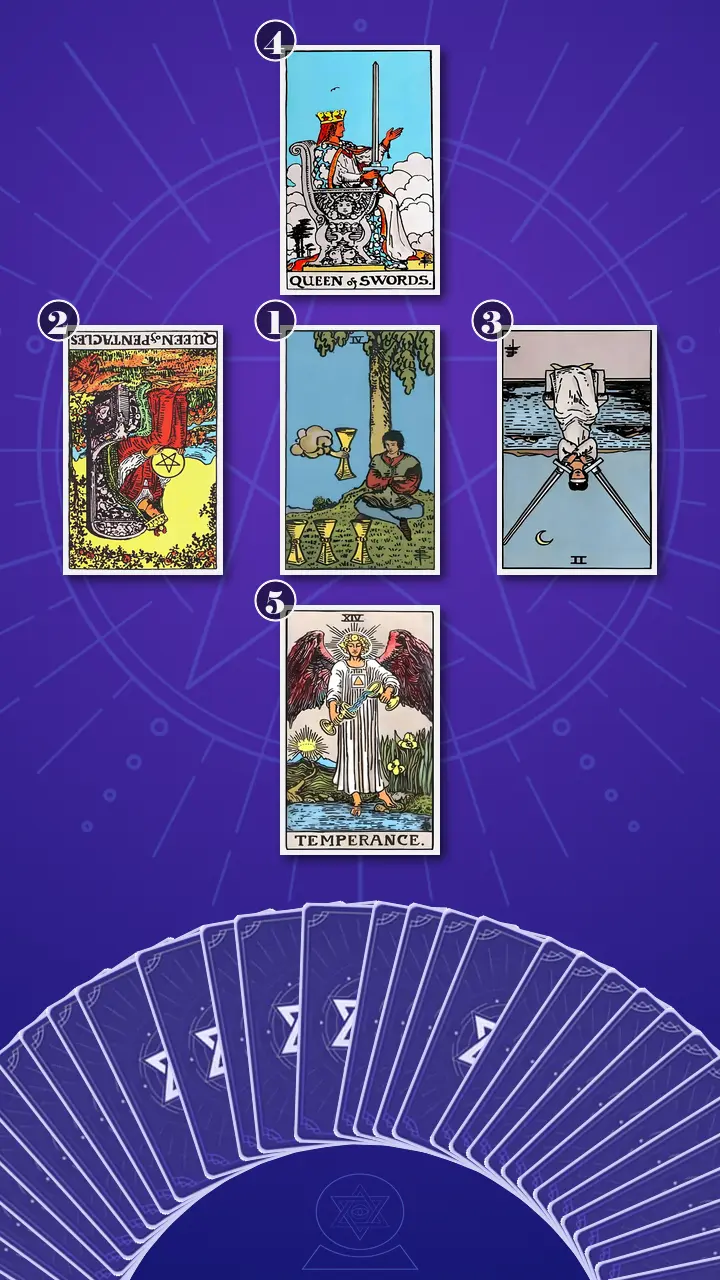
Reading the Map Under the Dinner Table
Shared atmosphere / Four of Cups
The first card was the Four of Cups, upright.
In this position, it did not mean disaster. It meant a room whose emotional weather had gone flat enough that everyone started orbiting the silence itself. The card showed me the exact dinner Jordan described: the question lands, her partner goes quiet, and she moves in before the pause can become public. It is the difference between actual intimacy and the exhausting job of preventing awkwardness. The modern-life version is simple: everyone has seen the message, and now the room is pretending not to notice the lack of reply.
I told her, “This is the atmosphere, not the verdict.”
She gave a small, bitter laugh that held more recognition than humor. “That is annoyingly accurate,” she said. Her hand tightened once around the mug, then loosened.
That reaction told me I had landed on the right layer.
Your default role / Reversed Queen of Pentacles
The second card was the reversed Queen of Pentacles.
Here was the overfunctioning piece. The one who becomes the host, the translator, the emotional air traffic controller, all while pretending it is just being helpful. In practical terms, this looked like topping up drinks, passing bread, making jokes, and answering on her partner’s behalf before he had even taken the breath to do it himself. Care had quietly tipped into invisible labour.
Reversed, the Queen of Pentacles is not “bad care.” It is care that has begun to erase the caretaker. The energy is too contracted, too busy managing the table to notice the body doing the managing: tight jaw, shallow breath, shoulders held high enough to create their own weather.
I let that sit for a moment and then said, “You are not just being kind. You are doing logistics for two people.”
She looked up at that, eyes narrowing slightly as if the words had turned a light on in a room she had been keeping tidy in the dark. Then she exhaled through her nose. “I do that all the time,” she said. “And then I’m mad later that I did.”
The hidden tension / Reversed Two of Swords
The third card was the reversed Two of Swords.
This was the stalemate under the table. Not because nobody knows anything, but because everyone knows enough to feel the pressure and not enough to say the useful sentence. The modern translation is painfully familiar: drafting and deleting the text after dinner, staring at the Notes app, deciding that naming the tension feels almost as risky as leaving it unnamed.
That is where the real fatigue lives. Not in the meal itself, but in the after-meal replay. The jaw that will not unclench. The little movie of the conversation that starts running the second you are alone again. The belief, slowly hardening, that if you do not keep the room smooth, the awkwardness will land on you and expose you as someone who cannot control the atmosphere.
I said, “This card shows me the cost of protecting the dinner from discomfort. It does not remove the discomfort. It just makes you carry it privately.”
Jordan went very still. First her shoulders froze, then her eyes drifted somewhere past my left shoulder, as if she had been rewatching a recent meal in real time. Then she swallowed and said, quietly, “I hate that this feels like my job.”
That sentence gave me the shape of the block. But it also pointed straight to the door.
When the Queen of Swords Cut the Fog
The air in the room changed before I even named the fourth card.
This was the key card, the one that matters most here: Queen of Swords, upright. And because I read relationships historically as much as emotionally, I used my Emotional Historiography lens on it. I do not read a dinner like a single event; I read it like a site with layers. Tonight’s silence was only the topsoil. Under it was an older contract — the one where she had become the person who keeps things smooth so nobody has to sit with awkwardness for long. That contract was ready to be revised.
Then I said the sentence exactly as it came through:
Stop acting like the room's interpreter, and let the Queen of Swords cut the fog with one calm sentence about what you will and will not cover.
For a second, nothing moved.
Jordan’s face did the whole sequence at once: a blink, a frown, and then the stillness that comes when a truth lands harder than you expected. Her mouth opened, closed, and opened again; for one second she looked genuinely irritated, as if the sentence had accused her of something she already knew. Then the charge moved through her body in order: fingers uncurling from the mug, shoulders dropping a fraction, a breath sliding out with a shaky laugh she did not seem to mean to make. She looked down at the table, then back up, and I could feel the room reassemble itself around a simpler fact. It was like finally putting down a heavy serving dish and using one clean sentence instead of three apologetic ones. Inside, I heard my own line — I can stay warm without translating him — and it felt less like a slogan than a structural correction. This was the shift from vigilant room management to self-respecting clarity. Now, using this new angle, think back to last week — was there a moment when this insight would have changed how you felt?
I told her, “Yes. And that is not a failure. It is the moment the pattern becomes visible.”
That was the real crossing. Not from conflict to perfect harmony. From hyper-vigilant room management and post-dinner resentment to calm, self-respecting clarity about what she would and would not cover. This was the turning point where the dinner stopped being a test of her loyalty and started being a question of structure.
The boundary / Temperance
The fifth card, Temperance, told me how to keep the truth usable.
If Queen of Swords is the clean cut, Temperance is the steady hand that makes the cut livable. It is not about going cold. It is not about turning dinner into a courtroom. It is about proportion: one calm sentence, one steady tone, one decision not to overcorrect just because the room feels a little strange.
I could see the shape of the next dinner already. The talk before the meal. The short sentence. The pause afterward. The possibility that the room would go awkward for a moment and then keep existing, which is usually how real life works.
“Keep the dinner warm, not managed,” I said. “Let the silence belong to the person who creates it.”
She nodded, slower this time, and the nod did not look like compliance. It looked like she was finally deciding where to sit inside the room.
The story the cards told was very clear. The Four of Cups showed the atmosphere everyone had been circling. The reversed Queen of Pentacles showed the way care had become overfunctioning. The reversed Two of Swords showed the avoidance loop: pause, rescue, replay, repeat. And the Queen of Swords broke the cycle by naming the one thing that actually changes the dinner — not a bigger effort, but a clearer boundary. Temperance then reminded me that clarity only helps if it can survive real people, real families, and a real table with soup cooling under the radiator tick.
The cognitive blind spot here was simple but stubborn: she had been treating silence as a problem to manage instead of a responsibility to return. The transformation direction was just as simple: move from rescuing the atmosphere to naming the expectation before the next dinner, and stop translating what is not hers to translate.
In my own shorthand, this is Amphora Balance: one cup for warmth, one cup for responsibility, and no more pretending you have to carry both. It is also Pictogram Dialogue at its cleanest — one short line, legible enough that nobody can claim not to see it.
So I gave her two small, concrete steps, because this kind of change needs a handhold, not a sermon.
- Write the hand-off sentence in NotesBefore the next dinner, write one 10-word boundary sentence: “I will not answer for you or manage the mood.” Keep it in your phone and read it once before you walk in.If it feels too sharp, shorten it to five words first. The point is clarity, not performance.
- Pause before you rescue the pauseAt dinner, when your partner goes quiet, wait three seconds before jumping in. Take one sip of water, unclench your jaw, and let one awkward beat stay awkward.If your body wants to rush, treat that urge as information, not instruction. One beat is enough.

The Quiet After One Plain Sentence
A few days later, Jordan sent me a message from the streetcar home. It was only two lines. She had written the sentence in her Notes app, said it before dinner, and not explained it past the point of clarity. The table went still for a moment, she told me, and then it kept going. Nothing exploded. Nobody disappeared. She ate her soup with both shoulders down.
That is what a small but real shift looks like. Not a solved life. Not a perfect relationship. Just the first unmistakable proof that she could stay warm without translating him, and that her care did not have to become cover.
When the table goes still, it can feel like your jaw is the one holding the whole room together — tight, shallow-breath tight — while embarrassment and resentment sit under the table and tell you to keep performing. But once you can see that pattern, the room is no longer a fog. It is a place with roles, and roles can change.
If you did not have to carry the room next time, what one calm sentence would you want ready before the first pause lands?