From Midnight Pressure to Quiet Self-Trust: Leaving Fixer Mode Behind

Finding Clarity in the 12:47 a.m. Notes App Draft
If you’ve ever sent a 1 a.m. advice message with bullet points, links, and “next steps,” then stayed awake monitoring the typing bubbles like you’re waiting for a grade—this is that pattern.
Jordan (name changed for privacy) sat down across from me with the particular tiredness New York gives you when it’s not just your calendar that’s full—your nervous system is, too. She was 29, a project manager in tech, the kind of person who can run a sprint planning meeting with one eye open… and somehow still ends up wide-awake at night because someone else’s feelings hit her phone like a Sev-1 incident.
She didn’t even need to “set the scene.” Her body already had it memorized.
“It’s always the same,” she said, and I watched her hands do a small, restless hover over her phone like they were checking for heat. “12:47 a.m. I’m in bed. Radiator clicking. Streetlight stripes through the blinds. Someone texts, ‘Can I vent?’ and it’s like…” She swallowed. “My chest tightens, my jaw locks, and my thumb is already opening Notes. I start drafting a plan. Bullet points. Scripts. Links. And I hate that I do it.”
Her voice had that pressed, careful edge—like she was trying to say the truth without sounding dramatic. But the truth was physical: a clenched jaw you could hear in her consonants, eyes that burned with exhaustion, hands that kept reaching for the phone even while she described how badly she wanted to put it down.
“I don’t know how to just listen without trying to fix it,” she added, quieter. “I’m supportive until I’m resentful, and I hate that about myself.”
Pressure was the only word that fit, but it didn’t feel like a word in her—it felt like a subway car door closing on her ribs. Like her kindness had become a job with a night shift, and she kept clocking in even when she didn’t mean to.
I leaned forward, soft but steady. “I’m not hearing ‘you’re a bad friend,’ Jordan. I’m hearing a system that’s learned: urgency equals love. And at midnight, when you’re depleted, that system runs on autopilot.”
I let that land, then offered the shared goal plainly. “Let’s try something different today. We’re going to map the pattern—not to judge it, but to find clarity inside it. If we can see what flips the switch into fixer mode, we can choose what happens next.”

Choosing the Compass: The Four-Layer Insight Ladder Tarot Spread
I’m Alison Melody. Most people know me from radio—ten years of hosting shows on music therapy and sound energy research. In my studio life, everything comes down to signal and noise: what you amplify, what you filter, what you let clip into distortion. In my tarot work, I use the same principle. We’re not trying to become “perfect.” We’re trying to stop letting the loudest impulse run the whole mix.
I asked Jordan to take one slow breath with me—not as a mystical ritual, just a way to bring her back into her body before her brain sprinted ahead. Then I shuffled, the cards making that soft papery hush that always reminds me of a record sleeve sliding out of its jacket.
“Today,” I said, “we’ll use a spread called the Four-Layer Insight Ladder · Context Edition.”
For you reading: this is ideal for something like midnight fixer mode because it’s not a single decision problem. It’s a recurring loop—triggered by timing, intimacy, and nervous-system urgency. The Ladder lets us start at the surface (what happens in the first 60 seconds after the text), move down into the exchange dynamic and the hidden fear underneath, and then climb back up into a practical, repeatable change and its longer-term outcome.
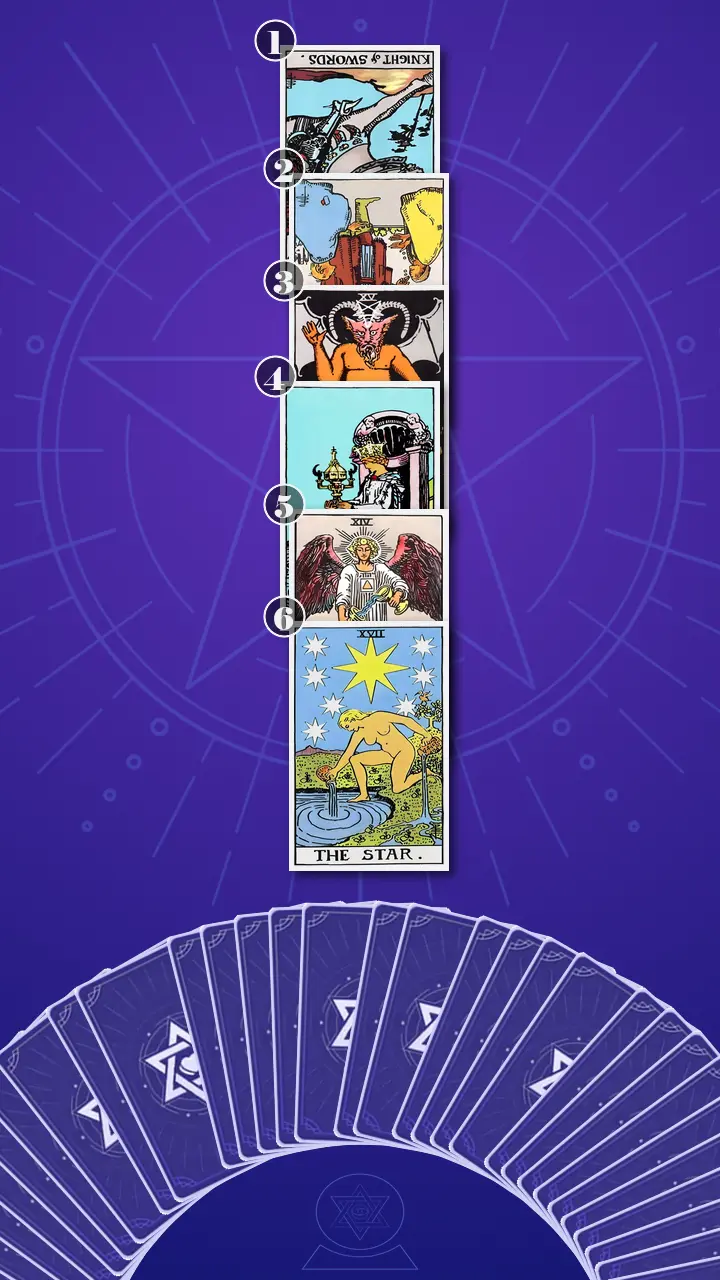
I showed Jordan the layout: six cards in a vertical column, like stairs down into the basement of a habit and back up into daylight. “Card one is your immediate trigger response,” I said. “Card three is the hidden driver—what keeps the loop sticky. Card five is our bridge: the key shift you can practice in real life, especially at night.”
Reading the Ladder: The Moment Your Thumb Starts Moving
Position 1: The immediate trigger response — Knight of Swords (reversed)
“Now flipping,” I said, “is the card that represents the immediate trigger response: what you do and feel in the first minutes after the midnight vent.”
The Knight of Swords, reversed.
Even before I spoke, Jordan gave a short, almost bitter laugh—one of those laughs that’s half recognition, half exhaustion. “Of course,” she said. “That’s… honestly a little too accurate.”
I nodded, keeping it gentle. “This card is speed without a capacity check. In real life, it’s exactly what you described: you see ‘can I vent?’ at 12:58 a.m. and your body reacts like a Slack escalation. You sit up, brightness up, thumbs flying. You send a long text fast, then immediately start drafting a second message to clarify so you won’t ‘mess it up.’”
Reversed, that Knight isn’t “decisive.” He’s impulsive—a nervous system sprinting to outrun discomfort. In energy terms, this is Air in excess: thoughts moving faster than your body can metabolize them, words moving faster than your values can catch up.
I watched her face while I said the line I use when this shows up in relationship readings: “Fixing is how pressure disguises itself as love.”
Jordan’s head dipped in a sharp nod, and she let out a small exhale through her nose like the truth had just been named without shaming her. Her fingers, which had been tense on her water bottle, loosened a fraction.
“It feels like triage,” she admitted. “Like if I can just send the right message, it’ll stop feeling scary.”
Position 2: The exchange dynamic — Six of Pentacles (reversed)
“Now flipping,” I said, “is the card that represents the exchange dynamic: how giving/receiving and boundaries are currently skewed in this connection.”
Six of Pentacles, reversed.
“This is the ‘scales’ card,” I told her, “but reversed, the balance is off. It starts as kindness. But by the third late-night thread in a week, your support becomes a one-way transfer: resources, check-ins, follow-ups, and you holding the plan in your head.”
I translated it into the modern version her body already knew: “It can feel like a subscription you never agreed to: unlimited emotional support, billed nightly, auto-renew on anxiety.”
Jordan’s mouth tightened, then softened—an “ouch” moment. She stared at the card like it had called her out with receipts. “And then I wake up and I’m… keeping score,” she said, disgusted with herself. “Like, did they even use what I sent? Did they say thanks? And I hate that I’m tracking it.”
“That’s not you being mean,” I said. “That’s your system trying to find fairness after you’ve over-given.” I paused. “Support without consent turns into a hidden contract.”
She blinked slowly, and her shoulders lifted and dropped in a quiet, defeated breath—as if she’d been carrying a spreadsheet no one asked her to maintain.
Position 3: The hidden driver — The Devil (upright)
“Now flipping,” I said, “is the card that represents the hidden driver: what fear or attachment keeps fixer mode locked in place.”
The Devil, upright.
The room got a little quieter—not in a spooky way, just in the way it does when a pattern stops being ‘a habit’ and starts being a hook.
“The Devil isn’t saying you’re bad,” I told her. “It’s saying the loop is sticky because it offers you something: control, proximity, proof.”
I used the card’s modern-life scenario exactly, because it matched her nervous system to the letter: “You tell yourself you’re just being a good friend, but the deeper truth is: being needed feels like proof you matter. So when someone is distressed, you latch onto the role of rescuer/manager. Even when you want to stop typing, you feel anxious—like if you don’t keep the thread moving toward a solution, you’ll be useless or pushed away.”
In energy terms, this is a blockage: attachment masquerading as responsibility. It’s Earth in a heavy, binding form—chains you can technically slip off, but you don’t, because part of you believes the chain is what keeps you close to people.
Jordan’s gaze went unfocused for a second, like she was replaying a dozen late-night threads at once. Then she whispered, “If I don’t fix it, I feel like… I’m failing. Like I’m not worth keeping around.”
That was the root. Not her kindness. Her fear of being disposable.
I let myself have a quick inner flashback: years ago, producing live radio, the terror of dead air—how your hands move too fast, how you overcorrect, how you fill every second because silence feels like failure. But the best broadcasts I ever made weren’t the ones packed with sound. They were the ones with intentional pauses. Structure. Timing. Trust.
“Your system learned that ‘doing’ equals safety,” I said. “So stillness feels like risk. But in relationships, control isn’t the same thing as closeness.”
The Lidded Cup in a Shared Kitchen
Position 4: Your inner resource — Queen of Cups (upright)
“Now flipping,” I said, “is the card that represents your inner resource: the capacity you can access to stay present without taking over.”
Queen of Cups, upright.
Jordan’s face changed almost immediately—her brow unknit, just slightly, like a muscle remembering it had another option besides clenching.
“This is emotional attunement without takeover,” I told her. “The lidded cup matters: it’s warmth with a lid on it. Care that doesn’t spill into tasks.”
And I grounded it in the specific modern scenario: “Instead of sending a plan, you send presence. You reply: ‘I’m here. That sounds really heavy.’ You don’t add steps. You don’t chase a resolution. You let the feeling be real without turning it into logistics.”
In energy terms, Queen of Cups is Water in balance: responsive, empathetic, but contained. Not avoidant. Not flooding. It’s the difference between being in the conversation and being responsible for the outcome.
Jordan’s shoulders dropped. She touched the base of her throat like she could feel her voice settling lower. “That feels… possible,” she said. “But my brain always goes, ‘Is that enough?’”
“That question is the old contract talking,” I said. “The one that says you have to earn closeness by over-delivering.” I paused. “You can be warm without becoming responsible.”
Then I brought in my own lens—one of my signature tools—because for Jordan, this pattern had a soundtrack.
“Can I try something?” I asked. “I call it a Melodic Mirror. We look at your emotional patterns through the playlists you default to.”
She gave a tiny, skeptical smile. “Okay.”
“What do you listen to when you’re in that midnight triage mode?”
Jordan thought for a beat. “Honestly? Fast stuff. Like… high-energy. Or I don’t even play music, I just have that buzzing in my head.”
“Exactly,” I said. “Knight of Swords energy has a tempo. It’s mental BPM—fast, sharp, relentless. Queen of Cups has a different tempo: slower, steadier, more spacious. Part of your work is learning that you can change the emotional BPM of the moment before you type a single word.”
When Temperance Set the Tempo
Position 5 (Key Card): The key shift in practice — Temperance (upright)
I held the next card for half a second longer than usual. “We’re flipping the bridge,” I said. “This is the card that represents the key shift in practice: a balanced way to respond that protects sleep, respect, and connection.”
Temperance, upright.
The imagery is simple: an angel pouring water between two cups, measured. No flood. No deprivation. One foot on land, one foot in water—real life and feelings, both included.
I leaned in. “In real life, this is: you stop treating the vent like a fire. You pace your care. One validating line, one consent question, one boundary. Maybe you offer ten minutes of listening, or you schedule a call tomorrow. Timing becomes part of the support.”
Setup (what she’s trapped in): Jordan was still caught in that 12:47 a.m. moment—phone lighting up the ceiling, thumb already opening Notes to draft a ‘quick plan,’ while her jaw clenched and her eyes burned with tiredness. Her mind kept insisting: If I don’t do this right now, I’m failing.
Delivery (the sentence that changes the frame):
Stop treating every midnight vent like a fire to put out, and start pouring your care in measured amounts like Temperance’s two cups.
I let the silence do what silence does when you don’t rush to fill it.
Reinforcement (the body learns it): Jordan went still in a way that wasn’t shutdown—it was a pause that finally had somewhere to land. First, there was a tiny freeze: her breath caught, and her fingers stopped moving entirely, as if her nervous system couldn’t decide whether to argue or surrender. Then I saw the cognition seep in: her eyes drifted off the card, unfocusing, like she was replaying that familiar midnight sequence—vent text, Notes app, bullet points, typing bubble watch—only this time with a new option spliced into it. Finally, the release: her shoulders lowered on a long exhale, and her jaw unclenched so visibly it looked like someone had loosened a strap.
But the release didn’t come with fireworks. It came with something more honest: a brief flash of irritation, almost grief. “But if I don’t fix it,” she said, voice sharper for a second, “then what am I doing? Like… what’s my role?”
“That’s the Devil card talking,” I said calmly. “The part that equates being needed with being loved.” I softened my tone. “Temperance isn’t asking you to care less. It’s asking you to care in a way you can repeat.”
I added the phrase I wanted her to remember at 1 a.m., not just understand at 2 p.m.: “Paced care is still care.”
Then I asked, exactly as I always do at the Temperance pivot, because insight needs a place to attach in lived memory: “Now—using this new lens—can you think of a moment last week when a 90-second pause would have changed the whole night?”
Jordan nodded slowly. “Tuesday,” she said. “I remember my chest tightening. I wrote three paragraphs. If I’d paused… I could’ve just asked what she needed. I didn’t even ask. I just… launched.”
“That,” I said, “is you moving from urgent pressure into grounded compassion. It’s the beginning of quiet self-trust: you don’t have to earn your place by exhausting yourself.”
Position 6: Integration outcome — The Star (upright)
“Now flipping,” I said, “is the card that represents the integration outcome: what changes in your self-trust and steadiness when you stop over-functioning.”
The Star, upright.
“This is nervous-system relief,” I told her. “Open sky. Steady water. No crisis performance required.”
I tied it directly to the real-life scenario: “A few weeks into paced support, you wake up rested after a night where you didn’t manage anyone’s crisis. You still care, but you’re not on edge. You can be a steady presence without proving it through exhaustion.”
Jordan’s eyes got a little glossy—not in a dramatic way, just in the way they do when you realize how long you’ve been living with your shoulders up around your ears. “Waking up rested sounds… unreal,” she admitted. “Like a fantasy.”
“It’s not fantasy,” I said. “It’s a pattern shift. And it starts small.”
The One-Page Plan That Isn’t a Plan: Measured Support, Real Boundaries
I slid the cards into a clean line again and gave Jordan the story they’d been telling, in plain language.
“Here’s the arc,” I said. “Knight of Swords reversed is the midnight triage reflex—speed as self-soothing. Six of Pentacles reversed shows what happens next: you over-give, and the exchange gets unbalanced, so you wake up resentful and guilty. The Devil is the root bind: the fear that if you’re not useful, you won’t be kept close. Queen of Cups is your resource—presence with a lid, warmth without takeover. Temperance is the bridge behavior: paced, measured, consent-based support that protects tomorrow. And The Star is what you get back: sleep, steadiness, and self-trust.”
“Your cognitive blind spot,” I added, “is that your brain treats being supportive as the same thing as being responsible. And at night, with Slack conditioning and low bandwidth, that belief gets louder. The transformation direction is the opposite: support becomes a choice with a container.”
Jordan frowned slightly. “Okay. But… what if I can’t even find five minutes?” she asked, practical to the bone. “Sometimes it’s back-to-back. Group chat. Voice memo. And I’m already fried.”
“Good,” I said, because that obstacle was real, not theoretical. “We’re not aiming for perfect boundaries. We’re aiming for a repeatable protocol.”
I leaned into my other toolbox—the one that turns insight into something you can actually do at 12:47 a.m. “This is where I use an Emotional BPM check,” I said. “If your inner tempo is racing, your reply will race. So we downshift the tempo first, then we respond.”
Then I gave her three concrete next steps—small enough to start, structured enough to hold under pressure.
- The Two-Line Boundary Reply (Temperance Template)Pre-write and pin a two-line night reply in your Notes app or iPhone text replacement: “I’m here and I’m really sorry you’re dealing with this. Do you want listening, comfort, or brainstorming—and is this for tonight or tomorrow?” Use it the next time a late-night “can I vent?” text lands.Expect your brain to argue “This is selfish.” Treat it like an alarm, not a truth. Copy/paste anyway.
- The 10-Minute Container + Clear CloseOnce this week, if you choose to engage at night, set a 10-minute timer. Listen/reflect only—no plans, no links. When the timer ends, send one closing line: “I’m going to sleep now, but I’m with you. We can pick this up tomorrow.”If you feel yourself drafting paragraphs, stop mid-text and save it as a draft. If it costs you tomorrow, it’s not sustainable tonight.
- Phone Face-Down Protocol (The Physical Boundary)After you send your reply, place your phone screen-down on the nightstand. Put one hand on your chest and take 6 slow breaths—long exhale. Let the conversation be unfinished without making it your overnight job.If your hand reaches for the phone, just label it: “My nervous system wants monitoring.” Naming it reduces the grip.
Because I’m me, I also offered a sound-based add-on—optional, but powerful for someone with a fast mind.
“One more,” I said. “Build a tiny Resonance Playlist—three tracks, max—specifically for the ‘I want to fix this’ spike. Not sad songs. Not hype. Think: steady tempo, grounded bass, something that tells your body ‘we’re safe.’ You play it for 90 seconds before you reply. It’s Temperance in audio form: measured input, measured output.”
Jordan actually smiled at that—small, real. “A playlist boundary,” she said. “That feels… weirdly doable.”

A Week Later: The Quiet Proof
A week later, I got a message from Jordan. Two lines, no essay—like she’d practiced being contained.
“Had a midnight vent last night,” she wrote. “Did the 90-second pause, sent the two-line template, asked ‘tonight or tomorrow.’ Put my phone face-down. I still felt twitchy for a minute… but I slept.”
That was the proof I care about most: not that life instantly got easier, but that her body had a new option. Clearer boundaries and steadier sleep, with the tiniest spark of self-trust returning.
This is what tarot looks like when it works as a practical tool: it doesn’t moralize your pattern. It names the trigger (Knight of Swords reversed), shows the relational cost (Six of Pentacles reversed), touches the fear underneath (The Devil), and then gives you a resource and a repeatable bridge (Queen of Cups into Temperance) so your support can stay real without becoming self-erasure.
When your phone lights up after midnight, it can feel like you’re choosing between being a good friend and being allowed to rest—and the panic is really the fear that if you’re not useful, you won’t be kept close.
If you didn’t have to earn your place by fixing, what’s one small, honest way you’d want to show up next time—listening, comfort, or a single bounded brainstorm?