Found Our Old Chore Chart - And Started Rewriting the 'Responsible One' Role

Finding Clarity in the Chore Chart Flashback
You find an old chore chart and suddenly your adult life makes an uncomfortable amount of sense—like you’ve been running ‘responsible one’ software in the background this whole time.
Taylor (name changed for privacy) told me that line almost verbatim, like they were quoting an error message they couldn’t close out of. They’re 29, in Toronto, a project coordinator by title and—too often—the unofficial project lead for everything else: roommate logistics, Slack threads, friend group plans, the emotional weather in the room.
They set their phone down on the counter and angled the camera toward their apartment kitchen. It was 8:41 p.m. on a Wednesday kind of night: overhead light humming with that faint fluorescent buzz, two mugs and a plate stalled in the sink, and the screen of their phone still warm from scrolling. They opened Notes and, without thinking, started typing a “house tasks” checklist for everyone. I watched their shoulders creep up like a reflex, jaw locking the way a seatbelt snaps tight.
“I want to step back,” Taylor said, voice low, like they didn’t want to wake the part of them that panics. “But if I do… what does that make me? Like, selfish? Unlovable? And then I’m already writing the follow-up text in my head.”
The feeling in the room wasn’t abstract. It had weight. It was guilt that moved like a tight backpack you packed as a kid and never took off—straps biting your shoulders even when you’re technically safe now.
I kept my tone gentle, the way I learned to do on long transoceanic voyages when people would come to me at 2 a.m., eyes bright with worry, asking for something that felt like solid ground. “Being dependable isn’t the problem,” I said. “Being automatic is. Let’s try to map where this script comes from—and what it would look like to rewrite it without swinging to extremes. This is your journey to clarity.”

Choosing the Compass: The Four-Layer Insight Ladder Tarot Spread
I invited Taylor to take one slow breath—not as a mystical ritual, just as a clean transition. A way to tell the nervous system: we’re not fixing everything tonight; we’re looking.
I shuffled while they held the question in mind: Found our old chore chart—what family role am I reenacting?
“For this,” I told them, “I want to use something I call the Four-Layer Insight Ladder · Context Edition.”
For anyone reading who’s curious about how tarot works in a practical, non-woo way: a spread like this is basically a structured set of prompts. Each position has a job. We’re not asking the cards to ‘predict’ a roommate’s personality. We’re using images and archetypes to surface patterns you’re already living—especially the ones that feel too normal to question.
This six-card linear ladder is perfect for inner-work questions like Taylor’s—questions at a career crossroads of identity, boundaries, and belonging—because it moves cleanly from (1) what you’re doing on autopilot, down into (2) the family conditioning behind it, (3) the emotional payoff that keeps it repeating, (4) the cost that makes you feel stuck, then back into (5) a new integrating stance, and (6) a next-step experiment you can actually try this week.
“Think of it like stairs,” I said. “We start with the visible habit. Then we descend into the origin and mechanism. And then we come back up with a more adult, self-respecting way forward—something you can test in real life.”
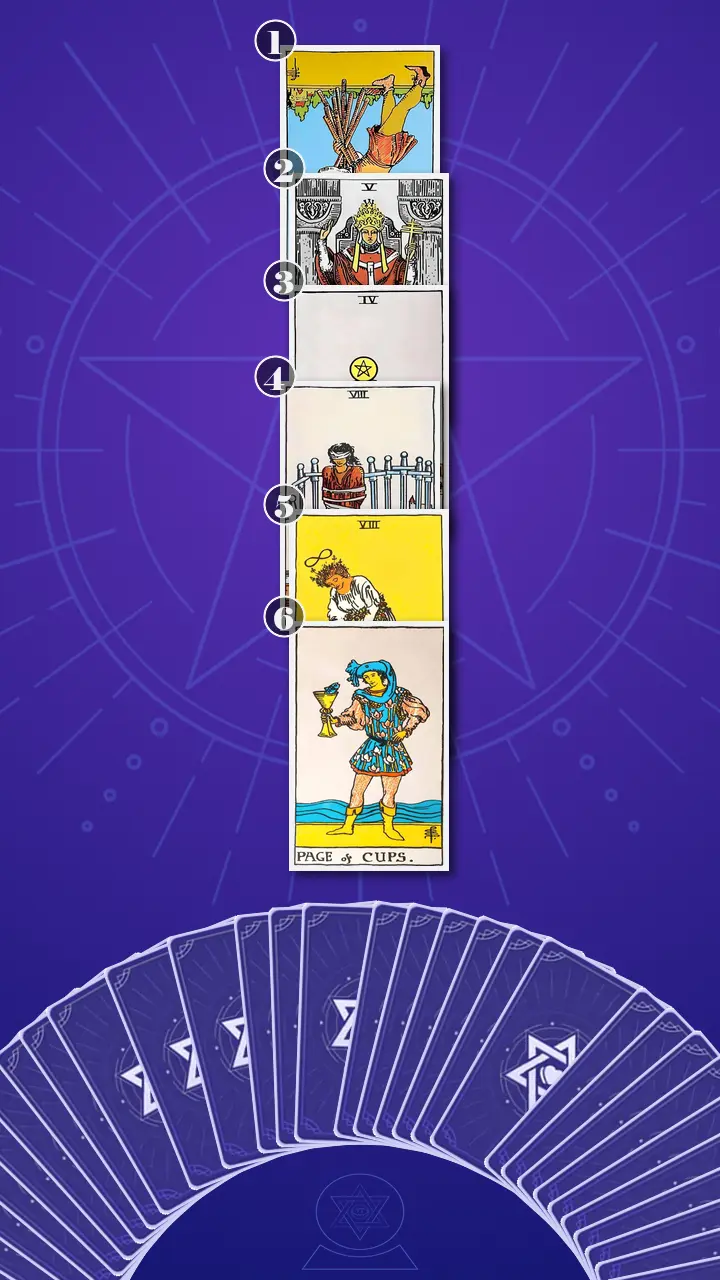
Reading the Map: The Hands That Clench, Grip, and Freeze
Position 1 — The current reenactment
“Now we’re turning over the card that represents The current reenactment: the concrete adult behavior pattern that the chore chart is activating right now,” I said.
Ten of Wands, in reversed position.
Immediately, I felt my eyes go to the figure’s posture—the bend of the spine, the way the bundle blocks their view. “This is the adult version of the chore-chart reflex,” I told Taylor. “It’s 9:30 p.m., you’re standing in the hallway with a garbage bag, already annoyed. No one asked you to take it out—but the moment the bin looks full, your body goes into handle it now mode.”
I watched Taylor swallow as I kept going, making it concrete the way the card demanded. “You do it. Then you end up in bed scrolling, and there’s that hot little wave of resentment—‘why is it always me?’—and then guilt rushes in to cover it: ‘don’t be dramatic, don’t be difficult.’ And suddenly you’re planning how to be nicer tomorrow.”
This is Fire energy in overload—effort without consent. In reverse, it’s not heroic anymore; it’s the moment the system starts tipping into burnout. Not because you’re weak. Because you’ve been carrying things that weren’t fully yours to begin with.
Taylor let out a small laugh that wasn’t funny. Their eyes narrowed like they were squinting at a mirror. “That’s… accurate,” they said, then added, quieter: “Why am I like this? It’s kind of brutal.”
“It’s precise,” I corrected softly. “And it means it’s a pattern—not a personal failing. That’s good news. Patterns can be changed.”
Position 2 — The original script
“Now we’re turning over the card that represents The original script: the family rule or role expectation that shaped how you learned to be ‘good’ or safe,” I said.
The Hierophant, upright.
“This,” I told them, “is the chore chart as a belief system. A written tradition. A ‘this is how we do things’ that turns into ‘this is who you are.’”
Taylor’s eyes flicked up like they’d just heard a voice they hadn’t named before. I leaned into the echo technique that always lands with people who grew up in invisible policies.
Good people don’t make it a thing.
Good people anticipate.
Good people handle it so no one is disappointed.
“That’s the Hierophant talking,” I said. “Like an inner HR memo.”
I asked them to picture the childhood artifact: magnets, checkboxes, handwriting. Then I cut to the present: a Slack thread with the line Who’s owning this? floating like bait. “It feels like your choice,” I said, “but your nervous system treats it like policy.”
This is where my Jungian work meets my Venetian one. In Venice, sound travels on water. A voice can bounce off stone and arrive twice—once as the original, and once as an echo. I call it Generational Echo Mapping: we listen for what’s yours, and what’s simply reverberating. “Your old role isn’t your personality—it’s your training,” I said. “Someone taught you that reliability earns belonging.”
Taylor exhaled—quiet, surprised. It was the kind of exhale that says, Oh. This is where I learned it. Their shoulders dropped a fraction, like they’d been holding a bag with their teeth.
Position 3 — The hidden payoff
“Now we’re turning over the card that represents The hidden payoff: what this role gives you emotionally that keeps it repeating,” I said.
Four of Pentacles, upright.
“Okay,” I said, “this is the part people hate admitting—because it sounds like you’re ‘choosing’ it. But the payoff is real.”
I gave them the modern version: “A shared project pops up at work and before anyone assigns an owner, you build a tracker. You assign yourself the follow-ups because it feels safer than waiting.”
Earth energy here is security—except it’s security through gripping. “It’s like keeping every tab open,” I said, “because closing one feels like you’ll lose track. Like keeping everything in your own Notion because if someone else holds it, it might vanish.”
I watched their hand tighten around their mug on instinct. Their knuckles went pale for a second. “The relief is real for about an hour,” I said. “Then the tracker becomes another thing you have to maintain, and now you’re resentful that no one else cares as much.”
Taylor’s mouth twisted. “Yeah,” they admitted. “Control feels like relief.”
“Exactly,” I said. “And we don’t shame that. We just name it so it stops being invisible.”
Position 4 — The constraint
“Now we’re turning over the card that represents The constraint: how the role limits you now, including the belief that makes the pattern feel non-optional,” I said.
Eight of Swords, upright.
Air energy can be clarity… or it can be a cage made of thoughts. “This is that feeling,” I told them, “when you need your roommate to handle a chore, but asking directly feels like sounding demanding. So you draft a message, rewrite it, delete it, rewrite it again—then you do the chore yourself so you don’t have to send the ‘too much’ text.”
I let the inner monologue switch into second person, because Eight of Swords always does: “If I ask, I’ll sound demanding. If I don’t ask, I’ll resent them. If I resent them, I’m the problem.”
Then I ended with the line the card always forces me to say, because it’s the loose rope moment: “It’s not that you can’t ask. It’s that your nervous system treats asking like a threat.”
Silence. Heavy, but clean. Taylor stared at the card like it had pulled a file they didn’t know existed. Their breathing paused, then restarted with a slow, almost reluctant inhale.
“And this is where the whole loop locks in,” I added. “Belief: ‘If I don’t carry this, things fall apart and I’ll be blamed.’ Behavior: you overfunction. Short-term relief: no conflict, outcome controlled. Long-term cost: you feel invisible and overextended. And then the belief gets reinforced.”
Taylor nodded once, small. Like signing something they didn’t want to sign but couldn’t deny.
When Strength Spoke: The Middle Option Between Carrying and Disappearing
Position 5 — The new role
I slowed down before turning the next card. The kitchen hum on Taylor’s end suddenly felt louder, like the room itself was listening. “We’re opening what I consider the bridge card,” I said, “the one that shows The new role: the healthier inner stance that rewrites the old script without swinging to extremes.”
Strength, upright.
Setup. I looked at Taylor and named the moment their mind keeps looping: “You find the old chore chart and suddenly your adult life snaps into focus. The same urge to be the one who remembers, follows up, smooths it over. Your shoulders climb up to your ears, and your brain starts drafting the ‘helpful’ message before you’ve even decided.”
Delivery.
Stop gripping the old chore-chart identity, and start leading yourself gently—like Strength, you can hold the lion without wrestling it.
I let the sentence hang for a beat.
Reinforcement. Taylor’s reaction came in layers, like weather changing over the lake. First: a tiny freeze—breath caught, eyes blinking fast, like their system didn’t know which script to run. Then: their gaze unfocused for a second, not dissociating exactly, more like replaying a hundred micro-memories of volunteering too fast, of “No worries!” texts typed with a clenched jaw. Then: their shoulders lowered in a way that looked almost unfamiliar, as if they’d just set something down and their muscles were surprised by the empty space. Their mouth opened, closed, opened again. The skin around their eyes went pink. “Wait,” they said, voice a little rough, “there’s… a middle option?”
“Yes,” I said. “Strength isn’t ‘do more’ and it isn’t ‘drop everything.’ It’s calm hands. It’s ‘I can care without becoming the unpaid manager of everyone’s life.’ A calm boundary is still care.”
Taylor rubbed their thumb over their own knuckle like they were checking for a pulse. “But if I don’t wrestle it,” they whispered, “what if it gets messy?”
“Then you practice tolerating discomfort without rescuing the outcome,” I said. And I brought back my canal-echo lens. “When that fear voice speaks, let’s map it. Is it your adult value… or is it an old echo bouncing off the walls of your childhood home?”
I leaned in just enough to keep them grounded, not exposed. “Now—use this new lens and look back at last week. Was there a moment when you felt your jaw tighten and your fingers volunteer on autopilot? If Strength had been in the room, what would your one respectful sentence have been?”
They didn’t answer immediately. They inhaled, slow. Then they said, “Monday. Slack thread. No owner. I typed ‘Happy to take this!’ and then hated myself.” Their face tightened, then softened. “I could’ve waited. I could’ve asked who was already scoped for it.”
“That’s the shift,” I said, making it explicit because naming it is how it sticks: “This reading is your move from guilt-driven overfunctioning and resentment-swallowing to steady self-trust, calm boundaries, and chosen responsibility. Not as a vibe. As a practice.”
The Page of Cups in a City That Never Stops Asking for More
Position 6 — The next step
“Now we’re turning over the card that represents The next step: one small, realistic experiment you can do this week to practice the new role in real life,” I said.
Page of Cups, upright.
“This card always makes me smile,” I admitted. “Because after all the responsibility talk, it brings the part of you that was never meant to be only useful.”
I translated it exactly into their life: “After holding a boundary, you might feel weirdly empty—like you don’t know what to do with your hands when they’re not gripping. And then, unexpectedly, you feel a small spark of wanting something that has nothing to do with being impressive: walking by the water, trying a new café, making a playlist. You do one small, unimpressive thing on purpose and your nervous system unclenches.”
Taylor’s lips curved, barely. “Like letting Spotify autoplay a weird song instead of curating the perfect vibe for everyone,” they said.
“Exactly,” I said. “You’re allowed to be more than useful.”
From Pattern to Plan: Actionable Next Steps for the Default Organizer
I summarized what the ladder had shown us, threading it into a single storyline Taylor could carry without turning it into another task list: “Right now, your chore-chart reflex (Ten of Wands reversed) kicks in fast—body first—because a family rulebook (Hierophant) taught you that being ‘good’ equals being reliable. The payoff is control-as-safety (Four of Pentacles), but the cost is a mental cage where asking feels like danger (Eight of Swords). Strength is the bridge: calm hands, clear scope. And Page of Cups is how you remember you’re a person, not a service.”
“Your cognitive blind spot,” I said gently, “is that your brain treats shared responsibility like a morality test. Like if you don’t carry the whole system, you’ll fail ‘good person’ school. That’s why stepping back feels like becoming selfish—when it’s actually becoming adult.”
“The transformation direction is clear,” I added. “Shift from earning safety through usefulness to practicing shared responsibility through clear asks, boundaries, and self-respect.”
Then I gave Taylor what they’d asked me for without saying it: something practical enough to try when the next Slack thread or kitchen mess hits.
- The One-Sentence Split (20% Less Boundary Test)Pick one recurring shared task you usually auto-adopt (trash, dishes, chasing a deadline). Write and send: “I can do X. I’m not doing Y this week—can you take Y by Friday?”Read it out loud once. Send it without rewriting more than one time. Feet flat, one slow exhale, then hit send.
- Count-to-Five Before VolunteeringIn one meeting or Slack thread this week, don’t volunteer in the first 10 seconds of silence. Count to five in your head and let someone else speak first.If guilt spikes, label it: “old rulebook voice.” You’re not being mean—you’re creating room for shared ownership.
- A Dockside Boundary Marker (Bollard Marking Method)Make two quick columns in Notes: “Chosen Responsibilities” vs “Reflex Responsibilities.” Move one item from reflex to chosen—or out of your column entirely. That’s your boundary line.Don’t go from “I do everything” to “I do nothing.” Aim for 20% less, consistently. Visible, said once, no dramatic speeches.

Ownership, Not Certainty
A week later, Taylor messaged me a screenshot of a text they’d sent their roommate. No apology paragraphs. No softening emojis as punctuation. Just the split: “I can do X. I’m not doing Y this week—can you take Y by Friday?”
“I thought I’d throw up,” they wrote. “But I didn’t. They said ‘yeah, sure.’ And I didn’t immediately add three more helpful suggestions. I just… stopped.”
They added one more line: “Also I walked by the waterfront and bought a pastry because it looked good. It felt illegal, but my shoulders dropped.”
Clear doesn’t mean invincible. Taylor told me they slept through the night for the first time in weeks—then woke up and their first thought was, What if I messed it up? They sat with it, breathed, and the thought passed like a streetcar going by. This time, they didn’t chase it.
That’s the quiet proof of a Journey to Clarity: not a perfect life, but a different reflex. A new kind of reliability—one that includes them.
When you’ve spent years earning belonging by being the reliable one, even resting can feel like you’re breaking a rule—and your body holds that fear in tight shoulders, a braced chest, and the urge to fix things before anyone can be disappointed.
If you didn’t have to prove you’re lovable by carrying the whole system, what’s one small responsibility you’d want to do this week—purely because you choose it?