From Default Peacekeeper Anxiety to Steady Boundaries in Group Chats

The 9:18 p.m. Notes App Draft
If you’re the 20-something in a big-city friend group who wakes up to 40+ unread messages and immediately slips into “default peacekeeper” mode—welcome to the group chat blowup cycle.
Jordan (name changed for privacy) sat down across from me with that specific kind of tired that isn’t about sleep. It’s the tired of being “on-call” for other people’s feelings. She’s 27, a marketing coordinator in Toronto, the kind of job where being “easy to work with” gets quietly rewarded. And lately, that same skill had leaked into her friendships—especially the group chat, which had become the main social calendar: plans, memes, passive-aggressive ‘lol anyway,’ and then… blowups.
She described Tuesday night like she was reading me a timestamped incident report.
“It was 9:18,” she said. “Condo couch. Takeout open but untouched. TV paused. And my phone wouldn’t stop buzzing on the cushion.”
I could see it: the warm screen in her hand, the micro-vibration traveling up her wrist, the tiny blue typing bubble appearing and vanishing like a heartbeat. Her jaw had that clenched, locked-in angle—like she was bracing for impact.
“I’m not even involved and somehow I’m the one writing the apology draft,” she said, and she laughed once—short, bitter. “It’s so dumb.”
It wasn’t dumb. It was a pattern with a nervous system behind it.
Her hands hovered over her phone as if she worked an emotional pager-duty rotation she’d never agreed to. Tight stomach. Restless fingers. A mind that kept opening new tabs—What did they mean by that? Should I say something? If I don’t… then…
Jordan said the part out loud that usually stays private: “If I don’t step in, it feels like the whole vibe collapses. And then… I don’t know. I’m scared they’ll remember I didn’t help. Like I’ll get pushed out.”
Wanting to keep the group together vs fearing you’ll be disliked or pushed out if you don’t fix it. That contradiction is the engine of so many friendships that look “fine” from the outside and feel like unpaid emotional labor from the inside.
The feeling in her body was vivid, specific: anxiety like a tight wire pulled across her ribs, humming, making her breathe shallow—like she was holding a crowded room’s microphone and trying to stop everyone from shouting over each other.
I nodded, and I kept my voice soft on purpose. “I get it,” I told her. “And I also hear how heavy the job has become. Let’s try something practical today: we’re going to map the system, not blame you for reacting to it. Our goal is clarity—so you can stay connected without becoming the group’s HR department.”

Choosing the Compass: The Energy Diagnostic Map (7)
I asked Jordan to take one slow breath—not as a ritual for the universe, but as a signal to her nervous system: we’re not in the chat right now, we’re in a room, with time. Then I shuffled the deck in a steady rhythm, the same way I used to teach overwhelmed travelers to ground themselves on long transoceanic voyages: one inhale, one exhale, one clear question.
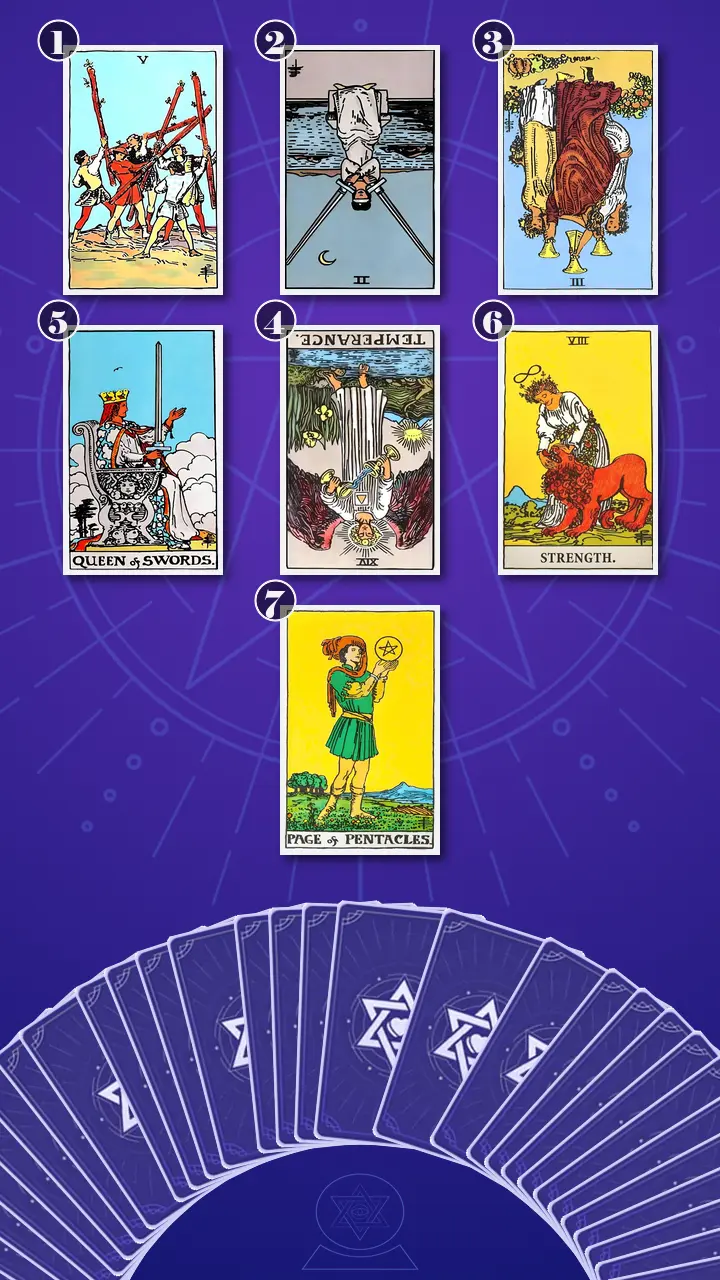
“Today,” I said, “we’ll use a spread I call the Energy Diagnostic Map (7) · Context Edition.”
For anyone reading along who’s ever Googled how tarot works in situations like friend-group drama: I chose this spread because a group chat blowup is not just one relationship issue. It’s a multi-voice social system plus an internal role identity—‘the mediator’—that keeps getting reinforced. This is the smallest structure that still captures: the visible conflict, the inner split, the social pressure field, the true sustaining blockage, and a next step that doesn’t require controlling other adults.
I previewed the map for Jordan in plain language. “The first card shows what the blowup looks like in real time. The next shows the tug-of-war inside you. Then the group pressure. Card four sits at the center—what keeps you stuck in mediator mode. Card five is your resource. Card six is the key transformation. And card seven is the one practical rule you can actually try.”
She swallowed and nodded like someone who’d been waiting for a plan that didn’t involve writing yet another flawless paragraph.
Reading the Weather: Conflict, Neutrality, and the Social Pressure Field
Surface energy: the blowup in real time — Five of Wands (upright)
“Now flipping over is the card that represents Surface energy: what the blowup looks and feels like in real-time behavior and tone.”
It was the Five of Wands, upright.
The image is a tangle—raised wands crossing, five figures all moving at once, no clear leader, no clear winner. And I told her exactly what I saw in modern terms, using the scene the card was already describing: Jordan opens the group chat after work and it’s pure overlap—five people replying at once, jokes turning sharp, someone quoting an old message, someone else dropping a sarcastic “k.” It’s not one villain—it’s competing perspectives fighting for airtime.
“This card isn’t calling you weak,” I said. “It’s showing you the weather. It’s loud. It’s messy. And because there’s no turn-taking, your body goes, ‘Someone has to moderate this.’”
Energetically, this is excess fire—too much heat, too much motion. Your impulse to mediate makes sense in a room like that. But the card also gently asks a question: are you trying to solve a problem, or are you trying to lower the volume of discomfort?
Jordan let out a little breath that sounded almost like a laugh. “That’s… brutal,” she said, and her eyes flicked away from the card. “It’s so accurate.”
Inner tug-of-war: the neutrality trap — Two of Swords (reversed)
“Now flipping over is the card that represents Inner tug-of-war: the split inside you that pulls you into the mediator role.”
The Two of Swords, reversed.
Blindfold. Crossed swords held tight across the chest. Still water behind her. It’s the posture of forced neutrality—until the neutrality starts to strain.
I mirrored the modern scenario the card was practically narrating: Jordan stares at the thread with a half-typed reply, trying to be perfectly fair. Her brain runs both sides like a courtroom, and silence starts to feel dangerous—like if she doesn’t move, the chat will spiral and somehow it’ll be on her. The longer she hesitates, the more likely she is to over-explain or drop a “final” paragraph that accidentally puts her at the center.
Reversed, the energy isn’t balance—it’s blockage. The swords aren’t protecting peace; they’re trapping her in a loop of hyper-monitoring and over-editing.
“This is decision fatigue,” I said. “Not because you can’t decide, but because you’re trying to decide in a way that keeps everyone comfortable and keeps you safe.”
Jordan’s fingers tightened around her phone without her noticing. “And I keep rewriting,” she admitted. “Like… five versions in Notes.”
“Of course you do,” I said. “Your nervous system thinks you’re drafting a document that determines belonging.”
External pressure: belonging, cliques, and side DMs — Three of Cups (reversed)
“Now flipping over is the card that represents External pressure: the group dynamics that make stepping back feel risky.”
The Three of Cups, reversed.
Upright, it’s friendship and celebration. Reversed, it’s what happens when the circle wobbles—when fun turns into alliance-testing and group energy turns sharp.
I used the card’s modern scenario almost word-for-word because Jordan’s face changed as I spoke: right after the blowup, she can practically feel the side DMs forming. Someone reacts to one person but ignores another; a private “are you okay?” message lands; the vibe shifts from group fun to subtle loyalty checks. Jordan feels pressured to respond fast so nobody misreads her silence as choosing a team—and that pressure makes her overparticipate until she’s drained.
Energetically, this is a distorted water current—connection mixed with social threat. The risk isn’t physical danger; it’s the fear of being iced out, quietly removed from plans, becoming “the bad guy” by silence.
Jordan’s mouth tightened. “It’s the screenshot thing,” she said. “Like anything I say could get forwarded out of context.”
“Exactly,” I said. “And when that fear gets loud, you start writing like you’re on trial.”
Core blockage: forced harmony as a job you never applied for — Temperance (reversed)
“Now flipping over is the card that represents Core blockage: the specific pattern that keeps you acting like the mediator even when it drains you.”
Temperance, reversed.
This is the pivot. The angel normally pours water between two cups with calm skill—blending, moderating, finding the right ratio. Reversed, that “blending” becomes over-functioning: trying to manufacture harmony by mixing everyone’s feelings until you’re depleted.
I held the card between us and let the imagery do what it does best: a mirror. “Here’s the split-screen I’m seeing,” I told her.
On the left: you DM Person A, softening Person B—editing their intent, translating their sharpness into something acceptable.
On the right: you DM Person B, softening Person A—diluting their frustration, asking them to rephrase, convincing them to ‘be the bigger person.’
And in the middle: you post the ‘balanced’ group message that tries to blend everyone’s perspectives into a single, reasonable narrative.
Then the line landed—clean, vivid, and a little painful: You keep transferring heat from one person to another until you’re the only one burning.
Jordan winced. Her hand went to her stomach like she was pressing down a flare of nausea. “Yep,” she said quietly. “And I still end up blamed anyway. Like… if it doesn’t resolve, it’s somehow because I didn’t say the right thing.”
“Temperance reversed is showing forced harmony,” I said. “Harmony you manufacture vs harmony a group earns through responsibility.”
I let my voice turn wry, the way it does when I’m naming an unfair contract. “It’s like being the group chat’s unpaid HR department. You’re doing the debriefs while everyone else just vents.”
In my mind—an old flashback from my cruise-ship years flickered: crowded lounge, a minor conflict at a table, everyone looking to the ‘staff’ to fix the vibe. On a ship, we had a protocol: you can de-escalate, yes, but you don’t become the social infrastructure. You don’t pour your whole shift into someone else’s argument and then wonder why you’re empty at midnight.
“You can care without carrying,” I told Jordan, and I watched her eyes soften like that sentence hit a place she hadn’t had language for.
Usable resource: clean language and scope — Queen of Swords (upright)
“Now flipping over is the card that represents Usable resource: the skill or inner capacity you can access without needing anyone else to change.”
The Queen of Swords, upright.
Her sword is vertical—clean separation. Her gaze is steady—no flinching, no over-editing. The sky behind her looks like a windy day that cleared the air.
I described the modern version of her, because Jordan lives in a world of screens and threads, not medieval thrones: Jordan drafts a boundary that fits in one screen—no apology tour, no ten lines of context. Something like: “I care about you all, but I’m not going to mediate—please address each other directly and kindly.” The Queen-of-Swords move is resisting the urge to manage reactions; Jordan lets the message be clear and stops trying to be liked into safety.
“Clarity isn’t cruelty,” I said. “It’s scope.”
Then I gave her the before-and-after, because this is where people get stuck:
Before: a 12-line diplomatic paragraph with caveats and emotional airbags. The kind that starts with “I just don’t want anyone to be mad…” and ends with you taking responsibility for everyone’s tone.
After: one sentence.
Jordan stared at the card and whispered, half to herself, “If I don’t explain, they’ll hate me.”
“That’s the old script,” I said. “And here’s the new one: Explaining isn’t the same as being understood. Your job is to communicate your role clearly and respectfully. Not to guarantee how it lands.”
Her shoulders dropped a fraction—like her body liked the idea even if her fear didn’t.
When Strength Spoke: The Moment You Stop Volunteering
Key transformation: calm courage in the typing bubble — Strength (upright)
“Now flipping over is the card that represents Key transformation: the quality that helps you step out of mediation while staying aligned with your values.”
The room got quieter in that way rooms do right before something true is said. Outside my window, a streetcar bell rang once—clean and distant—like punctuation.
It was Strength, upright.
In the card, the woman isn’t wrestling the lion. She’s not dominating it. She’s steady with it—hand gentle, presence calm. This is self-regulation over crowd control.
Setup (the familiar trap): I looked at Jordan and named the exact moment she’d described without shaming it. “You know that moment: 9:18 PM, dinner’s going cold, you’re rereading the thread from the top, and your thumbs hover over a ‘neutral’ paragraph like you’re the group chat’s overnight support line.”
She nodded, eyes fixed on the card as if it had been spying on her Notes app.
Delivery (the sentence that changes the angle):
Stop trying to tame the whole chat and start taming your impulse to rescue—like Strength, you hold the lion with steadiness, not force.
I let a beat of silence hang after it. Not dramatic. Just enough for her nervous system to hear there was another option.
Reinforcement (the body learns it first): Jordan’s reaction came in three layers, like a wave moving through her.
First: a tiny freeze. Her breathing paused mid-inhale, fingers suspended over her phone as if the typing bubble had appeared right here between us.
Second: her eyes unfocused for a second—like she was replaying Tuesday night on the condo couch, watching herself draft and redraft, watching the role click into place: mediator, translator, emotional infrastructure.
Third: the exhale. It wasn’t a sob. It wasn’t even a laugh. It was a quiet release from deep in the chest, the kind that makes your shoulders drop without permission. Her jaw unclenched. One hand opened, palm up, like she was finally putting something down.
“So… being a good friend doesn’t require being on-call,” she said, and there was relief in her voice—plus a thin edge of fear, like relief always has when it comes with change.
“Yes,” I said. “And here’s where I want to use a tool I teach that’s very practical.”
I leaned into my signature way of diagnosing social patterns—something I call Social Role Switching. “Right now,” I told her, “your nervous system flips you into ‘Mediator Mode’ automatically. It feels like loyalty. But it’s a role. Not your identity.”
“Strength is you choosing a different mode on purpose,” I continued. “Not ‘cold friend’ and not ‘disappearing friend.’ A Gentle Boundary-Holder. Steady instead of useful.”
Then I gave her an experiment straight out of the reinforcement plan, because insight needs a handle: “Set a 10-minute off-duty timer. Write—in Notes, not the chat—one clean boundary sentence you’d actually send: ‘I care about you all, but I’m not going to mediate—please address each other directly and kindly.’ Then put the phone face-down until the timer ends. If you notice your stomach tighten or your hands reach for the phone, name it once—‘rescue impulse’—and come back to the timer. If it’s too activating, do two minutes. The point is practice, not proving anything.”
Her brows knit. There it was—the unexpected reaction I was waiting for. Not disagreement with the logic, but resistance from real life.
“But I literally can’t,” she said, a flash of frustration rising. “Because if I leave it for even ten minutes, I’m scared someone’s going to say something nuclear. And then I’ll be blamed for ‘letting it happen.’”
I didn’t argue with her fear. I coached it. “Okay,” I said. “Then we scale it. Two minutes. And we build a script for the exact moment someone tries to recruit you. Strength isn’t about forcing yourself to be chill. It’s about being steady inside the discomfort.”
Then I asked the integration question that turns tarot into lived memory: “Now, with this new lens, think back—last week, was there a moment when your rescue impulse spiked, and if you’d waited even five minutes, the thread might have held its own tension without you?”
Jordan blinked, slow. “Yeah,” she said. “There was a pause. Like… people stopped typing for a bit. And I jumped in anyway because the silence freaked me out.”
“That’s the shift,” I told her. “Not from caring to not caring. From hyper-alert responsibility and belonging panic to calm self-trust and steadier boundaries.”
In other words: finding clarity isn’t fixing the group. It’s choosing yourself inside the group.
Next step: the small rule that makes it real — Page of Pentacles (upright)
“Now flipping over is the card that represents Next step: one practical boundary or habit you can implement the next time the chat escalates.”
The Page of Pentacles, upright.
This card is humble on purpose. It’s not a dramatic exit speech. It’s a person holding one coin with both hands, focused, learning by repetition. Earth energy: practical, measurable, repeatable.
I used the modern scenario the Page was offering: Jordan turns insight into a small system—one rule for the next blowup. Maybe it’s “wait 30 minutes before replying,” or “no replies after 9:30 PM,” or “mute for two hours after I state my boundary.” She treats it like practice—training, not a test of being a good friend—so the boundary becomes real through repetition, not one dramatic announcement.
“If your peace depends on everyone’s mood,” I said, “you’ll never get to clock out. The Page says: give yourself a rule that protects you even when you’re tired.”
From One Sentence to One Week: Actionable Advice for the Next Blowup
Here’s the story the whole spread told, in one thread: the chat gets loud (Five of Wands), and your brain tries to stay perfectly fair until it overloads (Two of Swords reversed). Then the social ecosystem kicks in—side DMs, fear of being misread, belonging pressure (Three of Cups reversed). So you start pouring between cups, translating adults to each other, manufacturing harmony to keep yourself safe (Temperance reversed). The exit ramp isn’t disappearing; it’s clean language (Queen of Swords), calm courage (Strength), and one repeatable rule (Page of Pentacles).
Your cognitive blind spot—the one this reading puts a spotlight on—is the quiet belief: “If I don’t regulate the emotional temperature, I’m not safe in this group.” The transformation direction is simpler, and harder: shift from managing everyone’s emotions to stating one clear boundary about your role and letting the group handle its own conflict.
To make that real, I offered Jordan a small set of moves—low-drama, high-impact—built from what I know works in tight social spaces (and yes, my cruise-ship years taught me that a “friendly room” can still become a pressure cooker in thirty seconds).
- The One-Sentence Boundary (copy/paste version)Write a 1–2 sentence boundary in your Notes app and keep it ready to paste: “I care about you all, but I’m not going to mediate—please address each other directly and kindly.” Use it only when the chat escalates—no extra context.Expect the “I’m being cold” guilt spike. That’s just your people-pleasing muscle firing. Keep the sentence pinned so you’re not composing under adrenaline.
- The Off-Duty Window (Strength practice)When the blowup starts, wait 30 minutes before responding. During the wait, do one grounding task (wash one dish, take a quick shower, stand by the window). If you respond, send only your boundary sentence—then mute the chat for 2 hours.If 30 minutes is too much, start with 10 or 2. Name the sensation once (“rescue impulse”), exhale slowly, shoulders down, and return to the timer.
- The No-Relaying Agreement (stop pouring between cups)Pick one “rule for the week”: no private relaying. If someone DMs “can you mediate?”, reply: “I care, but I’m not stepping into mediator mode. I trust you to talk to them directly.” You can listen to feelings—you just don’t carry messages.Use my ready-to-use script technique: make eye contact with yourself in the front camera if needed, slow your typing, and start with “I need…” or “I’m not able to…” Short beats safe.
I also suggested one piece of “Maritime Social Protocol” adapted for modern life: on a ship, we don’t argue the boundary mid-party. We state scope once, kindly, and we step back—because repeated justification is how you get recruited again. In friend-group terms: one clear message, then silence. Let the room learn it can hold tension without you.

A week later, Jordan messaged me from the TTC, Line 1 rattling in the background. “I did the 30-minute delay,” she wrote. “I muted for two hours. Nobody died. They actually talked to each other.”
Then she added: “I still felt the adrenaline when the typing bubble popped up. But I didn’t jump. I put my phone face-down. It was… weirdly empowering.”
Her update reminded me why I trust this work. Not because tarot makes conflict disappear, but because it helps people locate their lever: the one move that returns them to themselves.
Clear but not perfect, like most real growth: she slept a full night after the next mini-blowup, but the next morning her first thought was still, “What if they’re mad?”—and then she noticed it, exhaled once, and didn’t reach for the phone.
That’s a Journey to Clarity: not certainty, but ownership. You can care without carrying. And steady beats useful when the room is loud.
When the chat gets loud and your stomach tightens, it’s not that you love drama—it’s that part of you believes your belonging depends on keeping everyone calm.
If you didn’t have to earn your place by being the mediator, what’s one tiny boundary you’d want to try—just for the next blowup?