From Guilt-Fueled Yeses to Warm Boundaries at Work Parties—Without Going Cold

The Walking-LinkedIn-Button Moment on King West
If you’ve ever been at a Toronto work-adjacent party and someone corners you with “Can you intro me to your friend who works at…?” and your mouth says yes before your brain catches up—welcome to the walking-LinkedIn-button problem.
Jordan came to my consult with that exact look I recognize from a thousand after-events: mascara still on, phone still too close, shoulders still lifted like she’d been holding a smile in place for hours. She told me about 9:47 p.m. on a Thursday in a packed King West bar—the bass making the floor feel slightly sticky, a sweating glass cold against her fingers, her phone warm in her palm from checking names on LinkedIn like it was a scoreboard.
“Someone leaned in and said, ‘Can you introduce me to your friend at that company?’” Jordan said. “And my jaw did that thing. Like it locks. My chest braces. I smile like I’m fine… and my stomach drops.”
What she was describing wasn’t just “networking stress.” It was a whole-body reflex: being helpful and well-liked in social spaces, while also fearing being used as a networking tool—and judged the second she doesn’t comply.
Guilt was the main note in her system, but it didn’t feel soft. It felt like chewing on aluminum foil: the sharp irritation underneath, the self-doubt crackling over it, the resentment she tried to swallow fast so nobody could see it.
I nodded, slow. “We’re not here to make you colder,” I said. “We’re here to help you stay warm without being available on demand. Let’s give this fog a map—something you can actually use the next time someone asks in public.”

Choosing the Compass: the Relationship Spread · Context Edition
I’m Luca Moreau. I trained in Paris as a perfumer, and I’ve spent fifteen years watching how humans manage closeness—what we offer, what we withhold, what we give away too fast. Tarot, for me, works like sensory psychology: it’s a structured way to name patterns you’re already living, so you can change them on purpose.
I asked Jordan to take one breath in through her nose and one out through her mouth—nothing mystical, just a clean transition from “I’m in the party” to “I’m looking at the party.” Then I shuffled.
“Today we’ll use the Relationship Spread · Context Edition,” I said. “It’s a five-card cross: you, them, the dynamic, guidance, and then integration—how you actually hold the boundary in real time.”
For readers who wonder how tarot works in a situation like this: a boundary problem isn’t a single decision point. It’s repeated interpersonal pressure, plus the room’s unspoken rules. This spread is built to separate those layers—so you stop blaming yourself for the entire atmosphere, and start choosing what’s yours to carry.
I pointed to the invisible map the layout makes. “Card 1 shows your default role at parties—your automatic move. Card 3 sits in the center as the ‘rules of the room.’ And Card 4 is our north star: the boundary you need, in plain language.”
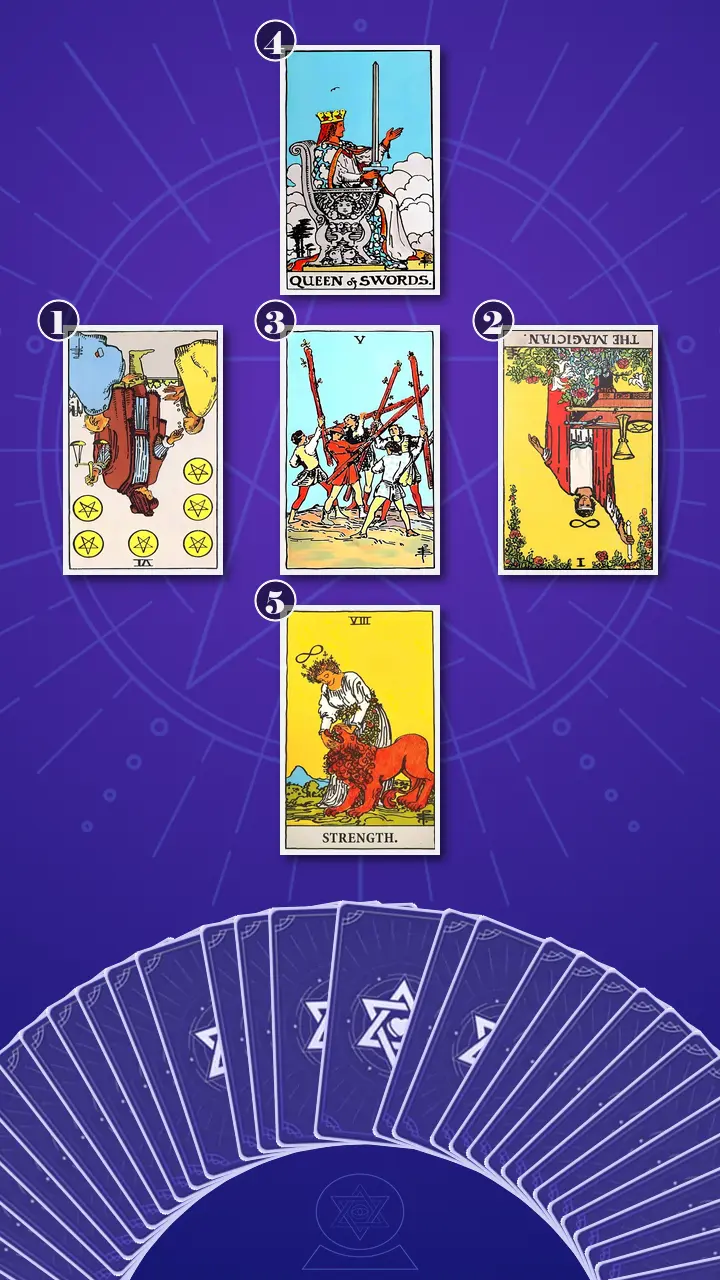
Reading the Map: Who’s Paying, Who’s Pushing, and the Arena You’re In
Position 1: Your default role at parties (the presenting problem in action)
“Now we’re turning over the card that represents your default role at parties and the specific over-giving behavior that keeps getting repeated,” I told her.
Six of Pentacles, reversed.
I didn’t have to reach for abstraction. The card already speaks fluent “work-adjacent party.” I said, “This is the moment someone asks for an intro and you say ‘Sure’ instantly—then you pay for it by hovering, doing emotional labor, and staying longer than you wanted so nobody feels awkward. You’re not just introducing; you’re silently vouching, moderating, and absorbing the risk if it goes weird.”
Reversed, the Six of Pentacles turns generosity into an imbalance—an invisible invoice. The giving happens fast, on cue. The cost shows up later: your energy, your time, your reputation anxiety.
Jordan gave a small, bitter laugh—one breath out through her nose like she couldn’t believe she’d been clocked so cleanly. “That’s… actually kind of brutal,” she said. “Because my brain is literally like: Sure—wait—how long will I have to stand here—what if it goes weird—what if they blame me? And my face is still doing ‘pleasant.’”
“Exactly,” I said, softening my voice. “You’re balancing scales no one asked you to hold.”
Position 2: Their approach (without assuming villainy)
“Now we’re turning over the card for their approach and what their repeated requests are trying to achieve,” I said.
The Magician, reversed.
I leaned in the way I do when I’m about to name something that relieves self-doubt. “This isn’t ‘they’re evil.’ This is: charm without clear ethics. Someone charismatic talks fast, name-drops, and frames their intro request like it’s a small, obvious next step—like you’re part of the process. It skips the part where they check whether you consent to lending your influence.”
Reversed, the Magician is energy that knows how to move a room—without necessarily taking responsibility for the ripple effects. It’s social sleight-of-hand: making their urgency feel like your obligation.
I gave her a spotlight question—simple, friendly, hard to argue with. “Next time: ‘What are you hoping to talk with them about?’”
Jordan’s eyes steadied. The tightness in her brow loosened a millimeter. “That would… change everything,” she said. “Because it forces the ask to be real. Not just vibes.”
Position 3: The shared dynamic (the unspoken rules of the room)
“Now we’re turning over the card for the social dynamic you’re both participating in—the rules of the room that make this feel like a test,” I said.
Five of Wands, upright.
I’ve always thought this card sounds like a party before it looks like one. “Clinking glasses. Half-heard job titles. Someone laughing a half-second too loud. People swapping numbers like they’re speed-running connection. That’s the vibe here,” I said. “The room becomes an arena—competitive, performative. Not because anyone is ‘bad,’ but because the environment rewards speed and visibility, not consent and fit.”
In that heat, your nervous system goes into survival-mode politeness: keep the vibe smooth, don’t be the bottleneck, don’t look stingy. Shoulders up. Breath shallow. Smile fixed.
Jordan nodded—not the frantic kind, but the kind that says, Oh. It’s not just me. “It’s like a high-stakes multiplayer lobby,” she murmured. “Everyone’s optimizing.”
“Yes,” I said. “And if it needs to be a public yes, it can be a private no.”
When the Queen of Swords Spoke: Standards Before Doors
Position 4 (Key Card): The boundary you need
“We’re turning over the most important card in this reading,” I said, and the room quieted in that subtle way it does when the truth is about to land. Even the radiator’s ticking sounded louder.
Queen of Swords, upright.
I exhaled once, like I was making space for clean air. “This is your boundary: consent, criteria, clean language. Introductions are selective endorsements, not automatic favors. You can be civil without handing over access.”
I watched Jordan’s posture—still a little braced, but listening. She was stuck in that familiar loop: I must respond quickly so I don’t look difficult. If I hesitate, I’m failing some social test. The party is loud, someone leans in smiling, and her body says yes before she chooses.
Stop treating an intro like a reflexive favor; start treating it like a deliberate choice—hold the sword of your standards before you open the door.
Jordan’s reaction came in layers—fast, honest, physical. First: a tiny freeze, like her breath paused mid-inhale and her eyes widened just enough to show it landed. Second: her gaze unfocused, not checking out, but replaying a memory—standing by the bar, phone in hand, someone saying her friend’s company name out loud like it was a spell. Third: the release—her shoulders dropped a fraction, her jaw unclenched, and she let out a breath that sounded like relief mixed with grief.
“But… if I do that,” she said, and there was a flash of anger under the guilt, “doesn’t it mean I’ve been letting people use me this whole time?”
I didn’t flinch. “It means you’ve been trying to buy belonging with access,” I said gently. “That’s not weakness. That’s a strategy you learned in an arena. And you’re allowed to upgrade it.”
This is where my Social Pattern Analysis clicks in—the way I would diagnose a hidden interaction barrier the same way I’d evaluate why a fragrance ‘turns’ on skin. “Notice the pattern,” I said. “Public ask. Time pressure. An audience. You go into ‘perform nice’ mode, and then you take responsibility for the outcome. That’s the hidden barrier: you’re treating a request like a test, not a choice. The Queen of Swords doesn’t argue with the room. She changes the rules for you.”
I leaned a little closer. “Now, use this new lens and tell me: last week—was there a moment where you said yes just because it was asked in front of other people? Where this standard would’ve let you breathe?”
Jordan swallowed and nodded once. “At that Queen West birthday,” she said. “I didn’t even want to. I just… didn’t want to look petty.”
“That’s the shift,” I told her. “From guilt-driven, approval-seeking compliance to calm, consent-based selectivity with warm boundaries. Warm doesn’t mean available on demand.”
Position 5: How you hold it in real time
“Now we’re turning over the card for how you hold the boundary in your body when the room pressure spikes,” I said.
Strength, upright.
“This is not aggression,” I said. “This is regulation. You don’t match their urgency. You breathe. You let one beat of silence exist. You repeat your standard once—no extra excuses.”
Jordan’s hand drifted to her jaw without her noticing. I saw her catch herself and lower it. The smallest proof that her body understood before her brain fully trusted it.
From Insight to Action: The Pause–Clarify–Choose Boundary
I gathered the cards into one story, the way I’d blend notes into something coherent.
Six of Pentacles reversed says you’ve been over-giving as a resource leak—dispensing access before you assess the real cost. The Magician reversed shows the style you’re up against: confident, fast, a little slippery with consent. The Five of Wands says the room itself is pressurized—an arena that makes boundaries feel like social risk. The Queen of Swords is the antidote: standards, not speeches. And Strength is the method: calm courage held in your body, not just your thoughts.
Your cognitive blind spot, Jordan, is thinking you have to keep the interaction smooth to keep your place in the room. But your place isn’t earned by being a networking shortcut. It’s earned by being a person with discernment.
Now I want your next steps to be small enough to actually happen—actionable advice you can use at the next event, not a personality transplant.
I also want to use my own toolkit here—because your presence is part of your boundary. In perfumery, dosage matters. Too much projection and people think you’re performing. Too little and you disappear. Boundaries work the same way: you’re calibrating your “sillage”—your social trail—so it’s warm, consistent, and not an open invitation.
- The Two-Sentence Pause (buy yourself a beat)At the next event, when someone asks for a warm intro, say: “I’m open to intros sometimes—what are you hoping to chat about?” Then: “Let me think about it and I’ll let you know.”Expect the pause to feel awkward. Awkward is not harm—it’s just silence your nervous system isn’t used to. You’re not deciding yes/no on the spot; you’re only buying time.
- The Fit-and-Consent Filter (one question, five seconds)Before any yes, ask: “What are you hoping to talk with them about?” Then do a five-second internal check: “Would I feel good if both of them told me later they met through me?” If it’s not a clear yes, defer: “I’ll think about it and circle back.”Keep it friendly. This is a fit-check, not an interrogation. If you feel yourself turning it into a cross-exam, return to one concrete question.
- The Clean No (protect relationships and energy)If you don’t want to do it, say: “I’m keeping intros pretty intentional, so I’m not going to connect you two—hope you understand.” Then use an exit line: “I’m going to grab water / say hi to someone—good to see you.”Repeat the standard once if they push. Don’t add extra reasons—reasons invite negotiation. Leaving is not rude; it’s resource management.
Jordan hesitated, then said the real obstacle: “But I genuinely don’t know if I can do this in the moment. Like… I freeze. I can’t even find five minutes to practice without feeling stupid.”
I nodded. “Then we make it smaller,” I said. “Tonight, do the two-minute version. Read your pause line once. Read your decline line once. Put one hand on your chest or jaw, exhale slower than you inhale for five breaths. Stop there. You’re not ‘desensitizing.’ You’re giving your nervous system a script you trust.”
“Context, capacity, consent—then connect,” I added, because the Queen of Swords loves a simple standard you can return to when the room gets loud.
If you ever want a structured way to reflect on this at home, you can use the Relationship Spread · Context Edition yourself: one card for your default role, one for their approach, one for the room dynamic, one for the boundary, and one for how to hold it. Five positions, one clear compass.

A Week Later: Leaving the Party With Energy Intact
Eight days later, Jordan messaged me after another event. Not an essay—just a screenshot of a Note titled “Intro Scripts,” and one line: “I paused. I asked what they wanted to talk about. And I said I’d circle back. I didn’t ‘manage’ anything.”
She added, almost as an afterthought: “I left at my planned time. I stood outside for two minutes by myself with water, feeling weirdly proud… and weirdly lonely. But my jaw wasn’t locked. I wasn’t drafting ‘Of course happy to connect…’ on the TTC home.”
That’s the quiet proof I look for. Not a perfect social life. Not a dramatic confrontation. Just a new relationship with choice—an intro isn’t a reflex. It’s a choice.
When you’re trying to stay warm and likable, even a simple “Can you intro me?” can hit like a test—your jaw tight, your chest braced—because saying no feels like risking your place in the room, not just refusing a favor.
If introductions were something you only did with full consent—context, capacity, and a genuine yes—what would change about how you walk into the next event?