From Hot-Faced Shame to Grounded Openness After a 👍 Text Reply

The 👍 That Hit Like a Spotlight
If you’re a late-20s London professional who can ship a product roadmap with confidence but freezes when someone replies 👍 to your vulnerable text, you already know what “texting anxiety” feels like in your body.
Jordan (name changed for privacy) sat down across from me with her coat still on, like she hadn’t fully decided whether to stay. She was 29, a product manager on a fast-paced team, the kind of person who can make a clean decision with three data points at work—and then lose an entire evening to one ambiguous reaction in WhatsApp.
She described it in a rush that sounded rehearsed. “I sent this… actually honest message,” she said, eyes flicking to her phone. “Not a novel. Just—real. And they reacted with a thumbs-up. That’s it. And now I feel… ashamed. Like I did something embarrassing.”
I pictured the scene before she even finished, because it’s so painfully specific it might as well be a modern rite: 10:46 PM on a Wednesday, on your sofa in a Zone 2 London flat, laptop still half-open on the coffee table while you toggle between WhatsApp and your Notes app—re-reading the vulnerable text you sent, then zooming in on the single 👍 like it’s a clue. The radiator ticks. Your phone screen is warm against your palm. Your chest feels tight while heat creeps up your neck. You want closeness so badly, but you also want to erase the part of you that asked for it.
Jordan swallowed. “A thumbs-up feels like getting patted on the head.”
What I heard underneath wasn’t drama. It was a nervous system trying to survive mixed signals. Her shame wasn’t abstract—it was physical: tight chest, sinking stomach, hot face, like she’d been caught doing something she wasn’t supposed to do.
I kept my voice calm. “A 👍 isn’t a verdict—but your nervous system can treat it like one,” I said. “And when it does, it can make your self-worth feel like it’s hanging on someone else’s reaction. Let’s not try to guess what they ‘really meant’ tonight. Let’s map what happens in you—so you can get back to self-respecting clarity.”

Choosing the Compass: The Four-Layer Insight Ladder
I asked Jordan to take one slow breath in, and a slower one out. Not as a mystical ritual—more like switching from “scroll mode” to “notice mode.” While she held the question in mind, I shuffled in the steady, practiced way my hands learned back when I worked markets: you don’t rush a signal you actually need.
“Today we’ll use a spread I call the Four-Layer Insight Ladder · Context Edition,” I told her.
For you reading along: this spread is designed for exactly this kind of problem—shame spirals after sending a vulnerable text and receiving only a thumbs-up reaction, leading to compulsive chat-checking, mental replay, and avoiding one direct clarifying question. It’s less about predicting what the other person will do and more about showing how tarot works as a practical tool: separating the surface sting from the deeper driver, then identifying the inner resource that changes the pattern, and translating that into one doable next step.
I laid six cards in a single vertical column, like rungs on a ladder—because the whole point is to climb out of the spiral.
“The top card,” I said, “shows your immediate reaction pattern right after the 👍—the observable loop.”
“The next two go deeper—what mechanism hooks you, and what fear sits underneath.”
“Then we’ll hit the turning point—your antidote. After that: one clean action for communication clarity, and finally what integration feels like when it’s working.”
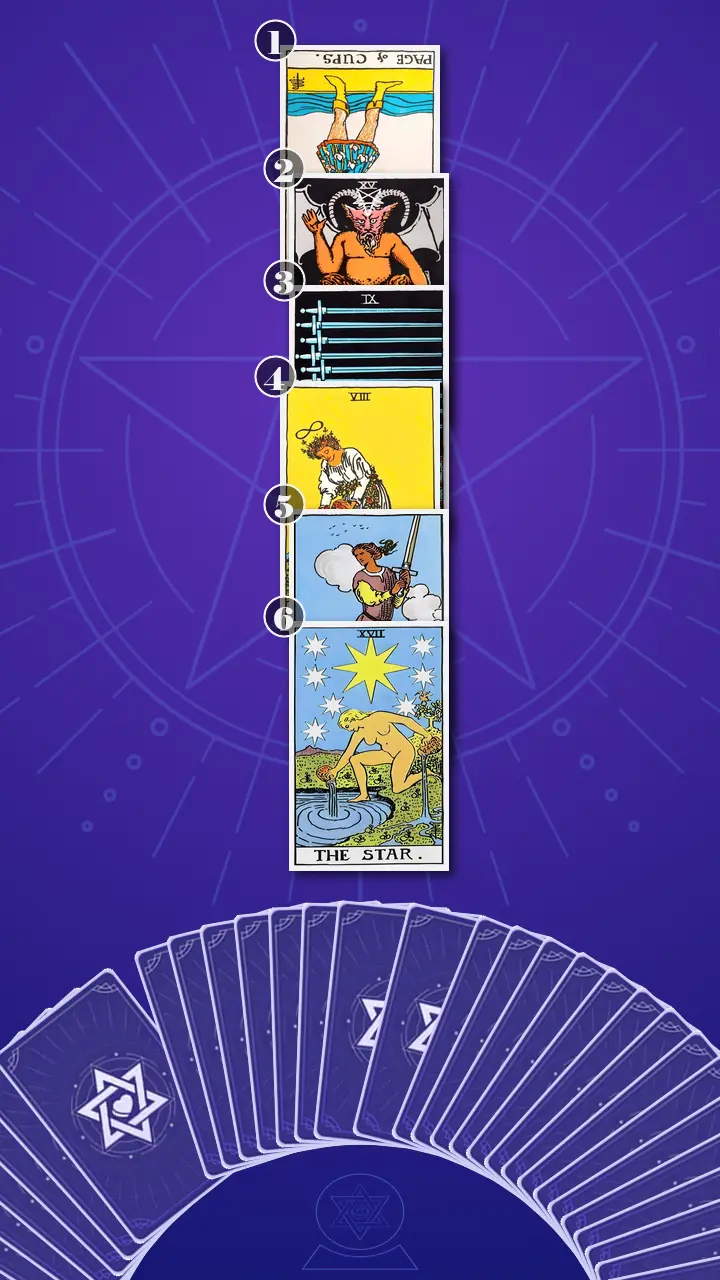
Reading the Map: From Post-Vulnerability Crash to Clarity
Position 1: The Moment of Impact
“Now turning over,” I said, “is the card that shows the observable reaction pattern right after the 👍 and the kind of vulnerability that feels exposed.”
Page of Cups, reversed.
I watched Jordan’s eyes sharpen, like she was trying to stay composed while something in her braced.
In modern life, this card is painfully literal: You hit send on a tender, honest message—then immediately regret your own sincerity. When the only response is a 👍, you start editing your personality in real time: rereading your text, cringing, and drafting a ‘lol never mind’ follow-up in Notes because it feels safer to shrink your feelings than to risk being seen.
“That fish popping out of the cup,” I said, tapping the air above the card, “is the sudden surge of extra feeling that shows up after you press send. Not because you did something wrong—because you were unarmored. Reversed, the Page isn’t ‘bad at emotions.’ It’s emotion plus instant self-consciousness.”
Energetically, it’s a blockage: openness tries to move forward, but it flips into shame and self-editing before it can land anywhere.
Jordan gave a small laugh that sounded like it had edges. “Okay,” she said, looking away for a second. “That’s… too accurate. Like, rude.”
“That reaction makes sense,” I told her. “And I want you to notice the difference between what happened and what your inner narrator did with it. You shared something real. Then the mind tried to protect you by rewriting your story.”
“Playing it cool can be a coping strategy, not a personality,” I added gently. Jordan’s mouth tightened like she’d been caught doing exactly that.
Position 2: The Root Hook
“Now turning over,” I said, “is the card that reveals the attachment-to-outcome mechanism: what the 👍 gets linked to in your mind about worth and safety.”
The Devil, upright.
In real life, this looks like: The 👍 becomes a hook: your mind treats it like a ranking of your worth. You start acting like you need to earn a ‘better’ response—by performing chill, withholding, or rewriting your message—when the real trap is outsourcing your safety to someone else’s minimal effort.
“The chains in this card are loose,” I said. “That’s the detail people miss. You’re not trapped by their reaction. But The Devil is the part of the mind that says: ‘Treat this tiny signal like a performance review you didn’t consent to. If you can decode it, you can control whether you’re safe.’”
I felt my old Wall Street brain flare for a second—an internal flashback to sitting under fluorescent lights, watching a number tick one basis point and feeling my whole body tense, like the market was judging my worth. I’d learned the hard way that when you hand your nervous system to an external feed, you become refreshable.
“In my work before tarot,” I said, “we’d call this an external scorecard. The trouble is, you’re using a thumbs-up reaction as a safety score.”
Jordan nodded once—small, startled—like the pattern had been named precisely enough to stop being fog.
Position 3: The Shadow Fear
“Now turning over,” I said, “is the card that names the feared consequence you’re trying to prevent by not asking directly and by self-editing.”
Nine of Swords, upright.
This is the 2 a.m. mental replay card, and it doesn’t need much translation: You lie awake, hot-faced, running the message back like a security camera clip, imagining how you looked, how they’ll tell their friends, how you ‘ruined the vibe.’ Nothing new has happened—yet your brain turns ambiguity into a full sentencing.
Energetically, Nine of Swords is excess—too much Air, too much mind, turning sharp and repetitive instead of useful. It’s not insight; it’s self-prosecution.
“This is your inner courtroom,” I said, and I let the room go quiet enough for that to land. “And if we wrote the transcript, it would sound like this.”
Accusation: ‘You revealed too much.’
Evidence: ‘They reacted with 👍.’
Conclusion (with no additional facts): ‘They think you’re needy.’
Sentence: ‘Now you have to disappear, or perform chill, or punish yourself until you feel “balanced” again.’
Jordan’s fingers tightened around her mug, then relaxed. Her eyes flicked down to the card and back up to me. It was the look of someone realizing they’ve been arguing with themselves in the dark and calling it “being realistic.”
“So the worst outcome isn’t even what they do,” I said. “It’s what you do to you afterward.”
When Strength Spoke: The Gentle Grip That Changes Everything
Position 4: The Antidote
I turned the next card slowly. “We’re opening the turning point now—the medicine, the inner resource that dissolves shame and restores self-trust.”
Strength, upright.
In modern life: Instead of trying to delete the feeling or fix the interaction perfectly, you treat yourself like someone worth protecting. You let the shame spike exist without obeying it, and you choose one steady move—pause, breathe, and decide from self-respect rather than panic.
Strength is not force. It’s not “stop feeling this.” It’s a balance of courage and gentleness—holding the lion’s mouth with calm hands, not wrestling it to the ground.
Here’s the setup I named for Jordan, because it was already playing in her body: it’s late, she’s on the sofa with the phone glow on her face, and she keeps tapping back into the thread like one more look will finally tell her what the 👍 “really meant.” She wants certainty so badly she’s willing to put herself on trial to get it.
Not ‘I need to stop feeling this’—choose steady courage and self-compassion, like Strength holding the lion with gentleness instead of force.
I let the sentence sit between us for a beat, the way you let a truth settle when you know someone’s been sprinting mentally for hours.
Jordan’s reaction came in a sequence—fast, physical, honest. First: her breathing stalled, just a hitch, like her body paused to check whether this was safe. Second: her gaze unfocused for a moment, like she was replaying last night’s scroll-and-cringe loop on a projector inside her head. Third: her shoulders dropped, not dramatically, but enough that I could see the effort she’d been holding in her neck.
She put her palm against her sternum without thinking. “I keep trying to… fix it,” she said, voice smaller now. “Or fix me.”
“Exactly,” I said. “And here’s the reframe I want you to keep.”
Your vulnerability isn’t the problem; the self-punishment you add afterward is.
This is where I used one of my own frameworks—not because your heart is a spreadsheet, but because sometimes a clean model interrupts a shame fog. “In my work, I use something I call Influence Credit Scoring,” I told her. “It’s a five-tier way to measure how much power you’re giving someone’s signal over your choices.”
“Right now,” I said, nodding toward her phone, “you’re treating that 👍 like a Tier 5 verdict—highest authority. Like they get to assign your value. Strength says: downgrade that signal. Not with bitterness—just with accuracy. A one-tap reaction is Tier 1 or Tier 2 information. It can mean ‘got it.’ It can mean ‘busy.’ It can mean ‘avoidant.’ It cannot be allowed to become a sentencing document.”
Jordan blinked hard, as if she was trying not to cry and not to laugh at the same time. “But if I stop punishing myself,” she said, a flash of irritation crossing her face, “doesn’t that mean I’ve been doing it wrong this whole time?”
There it was—an unexpected flare of anger, not at me, but at the idea that she’d suffered unnecessarily.
“It means you’ve been trying to stay safe with the tools you had,” I said. “And now you’re upgrading the tools. Strength isn’t an apology for the past. It’s a decision about what happens next.”
I leaned in slightly. “Now, with this new lens—can you think of a moment last week where this would have changed how you felt? Where, instead of refreshing the thread, you could have said, ‘I’m allowed to want clarity’?”
Jordan stared at the card, then nodded. “On the Tube,” she said quietly. “I kept checking like it was… a delivery tracker. Like my self-worth was on the map.”
“That’s the shift,” I told her. “This isn’t just about one emoji. It’s a move from shame-driven self-prosecution under ambiguity to self-compassionate, self-respecting clarity in communication.”
Position 5: The One Clean Sentence
“Now turning over,” I said, “is the practical move aligned with Strength—one doable communication step that invites clarity without self-abandonment.”
Page of Swords, upright.
In modern life: You trade mind-reading for one clean question. A simple follow-up—curious, not accusatory—cuts through hours of guessing: ‘Hey, I wasn’t sure how that landed. Are you up for talking about it?’ Then you stop hovering over the thread and let their response be information, not a verdict.
Energetically, this is balance again—Air used as discernment, not as a weapon against yourself. It’s the same mind, but it stops being a prosecutor and becomes a communicator.
“Stop decoding the reaction. Start naming the need,” I said, because Page of Swords is the exact opposite of zooming in on a reaction like it contains hidden meaning.
Jordan’s face tightened. “If I ask, I’ll look needy.”
“You’ll look clear,” I said. “Clarity is not neediness. It’s communication.”
I wrote two example texts on a card for her, same meaning, different tones—then circled the simplest one:
“Hey—just checking. I wasn’t sure how that landed. Are you up for talking about it?”
And, for the ultra-simple version:
“Can you tell me what you meant by the 👍? I wasn’t sure how to read it.”
She stared at the sentences like they were a door she’d been afraid to try.
Position 6: The Aftercare Anchor
“Now turning over,” I said, “is what stabilizes the change—what it feels like when you return to yourself after you act.”
The Star, upright.
In modern life, this is the quiet part people skip: After you act (or choose not to), you return to yourself. You do something small that tells your body, ‘We’re safe’: make tea, take a short walk, wash your face, put your phone on charge across the room. You hold hope without begging for certainty, and you remember you can be open-hearted without being at the mercy of someone’s texting style.
Energetically, The Star is renewal—Water that’s clean again, not turned inward into shame. It’s hope without delusion, steadiness without pretending you don’t care.
Jordan nodded slowly. “So even if they don’t answer…”
“You still come back to you,” I said. “That’s the whole point.”
The One-Page Plan for Finding Clarity (Without Begging)
I summed it up for Jordan the way I’d summarize a messy market day: not with blame, with structure.
“Here’s the story the spread tells,” I said. “You sent something tender (Page of Cups reversed), and ambiguity triggered the hook—your worth got tied to their response (The Devil). Under that, the real fear isn’t ‘they’ll think I’m too much’; it’s ‘I’ll put myself on trial and punish myself all night’ (Nine of Swords). Strength is the pivot: you meet the shame spike with self-compassionate courage instead of self-attack. Then Page of Swords gives you one clean clarity move, and The Star is the aftercare that teaches your nervous system: vulnerability is survivable.”
“Your cognitive blind spot,” I told her, “is thinking the shame is evidence you did something wrong. It’s not. It’s a signal that you care and you feel exposed. The transformation direction is simple but not easy: move from decoding their reaction to naming your need and choosing self-respecting communication.”
Then I gave her the smallest possible next steps—because the fastest way out of decision fatigue is a tiny, clean experiment.
- The Strength PauseBefore you open the chat thread again tonight, put your phone face-down, place one hand on your chest, take three slow breaths, and unclench your jaw. Then write one line in Notes: “What I need is ___.”If it feels silly, make it 60 seconds. This isn’t to force a reply—it’s to stop putting yourself on trial.
- The Cocktail Party Algorithm (One-Sentence Clarity Move)Send one message using a three-phase template: (1) Warm opener, (2) Clear context, (3) Simple invite. Example: “Hey—just checking. I wasn’t sure how that landed. Are you up for talking about it?” Then stop. No second message.Read it out loud first. If it sounds curious and respectful, it’s ready. No defending, no apologizing for having feelings, no essays.
- The No-Thread-Checking WindowAfter you send (or decide not to), set a 20-minute timer and physically move your body: wash dishes, take a quick shower, or walk around the block. Let your nervous system learn that uncertainty is not an emergency.If you fail and check anyway, don’t restart the shame loop. Just reset the timer once. Practice beats perfection.

A Week Later: Ownership, Not Certainty
A week later, Jordan messaged me. Not a long update—just a screenshot and one line: “I did the Strength Pause, sent the one sentence, and put my phone on charge across the room like you said.”
Her follow-up text was calm. Their reply wasn’t perfect, but it was real. And even if it hadn’t been, she’d done the part that mattered: she stopped treating ambiguity like permission to be cruel to herself.
In her last message to me she admitted something bittersweet: she’d celebrated by sitting alone in a café after work, tea in both hands, watching people rush past the window. “I still had the ‘what if I’m too much?’ thought,” she wrote. “But it didn’t own the whole night.”
That’s what a Journey to Clarity looks like in real life. Not certainty on demand—ownership of your voice, and a nervous system that can stay open without putting you on trial.
When you finally share something real and all you get back is 👍, it can feel like your face goes hot and your chest locks up—like wanting to be seen and fearing humiliation are happening in the same breath.
If you didn’t have to decode the 👍 at all, what’s the smallest, most self-respecting way you’d name what you need—one clear question, or one calm pause—just for tonight?