I Drafted a Breakup Text After 'Seen'—Then Tried One Honest Line

Finding Clarity in the 8:47 p.m. TTC Refresh
If you’ve ever opened your Notes app to draft a breakup text after a single delayed reply—welcome to the anxious attachment + texting anxiety spiral.
Taylor (name changed for privacy) sat across from me in my little studio office in Toronto, coat still half-on like she might bolt if I asked the wrong question. She was twenty-eight, the kind of woman people describe as “capable” at work—quick Slack replies, crisp meetings, a calendar that looks like a color-coded fortress. And yet her hands kept sliding back to her phone like it was hot.
“It’s embarrassing,” she said, voice steady in the way people sound when they’re trying not to sound like anything at all. “One weird pause, one ‘seen’ with no reply, and I’m… already packing.”
I pictured what she’d described in her intake note—8:47 p.m. on Line 1 heading home. The train rocking, fluorescent lights buzzing overhead, her phone warm from constant refreshing. One small digital cue—seen—and her throat tightening like a drawstring, stomach going sharp, brain stacking backup plans like Tetris: gym, laundry, early sleep. Not because she loves routine. Because wanting someone feels like standing in open air without a coat.
“So the question is…” she glanced down, thumb hovering over the screen like a nervous tic. “What abandonment story is driving my reaction? Because I hate that I’m always ready to leave. I want intimacy, but my body reacts like it’s danger.”
There’s a particular kind of anticipatory dread that shows up in the body before it ever becomes a thought—like your nervous system has already written the ending and stamped it URGENT. It makes you efficient. Detached. “Fine.”
I leaned forward, keeping my tone soft and plain. “I believe you. And I’m not going to treat that reaction like drama. We’re going to treat it like information. Let’s try to map the pattern—so you can choose what you do next, instead of the fear choosing for you.”

Choosing the Map: The Four-Layer Insight Ladder Tarot Spread
I asked Taylor to take one slow breath in through her nose and out through her mouth—not as a ritual for the universe, just as a handrail for the nervous system. As I shuffled, I slid a fragrance blotter across the table the way I would in a perfume evaluation. “If it helps,” I said, “pick a scent you like—something neutral. We’re not doing magic. We’re giving your body a steady sensory anchor while we talk.”
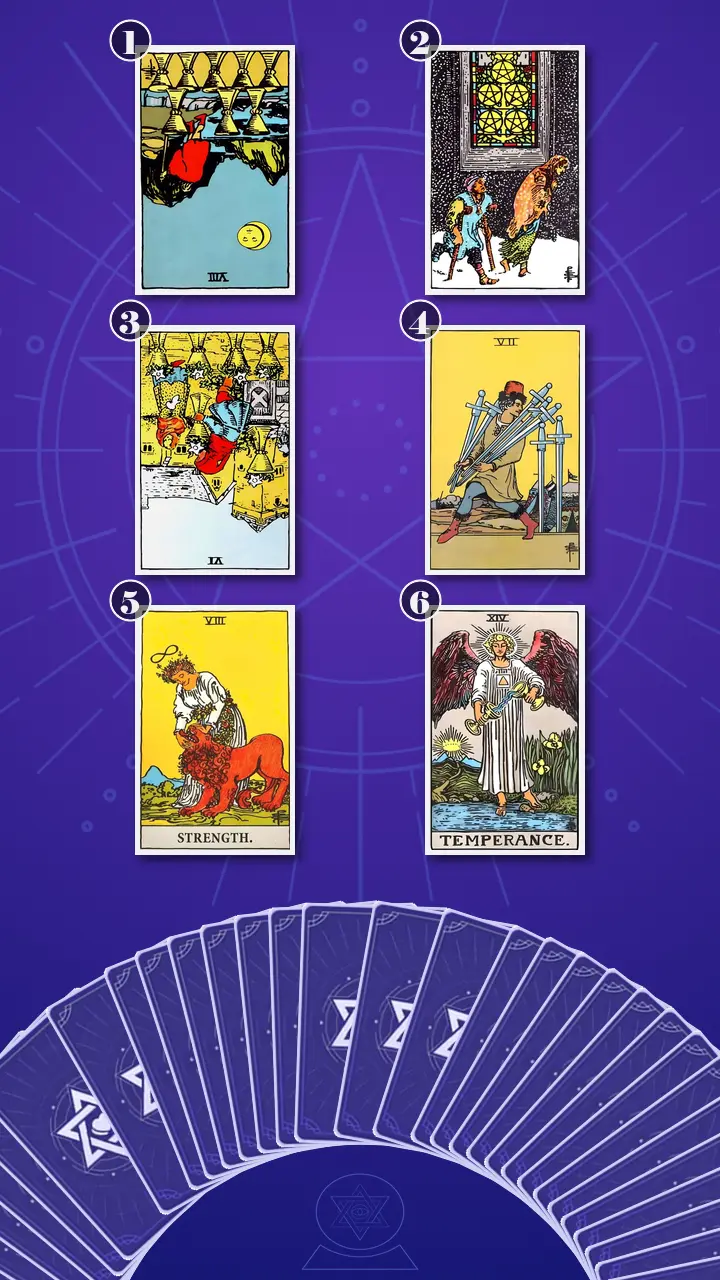
For this reading, I chose a spread I use constantly for relationship patterns and abandonment triggers: the Four-Layer Insight Ladder · Context Edition. It’s a compact 6-card tarot spread laid out as a 2x3 grid—like a ladder you descend from reflex into choice.
Here’s why it works for a “suitcase by the door” reflex: it starts with what you do on the surface, then pinpoints the exact modern trigger that lights you up (texts, tone, scheduling), then traces the intensity back to an older imprint. Only after that do we name the protective strategy—and then, crucially, we end on capacity-building and a practical integration step. No fatalistic “this means they’ll leave.” Just: this is the loop, and here’s how you interrupt it.
I pointed to the empty spaces as I spoke. “Top row: your surface reaction and what triggers it. Middle row: the origin story and the protective strategy. Bottom row: the healing resource and the next step you can actually practice this week.”
Reading the Ladder: The Exit Plan, the Cold Trigger, the Old Script
Position 1 — Surface reaction: the observable “suitcase by the door” behavior
“Now flipping,” I said, “is the card that represents your surface reaction: the visible ‘suitcase by the door’ behavior and the immediate impulse it creates.”
Eight of Cups, reversed.
Even before I spoke, Taylor’s jaw tightened in recognition. The image is a cloaked figure walking away at night—cups stacked behind them, mountains in the distance. Reversed, it’s not a clean departure. It’s the energy of almost leaving. Half-in, half-braced.
“In modern life,” I said, “this is when you’re not fully breaking up and you’re not fully in it either. You sense a tiny temperature change—slower texts, less warmth—and you start acting like you’ve already been left. Shorter replies. Fewer bids. More ‘I’m busy anyway.’”
I kept my tone precise. “Energetically, reversed here reads like a blockage. The part of you that craves secure closeness is blocked by the part of you that thinks closeness is a setup.”
Taylor let out a small laugh—one of those half-laughs that arrives with a sting. “That’s… rude,” she said, looking at the card like it had accessed her search history. “Like, yes. The second I start to care, I feel stupid.”
“Your suitcase isn’t drama,” I said, letting the words land gently. “It’s a strategy.”
And in my mind, I saw the split-screen the cards were already building: Left side: the body—tight throat, phone in hand, refreshing. Right side: the strategy—opening Notes, drafting the clean ending, suddenly becoming booked and breezy. ‘I’m fine’ out loud versus ‘I’m bracing’ inside. Intimacy versus control. Tenderness versus logistics.
Position 2 — Trigger cue: what activates the abandonment alarm
“Now,” I said, “this card represents the trigger cue: what specifically activates the abandonment alarm in everyday modern life—texts, tone, scheduling, social signals.”
Five of Pentacles, upright.
Two figures in a snowstorm. A warm stained-glass window nearby. It’s one of the most somatic cards in the deck for scarcity and exclusion.
“A late reply isn’t a verdict—your nervous system just treats it like one,” I said, because sometimes naming it plainly is the first mercy.
I watched Taylor’s shoulders rise and hover as if she were bracing for cold air. “This card says your trigger-state isn’t just mental. It’s temperature,” I continued. “A delayed reply drops you into scarcity. Chest tight. Stomach keyed up. Jaw set. Restless urge to do something—anything—to get out of the feeling.”
“It’s like,” she said, then stopped. Her fingers pressed briefly to the base of her throat.
“Like you’re outside a lit café in winter,” I offered, “and you decide you don’t deserve to go in before anyone even told you the door was locked.”
Her exhale came out slow, as if her body had been waiting for permission to put the weight down. She nodded once, small. The resonance here wasn’t intellectual; it was physical.
Position 3 — Origin story: the older attachment imprint
“Now we go deeper,” I said. “This card represents the origin story: the older attachment imprint your current trigger is borrowing its intensity from.”
Six of Cups, reversed.
Upright, it can be sweetness and memory. Reversed, it often points to a past that’s either edited or unresolved—where the story you tell yourself leaves out what was missing.
“This isn’t only about today’s text,” I said. “It’s about an older template that taught you: closeness can change without warning. So when a normal wobble happens now, your system reacts with the intensity of then.”
Taylor’s eyes went a little unfocused, the way they do when someone is replaying a scene they don’t fully want to admit they still carry. She didn’t give me a dramatic childhood monologue—most high-functioning people don’t. She gave me one sentence, and that was enough.
“I learned to… not ask,” she said quietly. “Because asking made things worse. Or it made me look… pathetic.”
“That makes sense,” I said. “If you learned that needing was unsafe, your brain will treat ‘I want you’ as a risk signal.”
I could almost hear the loop clicking into place: Trigger (they’re less available) → Belief (“If I need them, they’ll leave”) → Behavior (pull back, detach, pack the suitcase) → Relief (control returns) → Cost (less intimacy, more ambiguity) → belief strengthens (“See? People don’t stay”).
Position 4 — Protective strategy: control-through-distance
“Now,” I said, “this card represents the protective strategy: what you do to feel in control when the alarm is on—how you pre-empt closeness.”
Seven of Swords, upright.
The figure on the card is carrying swords away while looking back. It’s not villainy. It’s strategy. It’s the quiet exit plan.
“This is what I call exit-plan competence,” I said, without judgment. “Like saving a draft email you never send—just having it there makes you feel less trapped.”
I made it concrete, because this is where people finally feel seen: “Delayed replies on purpose. Calendar-filling. The ‘low effort’ posture. Telling yourself you’re just independent—while privately drafting the breakup speech in Notes.”
Taylor covered her mouth with her hand, and another laugh escaped—this one half relief, half horror. “The Notes app part is… too real.”
“Control-through-distance still costs you closeness,” I said. “It gives you short-term relief, but it also teaches the other person they can’t reach you. And then your fear goes, ‘See? I knew it.’”
She stared at the spread, and I could see the split-screen again: Body—cold, tight, braced. Strategy—cool, busy, unbothered. The contradiction wasn’t a personality flaw. It was a system.
When Strength Put a Hand on the Lion
Position 5 — Healing resource: the inner capacity you can build
I let the room go a little quieter before turning the next card. The buzzy city sounds outside my window—streetcar bell, distant traffic—felt suddenly far away, like we’d stepped into a smaller, truer space.
“We’re turning over what I consider the core card of this reading,” I said. “This one represents your healing resource: the inner capacity you can build so fear doesn’t make the decision.”
Strength, upright.
The image is simple and almost shocking in how gentle it is: calm hands on a lion, an infinity symbol above the head. Not domination. Regulation. Relationship with instinct.
“Strength isn’t being unbothered,” I said. “It’s staying present while you’re bothered.”
Before I went any further, my perfumer’s brain caught a detail I’d noticed when Taylor walked in: she wore a clean skin-musk—soft, close, almost like warm laundry. Not loud. Not demanding. The kind of scent that disappears unless someone leans in.
This is where my Attraction Analysis often adds a lever of clarity. I asked, “When you’re triggered—when the abandonment alarm hits—do you reach for scents that feel clean and self-contained? Like you’re making yourself… un-grabbable?”
Taylor blinked. “I… yeah. I hate anything too sweet. Anything that feels like it needs attention.”
“That’s not random,” I said. “Fragrance preference can mirror relationship strategy. Clean musks are beautiful—quiet intimacy. But in a trigger-state, ‘clean’ can become ‘untouchable.’ Like: if I stay neutral, nobody can accuse me of wanting.”
Her posture shifted—tiny, but real. A micro-softening at the shoulders.
The Aha Moment (Setup)
This was the exact TTC moment she’d described: the ride home where she refreshes messages, sees “seen,” and her chest tightens—so she starts stacking backup plans: gym, laundry, early sleep. Not because she loves being efficient, but because wanting someone feels like standing in open air. In her head, safety had become synonymous with leaving first.
The Aha Moment (Delivery)
Stop treating your fear like a fire drill and start treating it like a lion you can soothe—Strength turns the packed suitcase into calm, honest presence.
I let a beat of silence sit there, like a drop of perfume settling onto skin.
The Aha Moment (Reinforcement)
Taylor’s reaction came in layers—the way truth usually arrives when it’s finally safe enough to land.
First: her breathing froze for a second, like she’d been caught doing something in a mirror. Her fingers stopped moving. Phone face-down. Still.
Second: her eyes went distant, not dissociated—more like she was running a quick internal replay. You could almost see the scenes flicker: the “no worries :)” text, the delayed replies on purpose, the Notes app bunker, the calendar filling up like sandbags against a flood.
Third: the release. Her shoulders dropped a fraction. Her mouth opened, then closed, then she let out a breath that sounded like the first time you exhale after realizing you’ve been holding your breath for an entire conversation.
“But… if I don’t leave first,” she said, and there it was—an unexpected edge of anger, not at me but at the whole unfair architecture of it—“doesn’t that mean I was wrong? Like I did all of that for nothing?”
I shook my head. “No. It means you were brilliant at surviving. Your system built an alarm and an evacuation plan. We’re not shaming the plan. We’re updating it.”
I slid the blotter strip closer. “Strength is you learning to soothe the lion—your body—before you text. Not to perform chill. Not to flood. Just to stay present long enough to make one honest bid for connection.”
Then I gave her a practice, because insight without a next move can turn into another kind of spiral. “Try this as a 10-minute Strength Pause—stop anytime if it ramps you up too much.”
“Set a 3-minute timer,” I said, demonstrating with my own hands: one on chest, one on lower belly. “Breathe slower than you want to. Then write the message you’re tempted to send—the clean exit, the ‘no worries’ vibe. Under it, write one lower-drama truth that doesn’t plead or accuse: ‘Hey—my brain’s doing the thing. Are we still on for tonight?’ Or: ‘Can you give me a quick heads up if plans change?’”
Her eyes glistened—not cinematic tears, just that thin brightening that comes when someone is finally allowed to be honest without being made wrong for it.
I asked the question I always ask at this point, because it turns insight into lived memory: “Now, with this new lens—can you think of last week, any moment where this would have changed how you felt?”
She nodded, swallowing. “Wednesday,” she said. “Line 1. I literally wrote the breakup text. I didn’t send it, but I wrote it. And then I acted busy for two days.”
“That’s the shift,” I said softly. “This isn’t about predicting whether someone will stay. This is about moving from hair-trigger dread and control-through-distance to steadier self-trust and calm, honest bids for connection—one moment at a time.”
Position 6 — Integration step: the next small practice
“Last card,” I said, “represents the integration step: the next small, actionable practice to retire the exit-plan habit and build secure relating.”
Temperance, upright.
The angel pours between two cups—measured, steady. One foot on land, one in water. A path leading to a distant crown. It’s pacing. Calibration. The opposite of emergency evacuation.
“Temperance is the middle temperature,” I said. “Not flooding—sending five texts, over-explaining, chasing certainty. And not freezing—silent treatment, disappearing, turning cold. It’s one clear sentence, then waiting without punishing.”
I couldn’t help a small internal flashback to my training in Paris, weighing materials on a scale so sensitive it could register a single drop. Too much of one note and the whole fragrance collapses. Temperance is that kind of craft: not less feeling, but better proportion.
“One clear sentence beats a whole disappearing act,” I added, and Taylor’s mouth twitched like she might finally believe it.
The One-Page Plan: From ‘Suitcase’ to One Clear Sentence
I leaned back and traced the story the spread had told, so Taylor could hear it as one coherent narrative instead of six separate cards.
“Here’s the arc,” I said. “When closeness starts to feel real, Eight of Cups reversed shows you going half-packed—ready to leave, not because you don’t care, but because caring feels dangerous. Five of Pentacles is the trigger-state: the body goes ‘outside in the cold’ from one ambiguous cue, like ‘seen’ or a reschedule. Six of Cups reversed says that intensity is borrowed from an older lesson—closeness wasn’t stable, and needing felt risky. Seven of Swords is the coping tactic: control-through-distance, exit-plan competence, the Notes app bunker. Then Strength arrives as the antidote: regulate, soothe the lion, and stay present long enough to be honest. Temperance is how you practice it—small, paced experiments with connection.”
“Your cognitive blind spot,” I continued, “is that the suitcase reflex feels like self-respect, but it’s often self-abandonment in a nicer outfit. The transformation direction is exactly what Strength and Temperance offer: from pre-emptive withdrawal to one small, direct bid for connection at the moment you feel the urge to detach.”
Taylor made a face—half cringe, half fear. “But what if I can’t do it in the moment?” she asked. “Like, I can’t even find five minutes because I’m commuting, or I’m in a meeting, or I’m just… spiraling.”
“That’s real,” I said. “So we lower the bar. We make it one sentence. We make it two minutes. We make it something you can do on a platform, in a washroom stall, or while your kettle boils. The goal isn’t perfection. It’s: don’t abandon yourself first.”
Then I gave her the actionable advice—simple enough to start, structured enough to trust.
- The 20-Minute Exit-Text DelayWhen you feel the urge to send the clean ending (“all good, we can stop this”), wait 20 minutes first. Put your phone down and do one physical reset: wash one dish, take a quick shower, or walk around the block before you type anything.If 20 minutes feels impossible, do the “2-minute version”: one slow exhale longer than your inhale, five times. The point is to interrupt the fire-drill feeling.
- The One-Sentence BidSend one plain check-in when you notice yourself going cold: “Hey, checking in—are we still on for tonight?” or “No rush—just want to know what to expect so I can plan my evening.”Make it easier by pairing it with a sensory anchor: dab your signature scent on your wrist and inhale once before you hit send. Then set a 30-minute no-check window (Focus mode) so you don’t turn the bid into a monitoring job.
- The ‘Then vs Now’ Two-Column CheckWhen the old story flares, take 5 minutes to write: “What happened then” vs “What is happening now.” List three concrete differences between the past situation and your current relationship.Keep it observational, not a life essay. One line each is enough. This isn’t about blaming your past; it’s about giving your present a fair trial.
Before we wrapped, I offered one optional Temperance-style intimacy practice from my own toolkit—something that blended my worlds without turning the session into a perfume ad. “If you decide this person is safe enough to practice with,” I said, “try a shared blending moment sometime—smelling two or three simple notes together, choosing one you both like. It’s a low-stakes way to practice closeness and mutuality without forcing a heavy conversation. Temperance loves tiny, consistent rituals.”

A Week Later: Ownership, Not Certainty
A week later, Taylor texted me a screenshot. Not of a perfect relationship outcome—of a moment where she didn’t run.
It was a simple thread: someone had replied late, plans were wobbly, and instead of going efficient and “fine,” she sent one line: “Hey—just want to know what to expect so I can plan my evening.” Then she put her phone on Focus and made tea. No dramatic speech. No disappearing act. Just presence.
She added: “I still felt the spike. I still wanted to be cold. But I didn’t pack the suitcase. I asked. And regardless of their response, I felt… less trapped.”
In my work, that’s what a real Journey to Clarity looks like. Not certainty. Not a guarantee that someone stays. But the first quiet proof that you can feel the alarm and choose your response—moving from hair-trigger anticipatory dread and control-through-distance toward steadier self-trust and calm, honest bids for connection.
When you finally start to care, your body treats it like a countdown—so you go efficient, detached, and ‘fine,’ not because you don’t want closeness, but because you’re terrified it will prove you were never safe to need anyone.
If you didn’t have to be fearless—just honest for one sentence—what’s the smallest, calmest bid for connection you’d be willing to try the next time you feel your emotional suitcase sliding toward the door?