From Overexplaining to Fair Terms After They Ask for Your Passcode

Finding Clarity in the Netflix Pause Screen
The minute a partner says, “What’s your passcode?” your brain can start running a full Trust Test Script like you’re on trial—even when nothing in your life is remotely scandalous.
Jordan (name changed for privacy) sat across from me in my studio corner—half reading room, half radio booth—Toronto rain ticking the window like a metronome. They’d come straight from a hybrid-work day, hoodie still damp at the cuffs, phone held a little too tightly. When the screen lit up, their jaw clamped so fast I could practically hear it.
They described the scene that wouldn’t stop replaying: a Wednesday night, downtown apartment, Netflix paused. Their partner’s knee touching theirs. A group chat notification flashing bright blue in the dim room while the fridge hummed. “They didn’t even sound mad,” Jordan said. “It was light. Like asking for the Wi‑Fi. ‘What’s your passcode again?’ And my body did… that.”
Jordan swallowed and looked at their phone like it was evidence. “I want us to trust each other,” they said, voice careful, almost polished. “But I don’t want to audition for trust. I can’t tell if this is intimacy or a test.”
The unease wasn’t abstract—it was physical, like trying to breathe through a scarf pulled a little too tight. If I say no, I look suspicious. If I say yes, I’m agreeing my privacy is negotiable. And then the cultural noise kicks in: TikTok mic-drops, r/relationships comment wars, that line—If you have nothing to hide…—like it’s supposed to settle the whole thing.
I let the silence land for a beat, the way I do before a live segment when a caller is about to say something tender. “We’re not here to decide if you’re ‘normal,’” I told them. “We’re here to get you out of the fog and into something you can actually live inside—clear boundaries that still allow closeness. Let’s map it.”

Choosing the Compass: How Tarot Works for Phone Privacy Anxiety
I asked Jordan to take one slow breath—not as a mystical ritual, just a nervous-system reset. Then I shuffled the deck slowly, the soft rasp of cardstock like a brushed snare. “Focus on the exact question,” I said. “Not ‘Are they bad?’ Not ‘Am I dramatic?’ Just: They asked for my passcode—what privacy boundary comes next?”
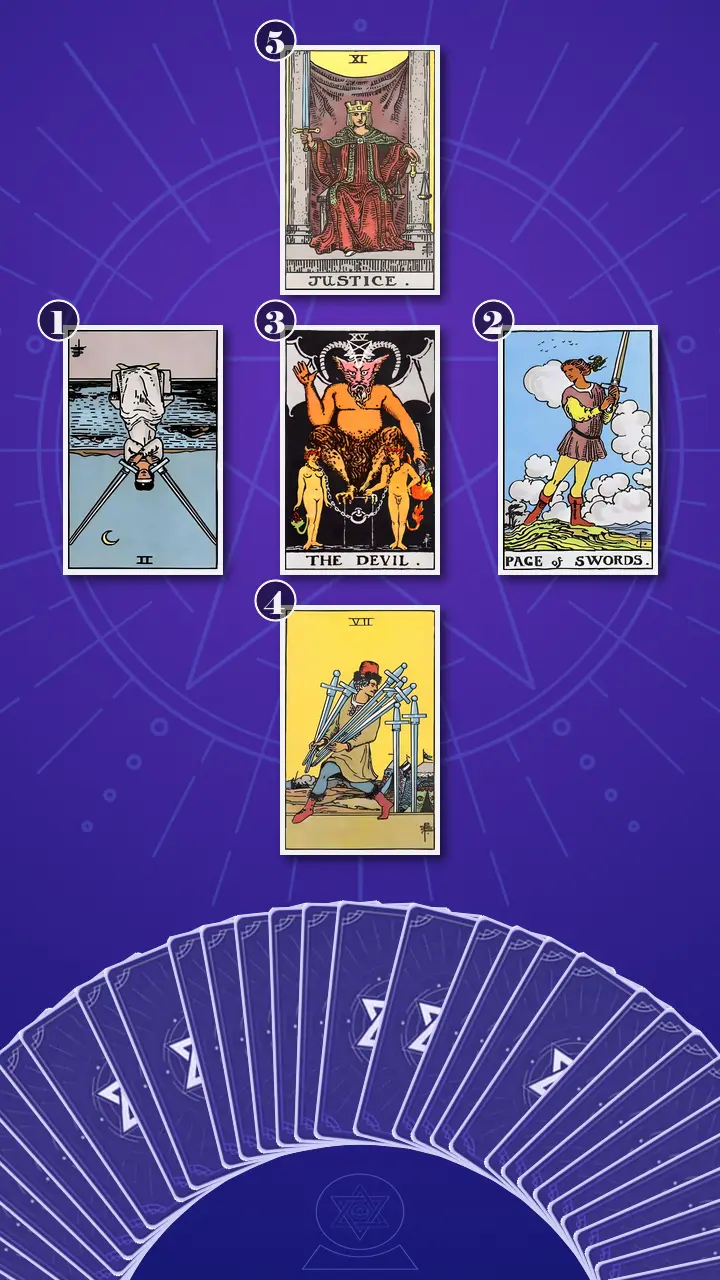
Today I chose a Relationship Spread—a five-card cross layout. I like it for this kind of situation because the real issue isn’t a yes/no about a code. It’s the dynamic: what access means, what trust is being used to demand, and where consent ends and pressure starts.
For readers who wonder how to read a relationship tarot spread for trust and privacy issues, this layout is clean and ethical. It gives us: (1) how you’re holding the boundary right now, (2) what your partner is actually seeking through the request, (3) the shared relationship pattern underneath, (4) the self-reinforcing loop that makes everything feel worse, and (5) the next boundary and communication posture that brings fairness back in.
I gestured to the table as I placed the cards in a cross. “Think of it like a negotiation table,” I said. “There’s a trapdoor below—where the coping strategies live—and a skylight above—where the healthiest next step comes in.”
Reading the Map: The Moment the Spiral Starts
Position 1 — How you’re holding the boundary right now
“Now we flip the card that represents how you’re holding the boundary right now—your presenting behavior and internal stance.”
Two of Swords, reversed.
Immediately, it matched the scene Jordan had described: the phone face-down, then face-up again. Apps reopening that were already closed. Notes app drafts multiplying like tabs in a browser you swear you’ll ‘organize later.’ The modern-life version of this card is: you’re running mental scripts like, “If I say no, I’ll look guilty. If I say yes, I’m giving up my space,” and you keep rewriting an explanation because you’re trying to find a version that can’t be challenged.
Reversed, the Two of Swords isn’t calm neutrality—it’s a stalemate that’s leaking. The energy is blocked Air: too many arguments in your head, not enough clean language in the room. It keeps you stuck in rehearsal instead of clarity.
Jordan gave a small laugh that sounded like it had teeth. “That’s… so accurate it’s kind of rude,” they said, rubbing a thumb along their phone case. “I literally have, like, three drafts in Notes.”
I nodded. “It’s not your morality that’s on trial. It’s your nervous system trying to avoid a moment that might cost you connection.”
Position 2 — What they’re really seeking through the passcode request
“Now we flip the card that represents what the other person is expressing or seeking through the passcode request—their stance and underlying motive.”
Page of Swords, upright.
In real life, this is the energy of a partner who asks for your passcode with the same tone as asking for the Wi‑Fi—light, ‘logical,’ almost casual. But the vibe is watchful. The Page notices your screen lighting up. The Page asks, “Who’s that?” and calls it curiosity. The Page collects information to feel safe.
Upright, this isn’t automatically malicious; it’s excess vigilance. It’s certainty-seeking. The sword is up before the conversation has even agreed there’s a battle.
I looked at Jordan. “If we strip away the passcode, what question do you think your partner is trying to answer? ‘Can I trust you?’ ‘Am I safe?’ Or ‘Do I get influence here?’”
Jordan’s eyes went unfocused for a second, like they were replaying the elevator moment in their head. “It’s ‘Am I safe?’… but it comes out as ‘Give me access.’”
Position 3 — The relationship dynamic underneath: privacy, trust, access
“Now we flip the center card—the one that represents the dynamic that forms when privacy, trust, and access get negotiated. The real issue under the surface.”
The Devil, upright.
The air in the room felt heavier the way it does when a bass note drops and you realize the song is about something darker than the chorus implied.
This card doesn’t mean your partner is a villain. It means the system that can form around access and control is sticky. The Devil shows the hidden bargain: “If you give me access, I’ll give you peace.” Pressure disguised as closeness. A soft voice with a hard expectation underneath.
In this context, the passcode request stops being about convenience and starts feeling like a relationship rule being quietly written: access equals trust. And that’s where the chains come in—not literal ones, but fear-chains: fear of being labeled untrustworthy, fear of losing belonging, fear that saying “no” will be punished with suspicion.
I said it plainly, because this is one of those moments where clarity is kindness: “Access is not the same thing as security.”
Jordan’s hand froze mid-motion above the table. Then their shoulders lifted, as if bracing for impact. Then, a slow exhale escaped through their nose—annoyed at themself, not at me. “That’s it,” they said quietly. “It feels like… if I pay with my privacy, I get a temporary ceasefire.”
Position 4 — The trapdoor: the coping loop that backfires
“Now we flip the card below the center—the one that represents the core blockage pattern, the self-reinforcing loop that keeps the conversation from becoming clean and mutual.”
Seven of Swords, upright.
This card is the montage. The quiet strategy. The sideways move you make to keep the peace.
Before they come over, you start ‘tidying’ your phone: archiving old threads, muting a group chat, moving apps off the home screen, clearing notifications. Not because you did something wrong—because you don’t want to be questioned. And then the paradox lands: the more you manage optics, the more you feel like you’re hiding.
I tapped the card lightly. “If you’re ‘tidying’ your phone, the boundary needs words, not edits.”
Jordan winced and then laughed again—embarrassed, but relieved to have it named. “I reorganized my whole home screen last week,” they admitted. “And then I was like, why do I feel guiltier now?”
“Because strategy mimics secrecy,” I said. “Even when your intentions are self-protection.”
When Justice Spoke: Contract, Not Confession
Position 5 — The next boundary and the healthiest posture to hold
I paused before turning the final card. The rain outside had softened, and in the quiet I could hear my studio clock—steady, impartial. “This last position,” I told Jordan, “is your next privacy boundary to set—and the healthiest communication posture to hold while setting it.”
Justice, upright.
In modern terms, Justice is the moment you stop trying to be ‘understandable enough’ and start being clear. Scales and sword: fairness and clean language. Reciprocity instead of vibe-based expectations.
And because my whole career is built around sound—what the voice does when a person is trying not to be criticized—I leaned into my signature tool. “Can we use something I call the Melodic Mirror?” I asked. “It’s a way of catching emotional patterns through what your brain reaches for on autopilot—your personal playlist.”
Jordan blinked. “Like… my Spotify?”
“Exactly. When you imagine saying, ‘I don’t share passcodes,’ what’s the soundtrack your body picks?”
They didn’t even have to think long. “Something… fast. Like a song that makes you feel like you need to explain yourself before someone interrupts.”
“That’s the Two of Swords reversed in audio form,” I said. “High tempo, high defense. Justice is a different sound: slower, steadier, fewer words. Same truth, less panic.”
Setup: I could see the exact loop Justice was about to break: Jordan caught in that courtroom moment where a simple boundary feels like an accusation, and their brain tries to write a closing argument—twelve paragraphs long—so nobody can call them suspicious.
Stop treating your passcode like a confession and start treating it like a contract—Justice asks for reciprocity, clear terms, and consent, not pressure.
There was a small, real pause after I said it—like the room itself waited to see if Jordan would fight it.
Reinforcement: First, their breathing stopped for half a second, a tiny freeze. Then their gaze slid away from the cards to the corner of the room, as if some memory was replaying: the elevator, the casual “What’s your passcode again?”, the hollow chest feeling. Their fingers tightened around the phone—then loosened. Their jaw unclenched in slow increments, like a muscle learning it doesn’t have to guard a secret it never had. Their eyes got a little glassy, not dramatic, just human. And when they finally exhaled, it was audible—one of those long, quiet releases that sounds like your body laying down a weight you didn’t realize you were carrying.
Jordan’s voice came out smaller, but steadier. “So I can just… say no. Without proving anything.”
“Yes,” I said. “And you can still offer closeness—just not surveillance.”
I leaned forward. “Now, using this new lens, can you think of a moment from last week—on the couch, on the TTC, in the kitchen—where this would’ve changed how you felt?”
Jordan nodded once. “When I started deleting stuff before they came over. I wasn’t doing anything wrong. I just didn’t want to be questioned. If I’d had this frame… I would’ve stopped and said, ‘This isn’t about my phone. This is about the kind of trust we’re building.’”
That was the shift in real time: from unease-driven overthinking and self-doubt about privacy to grounded clarity through consent-based, reciprocal agreements. Not a grand ending—an actual, usable next step.
The Agreement Layer: Actionable Advice That Doesn’t Require a Persuasive Essay
I gathered the spread into one coherent story for Jordan, the way I’d summarize a complex call-in segment for listeners: You started in a mental stalemate (Two of Swords reversed), trying to stay un-criticizable. Your partner’s uncertainty shows up as vigilance and questions (Page of Swords). The dynamic underneath can slide into a hidden bargain where access becomes the currency of peace (The Devil). Then you cope sideways—tidying, curating, rehearsing—because directness feels risky (Seven of Swords). Justice is the exit: make the rules visible, mutual, and consent-based, so nobody has to guess or gather ‘proof.’
The cognitive blind spot here is subtle: you’ve been treating the boundary as something you must justify—instead of something you can simply name. The transformation direction is clear: move from proving trust by granting access to building trust through explicit agreements and consent-based boundaries.
Then I gave Jordan the smallest possible next steps—because the point is not a perfect conversation. It’s momentum.
- The 30-Second Boundary Script (said out loud)In a calm moment (after dinner, doing dishes, or on a walk), say: “I don’t share passcodes. I’m open to talking about what helps us both feel secure, though.” Keep it to one sentence + one invitation.Use my Emotional BPM strategy: practice the line once with a slow, steady tempo—like you’re reading it on-air. If your voice speeds up, pause and restart. Slower pace = more Justice energy.
- Offer One Trust Signal That Isn’t SurveillanceChoose one alternative you genuinely mean: a weekly check-in, clearer plans, or “If you feel anxious, tell me directly and we’ll talk—no phone checks.” You’re replacing a proof-demand with a connection practice.Keep it specific and mutual: “Let’s do Sunday night ten minutes, phones away.” Consistency builds trust better than unlimited access.
- Ask the Reciprocity Question (fairness check)Ask: “Do you share your passcode with partners? What boundaries do you want respected on your phone?” You’re looking for shared values, not ‘winning.’If the conversation turns into interrogation (“Who are you texting?”), say: “I want closeness. I don’t want surveillance. Let’s pause and come back when we can talk respectfully.”

A Week Later: Quiet Proof, Not Perfect Certainty
A week later, Jordan texted me a short update—no long explanation, no five drafts. “I said the sentence,” they wrote. “Out loud. My voice shook at first, then it didn’t. We agreed: no passcodes, no checking. We’re doing a Sunday check-in instead.”
They added one line that made me picture the whole scene: “I still felt scared after, so I went to a coffee shop alone and just… sat there. But I didn’t tidy my phone first.”
That’s what a real Journey to Clarity looks like. Not fireworks. A small, fair agreement you can breathe inside. A boundary held without apology. Trust built through consistent behavior, not expanded permissions.
When someone asks for your passcode and your stomach drops, it’s not because you’re guilty—it’s because you can feel closeness getting negotiated through pressure, and you’re trying to keep belonging without giving away your space.
If you didn’t have to prove anything, what’s one small, fair agreement about phone privacy you’d actually want to live inside—starting this week?