When the Laundry Chair Felt Like a Verdict—and Turned Back Into Tasks

When the Laundry Chair Starts Sounding Like a Verdict
If one chair, one corner, or one tote bag has quietly become your permanent staging area for half-finished life admin, you are probably not dealing with a cleaning problem so much as a pile-up problem.
Jordan (name changed for privacy) came to me from Toronto with the kind of composure I have learned to read carefully. She could keep campaign timelines moving all day in a hybrid marketing job and still freeze at night when the laundry chair, unread messages, and Sunday Scaries all arrived at once. She told me about 8:47 PM on Line 1 northbound, wedged by the subway doors, half-replying to Slack while scrolling Instagram Stories of somebody doing a flawless Sunday reset in a bright kitchen. The fluorescent lights buzzed overhead, winter coats made the car smell faintly metallic and damp, and her phone felt hot in her palm. By the time she got home, her jaw was already tight because she knew the chair was waiting.
Then she gave me the other scene: 6:18 PM on a Sunday in her small apartment bedroom, standing in socks beside the chair, lifting a T-shirt with two fingers like maybe this one did not count. The room went dim blue with early evening, the radiator clicked, and detergent mixed with stale fabric in the air. The second she saw the pile, her brain opened five more tabs: inbox, groceries, unanswered texts, the return package by the door. Overwhelm sat on her like wet winter wool—heavy across the shoulders, scratchy at the jaw, and impossible to ignore once it touched skin.
“I keep saying I’ll do a proper reset when I have time,” she told me, “but somehow that time never shows up.”
I nodded. “That makes sense to me. A visible pile can recruit five invisible ones. Let’s not moralize the chair. Let’s draw a map through the fog and find some clarity about what is actually piling up underneath it.”

Choosing the Compass: The Shadow Spread for a Life Admin Pile-Up
I asked her to take one slow breath, keep the question simple in her mind, and shuffle until the static in her body lowered by even one notch. I read tarot less as fortune-telling and more as a way of getting card meanings in context—seeing what the psyche is doing, protecting, and avoiding when ordinary life starts feeling emotionally loud.
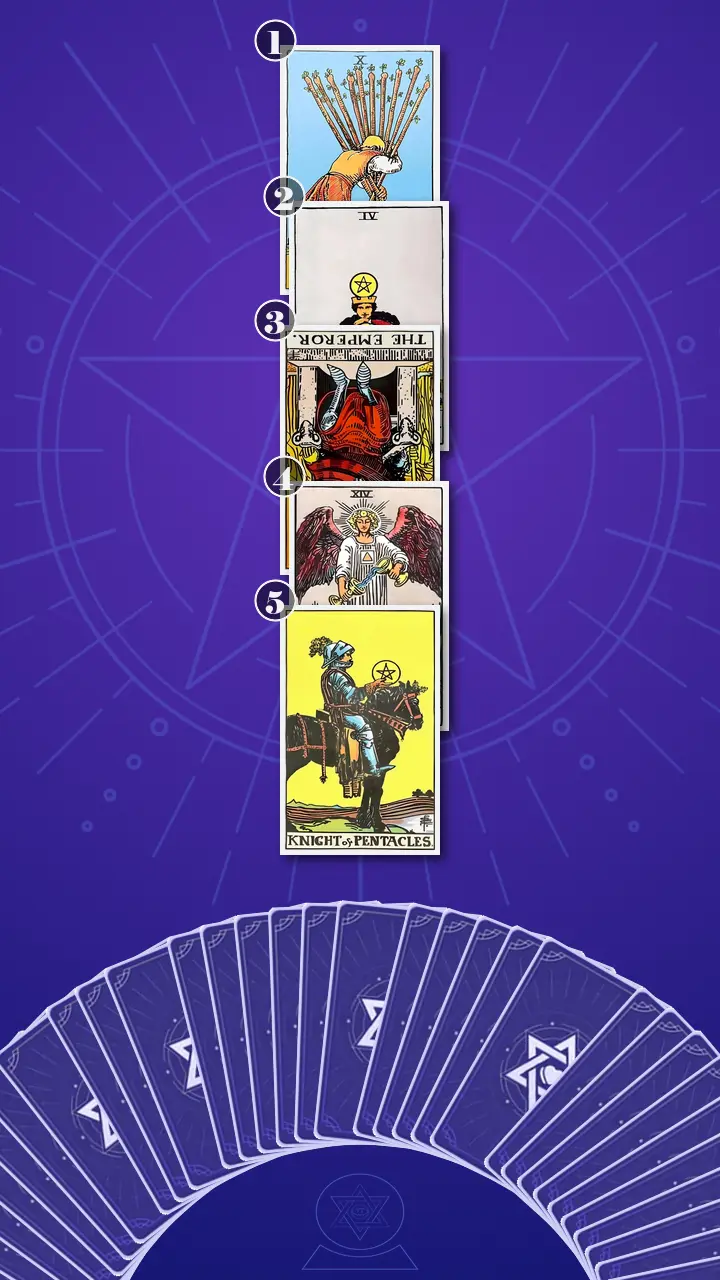
For a question like this—why does laundry make me feel overwhelmed, and what else in my life is piling up?—I chose The Shadow Spread, a five-card tarot spread for clutter and overwhelm. I use it when the visible symptom looks small, but the charge around it is not. The structure is clean and honest: it moves from the outer symptom to the hidden protective habit beneath it, then to the deeper belief feeding the pattern, before it offers a restorative lesson and a grounded next step. It is ideal for all-or-nothing life admin pile-up, because it lets me trace the backlog without turning the reading into more noise.
I told her what I would be watching for. The first card would show the visible pile-up behavior. The second would reveal the hidden holding pattern beneath it. The middle card would expose the deeper fear about competence, adulthood, or control. The fourth would bring the medicine that interrupts the cycle. And the fifth would tell us what sustainable follow-through actually looks like in a real week, not a fantasy one.
Reading the Stack Downward
Position 1: The Armload That Never Gets Put Down
Now the card representing the visible pile-up behavior named in her question lay at the top of the spread: Ten of Wands, upright.
“This isn’t just laundry,” I said as soon as I saw it. “This is your whole day still in your arms.”
The Ten of Wands shows excess effort and strain. The figure is bent, still moving, but with her sightline blocked. That is exactly what happens when Jordan gets home carrying her tote, laptop, groceries, and the residue of a day full of context switching, then drops one sweater onto a chair already holding jeans, a hoodie, and a return bag. The second her eyes land there, laundry stops being laundry. It merges with unread texts, unopened tabs, and errands until everything feels equally urgent. It is like having 27 browser tabs open and every one of them suddenly starts auto-playing sound.
This card told me the conscious symptom was overload, not mess. Fire energy here was in excess—too much carrying, not enough setting down. She could technically do tasks one by one, but the moment she held them all mentally at once, perspective vanished.
Jordan let out a short laugh that snagged on the edge of a wince. “Okay,” she said. “That’s so accurate it’s almost rude.”
Her fingers froze around her mug, then tapped twice against the ceramic before settling again. That little bitter laugh was recognition arriving fast: capable in public, overloaded in private.
Position 2: The Safety of Keeping It in Sight
The next card represented the hidden holding pattern beneath the visible mess: Four of Pentacles, upright.
I have always found this card deeply practical. The chair is not random clutter. It is a control device. Maybe-clean clothes stay there because keeping them visible feels safer than deciding their final place. The same pattern shows up in starred emails, the tote bag full of receipts, the Notes app list that keeps getting reopened but not cleared. Nothing is lost, but nothing is moving either.
That is blocked Earth. Containment has turned into stagnation. The energy is not absent; it is clenched. The pile survives because visible holding zones can feel safer than real sorting. In modern terms, the chair becomes the physical version of an open tab you are scared to close.
Jordan looked at the card for a long second. “I keep it where I can see it so I don’t fully lose track of it,” she said quietly. “Even though it makes the room louder.”
“Exactly,” I told her. “You are not failing to care. You are gripping so tightly that circulation stops.”
Position 3: When Disorder Starts Feeling Personal
The third card, sitting in the center where the real psychological anchor lives, represented the deeper fear driving the pile-up: The Emperor, reversed.
This card sat there like a clenched jaw. On paper, Jordan was waiting for the right window to reset. In practice, she was waiting for an unreal level of control before letting herself begin. One skipped laundry cycle, one full chair, one messy corner, and suddenly it felt as if her entire adulthood system was unstable. That is The Emperor reversed: structure becoming so rigid that it stops supporting life and starts policing it.
I told her what I saw. “This is not discipline versus laziness. This is stability versus self-pressure. It is the Sunday reset montage fantasy from social media colliding with actual Tuesday energy and losing.”
When I read this card, I do not hear “You should be better at this.” I hear an inner manager running impossible standards—like a Notion weekly reset template that gets redesigned more often than it gets used, or a perfect project plan that becomes useless the second one meeting runs over. Backlog gets louder when it starts sounding like identity.
Jordan’s breathing paused. Her gaze slipped out of focus for a moment, like she had opened the note on her phone called “Life Reset” and was staring at it again in real time. Then came the third part of the reaction: a long exhale that seemed to leave from somewhere lower than her lungs. “Yeah,” she said. “If I can’t do it properly, starting just feels like proof I’m behind.”
That was the root. Not a cleaning problem. A control wound.
When Temperance Poured Between Two Cups
Position 4: The Medicine of Circulation
When I turned the fourth card, the atmosphere changed. The late light at my window thinned across the table, and somewhere in the building a pipe gave a soft water-knock, as if the room itself wanted to echo the symbol. This was the core of the reading, the antidote card, the one everything had been leaning toward: Temperance, upright.
This position introduces the key rebalancing lesson that interrupts the cycle. Temperance is measured self-regulation, patience, and sustainable flow. One foot on land, one in water. Feeling and practicality in the same body. Not a flood, not a freeze.
By then I could feel Jordan’s pattern clearly. She would look at the chair, then the sink, then her inbox, and her whole nervous system would go into silent alarm mode like every unfinished thing had entered the room together. Even across from me, her body was telling the truth before her words did—jaw braced, shoulders high, phone face-down but close enough to grab.
You do not need one dramatic catch-up day; you need to let energy move cup to cup and task to task, the way Temperance restores flow.
I let the sentence sit there.
Then my own old imagery rose, the way it often does with this card. For one second I was back in Venice at dawn, watching canal water cloud under a moored boat while the open channel kept moving cleanly around it. Later, on cruise decks, I watched people mistake pressure for movement every day. They would white-knuckle their way through exhaustion and call it discipline, when what they really needed was circulation. That is why I use what I call Venetian Aqua Wisdom in moments like this: if a week has turned swampy, I do not ask where you can be heroic. I ask where you can reopen one channel.
I also use a simple energy flow diagnosis in session. Non-medically, and very plainly, heavy shoulders and a locked jaw usually tell me the mind has turned a task into a threat. Jordan did exactly that in front of me. First, her breath caught. Then her eyes unfixed, not dreamy but searching, as if last Thursday night with the TikTok scroll and the still-full chair had begun replaying behind them. Then the feeling moved through her body: her shoulders dropped a full inch, her lips parted on a silent little “oh,” and she leaned back with that strange lightheadedness people sometimes get when a burden stops being an identity and goes back to being a situation.
“But…” She frowned at the card. “If that’s true, doesn’t that mean I’ve been making it mean way too much?”
“It means you’ve been protecting yourself from the feeling of seeing the backlog,” I said. “Not that you’ve been foolish. The pile feels personal because you are treating it like evidence. It gets manageable when you treat it like movement.”
I leaned in a little. “Now, with that new lens, can you think of a moment last week when this would have changed the way you felt?”
She gave me a softer version of the laugh from earlier. “Literally Sunday. If I’d just moved the hoodie, the mug, and the return bag instead of staring at the whole room, I probably wouldn’t have spiraled.”
“Exactly,” I said. “You do not need a total reset. You need circulation. Temperance asks only one question: not all of it, just the next amount I can actually integrate today.”
That was the emotional crossing point of the reading: from embarrassed overwhelm and control-based avoidance toward steadier calm through circulation. Not solved. But no longer fused with shame.
Position 5: The Boring Rhythm That Holds
The final card represented the grounded action that could keep this insight from turning back into a theory: Knight of Pentacles, upright.
I love this card after Temperance because it refuses cinematic change. It gives me Tuesday night, 12 minutes, laundry bag beside the chair, same playlist, same tiny reset. Not because that transforms your personality, but because repetition lowers the emotional charge of the pile before it can become a story again.
This is balanced Earth. Not hoarded, not frozen—just dependable. The still horse and the plowed field tell me the answer is not inspiration. It is prepared ground. A real slot in a real week. A low-drama maintenance rhythm your tired self can still trust.
Jordan smiled with actual relief this time. “So the answer isn’t a whole-life reset weekend?”
“No,” I said. “It’s something much less glamorous and much kinder. Boring consistency is kinder than dramatic catch-up.”
In the logic of this Shadow Spread, that was the final transformation: the over-carrier becoming a steward.
From Insight to Action: The Chair-to-Hamper Loop
When I laid the entire reading back to her, the story was clean. The Ten of Wands showed that she had been carrying too much of life at once, until laundry, texts, errands, and browser tabs all felt equally heavy. The Four of Pentacles revealed why the pile stayed: the chair worked like a visible holding zone, a starred email, an open tab she was afraid to close. The Emperor reversed named the real blind spot—she had been reading ordinary disorder as a verdict on competence, so every missed rhythm became an adulthood problem. Temperance changed the architecture from vertical pile-up into horizontal rhythm. Then the Knight of Pentacles turned that new understanding into a routine that could actually survive a tired Tuesday.
I said the blind spot plainly because sometimes clarity needs a direct sentence: “You keep treating backlog like character evidence when it is really a queue problem.”
There was another factor I did not want her to miss. Jordan was not arriving home to that chair with a fresh nervous system. Hybrid work had already thinned her attention through Slack, email, transit noise, and screen-induced exhaustion. My fatigue analysis is never about excuse-making; it is about realism. The version of you who gets home at 8:41 PM cannot be measured against the fantasy version who exists only in Sunday reset TikToks and perfectly edited CleanTok loops.
Before giving her next steps, I taught her one of my old between-meetings recovery methods from ship life: feet flat, exhale longer than inhale once, shoulders down, jaw loose, then touch only the first item. A body that feels less threatened makes better promises.
When I suggested starting small, she made a face. “But some nights I genuinely don’t have even seven clean minutes before I melt into bed.”
“Then we work with real energy,” I told her. “Three minutes. Three items. The body trusts what it can repeat.”
- The 7-Minute Circulation RoundChoose one visible pile only this week—the chair, not the whole apartment. Set a 7-minute timer before Instagram or TikTok and do a three-destination sort: hamper, drawer, trash.If your chest tightens, scale it down to three items and stop when the timer rings. One surface, one timer, one next place.
- The Tuesday 12-Minute ResetPick one boring slot your actual week can hold—say Tuesday at 8:30 PM. Put an empty hamper or tote beside the chair, plug in your phone, start the same playlist, and do only a 12-minute chair reset.Do not make up for missed days with a punishing marathon. Resume at the next slot. Half-done is how maintenance begins.
- Minimum Viable MaintenanceWrite one private line in your Notes app: “Laundry done enough means washed and back in the room, even if not folded yet.” Use that standard the next time perfect-reset brain shows up.Keep the sentence specific and gentle. Flexible structure is the goal, not a prettier rule to fail.
Those were her next steps. Not a moral cleanse. Not a better personality. Just circulation over reset, one layer at a time, in a way her real life could hold.

A Week Later: The Quiet Proof
A week later, Jordan texted me a photo at 8:36 PM. There was still a sweater on the chair. But the chair itself was visible again. A hamper sat beside it, the kettle was on, and her message said, “Did the 7-minute round before opening Instagram. Not fixed. Just… not yelling at me anymore.”
That, to me, is what finding clarity usually looks like. Not a transformed life in one cinematic sweep, but the first honest proof that shame has loosened and movement has begun. This journey was never about becoming the kind of woman who always has matching sheets and an empty inbox. It was about moving from embarrassed overwhelm to steadier calm, and letting small tasks become small again.
The next morning, she told me, her first thought was still, “What if it piles up again?” Then she smiled, moved one T-shirt to the hamper, and made her coffee anyway.
If tonight a chair, a counter, or an inbox makes your shoulders go heavy and your jaw lock, please remember: the hardest part is often not the chore itself, but the flash of fear that ordinary mess means you are losing your grip on your own life.
If that pile did not get to mean anything about your worth, what would be your first cup-to-cup move—hamper, drawer, trash, or the one tiny layer you would finally let start moving?