My 'Getting Organized' Was Avoidance: How I Started With One Loop

The 5 p.m. Kitchen-Table Verdict
If you’re a late-20s city professional who can run meetings and timelines all week… but still gets Sunday Scaries from a small pile of unopened mail on the kitchen table.
Casey said that to me like it was a confession and a joke at the same time—like she was trying to make it smaller by putting it in quotation marks.
We were on a video call, and I could see her Toronto apartment kitchen behind her: the one rectangle of cleared space on the table, the envelopes aligned into a crisp stack, the overhead light turning the paper almost painfully white. Even through the screen, I could hear it—the fridge hum, the faint buzz of the fixture, the quiet pressure of a Sunday evening that’s about to become Monday.
She rubbed her jaw without realizing it. “It’s not even that much mail,” she said, eyes flicking toward the stack like it might move. “But it feels like it weighs a ton.”
“What happens in your body,” I asked, “in the exact second you look at it?”
She exhaled through her nose, sharp. “My chest goes tight. Like… a band. And then I’m standing up wiping counters like that was the plan all along.”
Casey’s question sounded simple on paper: Sunday mail pile—what’s my next step in a life audit?
But the feeling underneath it was heavy and specific: craving clarity and control in a life audit vs fearing what the paperwork will reveal about your competence and stability. The pile wasn’t paper to her nervous system. It was a weekly audition for being an “actual adult.”
She gave me a small, frustrated laugh. “Okay, why does unopened mail feel like it’s judging me? And why am I cleaning the kitchen like it’s a legitimate plan?”
I let that land, because it was already honest. “You’re not broken,” I said, keeping my voice warm and plain. “Your system is doing what it thinks will keep you safe—avoid contact with anything that could confirm your worst story. Today, we’re going to make a map through the dread. Not a perfect life overhaul. Just enough clarity to take one real step.”

Choosing the Compass: Celtic Cross · Context Edition
I invited Casey to put both feet on the floor—just for ten seconds. Not mystical. A transition. A way to tell the body, we’re here, we’re not running.
While I shuffled, I did what I often do as a radio host who lives half in music psychology and half in real life logistics: I asked for data that wasn’t numbers.
“Before we look at the cards,” I said, “quick check—what have you been playing lately when the mail pile is in your peripheral vision? Any song you keep putting on, or avoiding?”
Casey blinked, surprised. “Honestly? Lo-fi beats. Like… constantly. And then angry girl pop when I’m cleaning instead of opening anything.”
I nodded. That was already a pulse reading. In my practice, I call it Music Pulse Diagnosis: the songs we reach for right before a spiral often point to what the nervous system is trying to do—numb, energize, control, escape.
“Lo-fi to go flat,” I reflected, “and angry pop to run hot. That’s your system swinging between freeze and overdrive.”
For this question, I chose a spread with enough structure to hold both the practical problem and the emotional mechanics underneath it: the Celtic Cross · Context Edition.
For you reading along—this is why I like this spread for a life audit when you feel overwhelmed. It doesn’t just tell you ‘what happens.’ It shows the chain: the present overwhelm, the specific blocker that turns intention into freeze, the root fear driving it, and then—crucially—the next step that is ethical and doable. In this version, Position 10 isn’t a fate-stamp “outcome.” It’s an integration point: the most constructive, concrete next step if you follow the guidance. That keeps the reading self-empowering and action-oriented.
I told Casey what to expect: “The center cross will name what the Sunday mail pile is doing to you—and why. Then we’ll climb the right side like a staircase: what internal shift helps, what support holds you steady, what your hope-fear loop is, and what the next step looks like in the real world.”
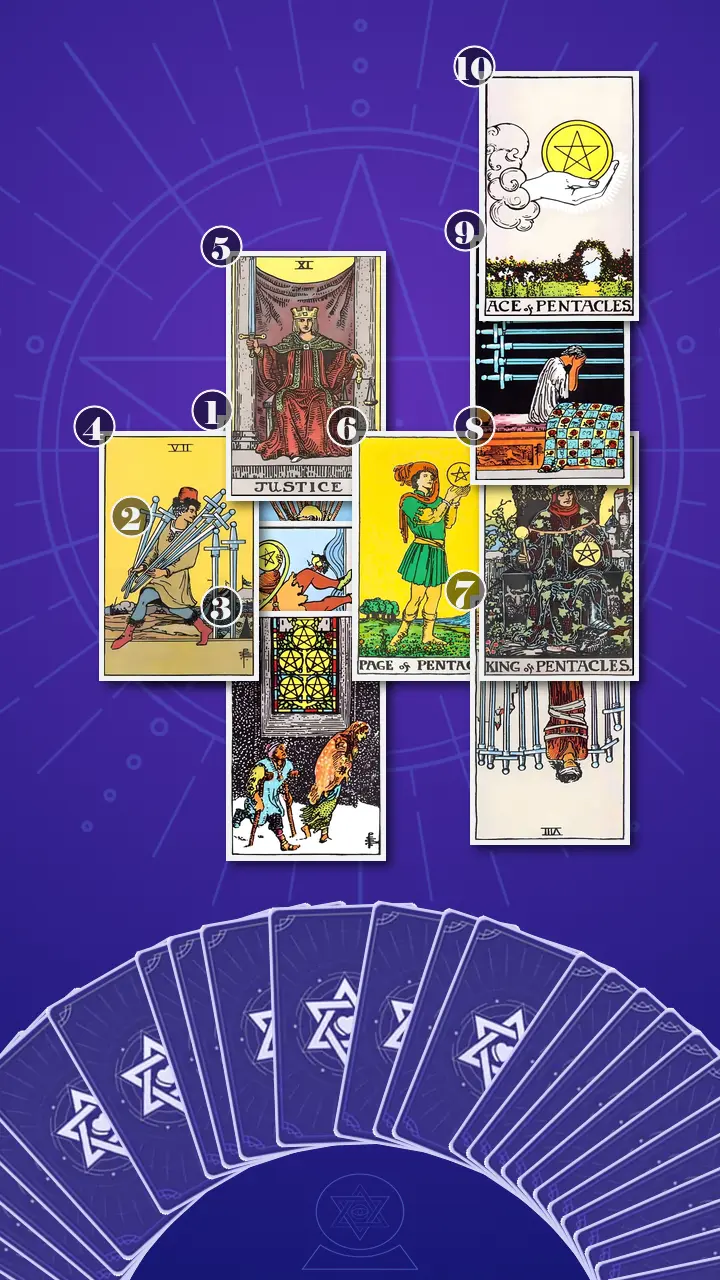
Reading the Map: The Weight, the Wobble, the Real Fear
Position 1: The current lived reality of the mail pile
“Now flipping over is the card that represents the current lived reality of the mail pile—what the ‘Sunday audit’ feels like in your body and behavior right now,” I said.
Ten of Wands, upright.
In the classic image, someone is hunched forward, arms full, carrying a bundled load that blocks their view. I could almost see Casey’s shoulders doing the same thing on camera—up near her ears, like she was already bracing for impact.
“This is that moment where the pile becomes one combined crisis,” I told her. “Not ten separate sticks you can set down one by one. One huge bundle pressed against your chest.”
I anchored it to her real Sunday pattern. “You line them into a tidy stack—because tidying is a way to touch it without touching it. And then your nervous system reads the whole thing as unliftable. So you do the thing that feels like motion—cleaning, reorganizing, scrolling—anything except the first real step.”
Energy-wise, the Ten of Wands is overload—excess. Too much responsibility held too close, too alone, too all at once. “There’s a distant town in the card,” I added. “A path exists. But you can’t see it because the bundle is blocking your line of sight.”
Casey let out a laugh that was half a wince. “That’s… so accurate it’s kind of mean.”
“It’s not mean,” I said gently. “It’s specific. And specificity is how we get out.”
Position 2: The main blocker that keeps the audit from starting or finishing
“Now we’re looking at the main blocker—what turns intention into freeze or scatter,” I said.
Two of Pentacles, reversed.
I didn’t even have to reach. This card has a built-in modern metaphor: the infinity loop of juggling, turned upside down into wobble.
“This,” I said, “is 47 browser tabs open and calling it ‘multitasking.’”
I narrated the montage the way I’ve watched it play out in so many kitchens: “One hand on the laptop with a Notion life dashboard template. The other checking the RBC/TD app ‘just to confirm.’ Calendar tab blinking. Email open. Then you open one envelope, see a due date, and spawn five more tasks—password reset, login code, subscription portal, a phone call you don’t want to make. Suddenly there are three half-open letters splayed out like you started a task and multiplied it.”
Her eyes dropped to the table, and she gave me the quietest, slightly embarrassed nod—then a visible exhale, like her body had been holding its breath for weeks. “Oh. That’s exactly what I do.”
“The Two of Pentacles upright can juggle because it has rhythm,” I explained. “Reversed, the rhythm breaks. It becomes blockage—too many moving parts, no stable beat. When everything is ‘now,’ nothing gets finished.”
I paused, then added a warning I knew she needed: “And when you try to regain control, your brain will want complexity—multiple spreadsheets, color-coding, three apps. That’s not discipline. That’s panic dressed as productivity.”
Position 3: The root fear under the avoidance
“Now we’re under the behavior,” I said. “This card represents the root fear—what the mail symbolizes emotionally beyond paperwork.”
Five of Pentacles, upright.
In the card, two figures move through snow outside a warm, glowing stained-glass window. It’s one of the clearest images I know for money shame that feels like exile.
“This is the Toronto winter vibe,” I told her softly. “You’re technically okay—you’re working, you’re functioning. But one official-looking letter makes you feel like you’re outside the warm room of people who have it together.”
Casey swallowed, throat moving. Her fingers tightened around her mug, then loosened like she’d noticed she was gripping it.
“Your nervous system isn’t scared of paper—it’s scared of what the paper might mean,” I said, careful not to moralize. “The fear here is scarcity and exclusion. The story is: If the number is bad, it means I’m bad.”
She stared at the card area on her screen and whispered, “Yeah.” Not dramatic. Just precise.
“The thing the card also shows,” I added, “is that warmth and help exist. But shame keeps you outside. Payment plans exist. Clarifying calls exist. Asking a friend to sit with you exists. This reading isn’t telling you ‘you’re doomed.’ It’s telling you why it feels like danger.”
Position 4: The recent pattern that created the pile
“Now we’re looking at the recent pattern—what you’ve been doing indirectly instead of directly,” I said.
Seven of Swords, upright.
In the image, someone carries swords away and looks back over their shoulder. Half-commitment. The nervous glance of “I’ll deal with it later,” while still feeling watched by consequences.
“This is the draft-email-save-as-draft energy,” I said. “The ‘I basically handled it’ move.”
Casey’s mouth twisted into something like a smile, but it didn’t reach her eyes. “I have a folder called ‘Life Admin’ in my email,” she admitted. “It’s… mostly things I marked as unread.”
“That’s Seven of Swords,” I said, not shaming it. “It’s a strategy to reduce immediate discomfort. But it trains your brain to believe the only way to be safe is to be indirect.”
I let my voice go a little more coach-like. “And it makes Sundays heavier, because the pile becomes proof—proof that you ‘can’t handle it’—even though avoidance created the proof.”
When Justice Spoke: A Fair Rule, One Clean Decision
Position 5: Your conscious life-audit intention
I slowed down before turning the next card. “We’re at the center of the reading,” I said. “This is your conscious life-audit intention—the fair standard you want to live by while you face the facts.”
Justice, upright.
The room felt quieter—even through a screen. Like the fridge hum stepped forward and everything else backed away. Justice does that. It doesn’t hype you up. It organizes you.
“This card gets misunderstood,” I told her. “People think it’s a verdict. In this context, it’s a neutral process.”
“Scales,” I continued, “are three piles. Not ten categories. Not a perfect spreadsheet. Just balance: Pay/Respond, File, Trash.”
“And the sword,” I said, “is one clean decision. One follow-through action that closes a loop.”
Casey’s face tightened—not with dread this time, but with resistance. “But if I need a process,” she said, a little sharper, “doesn’t that mean… I should’ve had this figured out already?”
There it was: the hidden test. The performance review she’d been giving herself every Sunday.
I leaned in slightly. “Let’s do the setup honestly,” I said. “It’s Sunday around 5pm, and the envelopes are lined up so neatly on the kitchen table that it almost looks like you’ve handled it—until your jaw clenches and your brain starts narrating worst-case outcomes before you even open one.”
“You’re trapped in ‘I need to do this perfectly’ and ‘if it’s bad, it proves something about me.’ And that makes you wait for it to feel safe. But admin doesn’t get safe by waiting. It gets safe by structure.”
I let a breath pass, then delivered the sentence I wanted to hang in the air like a studio cue tone—clear, unmissable.
Stop waiting for the pile to feel safe, choose a fair rule with the scales, and let the sword be one clean decision today.
Casey froze in a three-beat sequence I’ve learned to recognize.
First: her breathing paused, like her lungs were holding a place-marker. Her fingers hovered over the edge of her mug.
Second: her gaze went slightly unfocused—not dissociation, more like her brain was replaying last Sunday, and the Sunday before that, and noticing the pattern with new eyes.
Third: her shoulders lowered an inch. A breath finally came out, shaky at the start, then steadier. “Wait,” she said, voice smaller. “That’s… actually doable.”
I nodded. “This is where we reframe the entire thing.”
I spoke like I’d speak in a control room when someone’s audio is peaking—not judging the singer, just adjusting the levels. “A life audit works when it’s a process you can repeat—not a performance you have to ace.”
Her eyes got wet, just a thin shine. “I hate that I needed to hear that,” she admitted.
“You didn’t need to hear it because you’re behind,” I said. “You needed to hear it because your brain keeps turning tasks into identity.”
I added the phrase I wanted her to borrow like a mantra, but also like a workflow: “Facts first. Then choices. Not the other way around.”
And because I’m Alison Melody—and I can’t not hear the rhythm in a plan—I offered my signature bridge from insight to action: Breath Soundtrack.
“Justice wants a steady tempo,” I said. “When you feel your chest tighten, we’re going to give your body a beat to follow so your mind can stop improvising worst-case outcomes.”
“Try this right now,” I guided. “Inhale for four counts. Exhale for six. Do three rounds. Not to calm down perfectly—just to make one percent more room.”
She did it. The overhead light still buzzed. The mail still existed. But her face looked less like she was bracing for a hit.
“Now,” I asked, “with this Justice lens—can you think of one moment last week where a fair rule would’ve saved you from spiraling?”
Casey nodded slowly. “Thursday. I saw a bank notification on the TTC and I spent the whole day thinking it meant I was screwed. I didn’t even open the app.” She swallowed. “It was… probably nothing. But I turned it into a trial.”
“Exactly,” I said. “Justice doesn’t do trials in your head. Justice does facts on the table.”
That was the shift: from Sunday dread and freeze toward calm, practical confidence—not by force, but by fairness.
Position 6: The next near-term opening
“Now we’re looking at the near future—what becomes easier once you begin, the kind of step that creates momentum,” I said.
Page of Pentacles, upright.
“This is beginner energy,” I told her. “Not babyish—apprentice. The Page holds one pentacle with full attention. Single-task focus. One envelope. One note. One place it goes.”
Energy-wise, it’s balance returning through simplicity. “The near future isn’t ‘you master your finances in one night,’” I said. “It’s you learning the pattern of your bills and paperwork the way you’d learn anything else—one rep at a time.”
Position 7: Your internal lever
“Now this card represents your internal lever—what mindset shift makes the first real action possible this week,” I said.
Eight of Swords, reversed.
I leaned into the micro-moment, because this is where change actually happens. “This is the millisecond before opening the first envelope,” I said. “Your phone is warm in your palm. The fridge hum is suddenly loud. Your shoulders lift.”
“Then the shift: you touch the paper—and nothing explodes.”
“Reversed,” I explained, “this card is release. It’s not ‘everything is fine.’ It’s ‘movement is possible.’ Your imagination was the locked door. The envelope is just information.”
Casey’s hand drifted toward the stack on her table, like her body was rehearsing the new reality. She didn’t open one on camera—and she didn’t have to. But I watched her fingers rest on the top edge for one second longer than before.
“One envelope opened,” I said, “is one blindfold lifted. Proof of freedom.”
Position 8: External structure and support
“Now we’re looking at external structure—systems, tools, or people that can hold you steady without shame,” I said.
King of Pentacles, upright.
“This is ‘grown-up systems that actually hold,’” I told her. “Autopay for fixed bills. A physical file box. A calendar reminder. Or a friend who’s calm about logistics—someone who can sit with you for 30 minutes without making it a morality play.”
Casey made a face. “I hate the idea of someone seeing my mess.”
“You don’t need an audience,” I said. “You need a container. King of Pentacles energy is stewardship, not surveillance.”
Position 9: Your hope-fear loop
“Now we’re naming the hope-fear loop—what you’re afraid you’ll find, and what relief you’re craving,” I said.
Nine of Swords, upright.
“This is 2 a.m.,” I said plainly. “The rumination. The mental rehearsals. Your brain trying to protect you by imagining pain first.”
“But it’s a trap,” I added. “Because the stress isn’t coming from information. It’s coming from anticipation.”
Casey’s eyes slid away from the camera. “Sunday nights are the worst,” she admitted. “I’ll open a spreadsheet template, adjust column widths, color-code… and then I’m still thinking about the pile.”
“That’s Nine of Swords,” I said. “Your mind wants to feel prepared, but it ends up building a wall of swords above your bed.”
Position 10: Integration as a next step
“Last card,” I said. “This is integration—the most constructive, concrete action to anchor the audit into a repeatable habit.”
Ace of Pentacles, upright.
I smiled, because this is the antidote to the Ten of Wands. “This is the seed,” I said. “One tangible beginning you can hold in your hand and repeat.”
“Not a perfect system,” I emphasized. “A single container that actually gets used.”
“A cheap file box. One labeled folder. One recurring 20-minute calendar block. One completed payment or one scheduled call. The pile becomes one slim folder you can pick up with one hand.”
Energy-wise, the Ace is grounded opportunity. Not hype. Not shame. Just reality made manageable.
The One-Page Justice Rule Reset (Actionable Next Steps)
I summarized what the spread had just told us in one coherent story—because that’s what a good tarot reading does: it turns scattered dread into a sequence you can work with.
“Casey,” I said, “the mail pile became heavy because you’ve been carrying it like one giant burden (Ten of Wands). When you try to start, you trigger the wobble—too many tabs, too many parallel checks, no rhythm (Two of Pentacles reversed). Underneath, the real pain is the fear that a number equals a verdict on your worth (Five of Pentacles), so you sidestep with ‘almost-actions’ like templates and drafts (Seven of Swords).”
“Justice is your way through: a fair process, not a self-punishment ritual. Page of Pentacles is the beginner routine. Eight of Swords reversed is permission to move without waiting to feel safe. King of Pentacles is external structure that holds. Nine of Swords is the late-night loop that dissolves when you touch facts. And Ace of Pentacles says: make the next step tangible.”
“Your cognitive blind spot,” I added, “is thinking you must handle everything at once to be ‘responsible.’ That belief turns a 20-minute admin task into a full-body threat response.”
“The transformation direction is smaller on purpose,” I said. “From ‘I need to handle everything at once’ to ‘I only need to complete the first 20-minute sorting and one concrete action today.’”
Then I gave her the plan—tight, doable, and designed to prevent the Two of Pentacles reversed spiral.
- The Definition-of-Done Sticky NoteWrite one sentence and place it where the mail sits: “Open / Sort into 3 piles / Do 1 action.” Keep it visible while you work.If you catch yourself opening Notion or a budgeting app, say: “Facts first. Then choices.” Return to the paper.
- The Three-Pile Peace MethodUse three physical containers—grocery bags are fine: “Pay/Respond,” “File,” “Trash.” No sub-categories today. Open an envelope, decide its pile, place it, then move to the next.Stop after 20 minutes even if envelopes remain. Stopping on purpose trains safety better than finishing in panic.
- The 9-Minute Justice Check (One Loop)Set a timer for 9 minutes. Open exactly 3 envelopes. On a sticky note for each, write ONLY: “What is required?” (e.g., “Pay $42 by Mar 22,” “Call to confirm address,” “File for taxes”). When the timer ends, stop. Pick ONE sticky note and take ONE concrete action (pay online, set up autopay, set a reminder, or draft a two-sentence email).Use my Breath Soundtrack rhythm if your chest tightens: inhale 4 counts, exhale 6 counts, three rounds—then continue. The goal is contact with facts, not forcing yourself through panic.
Casey frowned, then laughed softly. “But I don’t have even nine minutes sometimes. Sundays are… a lot.”
“That’s real,” I said. “So we make it smaller without making it meaningless. Five-minute version counts. Three envelopes becomes one envelope. The win condition is one completed loop, not a heroic cleanup.”
And because my work always translates insight into sound-based support, I added immediate nervous-system scaffolding—tools you can use while you’re doing the admin, not after you’ve magically become calm.
“Two sound strategies,” I told her.
White Noise First Aid: “When you sit down to open the mail, put on steady white noise or rain noise at low volume. It masks the apartment’s little ‘alert sounds’—fridge hum, street noise—that your brain can hook onto as danger cues. We’re building a neutral background so your attention can stay on the facts.”
BGM Prescription (three-track approach): “Pick three predictable tracks for the routine—same ones every time. One for starting (gentle, steady beat), one for sorting (no lyrics, minimal changes), one for the one action (slightly more forward energy). The point is conditioning: your body learns, ‘when this plays, we do life admin lite, and it ends.’”
“You’re basically making a ‘Sunday reset that actually gets done’ playlist,” Casey said, eyebrows lifting.
“Exactly,” I said. “We’re giving your nervous system a repeatable ritual. Justice loves repeatable.”

A Week Later: The Quiet Proof
Eight days later, I got a text from Casey.
“Did the 9-minute Justice check,” it read. “Opened 3. Wrote ‘what is required.’ Paid one thing online. Stopped on purpose. The world didn’t end. The pile is smaller and I’m… weirdly proud?”
She sent a second message right after: “Also I set up one autopay. Felt like becoming a King of Pentacles for like 30 seconds.”
I pictured her kitchen table not as a courtroom anymore, but as a workspace. Not perfect. Just honest.
Her bittersweet proof came in the last line: “I slept through the night for the first time in a while. Woke up and my first thought was still ‘what if I missed something?’—but then I remembered I have sticky notes. I laughed and made coffee.”
That’s what I mean by a Journey to Clarity. Not the fantasy of ‘never feeling dread again.’ The reality of having a fair process you can return to when dread shows up.
When you want a clean, in-control reset but your chest tightens at the thought of what the envelopes might prove, the mail pile stops being paper and starts feeling like a verdict on your adulthood.
If you didn’t have to solve the whole pile—what would your one fair, repeatable ‘next step’ look like this week?