From panic hovering to a grounded choice: the HR pronouns form

Finding Clarity in the Workday Pronoun Dropdown
If you’ve had an HR form due today and you’ve kept the pronoun field tab open all day like it’s a bomb you have to defuse—welcome to the workplace visibility dilemma.
Jordan (name changed for privacy) sat across from me in my studio space downtown, laptop balanced on their knees like it was both shield and evidence. They were 27, Toronto-based, early-career corporate—hybrid schedule, Slack-first culture, the kind of job where “quick sync?” can feel like a tiny trial.
They’d come straight from a Wednesday lunch break that never really became a break. In their kitchen, the Workday tab had been open beside a half-eaten sandwich. Slack notifications kept doing their little chirp-chirp, the fridge hummed, and the screen felt aggressively bright—like it was insisting, choose. Their cursor hovered over the pronoun dropdown the way your hand hovers over a hot stovetop: close enough to feel the heat, not close enough to touch.
“It’s a tiny field on a form,” they said, voice steady in that practiced-professional way. “But it feels like a big switch.”
I watched their shoulders hold themselves up by force, as if gravity had become optional. Their throat looked tight, like they were bracing to speak in a meeting they never volunteered for. The apprehension wasn’t abstract—it had a texture. It felt like trying to swallow while wearing a too-snug turtleneck: technically possible, constantly uncomfortable.
What they were really asking wasn’t only Should I update my pronouns or leave it blank? It was the core contradiction so many people recognize at a career crossroads: be recognized accurately at work vs fear that disclosure will change how colleagues and leadership treat you.
“I don’t want a conversation,” Jordan added. “I just want to be addressed correctly. But… I’m tired of disappearing in plain sight.”
I let that land. “That makes complete sense,” I said. “A dropdown shouldn’t have to be a survival skill. Let’s not force a brave-speech moment out of an admin task. We’re here to find clarity—what’s actually being decided today, what you can control, and what the next step looks like without pretending you can control other people’s reactions.”

Choosing the Compass: The Decision Cross Spread
I’m Lucas Voss—Oxford Business School alum, former Wall Street professional—and I read Tarot the way I used to read a balance sheet: not as prophecy, but as a structured way to see what’s driving the numbers under pressure. People come to me when they’re overloaded with “what ifs” and need a map that respects reality.
I asked Jordan to take one slow breath in through the nose and out through the mouth—not as a mystical ritual, just a nervous-system gear shift. Then I shuffled while they held the question in mind: HR form due today—update my pronouns or stay invisible?
“Today we’ll use a spread called the Decision Cross,” I told them, laying out the structure before a single card hit the table.
For you, reading along: the Decision Cross is built for high-stakes, two-path choices—especially when both options have real trade-offs. It keeps the reading from turning into a spiral of symbolism and instead mirrors the decision itself: Option A vs Option B, plus what’s actually underneath, plus a grounded next step. It’s one of the cleanest ways to explore a workplace visibility dilemma without pretending Tarot can guarantee how a manager will react or how culture will behave.
“Card one,” I said, “names the immediate stuck point—what the pronoun field is triggering in your mind and behavior right now. Cards two and three show each path side-by-side: updating quietly vs staying private in the system. Card four is the hidden factor—the institutional layer. Card five is guidance: the most realistic next step today.”
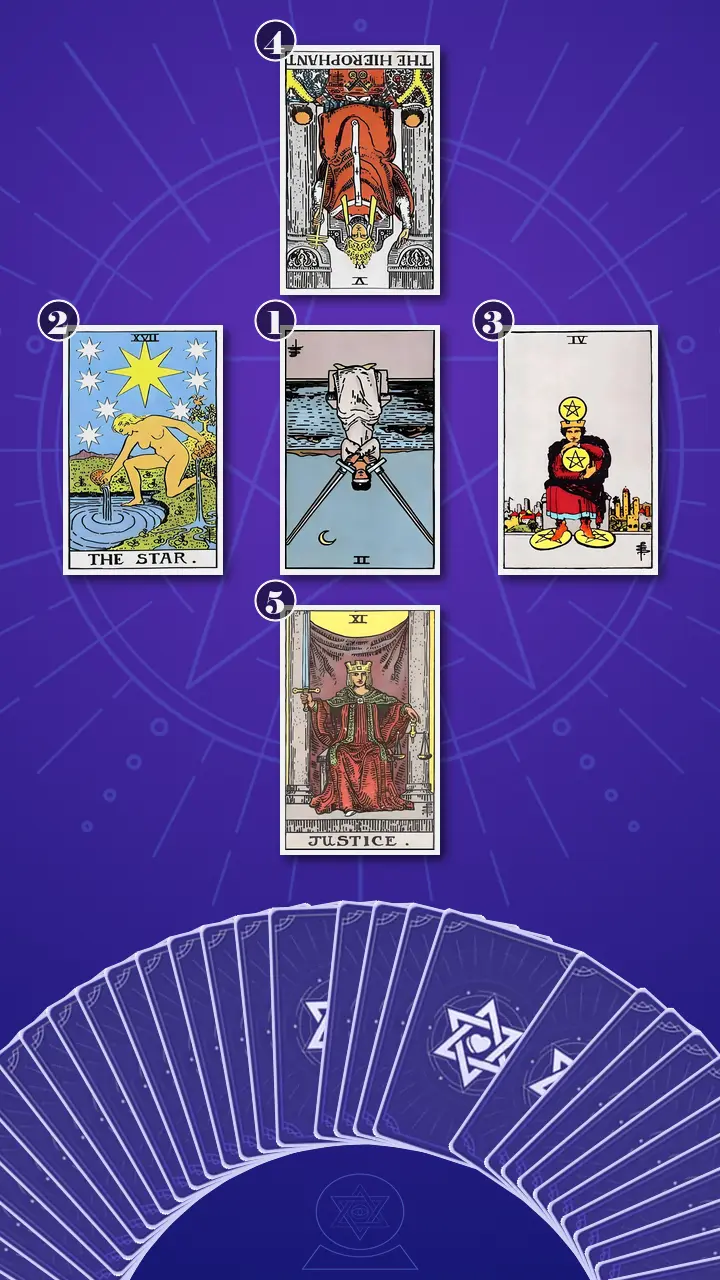
Reading the Map: A Two-Path Tarot Spread for a Workplace Visibility Decision
Position 1 — The immediate stuck point: what the pronoun field is triggering right now
“Now we’re turning over the card that represents the immediate stuck point,” I said, and I flipped it.
Two of Swords, reversed.
This one almost always shows up when decision fatigue disguises itself as “being responsible.” In Jordan’s world, it looked exactly like their day: HR portal open at lunch, pronoun dropdown expanded, shoulders tight, mind running a full risk assessment like it’s performance-review season. They toggle between options, then switch tabs to the employee handbook and Slack to hunt for proof of safety. Not choosing becomes the choice—because the moment they click, they fear they’ll become a subject, not just a coworker.
Reversed, the Two of Swords is Air energy in blockage: thinking that freezes action. It’s not calm neutrality; it’s bracing. The blindfold in the classic image becomes, in modern life, that feeling of trying to make the “right” choice with missing data—so your brain fills in the blanks with worst-case scenarios.
I mirrored it back gently but precisely, split-screen style. “Your hands are doing one thing—hovering, clicking, backspacing, closing the tab. Your mind is doing another—running simulations like: If I click this, I can’t unclick it. That’s not indecision because you don’t know yourself. That’s indecision as a safety strategy.”
Jordan let out a short laugh that had a bitter edge. “That’s… kind of mean,” they said, then shook their head. “But yeah. It’s literally me. It’s like you read my screen.”
As they spoke, their fingers rubbed their own thumb—small self-soothing, like their body was trying to negotiate with the moment. I noted it without making it clinical. “When you picture clicking ‘Submit,’ where do you tense first?” I asked.
“Throat. And shoulders,” they said immediately, surprised by how fast the answer came.
Position 2 — Path A: the energy of updating your pronouns
“Now we’re turning over the card for Path A—updating your pronouns on the HR form,” I said.
The Star, upright.
The Star doesn’t show up as a megaphone. It shows up as a measured pour. In Jordan’s modern-life translation, it’s a normal Tuesday where the system matches reality: fewer micro-corrections, less bracing before meetings, less energy spent translating themselves in their own head. Updating pronouns isn’t a speech—it’s quiet accuracy that makes the workday smoother.
Upright, The Star is Air in balance: clarity that opens breathing space. It’s not “everything will be fine.” It’s “there’s a version of this that doesn’t require you to shrink.”
I gave them a future-snapshot that wasn’t a fantasy. “Imagine a Zoom invite populates with your name and pronouns—nothing announced. Just there. And you realize you’re not clenching your jaw waiting for the first ‘Hey, man—’ moment. Not perfect safety. Just… less friction.”
Jordan’s shoulders dropped a fraction, almost like they’d forgotten they were allowed to lower them. “I want that,” they admitted, quiet. “Just… quieter. Safer.”
Position 3 — Path B: the energy of staying invisible in the system
“Now we’re turning over the card for Path B—leaving it blank, staying private in the system,” I said.
Four of Pentacles, upright.
This card is privacy as a controlled asset. It can be wise. It can also get heavy.
In Jordan’s life scenario, it’s the appeal of predictability: leave the pronoun field blank and your day stays quieter—no questions, no awkward jokes, no sudden spotlight. If trust hasn’t been earned, privacy can be a boundary, not a failure.
But upright Four of Pentacles also shows Earth energy in excess—clenching. Holding so tightly that protection becomes isolation. “The trade-off,” I said, “is that what you protect can also become what you carry alone. If you choose blank today, I want it to be a conscious boundary, not a last-minute collapse.”
Jordan nodded, then looked away toward the window like they were trying to picture two timelines at once. Their mouth tightened—not panic, more like resentment that they had to do this math at all.
“I’m not hiding because I’m ashamed,” they said. “I’m hiding because I’m tired.”
“That’s a real truth,” I said. “And it deserves respect.”
Position 4 — Hidden factor: the institutional dynamic shaping the fear
“Now we’re turning over the card for the hidden factor—what’s influencing your sense of safety beneath the surface,” I said.
The Hierophant, reversed.
This is the card of institutions and “the official way”—and reversed, it’s friction with that whole idea. It’s the gap between the company’s DEI landing page and the day-to-day standup. Brand voice vs lived product.
In Jordan’s modern translation, it’s remembering a Pride graphic posted on LinkedIn—and also remembering the Slack silence when someone mentioned trans issues. Their brain stored that silence like a file labeled: not safe. So now the HR form doesn’t feel like a form. It feels like stepping into that silence on purpose.
I leaned into a metaphor they’d already been living: “This is like a privacy settings screen,” I said. “The label looks friendly, but the real question is who has access. Who has admin permissions over this data? Who sees it? What’s the escalation route if someone gets weird?”
Jordan’s expression sharpened—less self-blame, more systems-thinking. “Yes,” they said, fast. “Exactly. I keep telling myself I’m overreacting, but… I’m doing due diligence.”
“Right,” I said. “This isn’t paranoia. It’s pattern recognition.”
When Justice Spoke: Choosing Fairness With Your Eyes Open
Position 5 — Best next step today: a values-led, realistic way to decide
I paused before turning the last card. The room got quieter in that way it does right before a hard truth arrives—like the city outside briefly held its breath. “We’re about to flip the guidance card,” I said. “This is the one that turns the reading into something you can actually do today.”
Justice, upright.
Justice is clear-eyed truth. It’s fairness as structure, not a vibe. When I worked finance, I used to read contracts where every word mattered because every word had consequences. Justice feels like that: not cruel, not sentimental—just clean. Scales, then sword.
And this is where my business brain and Tarot brain lock into the same gear. The way Jordan had been treating the pronoun dropdown was like trying to price an acquisition with zero data, then blaming themselves for not getting the “right number.” So I brought in my signature lens—Strategic Crossroads Analysis, the same probability-weighting logic we use in M&A valuation when the future is unknowable but a decision still has to be made.
“We’re not going to pretend you can predict people,” I said. “But we can reduce the uncertainty range. We can turn ‘infinite risk’ into ‘known variables plus a plan.’ That’s Justice.”
Setup
You’ve had the HR portal open since lunch, cursor hovering over the pronoun dropdown, shoulders up by your ears—then suddenly you’re three tabs deep into policies and Slack vibes, still not clicking “Submit.”
Delivery
Not “hope they’ll be fair,” but choose fairness with your eyes open—use Justice’s scales to gather what’s true and the sword to make one clean decision.
I let the sentence sit there for a beat, like a bell finishing its ring.
Reinforcement
Jordan’s reaction came in a three-step wave. First: a tiny freeze—breath caught, fingers suspended above their trackpad like they’d been interrupted mid-hover. Second: their gaze unfocused for a second, as if their brain replayed the last week of HR-tab reopening, Slack vibe-checking, and policy doom-scrolling with new subtitles: I wasn’t being dramatic. I was trying to create safety with missing information. Third: a slow exhale from deep in the chest, shoulders dropping in a way that looked almost unfamiliar on them—like setting down a bag you forgot you were carrying.
Then the vulnerability showed up right behind the relief. Their eyes got a little wet, and they blinked hard, like they were annoyed that clarity could be so simple and still so hard. “But if I do it this way,” they said, voice tighter, “it doesn’t guarantee anything.”
“No,” I said, honest. “Justice never promises control. Justice promises integrity. A decision you can defend to yourself next week because it was informed, bounded, and rooted in self-respect—not in panic.”
I slid the card slightly closer to them. “Now—use this new perspective and look backward for a second. Last week, was there a moment when someone misgendered you on a Zoom, or an all-hands got quiet around identity stuff, and you told yourself, this is why I can’t do it? If you’d had two facts and one boundary back then, what would’ve felt different in your body?”
Jordan swallowed. “I would’ve… stopped treating it like a confession,” they said. “More like… admin with permissions.”
“Exactly,” I said. “You’re not choosing an identity. You’re choosing a visibility level—today.”
And that was the shift I could feel in the room: from braced apprehension and compulsive risk-scanning to a first taste of grounded clarity. Not bravado. Not certainty. Just a steadier grip on what’s real.
The One-Page Justice Ledger: Actionable Advice for Your Next Click
I pulled the whole spread together in plain language, the way I’d summarize a complex deal for a boardroom that doesn’t have time for fluff.
“Here’s the story,” I said. “Two of Swords reversed is the freeze: the pronoun field became a proxy for safety, belonging, and control, so your mind keeps stalling to avoid exposure. The Star is the part of you that wants quiet accuracy—less daily friction, more breath. Four of Pentacles is the part that values stability and privacy, and it’s not wrong for wanting protection. Hierophant reversed says your hesitation isn’t only personal; it’s also about institutional ambiguity—policies that sound good but don’t show you the actual escalation route. Justice is the bridge: hope with structure, privacy without self-erasure.”
“The blind spot,” I continued, “is that you’ve been treating this like a permanent, all-or-nothing identity announcement. That framing makes the risk feel infinite. The transformation direction is different: a bounded, values-led decision supported by concrete workplace safeguards and personal boundaries.”
I offered them my go-to intervention for moments like this: a boardroom-style decision ledger, simplified to fit on one page. Not because you need to justify your identity—because your nervous system needs a structure that says, we’re not guessing in the dark anymore.
“We’re going to do a 10-minute rapid assessment—SWOT-TAROT hybrid,” I said. “Then we’ll make a clean cut.”
- Two Facts (Justice’s Scales)Open the HR form and take one screenshot of the pronoun field page. Then find the exact internal policy section for discrimination/harassment protections and save the link in Notes titled: “If anything gets weird.”If your brain says, “This is dramatic,” treat that as noise. You’re not writing an essay—you’re gathering one fact and one safeguard.
- One Low-Exposure Question (Access Control)Send a single, neutral message—either to HR or, if that feels safer, to your manager as a workflow question: “Quick question—who can view the pronoun field in our HR system (HR only, manager, or everyone)?”Write it in your Notes app first, then copy/paste. Keep it boring on purpose. Boring is protective.
- Visibility Level—This Week OnlyDecide your scope for the next 7 days: (A) HR field only, (B) HR + email signature, or (C) no change yet. Whatever you choose, write one sentence you’ll use if asked: “I updated it so the system addresses me correctly—no further action needed on your end.”If you update, do it in a calm 5-minute calendar block titled “Admin,” not at 4:58 PM. If you don’t update, add a revisit date so “blank” doesn’t become forever by default.
- Post-Submit Cooldown (Trading-Floor Pre-Commitment)Before you click Submit—updated or blank—do three slow breaths, feet on the floor. After you submit, turn off Slack notifications for 20 minutes so you’re not immediately scanning for penalty signals.This is a pre-commitment ritual: you decide in advance you won’t feed the risk-scanning loop right after the click.
Jordan looked down at their phone and actually opened Notes, thumbs moving. That mattered more than any dramatic emotional release. It was the “that’s actionable” shift: from trying to control everyone’s feelings to controlling their own process.

A Week Later: The Quiet Proof
A week later, Jordan emailed me a short update. Not a novel—just receipts, like they’d learned the language of Justice.
They’d asked the one question about who could view the field. They’d saved the policy link. They’d written the one-sentence script. Then they made a bounded choice: HR field only for now—quiet accuracy, no announcement. “I didn’t turn it into a thing,” they wrote. “But I also didn’t disappear.”
The bittersweet part was there, too—because clarity doesn’t erase history. The morning after they updated it, they said they woke up with the first thought: What if this was a mistake? Then, in the next breath, they noticed their shoulders weren’t up by their ears. They drank coffee and didn’t open Slack like it was a courtroom.
That’s the Journey to Clarity I trust: not a perfect outcome, but a steadier inner posture. From panic decisions to documented decisions. From “I have to handle this alone” to “I can create structure and support.”
When a tiny dropdown makes your throat tighten, it’s not because you’re “overthinking”—it’s because you’re trying to be real and stay safe in the same breath.
If you treated this as a bounded, today-only choice—one you can support with one fact and one boundary—what would feel like the most self-respecting next click?